

BRICS Explained
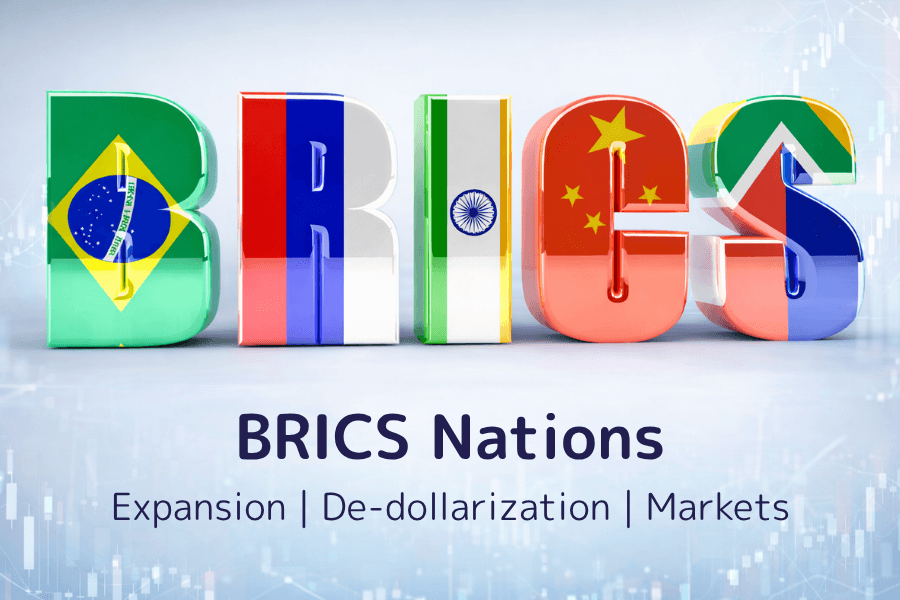
In recent years, "BRICS" has shown up far more often in international news and trading floors. From de-dollarization debates to shifting energy trade flows and the rising influence of emerging markets, BRICS has moved beyond its original role as shorthand for a handful of emerging economies and now functions as a broad macro backdrop that quietly shapes FX, oil and gold over the medium and long term.
For traders, understanding how BRICS is structured and where its expansion is heading helps build a more complete view of geopolitical risk, capital flows and commodity-cycle dynamics—rather than reacting only to short-term price swings.
- BRICS membership. Original five (Brazil, Russia, India, China, South Africa) plus the 2024 expansion (Saudi Arabia, UAE, Iran, Egypt, Ethiopia).
- De-dollarization is structural. Settlement currencies, reserve diversification, swap lines—not an overnight replacement of the dollar.
- FX impact is expectational. Watch USD index and EM currencies, paired with Fed policy as the actual driver.
- Oil and gold link to BRICS. Energy-exporter entrants and EM central-bank gold buying form a medium-term backdrop.
- Use it as macro context. A backdrop for risk-appetite reading, not a standalone trading signal.
1. What Is BRICS?
BRICS was originally the acronym for five major emerging economies: Brazil, Russia, India, China and South Africa. For more than a decade the group was known simply as the "BRICS five"—a convenient label for the largest emerging markets outside the developed world.
That label is no longer enough. As the global economy moves toward a more multipolar structure, BRICS has formally entered an expansion phase since 2024, adding new members and turning itself from a five-country grouping into a multi-region economic cooperation framework.
As of today, BRICS members include the original five plus the following countries:
- ▸Saudi Arabia
- ▸United Arab Emirates (UAE)
- ▸Iran
- ▸Egypt
- ▸Ethiopia
Most of the new members share a common profile: they are major energy exporters, key commodity producers, or important regional hubs. As a result, BRICS now carries noticeably more weight in the global energy and commodity ecosystem than the original five-country grouping ever did on its own.
Looking through a macro lens, BRICS today represents more than just "emerging-market growth potential". It looks more like an economic bloc with high structural complementarity across energy, resources and population. That is one reason BRICS has become harder to ignore as a background factor when analyzing currency pairs, EM capital flows, and oil and gold prices.
2. BRICS Development and Expansion Trends
The expansion of BRICS is not merely a story of "more members joining". It reflects a deeper structural reshuffling in the global economic order.
For many newly admitted or interested countries, BRICS offers a platform to reduce dependence on any single financial system and to keep more options on the table for trade, settlement and resource cooperation. Areas such as energy invoicing, bilateral trade currencies and financial swap arrangements are where this preference shows up most clearly.
Looking at the post-expansion membership, a few characteristics stand out:
- ▸Most members are major suppliers of energy or key raw materials
- ▸The footprint now spans the Middle East, Africa, Asia and Latin America
- ▸The bloc holds a substantive share of global energy and commodity supply chains
That shifts the role of BRICS from a "representative of emerging markets" toward an economic group with long-term influence over the structure of energy and commodity markets.
From a market standpoint, the headline of BRICS expansion alone is rarely a direct price driver. What it tends to do instead is:
- ▸Reinforce medium- and long-term expectations about energy and commodity supply-demand structures
- ▸Raise market attention on capital flows in and out of emerging markets
- ▸Provide a useful interpretive frame for geopolitical events and macro headlines
For traders, BRICS is therefore better treated as a trend- and context-type factor, rather than a tradable signal on its own.
3. BRICS and De-dollarization
A term that increasingly travels alongside BRICS in market commentary is "de-dollarization". De-dollarization refers to the gradual reduction of US dollar exposure in international trade, foreign-exchange reserves and financial settlement, replaced in part by domestic currencies or alternative units of account.
Within the BRICS framework, the de-dollarization discussion mostly revolves around bilateral and multilateral trade settlement, currency swap arrangements and adjustments to the composition of FX reserves. These efforts are generally not designed to immediately replace the US dollar in global finance. They are better understood as a way to diversify currency risk and reduce concentration in any single financial system.
In practice, the US dollar still enjoys the deepest liquidity and broadest usage of any international currency. The idea that a single alternative currency—or even a coalition of currencies—could quickly take its place is not a realistic short-term scenario. The impact of BRICS and de-dollarization on markets is therefore more about gradual, long-term structural change than sudden directional shifts.
That said, this theme does influence how investors think about the US dollar's long-term trajectory, and at certain moments it amplifies volatility in FX markets. When de-dollarization headlines pick up, attention often rotates toward emerging-market currencies and to gold, which is frequently treated as a hedge or diversification asset.
For traders, de-dollarization works poorly as a standalone trading thesis. It works better as a background lens used together with Fed policy, the interest-rate environment and overall risk sentiment, helping build a more complete analytical framework.
4. How BRICS Affects Financial Markets
As BRICS becomes more visible across the global economy, its developments increasingly act as a background factor that markets watch from the corner of their eye. BRICS is not itself a directly tradable instrument, but the direction it is heading in shapes medium- and long-term expectations for FX and commodity prices.
FX Market: USD and Emerging-Market Currencies
In FX, BRICS is most often discussed in connection with the US dollar outlook and the performance of emerging-market currencies. When markets talk about de-dollarization or members ramping up local-currency settlement, investors tend to reassess the role the US dollar plays in the global financial system.
That said, much of this impact is expectational rather than mechanical. The dollar's actual exchange-rate path still depends heavily on US monetary policy, economic data and the overall risk environment. Some EM currencies, meanwhile, may experience widened intraday ranges around BRICS-related headlines.
In other words, BRICS is best treated as a supplementary input for FX analysis, watched together with central-bank policy and technical analysis rather than as a primary driver.
Further reading: Forex Trading Explained: Margin, Pips and Order Flow in One Read
Commodity Markets: Crude Oil and Gold
Compared with FX, the BRICS theme tends to leave a clearer footprint on commodity markets. Several BRICS members and their partners are major energy and raw-material producers, so policy coordination or strategic alignment among them can shift medium-term supply-demand assumptions even when spot prices barely move.
In the energy market, crude oil prices respond not only to global demand and geopolitical risk, but also—incrementally—to the fact that BRICS expansion has pulled additional energy-exporting nations into the bloc.
In the precious-metals space, gold is often grouped together with the de-dollarization discussion. When concerns about the global monetary system or geopolitical stress rise, gold's safe-haven character tends to attract more investor attention.
Further reading: An introduction to commodities, their classifications and what moves their prices is covered separately in the Titan FX Research precious-metals overview.
Why BRICS Is Often Mentioned Alongside Oil and Gold
Structurally, BRICS members and prospective members overlap heavily with the global energy and gold markets.
On the energy side, several BRICS members are major producers and exporters of crude oil and natural gas. Their policy direction and degree of alignment are watched as background signals for medium-term supply-demand expectations, even when there is no immediate spot-market impact.
On the precious-metals side, multiple BRICS central banks and other emerging-market central banks have been steadily increasing the gold share of their official reserves. That puts gold in a dual role—still a safe-haven asset, but increasingly also a diversification asset linked to reserve restructuring and the de-dollarization narrative.
For these reasons, when BRICS or related geopolitical themes heat up, markets tend to watch crude oil and gold prices together, using them as auxiliary indicators of broader risk appetite and capital flow.
Further reading: Central Bank Gold Reserves Around the World
5. How Should Traders View BRICS?
For traders, BRICS works best as a macro-context and trend-watching tool rather than as a direct trigger for short-term trades. Related news typically arrives as event-driven themes that can briefly amplify volatility, but price direction itself is still driven by capital flow and market sentiment.
In practical analysis, traders can monitor BRICS alongside the US Dollar Index (USDX), emerging-market currencies, and assets such as gold and crude oil to gauge the market's overall risk and growth stance.
When you want to watch FX, energy and precious metals on the same screen, a trading platform with diversified CFD products makes it easier to put a cross-asset macro view in place. On Titan FX, for example, traders can track major currency pairs, energy and precious metals in the same environment and pair that with research and economic data to read how macro themes filter into price.
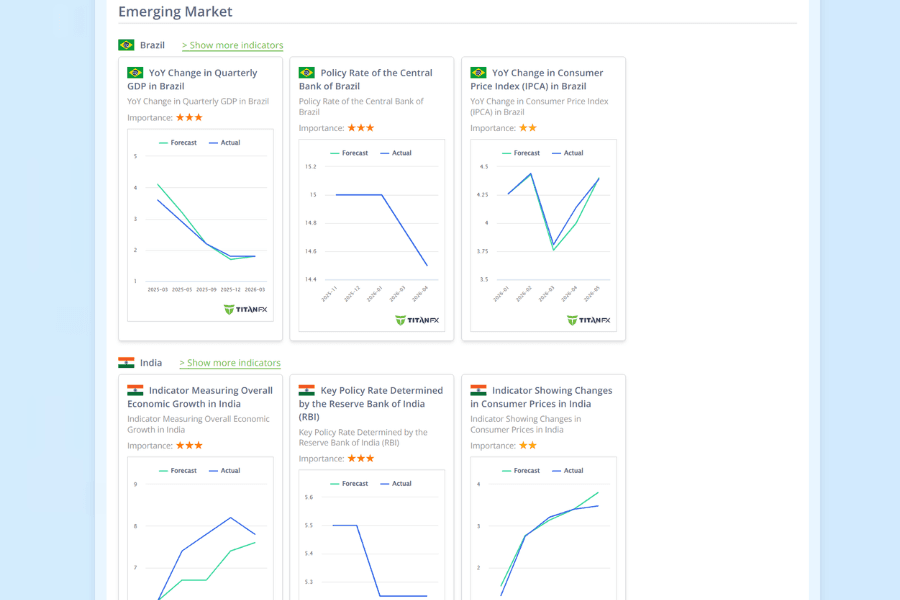
Further reading: Emerging-market economic indicators on the Titan FX Research economic calendar
6. Summary: Why BRICS Matters for the Long Run
BRICS development illustrates how the global economy is gradually moving toward a more multipolar structure. Its impact is not a short-term burst but rather a slow build, layering on FX and commodity markets as a medium- to long-term backdrop.
For traders, working through BRICS helps anchor a more complete macro view when interpreting headlines, and discourages overly emotional decisions on a single news cycle.
In real-world trading, when BRICS, de-dollarization or related geopolitical themes are influencing markets, a platform that combines FX and a wide range of CFD products—Titan FX is one example—lets traders monitor cross-asset reactions in one place while drawing on the platform's research and economic data to track the global picture.
Further reading: Titan FX Review: Platform Overview, Safety, Leverage and Instrument Coverage
7. FAQ: BRICS and Financial Markets
Q1. How many countries are currently in BRICS?
The original five (Brazil, Russia, India, China, South Africa) plus the post-2024 expansion: Saudi Arabia, the UAE, Iran, Egypt and Ethiopia. BRICS continues to engage with additional interested countries, so it is more accurate to view membership as gradually expanding rather than fixed.
Q2. If de-dollarization advances, will the US dollar weaken right away?
Not in the short term. The US dollar still dominates global liquidity, trade settlement share and FX reserves. No single alternative currency or bloc can realistically replace it overnight. In FX, de-dollarization tends to surface as a long-term expectational theme rather than a direct daily-price driver. Fed policy and macro data remain far more decisive in the near term.
Q3. How is BRICS linked to the long-term path of gold?
The link is mostly indirect, working through the reserve-diversification narrative. Central banks across BRICS and other emerging markets have been steadily raising the gold share of official reserves, which positions gold not only as a safe-haven asset but also as a diversification asset tied to reserve restructuring. Whenever geopolitical risk or de-dollarization themes resurface, gold often regains attention.
Q4. Should I trade BRICS-related news directly?
It is usually more reliable as part of a broader macro context than as a standalone signal. Combine BRICS themes with Fed policy stance, geopolitical risk, risk appetite and technical factors, and they help frame trend formation and turning points. As a sole short-term trigger, BRICS news tends to be unstable; as input for positioning and scenario analysis, it is genuinely useful.
Q5. Where can I track the latest BRICS developments?
BRICS summit communiques and official statements from member governments and central banks are the primary sources. From a market perspective, watching the simultaneous reaction of EM currencies, crude oil, gold and the US Dollar Index gives a fast read on how a theme is being priced. The Titan FX Research economic calendar—emerging-markets section is useful for tracking the release schedule of related data.
Titan FX Research Economic CalendarFurther Reading
- Geopolitical risk explained: how it shapes macro and price action
- US Dollar Index (USDX) explained
- Gold CFD trading basics
- Crude oil CFD (WTI and Brent) basics
- Central bank gold reserves around the world
Titan FX Research and Review Team — covering forex (FX), commodities (oil, precious metals, agricultural products), stock indices, US equities, and crypto assets, producing educational content for retail and institutional investors.
Primary Sources by Category
- Official data and regulators: BRICS official site (chair-country statements and summit communiques), member-country central banks and finance ministries publications, IMF International Financial Statistics, World Bank Open Data.
- Market data and liquidity: Bloomberg Markets (EM and BRICS coverage), Reuters (BRICS reporting), Bank for International Settlements (BIS) Triennial Central Bank Survey, World Gold Council "Gold Demand Trends".
- Academic research: Jim O'Neill, "Building Better Global Economic BRICs" (Goldman Sachs, 2001); Eswar Prasad, "The Future of Money"; Barry Eichengreen, "Exorbitant Privilege".
- Industry and third-party references: IMF Working Papers (reserve currency composition), Council on Foreign Relations BRICS briefings, Atlantic Council Geoeconomics Center, Titan FX Research economic calendar.