

CFD (Contract for Difference)
From single stocks and crude oil to Bitcoin, more and more traders want to reach global markets from a single account — and CFDs (Contracts for Difference) are the tool that makes it possible. They make capital more flexible and let you position for both rising and falling prices, which is why short-term traders and institutions favor them.
That flexibility comes with risk. For beginners, understanding how CFDs work, what they really cost, and how to control downside is the first step toward disciplined trading.
This guide walks through the core concepts, how CFDs differ from forex margin trading, the assets you can trade, the cost structure, and a six-step path to start with confidence.
- Definition: CFD = Contract for Difference; bet on price without owning the asset
- vs Forex margin: both use leverage; CFD covers more asset classes
- 3 main costs: spread, overnight swap, slippage
- 3 main risks: leverage amplifies losses, forced liquidation, gap risk
- Risk tools: stop loss, 2% rule, Kelly Criterion sizing
- 1. What Is a CFD (Contract for Difference)?
- 2. How Does CFD Differ from Forex Margin Trading?
- 3. What Assets Can You Trade with CFDs?
- 4. What Are the Main Trading Costs of CFDs?
- 5. CFD Features and Risks
- 6. How Should Beginners Start CFD Trading?
- 7. Frequently Asked Questions
- 8. Conclusion: CFDs Are Both Opportunity and Challenge
1. What Is a CFD (Contract for Difference)?
A CFD, short for Contract for Difference, is a derivative financial instrument that lets traders take positions on whether an asset's price will rise or fall — without ever owning the underlying asset.
Rather than buying or selling the asset directly, the trader enters into a contract with a broker. Profit or loss is determined by the price difference between the opening and closing of the position. This design makes CFDs highly flexible, particularly for short-term trading and technical strategies.
Basic CFD Trading Mechanics
The core of CFD trading is capturing the price difference between entry and exit. There are two basic directions:
Long (Buy)
When you expect the price to rise, you buy a CFD on the asset and close (sell) the position after the price moves up to lock in the gain.
Example:
- Buy a crude oil CFD at $70 per barrel. A few days later the price rises to $75 and you close the position. You earn the $5/barrel difference.
Short (Sell)
If you expect the price to fall, you sell a CFD on the asset and buy it back at a lower price.
Example:
- Sell a gold CFD at $3,000 per ounce. The price falls to $2,950 and you buy it back. You earn the $50/ounce difference.
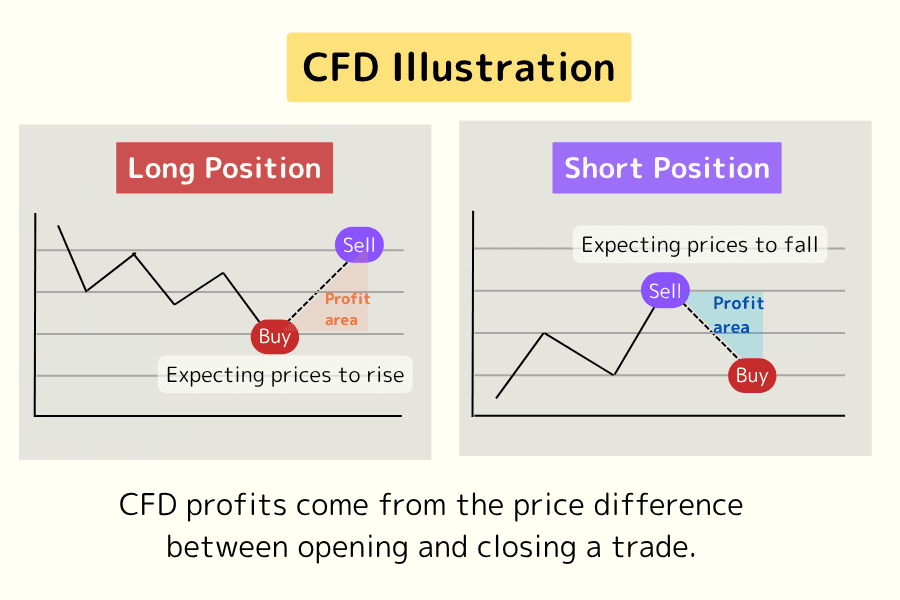
This bidirectional mechanism is what lets CFD traders find opportunities in both rising and falling markets.
2. How Does CFD Differ from Forex Margin Trading?
Both CFDs and forex margin trading are leveraged instruments that support trading in either direction. But they differ meaningfully in what you trade, how the contract is structured, and how the market is organized.
Core Comparison
| Item | CFD | Forex Margin |
|---|---|---|
| Underlying | Stocks, commodities, indices, crypto, etc. | Currency pairs only (e.g. EUR/USD) |
| Contract nature | Synthetic price exposure, no physical delivery | Margin used to take a position in a currency |
| Quote source | Broker-aggregated; small differences across platforms | Bank-aggregated; generally tighter and more transparent |
| Holds underlying? | No | No |
| Costs | Spread, overnight swap, occasional commission | Spread, overnight swap |
| Asset diversity | High — cross-market allocation | Focused on FX market |
Which One Should You Choose?
If you want exposure across stock indices, gold, oil, or crypto, CFDs offer broader flexibility and integration.
If your interest is currency moves driven by macroeconomic events, forex margin trading provides deeper market depth and clearer macro signal.
Pick the instrument that best fits your strategy, capital, and personal interest.
3. What Assets Can You Trade with CFDs?
The CFD product range is wide and gives access to most global financial markets:
- Stock CFDs
- Index CFDs
- Commodity CFDs
- Cryptocurrency CFDs
A brief overview of each:
Stock CFDs
Stock CFDs use a single company's share price as the underlying. You can take long or short exposure without owning the actual share.
- Typical underlyings: large-cap US and Japanese single names
- Useful for: short-term swing trades and hedging physical stock positions
- Practical use: downside protection on existing equity holdings
Titan FX offers: a US single-stock CFD trading environment
Index CFDs
Index CFDs track the major equity indices of the world's leading markets, for example:
- Common indices: S&P 500, Nasdaq 100, Nikkei 225, Hang Seng, DAX, etc.
- Profile: relatively smoother volatility; driven by macro data and policy
- Suited to: traders who think top-down or focus on macro
Titan FX offers: index CFDs across Japan, the US, Taiwan, Hong Kong, mainland China, Singapore, and the UK
Commodity CFDs
Commodity CFDs cover raw materials and physicals, which tend to be highly volatile and sensitive to:
- Geopolitical risk (e.g. war, sanctions)
- Inflation and rate cycles
- Weather and supply-chain disruption
Common underlyings:
Titan FX offers: a full lineup of metals, energy, and agricultural CFDs
Cryptocurrency CFDs
Cryptocurrency CFDs give exposure to digital asset prices through derivatives. Their high volatility and decentralized nature make them well-suited to short-term and high-risk strategies.
- Common underlyings: Bitcoin (BTC), Ethereum (ETH), Solana, Ripple, etc.
- Profile: shortable, high leverage available, flexible position building and hedging
- Market character: sharp moves and information-heavy — risk control is critical
Titan FX offers: 25+ crypto pairs (USD and JPY settlement supported)
4. What Are the Main Trading Costs of CFDs?
Beyond the asset's own price movement, every CFD trade carries execution-related costs. The four main categories are:
Cost 1. Spread
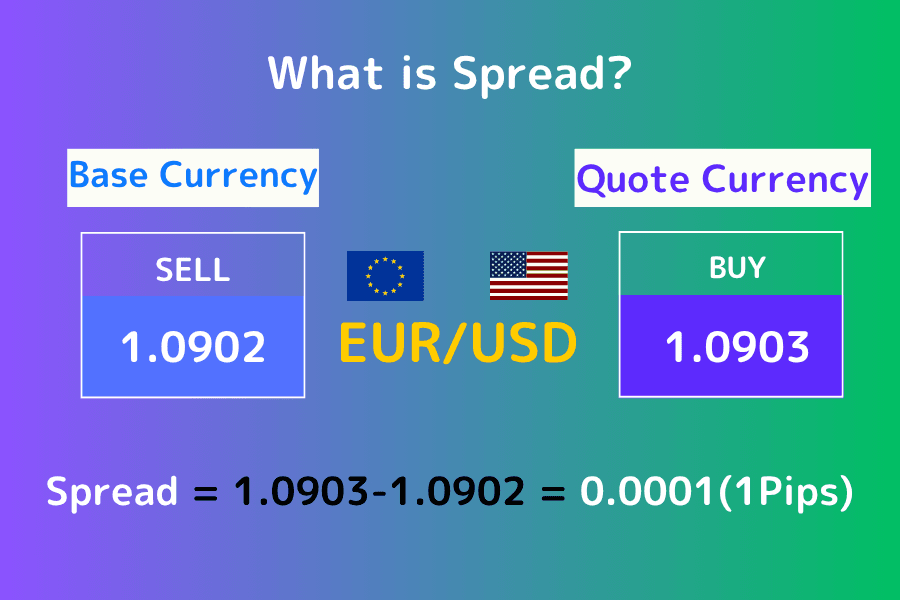
The spread is the difference between the bid and ask price — the most basic execution cost. The moment you open a position, you are effectively down by one spread, so a tighter spread is better.
- Example: if the bid is 100.00 and the ask is 100.10, the spread is 0.10
- Short-term traders need to watch this closely — high-frequency entries accumulate spread cost quickly
Cost 2. Overnight Interest (Swap)
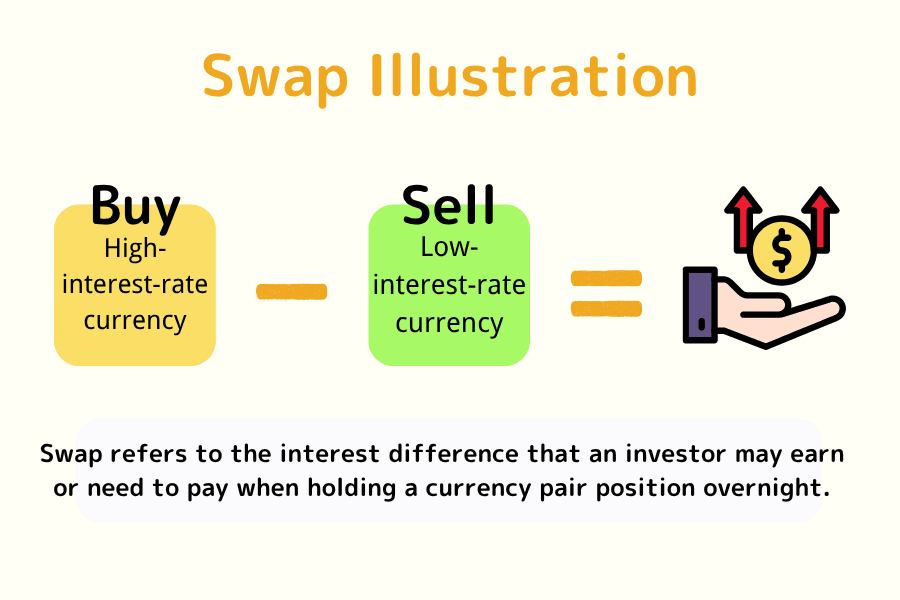
If you hold a position past the daily rollover, the broker applies overnight interest (swap), positive or negative, based on direction and the interest-rate differential of the underlying.
- The amount depends on leverage, asset class, and rate structure
- For longer-term positions, accumulated swap cost matters
- Some brokers offer swap-free accounts but usually at the cost of a wider spread
Learn more about overnight financing
Cost 3. Commission
Most CFD products embed costs into the spread, but specific products (e.g. US stock CFDs, crypto CFDs) may charge an explicit commission:
- Common structures: fixed fee per ticket, or a percentage of notional
- Example: 0.05% of trade value, or $1 per unit
- Charged on both open and close — watch the round-trip cost
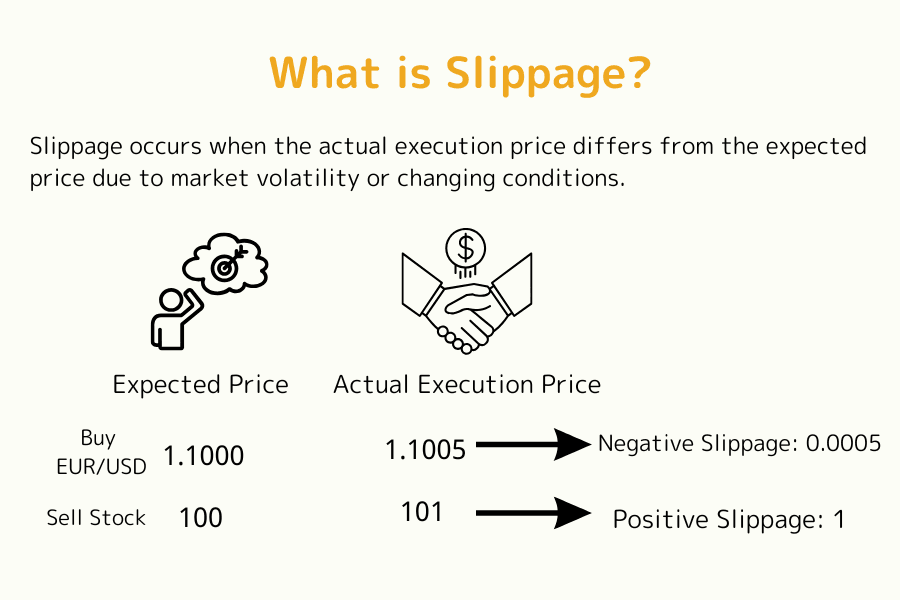
Cost 4. Slippage and Execution Delay
Slippage isn't a stated fee but it shows up routinely in real trading, especially during:
- High-volatility windows (major data releases such as US non-farm payrolls)
- Low liquidity or platform-side latency
- Pre-set stops and market orders, which are vulnerable to slipped fills
These factors push the executed price away from the expected price, indirectly inflating cost.
This kind of hidden technical risk deserves careful management, especially when using high leverage.
Note: every broker prices these costs slightly differently. Read each platform's fee schedule carefully and watch for funding fees or dormant-account charges.
5. CFD Features and Risks
CFDs are attractive because they are flexible and reach a wide market universe. They are risky for the same reason — leverage and breadth cut both ways. Understanding both sides is part of the basic homework before opening a position.
Main Features (Advantages)
- Advantage 1: Bidirectional opportunities
- Advantage 2: Leverage improves capital efficiency
- Advantage 3: High operational flexibility
- Advantage 4: Broad selection of underlyings
Advantage 1: Bidirectional Opportunities
CFDs support both long and short positions. Whether the market is rising or falling, you can look for setups — particularly useful in volatile regimes.
Advantage 2: Leverage Improves Capital Efficiency
Margin lets you control a larger notional with less capital. At 1:100 leverage, $100 can manage a $10,000 position. Used carefully, it improves capital efficiency.
Advantage 3: High Operational Flexibility
CFDs have no fixed expiry, so traders can run intraday strategies, swing trades, or hold positions across weeks — whichever fits the style.
Advantage 4: Broad Selection of Underlyings
Stocks, indices, commodities, crypto — all are accessible through one account, making cross-market allocation simple.
Main Risks
- Risk 1: Leverage amplifies losses
- Risk 2: Overnight swap pressure
- Risk 3: Technical and slippage risk
- Risk 4: Platform and regulatory risk
Risk 1: Leverage Amplifies Losses
The same leverage that boosts returns also magnifies losses. Even a small adverse move can trigger margin calls or forced liquidation.
Risk 2: Overnight Swap Pressure
Holding past the daily rollover means paying (or earning) swap. For longer-term leveraged positions, accumulated financing cost can erode total return.
Risk 3: Technical and Slippage Risk
In volatile sessions or when platforms see heavy load, you may face slippage, delayed fills, or order rejections — any of which can throw off your plan.
Risk 4: Platform and Regulatory Risk
Not all CFD brokers operate under strong regulation. Pick a broker with a recognized regulatory framework (e.g. ASIC, FCA) and clear segregation of client funds.
CFDs reward traders who combine market understanding with disciplined risk control. Beginners should master the mechanics on a demo account before committing real capital.
6. How Should Beginners Start CFD Trading?
You do not need to dive into a large live account from day one. A more sustainable path is: build the concepts, practice on demo, then test with a small live account.
- Step 1: Learn CFD fundamentals
- Step 2: Pick a familiar underlying
- Step 3: Choose a regulated broker
- Step 4: Practice on a demo account
- Step 5: Build a basic trading plan
- Step 6: Trade live with small capital
Step 1: Learn CFD Fundamentals
Before any live trade, lock in the concepts:
- What a CFD is and how it differs from direct ownership
- Entry/exit workflow, stop-loss and take-profit
- Leverage, margin, and capital management
- Spread, swap, and other execution costs
- Long vs short logic and how risk differs across them
Structured learning — through articles or online courses — works better than ad-hoc reading.
Titan FX provides a complete online learning library, covering:
- Asset-by-asset education (forex, indices, oil, gold, crypto, etc.)
- Technical analysis and an introduction to automated trading
- Foundational finance vocabulary and strategy explainers
Both beginners and intermediate traders can find structured content in the Titan FX education hub to build foundations step by step.
Step 2: Pick a Familiar Underlying
A new trader should focus on one or two underlyings, not the whole market. Markets you already follow are easier to read.
Common choices:
- Single-stock CFDs: a good fit if you track a specific sector (tech, energy, financials)
- Index CFDs: e.g. S&P 500 or Nikkei 225 — smoother movement, well-suited to macro analysis
- Gold / crude oil: highly sensitive to inflation, rates, and geopolitics — good for event-driven traders
Picking well speeds up learning and gives you defensible trade ideas.
Step 3: Choose a Trustworthy CFD Broker
A stable, transparent, and safe broker is the first risk control. Because CFDs are leveraged, the platform's pricing quality, execution speed, and treatment of client funds matter more than the marketing.
When evaluating brokers, look for:
- Execution stability: tight quotes, fast fills, minimal slippage or freeze
- Funding efficiency: clear deposit/withdrawal flow, no hidden fees
- Client support: multi-language coverage, responsive support team
- Product breadth: wide asset list, flexible leverage, room for different strategies
Why Titan FX?
Titan FX has more than ten years of operating history and focuses on a stable, fast, low-cost professional trading environment — ECN pricing, ultra-tight spreads, Zero Point execution, and 24-hour multilingual support. Whether you are a beginner or experienced trader, the goal is to let you focus on strategy.
Step 4: Practice on a Demo Account
Before sending live orders, use a demo account to learn the workflow with zero financial risk.
A demo account helps you:
- Practice open / close mechanics and order types (market, limit, stop)
- Set stop-loss and take-profit and rehearse risk control
- Observe how margin and P&L move with position size
- Feel the actual cost from spread and overnight swap
You can practice with MT4 or MT5 demo accounts before moving to live capital.
Step 5: Build a Basic Trading Plan
Stable performance needs a simple, executable plan. Two starting angles for beginners:
-
Technical analysis: use charts and indicators to time entries, e.g. moving averages, RSI, Bollinger Bands, candlestick patterns, and support/resistance.
-
Fundamental analysis: watch macro drivers — GDP, inflation, policy rates, and geopolitical risk.
Start with simple setups (e.g. moving-average crossovers or range breakouts), validate them on a demo account, log every trade, and iterate. That is how a personal trading system gets built.
Step 6: Trade Live with Small Capital
After demo, scale into live trading with small size. The aim is to apply the plan and risk control in real markets and build discipline.
- Control leverage and position size; avoid concentrated risk
- Trade a few underlyings, not many at once
- Log every trade and review them to refine the plan
CFDs move quickly. Beginners should scale up only after the process is stable.
7. Frequently Asked Questions
Q1: What is a CFD, and how does it differ from other instruments?
A CFD is a derivative that lets a trader speculate on price movement without owning the underlying. The table below summarizes the main differences vs. stocks, futures, ETFs, and forex.
| Item | CFD | Stock | Futures | ETF | Forex |
|---|---|---|---|---|---|
| Holds underlying? | No | Yes | Deliverable at expiry | Yes (basket) | No |
| Short available? | Yes | Usually via lending | Yes | Usually via lending | Yes |
| Leverage | Flexible (e.g. 1:20, 1:100) | None | Fixed margin requirement | Limited | Flexible |
| Expiry | None | None | Fixed | None | None |
| Trading hours | Near 24h on weekdays | Cash-session only | Per market rules | Cash-session only | 24h |
| Cost structure | Spread, swap, occasional commission | Commission, taxes | Margin, commission | Commission, management fee | Spread, swap |
CFDs offer flexibility, bidirectional trading, and high leverage — well suited to short- and medium-term strategies and advanced setups.
Q2: Are CFDs Just Virtual Trades — Are They Safe?
CFDs are over-the-counter (OTC) derivatives. The platform synthesizes asset prices and settles the contract; no physical asset changes hands. As long as the broker is properly regulated (FCA, ASIC, SFC, etc.), client funds and execution fairness are protected by the regulatory framework.
Q3: Can I Hold CFDs Long-Term?
In principle yes, but you must account for overnight financing cost. CFDs are best suited to short- and medium-term swing trading. For long holds, evaluate how much swap will erode return, or choose products with low or zero financing cost.
Q4: Is a CFD the Same as Forex?
No. Forex is an asset class. CFD is a contract structure. You can trade "forex CFDs," but CFDs also cover stocks, indices, crypto, and more. The two are not equivalent — forex trading can also happen as spot, not just CFD.
Q5: Do Beginners Have to Start on a Demo Account?
It is strongly recommended. A demo account lets you learn the platform, validate strategies, and rehearse risk control without exposing real capital to early-stage mistakes.
8. Conclusion: CFDs Are Both Opportunity and Challenge
CFD trading opens the door to a wide range of markets — stocks, indices, commodities, crypto — all from a single account. Bidirectional trading and margin-based leverage make capital efficient.
Higher potential return comes with higher risk. Spread, swap, slippage, and broker choice all shape the actual outcome. Beginners are usually best served by learning risk and strategy on a demo first, then scaling position size gradually through disciplined practice.
A final reminder: CFDs are not a shortcut to fast wealth. They are an advanced operational tool that rewards knowledge and judgment. Build the right concepts and a clear plan, and CFDs become a flexible, high-potential component of how you manage capital.
Further Reading
- Forex Margin Trading Basics
- What Is Leverage?
- What Is Spread?
- What Is Stop Loss?
- What Is Forced Liquidation (Loss-Cut)?
- The 2% Risk Rule
Titan FX Trading Strategy Lab. We produce investor-education content covering forex, commodities (crude oil, precious metals, agricultural goods), stock indices, US equities, and digital assets.
Primary Sources (by category)
- Regulatory: ESMA (European Securities and Markets Authority) — CFD Product Intervention Measures (2018) on retail leverage restrictions; FCA (UK) — CFD risk disclosures
- Industry data: Bank for International Settlements (BIS) — Triennial Central Bank Survey (2022) on OTC derivatives turnover
- Accounting treatment: IFRS 9 Financial Instruments — accounting treatment of contracts for difference
- Academic analysis: Heimer, R. & Imas, A. (2022) "Biased by Choice: How Financial Constraints Can Reduce Financial Bias", Review of Financial Studies — retail CFD behavior