

What is Brent Crude Oil? BFOET, Pricing, WTI Differences & CFD Trading

Brent Crude Oil is the global oil-pricing benchmark anchored on North Sea production, accounting for roughly two-thirds of global oil trade. It is light and sweet (low-sulphur), making it ideal for refining.
Brent Crude Oil (Brent) is the international benchmark for the global energy market. Its light, low-sulphur profile makes it an ideal feedstock for refining into gasoline, diesel, and jet fuel. Brent's price not only sets the tone for European oil markets, it reflects shifting global economic conditions and energy-policy directions.
This article explains Brent's market characteristics, the factors that move its price, CFD trading mechanics, and risk-management considerations to help you participate in the oil market effectively.
Want to see real-time prices and the chart? Head to the XBR/USD product page for the latest quote and candlestick chart.
- Brent Crude is the pricing benchmark for ~65% of global physical oil, set by the BFOET basket of 5 fields.
- Physical profile: API ~38–39 (light), sulphur < 0.4% (sweet), high refining efficiency.
- The Brent–WTI spread reflects EU/US supply-demand differences and geopolitical risk premium, typically USD 1–5.
- Main drivers: OPEC+ policy, North Sea output, geopolitical events, the dollar index, and seasonal demand.
- On Titan FX, trade XBR/USD CFD long or short — watch margin, swaps, and stops around major events.
1. What is Brent Crude Oil?
Brent Crude Oil is light, low-sulphur crude produced from the Brent oil field in the North Sea Atlantic, located between the United Kingdom and Norway. Thanks to its quality and stable supply, Brent is a favoured feedstock for refineries and one of the main pricing benchmarks of the international oil market.
Its physical characteristics:
- Per S&P Global Platts specifications, an API gravity of around 38–39 places it in the light-crude category, easy to process and refine.
- Sulphur content below 0.4% makes it a sweet crude that complies with most environmental regulations.
These properties allow Brent to yield a higher proportion of high-value refined products such as gasoline and jet fuel, supporting strong economics in refining.
Main applications of Brent Crude
- Refining for transport fuels: gasoline, diesel, jet fuel
- Feedstock for chemical products such as plastics and lubricants
- Industrial and power-generation energy needs
Brent's global influence rests not only on its quality and stable supply but also on its role as a reference price for most oil contracts in Europe, Asia, and the Middle East — making it a core indicator of international oil prices.
The 3 global crude oil benchmarks explainedWhat is the BFOET Benchmark? Brent's 5 oil fields
BFOET = Brent + Forties + Oseberg + Ekofisk + Troll, a 5-field weighted basket that prices ~65% of global physical crude.
Today's "Brent Crude" is no longer a single field — it is the BFOET benchmark, weighted across five North Sea light, low-sulphur crude streams:
| Field | Location | Joined |
|---|---|---|
| Brent | UK offshore | 1970s (original) |
| Forties | UK offshore | 2002 |
| Oseberg | Norway offshore | 2002 |
| Ekofisk | Norway offshore | 2007 |
| Troll | Norway offshore | 2018 |
Per ICE (Intercontinental Exchange) data, more than ~65% of global physical crude is priced off this BFOET benchmark. In 2021, the original Brent field itself stopped production, and ICE expanded the classification to formally include Troll. From 2023, Dated Brent has even brought US WTI Midland into the Cash BFOE trading pool, further entrenching its status as the international benchmark.
Ways to invest in Brent Crude: ETF, CFD, futures, equities
Four main ways to invest in Brent: ETF, CFD, futures, and equities. CFD is the most flexible (small size, leverage, two-way trading, 24-hour access).
There are four mainstream ways to participate in Brent crude, each with trade-offs:
| Method | Minimum capital | Leverage | Suited to |
|---|---|---|---|
| Energy ETF | from ~US$150 | None | Long-term holders who don't want to monitor closely |
| CFD (details) | from ~US$100 | up to 1:100 | Short / medium-term, flexible position management |
| Crude oil futures | from ~US$5,000 margin | ~1:10 | Capital-rich professional traders |
| Energy equities | from ~US$300 | None | Investors who also want dividends |
CFD is the most flexible: long or short, small entry size, 24-hour access, and no physical delivery risk. Titan FX offers two crude CFDs: XBR/USD (Brent) and XTI/USD (WTI).
The 3 global crude oil benchmarks: Brent, WTI, Dubai/Oman
Three benchmarks dominate global oil pricing: Brent (Europe), WTI (US), Dubai-Oman (Middle East-Asia). The OPEC Basket is an additional policy reference.
The oil market relies on three pricing benchmarks, each anchoring a different regional market:
| Benchmark | Origin | Exchange | API gravity | Sulphur | Main markets |
|---|---|---|---|---|---|
| Brent | North Sea (UK, Norway) | ICE | 38–39 (light) | < 0.4% | Europe, Africa |
| WTI | US West Texas | NYMEX | 39–40 (lighter) | < 0.24% | Americas |
| Dubai/Oman | UAE, Oman | DME | ~31 (medium) | ~2% | Middle East, Asia |
There is also the OPEC Basket — a weighted average of the main OPEC member-state crudes used as a reference for OPEC policy assessment.
Brent vs WTI Crude Oil: Quick comparison
Brent: European and international pricing benchmark (ICE). WTI: US benchmark (NYMEX). Brent sulphur 0.4%, WTI 0.24%. Brent allows cash settlement; WTI is physically delivered.
A quick side-by-side of the two major crudes:
| Item | Brent Crude | WTI Crude |
|---|---|---|
| Origin | North Sea (UK, Norway) | US West Texas |
| Market role | European and international pricing benchmark | US market pricing benchmark |
| Exchange | ICE (Intercontinental Exchange) | NYMEX (New York Mercantile Exchange) |
| API gravity | 38–39 (light) | 39–40 (lighter) |
| Sulphur | < 0.4% (sweet) | < 0.24% (sweeter) |
| Typical spread | Usually USD 2–5 per barrel above WTI | — |
| Settlement | Cash settlement available (EFP) | Physical delivery (must take delivery if held to expiry) |
| Titan FX symbol | XBR/USD | XTI/USD |
Brent typically trades USD 2–5 per barrel above WTI, reflecting its international market role and shipping costs. The spread fluctuates with geopolitics, transport bottlenecks, and US shale output.
Brent Crude trading hours (GMT and major time zones)
ICE electronic trading runs near-24 hours, GMT 00:00 to 22:00. Most active windows: 2 hours after London open and around the US inventory release.
Brent trades primarily on ICE's electronic platform, near 24-hour:
| Window | London time (GMT) | Notes |
|---|---|---|
| Main session opens | 00:00 | — |
| Main session closes | 22:00 | — |
| Daily downtime | 22:00–24:00 | — |
Most active windows (high liquidity, large moves):
- 2 hours after London open (around 08:00–10:00 GMT): European capital dominates
- 1 hour after the US open (around 14:30–15:30 GMT): driven by the US Energy Information Administration (EIA) weekly crude inventories report (released Wednesdays at 14:30 GMT).
For new traders, avoid the weekend gap and the 30 minutes around the US inventory release — the volatility is large.
2. History and Market Role of Brent Crude
Brent Crude takes its name from the Brent oil field in the North Sea, developed by Shell in the 1970s. The field was named after the "Brent goose," a migratory bird. As the North Sea grew in importance, Brent gradually became the dominant European crude.
In 1988, the International Petroleum Exchange in London (now ICE) launched the Brent Crude futures contract, providing a deep and transparent market that cemented Brent's role as the global pricing benchmark. Alongside WTI crude, Brent underpins the pricing and trading of most contracts in Europe, Asia, and the Middle East.
Brent's role in the market
- European pricing core: Brent reflects North Sea and European energy supply-demand dynamics; it is the regional benchmark for refining and energy trade.
- Global reference price: Asia, Africa, and Middle East crude contracts widely use Brent as the pricing reference, shaping international trade.
- Strategic spread indicator: The Brent–WTI spread is a key indicator that traders watch for regional supply-demand and policy differences.
- Foundation for financial products: Brent futures and ETFs offer institutions and retail investors diverse risk-management and speculative tools.
3. Key Factors Driving Brent Crude Prices
Brent moves on a mix of global and regional drivers. Understanding them helps traders pick entries and avoid avoidable risks.
Factor 1: Supply and demand
The international supply-demand balance is the core anchor. Economic growth lifts energy demand and prices; slowdowns and the rise of alternatives can pressure prices lower. Watch North Sea production stability and OPEC+ output policy.
Factor 2: Geopolitical risk
Conflicts in the Middle East, the Russia–Ukraine war, and other global flare-ups can disrupt the oil supply chain. Maintenance or accidents at North Sea pipeline infrastructure can briefly affect Brent supply.
Factor 3: USD trajectory
Crude is priced in US dollars. A stronger dollar raises import costs for non-USD economies and can dampen demand; a weaker dollar tends to support demand and prices.
Factor 4: European inventory and demand changes
European seasonal demand (e.g. winter heating), gas-price moves, and storage levels show up in Brent. Inventory reports often act as short-term volatility triggers.
Factor 5: Energy transition and policy shifts
Carbon-neutral targets and renewable-energy investment shape long-run demand. The EU's Emissions Trading System and subsidies for hydrogen and wind power can compress fossil-fuel demand.
Factor 6: Speculation and market sentiment
Brent futures markets are deep and attract heavy institutional and quant flows. Around major data releases (OPEC decisions, CPI prints), positioning can amplify price swings.
4. Brent Crude Trading: Opportunities and Risks
Brent has strong liquidity and market depth, making it one of the most-watched energy instruments. Its volatility creates trading opportunities — but also non-trivial risks.
Trading opportunities
High volatility
Brent is driven by geopolitics, inventories, and OPEC+ decisions. In the short run, price swings can be sharp, providing material opportunities for short-term trading.
Two-way (long/short) flexibility
Through derivatives (CFDs, futures), traders can take positions on rising or falling prices and adapt to market direction.
Global price linkages
Brent is highly correlated with WTI, natural gas, and other energy products, supporting cross-commodity strategies and arbitrage.
Clear policy drivers
EU emission-reduction legislation, international trade policy, and OPEC+ output adjustments produce clear effects on the oil market and tend to generate trends.
Trading risks
Sharp volatility risk
Crude is a high-volatility asset. Sudden events such as Middle East conflict or supply disruptions can produce abrupt rallies or drops — risk that cannot be ignored.
Leverage amplifies risk
Using leverage magnifies both gains and losses. Without proper position sizing and stops, even a small move can cause significant losses.
Uneven liquidity risk
Outside the main session (e.g. early Asian hours), volume drops, spreads widen, and slippage becomes more common — pushing trading costs up.
Event risk is high
Around the North Sea inventory report, OPEC monthly statements, or major political announcements, markets can move sharply; without prior risk control, stops can get hit easily.
Risk management suggestions
-
- Set clear stop-loss and take-profit levels — do not chase price, do not average down.
-
- Control position size to limit leverage exposure.
-
- Track release schedules of major reports and avoid entering around high-uncertainty windows.
-
- Trade preferentially during liquid hours (e.g. London–New York overlap).
5. How to Trade Brent Crude (XBR/USD) on Titan FX
After opening a Titan FX account, you can trade Brent Crude (XBR/USD) CFDs on MT4 and MT5. Titan FX offers leverage of up to 100x, supports two-way trading, and combines low spreads with fast execution to optimise your trading experience.
Step 1: Log in to your trading account
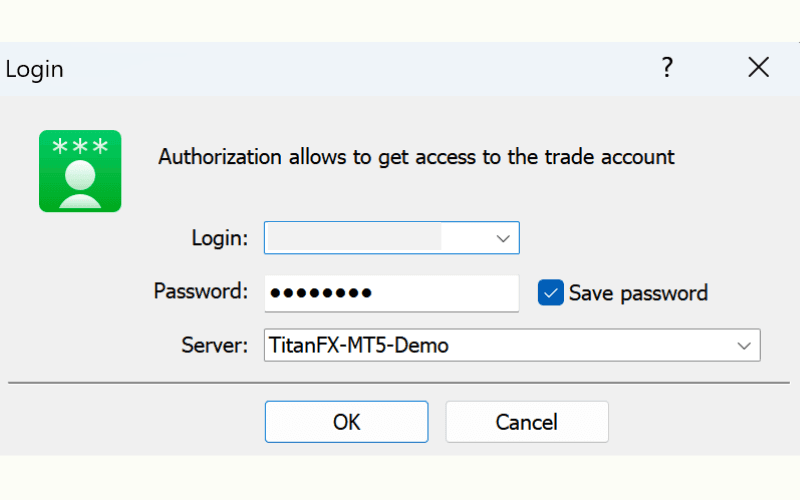
Download MT4/5, then enter your account number and password to log in.
Step 2: Add XBR/USD to "Market Watch"
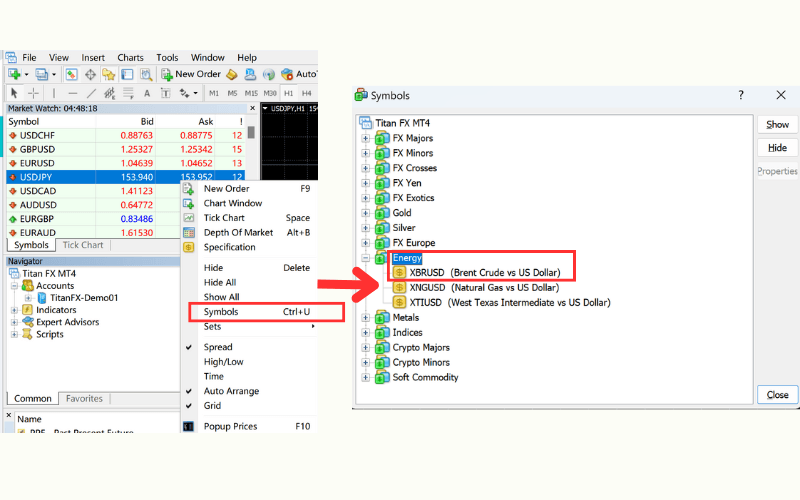
Right-click in the Market Watch window, click "Symbols," then double-click "XBR/USD" under "Energy" to add the Brent quote to your Market Watch panel.
Step 3: Trade Brent
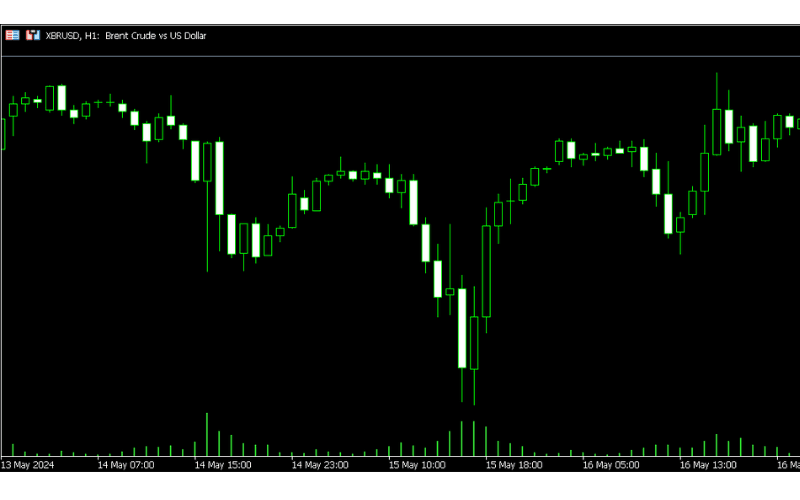
Double-click the Brent quote or open the Brent chart to start trading.
Trade Crude Oil CFDs with Titan FX
Titan FX offers WTI (XTI/USD) and Brent (XBR/USD) crude oil CFDs with up to 100:1 leverage, tight spreads, and the flexibility to go long or short without holding the physical commodity.
6. FAQ: Brent Crude Trading in Practice
Q1: What kind of investor is Brent Crude trading suited to?
Brent shows clear volatility and global participation, suiting investors with short to medium-term experience who can handle higher-risk environments. If you are comfortable with event-driven trading, macroeconomic analysis, or geopolitical risk management, Brent is a flexible instrument.
Q2: How do I tell when Brent is forming a trend?
Combine technical indicators (moving-average crossovers, Bollinger Band breakouts) with fundamental observation (OPEC news, sentiment indices) to identify price trends. Large fund inflows into commodity ETFs and changes in futures open interest are often important signals.
Q3: What market correlations should I watch when trading Brent?
Beyond the WTI spread, Brent often interacts with natural gas, the dollar index, US Treasury yields, and European gas futures. These shifts affect risk sentiment and pace of trading — useful for cross-commodity or hedging strategies.
Q4: Is there seasonality in the Brent trading cycle?
Yes. Demand peaks tend to come in winter (heating) and summer (shipping and travel). Spring and autumn shoulders are usually quieter, but maintenance shutdowns or policy adjustments can still produce unexpected volatility.
Q5: How should a new trader build a Brent strategy?
Start with demo trading or low-leverage small positions, observing how prices react to news. Pick a fixed window (e.g. the first two hours after London open), get comfortable with order entry, and build the habit of using the economic calendar and technical analysis tools.
7. Conclusion
As the recognised international benchmark for oil prices, Brent Crude reflects more than just supply-demand and geopolitics — it embeds the energy of financial markets and the direction of policy. For investors, participating in the Brent market through CFDs allows you to use leverage and long/short strategies flexibly while staying connected to the global energy market's rhythm.
Whether you are new to trading or a seasoned professional, understanding Brent's basic characteristics, its price drivers, and the risk-management principles behind oil trading is the first step. Track the economic calendar, geopolitical events, and inventory data; combine fundamentals with technical tools; and you can build a steady trading edge in a high-volatility market.
Further Reading
- XBR/USD (Brent Crude CFD) live quote — Titan FX's Brent CFD product page with live candles
- The 3 global crude benchmarks (Brent / WTI / Dubai) — How Brent compares with WTI and Dubai
- What is a CFD? — Leverage and two-way trading basics
- Geopolitical risk — How Middle East and North Sea events transmit into oil prices
- Inflation — How oil prices feed into the broader price level
- Asset Allocation — How oil fits into a portfolio framework
The Titan FX Research team covers global macroeconomic indicators, foreign exchange (FX), commodities (oil, precious metals, agriculture), equity indices, US stocks, and crypto assets, producing educational content for investors and traders.
Primary Sources by Category
- Official data and regulators: U.S. Energy Information Administration (EIA) — Petroleum & Other Liquids weekly; OPEC — Monthly Oil Market Report (MOMR); International Energy Agency (IEA) — Oil Market Report.
- Exchanges and market data: Intercontinental Exchange (ICE) — Brent Crude futures; S&P Global Platts — Dated Brent / BFOET methodology; CME Group — WTI / Brent benchmark spread data.
- Media and historical references: Bloomberg; Reuters; Brent oil price history (1985–present), the 2014–2016 oil-price collapse, the 2020 COVID-19 demand shock, and the 2022 Russia–Ukraine war supply shock.