

What Is the Hang Seng Index (HK50)? Components & Trading Guide
When investors think about gaining exposure to Hong Kong stocks, the Hang Seng Index (HK50) is usually the first name they encounter. It works as a mirror of Hong Kong’s economy and its links to mainland China, drawing attention from traders worldwide.
This article covers how HK50 is calculated and what it contains, the key factors that move its price, and practical ways to trade it at Titan FX.
- What HK50 is: The benchmark index of Hong Kong's stock market, compiled by Hang Seng Indexes
- Components: Large-cap leaders such as HSBC, Tencent, and AIA
- HK50 vs HSI: Same constituents and price; HK50 is the CFD code, HSI the official index name
- Price drivers: China/Hong Kong policy, U.S. rates, global capital flows, and FX
- Trading: Available as a CFD on margin via MT4/MT5 at Titan FX (up to 500x)
What Is the Hang Seng Index (HK50)?
The Hang Seng Index (HSI) is the most representative benchmark index of the Hong Kong stock market. It was launched on November 24, 1969, by Hang Seng Indexes Company Limited, a subsidiary of Hang Seng Bank. In CFD trading, the Hang Seng Index is traded under the ticker symbol HK50.
The index tracks the largest and most liquid companies listed on the Main Board of the Hong Kong Stock Exchange, covering sectors such as financials, real estate, technology, consumer goods, industrials, and utilities, providing a comprehensive reflection of Hong Kong's economy and overall market performance.
| Item | Details |
|---|---|
| Official Name | Hang Seng Index (HSI) |
| Trading Symbol | HK50 (CFD) |
| Launch Date | November 24, 1969 |
| Index Provider | Hang Seng Indexes Company Limited |
| Weighting Method | Free-float market capitalization weighted |
| Number of Constituents | Approximately 80 (expanded from the original 50 since 2021) |
| Review Frequency | Quarterly (March, June, September, December) |
Historically, the Hang Seng Index consisted of 50 companies, which is why it is also known as the "Hong Kong 50 Index." However, since 2021, Hang Seng Indexes Company Limited announced an expansion of the constituent count, targeting 100 stocks. As of May 2025, the HSI includes over 80 constituents, with the specific list updated periodically by Hang Seng Indexes Company Limited.
The Hang Seng Index uses a free-float market capitalization weighting methodology, calculating each constituent's weight based on its free-float shares multiplied by its share price. Individual constituents are subject to a weight cap (currently 8%) to prevent any single company from having an outsized impact on the index. Quarterly reviews adjust the constituent list based on market capitalization rankings and liquidity criteria.
Compared to the Hang Seng China Enterprises Index (HSCEI), HK50 has a broader coverage that includes not only H-shares of mainland Chinese companies but also local Hong Kong companies, international corporations, and red-chip stocks. Compared to the FTSE China A50 Index (CN50), HK50 tracks companies listed in Hong Kong, whereas CN50 tracks companies in mainland China's A-share market.
Methodology and Constituents
The selection criteria for Hang Seng Index constituents include: the company must be listed on the Main Board of the Hong Kong Stock Exchange, rank highly in terms of market capitalization and liquidity, represent a range of core industries, and demonstrate strong financial performance. Below are the main sector distributions and representative companies:
Financials
Financial stocks are among the most heavily weighted sectors in HK50:
| Company | Ticker | Sub-sector |
|---|---|---|
| HSBC Holdings | 0005.HK | Commercial Banking |
| AIA Group | 1299.HK | Insurance |
| Hong Kong Exchanges and Clearing | 0388.HK | Exchange Operations |
| China Construction Bank | 0939.HK | Commercial Banking |
| Ping An Insurance | 2318.HK | Insurance/Financial Services |
Technology
In 2025, the technology and consumer sectors have seen notable growth, boosting the dynamism of the index:
| Company | Ticker | Sub-sector |
|---|---|---|
| Tencent Holdings | 0700.HK | Internet/Gaming |
| Alibaba Group | 9988.HK | E-commerce/Cloud Computing |
| Xiaomi Corporation | 1810.HK | Consumer Electronics/IoT/EVs |
| Meituan | 3690.HK | Local Services |
Real Estate
| Company | Ticker | Sub-sector |
|---|---|---|
| Sun Hung Kai Properties | 0016.HK | Property Development |
| Henderson Land Development | 0012.HK | Property Development |
| CK Asset Holdings | 1113.HK | Property Development |
Consumer Goods
| Company | Ticker | Sub-sector |
|---|---|---|
| China Mengniu Dairy | 2319.HK | Dairy Products |
| Hengan International | 1044.HK | Consumer Staples |
| Li Ning | 2331.HK | Sportswear |
Utilities and Industrials
| Company | Ticker | Sub-sector |
|---|---|---|
| CLP Holdings | 0002.HK | Power |
| Power Assets Holdings | 0006.HK | Power |
| CNOOC | 0883.HK | Offshore Oil & Gas |
| China Resources Beer | 0291.HK | Beverages |
Sector Composition Characteristics
The sector composition of the Hang Seng Index has undergone a significant transformation. Traditionally dominated by financial and real estate stocks, the index has seen a substantial increase in the weight of the technology sector as companies such as Tencent, Alibaba, Meituan, and Xiaomi were added as constituents. The growth of the technology and consumer sectors has been particularly notable in 2025, making the index more reflective of Hong Kong's role as a hub for technology company listings.
This diversified sector distribution means that HK50 is simultaneously influenced by global technology trends (tech stocks), Chinese financial policy (banking stocks), Hong Kong's interest rate environment (real estate stocks), and international consumer trends (consumer stocks).
Key Price Drivers
1. Economic Factors
Economic indicators such as GDP growth, inflation, and employment in both Hong Kong and mainland China affect constituent company earnings and reflect overall market health.
-
Hong Kong GDP Growth Rate: Hong Kong's economic growth directly impacts earnings expectations of local companies
-
Hong Kong CPI (Consumer Price Index): Inflation data affects consumer sector performance and interest rate expectations
-
China GDP Growth Rate: China's economic performance directly impacts the earnings of Chinese companies listed in Hong Kong
-
China Manufacturing PMI: A leading economic indicator; PMI readings above the 50 expansion/contraction threshold are generally positive for HK50
On the central bank policy front, interest rate decisions by the Hong Kong Monetary Authority and the People's Bank of China affect funding costs in the stock market and investors' risk appetite.
2. Political Factors
Policy changes by the Hong Kong SAR government and the Chinese government, including fiscal policy, tax policy, and trade policy, directly affect market confidence and corporate earnings expectations. As an international financial center, Hong Kong is significantly influenced by geopolitical relationships and trade policy shifts among major economies (such as US-China trade relations).
3. Market Factors
-
Financial results, earnings forecasts, and dividend policies of constituent companies affect investor valuations
-
Investor sentiment, risk appetite, and trading strategies can have a significant impact on short-term index fluctuations
-
Southbound capital flows (via Stock Connect) represent an important marginal force influencing HK50
4. Technical Factors
-
Large capital movements, including institutional investors and hedge fund activity, can cause significant index volatility
-
Changes in trading volume, particularly block trades and unusual trading activity, can impact short-term price movements
5. International Factors
-
Global economic growth, economic data from major economies, and overall trends in international markets influence the Hang Seng Index
-
The performance of US stock markets (such as the Dow Jones Index and the S&P 500 Index) and other major international markets show a degree of correlation with HK50
Exchange Rate Fluctuations
Fluctuations in the Hong Kong dollar against other major currencies (especially the US dollar) and the RMB affect the flow of foreign capital. Because the Hong Kong dollar operates under a linked exchange rate system pegged to the US dollar, the Federal Reserve's interest rate policy directly impacts Hong Kong's interest rate environment, which in turn affects the performance of real estate and financial stocks.
Using Titan FX's Economic Calendar and Hong Kong Economic Indicators page, traders can track the release timing and market expectations for these key data points in real time.
Index Comparison and Investment Focus
HK50 vs HSCEI vs CN50
| Item | HK50 (Hang Seng Index) | HSCEI (H-Share Index) | CN50 (FTSE China A50) |
|---|---|---|---|
| Coverage | Top 80+ companies on HKEX | H-shares listed on HKEX | Top 300 A-shares in Shanghai/Shenzhen |
| Constituent Source | Hong Kong + China + International | Mainland China-incorporated companies | Mainland China A-share companies |
| Trading Currency | HKD | HKD | RMB |
| International Access | Fully open | Fully open | Via Stock Connect / QFII |
| Sector Profile | Well-balanced (Tech + Financials + Real Estate) | Higher weight in Financials + Energy | Balanced across Tech + Consumer + Financials |
| Volatility | Medium-High | High | Medium |
| Titan FX Symbol | HK50 | HSCEI | CN50 |
HSI vs HK50
HK50 and HSI (Hang Seng Index) track the same set of constituents. The key difference lies in their names and use cases:
| Item | HSI (Hang Seng Index) | HK50 (Hong Kong 50 Index) |
|---|---|---|
| Full Name | Hang Seng Index | Hong Kong 50 Index |
| Publisher | Hang Seng Indexes Company Limited (official) | No official publisher; used by brokers as a product name |
| Index Type | Stock market index | Index CFD product |
| Use Case | Financial news, funds, ETFs, market analysis | CFD trading platforms, MT4/MT5 quote lists |
| Constituents | Largest companies listed in Hong Kong | Same as HSI |
Investment Strategy Highlights
-
Sector rotation: HK50's diversified sector composition provides opportunities for sector rotation. During falling interest rate cycles, real estate and utility stocks benefit; during tech rallies, heavyweight stocks like Tencent and Alibaba drive the index
-
China-Hong Kong linkage: China's economic policies have a profound impact on HK50. Watch for PBOC reserve requirement ratio cuts/interest rate cuts and State Council economic stimulus packages
-
International correlation: Hong Kong stocks show a significant correlation with US equities. When US markets fall sharply, HK50 typically opens under pressure the following day
-
Capital flows: The volume and direction of southbound capital (mainland capital buying Hong Kong stocks via Stock Connect) are important references for gauging short-term trends
How to Trade HK50 on Titan FX
On the Titan FX platform, the Hang Seng Index is traded under the symbol HK50, available on both MT4 and MT5 platforms. Trading is conducted via CFDs (Contracts for Difference) with leverage up to 500x. You can also trade using WebTrader directly in your browser.
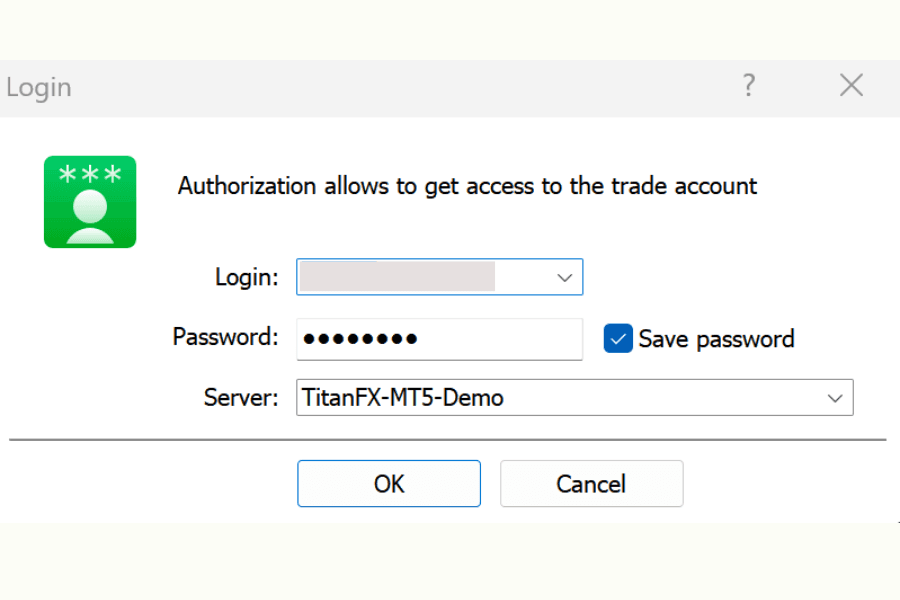
Step 1: Log In to Your Trading Account
Open a Titan FX trading account (Zero Standard or Zero Blade), complete your deposit, then download the MT4 or MT5 platform and log in with your account credentials.
Step 2: Add HK50 to Your Watchlist
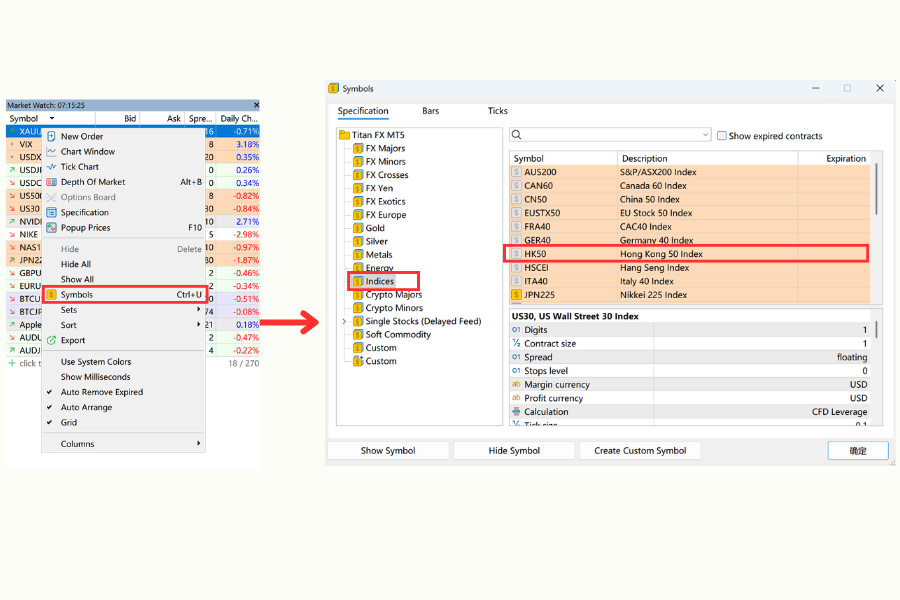
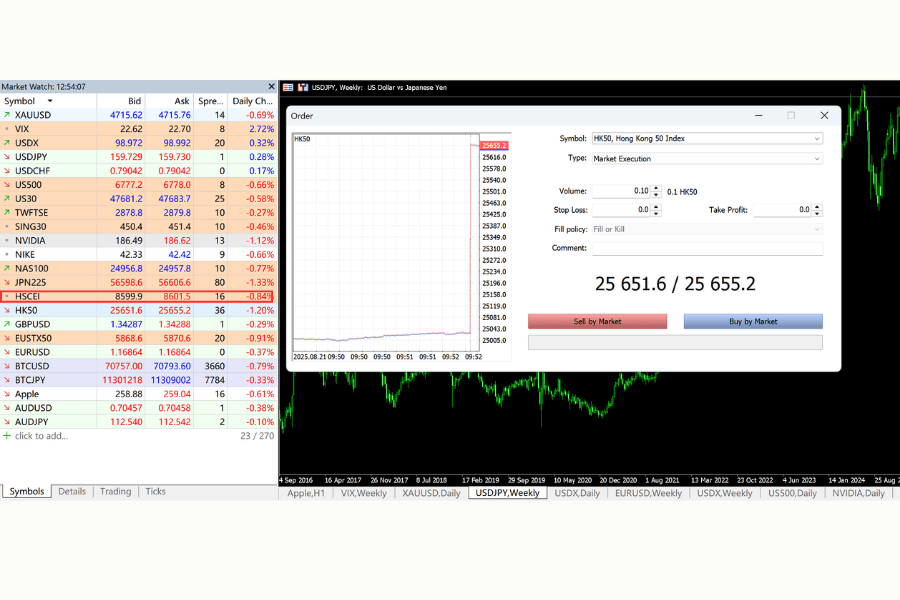
Right-click in the "Market Watch" window, select "Symbols," expand the "Indices" category, find HK50, and double-click to add it to your quote list.
Step 3: Place Your Trade
Double-click on the HK50 quote or open its chart to access the order screen. Enter the lot size (minimum 0.1 lots), choose your buy or sell direction, set your stop loss and take profit, and execute the trade.
Trading Hours
HK50 trading hours are divided into three sessions, corresponding to the Hong Kong Stock Exchange's market hours:
| Session | Server Time (GMT+3) | Hong Kong Time (GMT+8) |
|---|---|---|
| Session 1 | 04:15 - 07:00 | 09:15 - 12:00 |
| Session 2 | 08:00 - 11:30 | 13:00 - 16:30 |
| Session 3 | 12:15 - 22:00 | 17:15 - 03:00 next day |
Sessions 1 and 2 cover the morning and afternoon trading sessions of the Hong Kong stock market, where liquidity is highest. Session 3 is after-hours trading, with relatively lower volatility but still potentially influenced by international market developments.
Titan FX Analysis Tools
Titan FX offers a range of analysis tools to help traders assess the technical outlook for HK50:
- Support and Resistance: Identify key price levels for HK50 to assess breakout or reversal potential
- Order Book (Position Information): Observe pending order distribution and long/short ratios of other traders
- Trend Analysis: Determine whether HK50 is in an uptrend, downtrend, or consolidation phase
- RSI Analysis: Identify overbought or oversold conditions to help time reversals
- Volatility Heatmap: Understand HK50's volatility patterns across different trading sessions
- Percentage Change Ranking: Compare HK50's real-time performance against other indices
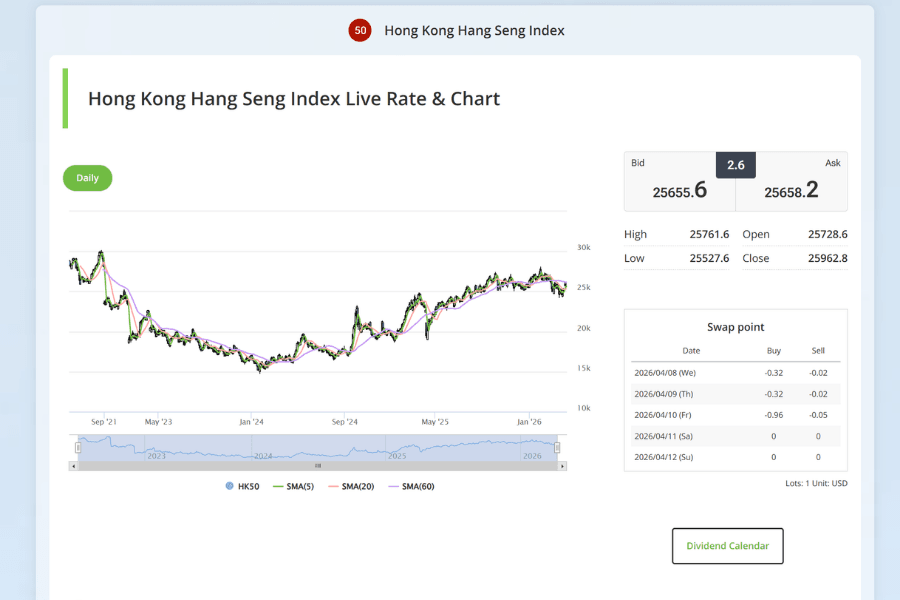
- Swap Calendar: Check overnight financing rates for HK50
- Dividend Calendar: Track the impact of constituent ex-dividend dates on your CFD account
- Margin Calculator: Calculate required margin and appropriate position sizes
For the latest trading conditions and spreads, please visit the official page.
For the latest trading conditions and live prices, see the HK50 instrument page.
Start Trading the HK50 Index
Trade HK50 CFDs on Titan FX with up to 500x leverage, tight spreads, and the flexibility to go long or short. Both Zero Standard and Zero Blade accounts support index CFD trading (Zero Micro accounts do not support index CFDs).
FAQ
Q1. What is the difference between HK50 and HSI?
HK50 and HSI (Hang Seng Index) track the same set of constituents. The key difference is in their names and use cases. HSI is the official index name compiled by Hang Seng Indexes Company Limited, widely used in financial news, funds, and ETFs. HK50 is the product code used by CFD trading platforms (such as Titan FX), making it easy for investors to trade directly on MT4/MT5 platforms. The constituents, weighting methodology, and price movements are identical.
Q2. Is HK50 suitable for short-term trading?
Yes. HK50 offers high liquidity and moderate volatility, with three trading sessions covering both Asian and parts of European/American hours. Sessions 1 and 2 in particular (corresponding to the Hong Kong morning and afternoon sessions) provide the strongest liquidity, making them well-suited for day trading and short-term swing trading. However, note that international market news during closed hours may cause gaps at the open.
Q3. What should I be aware of when trading HK50?
Three main points: First, currency risk -- because the Hong Kong dollar is pegged to the US dollar, Federal Reserve interest rate policy directly impacts Hong Kong's interest rate environment and stock market liquidity. Second, policy risk -- changes in Chinese government economic policy can trigger sharp volatility in the short term. Third, leverage risk -- HK50 supports up to 500x leverage, and high-leverage trading requires strict stop-loss placement, keeping risk per trade within 1-2% of account equity. It is recommended to use Titan FX's Margin Calculator to determine appropriate position sizes.
Conclusion
The Hang Seng Index (HK50) is the most representative benchmark index of the Hong Kong stock market, bringing together blue-chip companies from financials, technology, real estate, consumer goods, and more. As the Greater Bay Area initiative advances and technology companies continue to list in Hong Kong, the sector composition of the Hang Seng Index is becoming increasingly diversified, offering traders richer opportunities.
Understanding the economic policy direction in both mainland China and Hong Kong, tracking international capital flows and exchange rate dynamics, and applying technical analysis tools to time entries and exits form the essential framework for trading HK50.
Use Titan FX's HK50 live quotes and chart page to stay on top of market movements, and refer to the HSCEI (Hang Seng China Enterprises Index) trading guide for more trading strategies on Hong Kong market indices.
Further Reading
Titan FX Trade Strategy Research Lab covers forex (FX), commodities (oil, precious metals, agricultural products), stock indices, U.S. equities, and crypto assets — producing educational content for retail investors across asset classes.
Primary Sources (by Category)
- Index: Hang Seng Indexes Company
- Exchange: Hong Kong Exchanges (HKEX)