

What Is HSCEI? H-Share Index Components & Trading Guide

To take part in China's growth through an international, highly liquid channel, many investors look to the "H-shares" listed in Hong Kong—and HSCEI is the core index tracking those leading Chinese companies.
This article breaks down HSCEI's methodology and constituents, the key drivers of its price, how it compares with other indices, and how to trade it on Titan FX.
- Definition: A core index tracking Hong Kong–listed mainland Chinese companies (H-shares).
- Constituents: Leaders in finance, energy, tech, telecoms (CCB, PetroChina, Tencent, etc.).
- Price drivers: Chinese policy, the yuan rate, global capital flows, and US-China relations.
- vs other indices: Focused on H-shares, unlike the Hang Seng Index or CN50 (A50).
- How to trade: Long or short via ETFs, futures, or CFDs (Titan FX).
1. What Is the H-Share Enterprises Index (HSCEI)?
The Hang Seng China Enterprises Index (HSCEI) was launched by Hang Seng Indexes Company on August 8, 1994. It is a market-capitalization-weighted index tracking the performance of mainland Chinese companies (H-shares) listed on the Hong Kong Stock Exchange. "H-shares" refer to stocks of companies incorporated in mainland China and approved by the China Securities Regulatory Commission (CSRC) to list in Hong Kong.
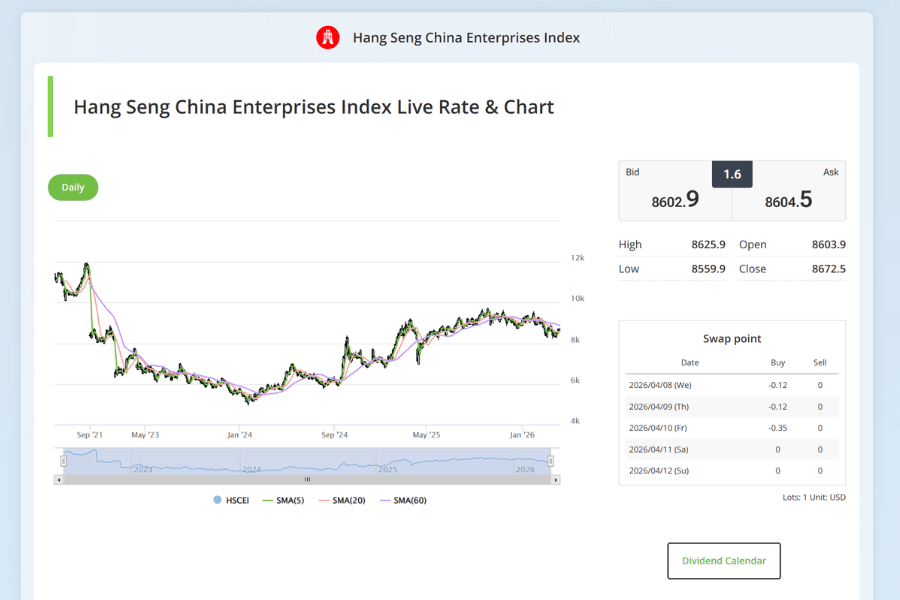
HSCEI is one of the primary channels for international investors to access the Chinese economy. Since these companies trade in Hong Kong dollars while their business foundations are in mainland China, the index is simultaneously influenced by Chinese economic fundamentals and international capital flows.
| Item | Details |
|---|---|
| Official Name | Hang Seng China Enterprises Index |
| Trading Symbol | HSCEI (CFD) |
| Launch Date | August 8, 1994 |
| Index Compiler | Hang Seng Indexes Company Limited |
| Weighting Method | Free-float market capitalization weighted |
| Constituent Source | H-share companies listed on the HKEX Main Board |
| Review Frequency | Quarterly (March, June, September, December) |
HSCEI uses a free-float market capitalization weighting methodology, calculating weights based on each constituent's free-float shares (excluding locked-up shares held by major shareholders and governments) multiplied by share price. Individual constituent weight caps are imposed to prevent any single company from having an outsized impact on the index. Quarterly reviews add or remove constituents based on market capitalization rankings and liquidity criteria, ensuring the index continues to reflect overall H-share market performance.
Compared to the Hang Seng Index (HK50), HSCEI focuses exclusively on companies with mainland Chinese backgrounds and excludes local Hong Kong companies and red-chip stocks. Compared to the FTSE China A50 Index (CN50), HSCEI tracks Chinese companies listed in Hong Kong, while CN50 tracks companies listed on the Shanghai and Shenzhen A-share markets.
2. Methodology and Constituents
HSCEI constituent selection requires listing on the HKEX Main Board, with priority given to market capitalization and liquidity, while also considering sector distribution and financial stability. Below are the major sector allocations and representative companies:
Financials
Financial stocks carry the largest weight in HSCEI, comprising major state-owned banks and insurance companies:
| Company | Code | Subsector |
|---|---|---|
| China Construction Bank | 0939.HK | Commercial Banking |
| ICBC | 1398.HK | Commercial Banking |
| Bank of China | 3988.HK | Commercial Banking |
| Ping An Insurance | 2318.HK | Insurance/Financial Services |
| China Merchants Bank | 3968.HK | Commercial Banking |
Energy
China's three major state-owned oil companies are all significant HSCEI constituents:
| Company | Code | Subsector |
|---|---|---|
| PetroChina | 0857.HK | Oil Exploration/Refining |
| Sinopec | 0386.HK | Oil Refining/Marketing |
| CNOOC | 0883.HK | Offshore Oil Exploration |
Technology and Consumer
In recent years, technology and consumer stocks have been gaining weight through index adjustments. In 2025, benefiting from growth trends in new energy and technology industries, Xiaomi's weight continues to rise:
| Company | Code | Subsector |
|---|---|---|
| Tencent Holdings | 0700.HK | Internet/Gaming |
| Lenovo Group | 0992.HK | PC/Servers |
| Xiaomi Corporation | 1810.HK | Consumer Electronics/IoT/NEV |
Telecommunications
| Company | Code | Subsector |
|---|---|---|
| China Mobile | 0941.HK | Mobile Telecom |
| China Unicom | 0762.HK | Mobile Telecom |
| China Telecom | 0728.HK | Fixed-line/Mobile Telecom |
Industrials and Infrastructure
| Company | Code | Subsector |
|---|---|---|
| China Communications Construction | 1800.HK | Transport Infrastructure |
| CRRC Times Electric | 3898.HK | Railway Equipment |
| Chalco | 2600.HK | Non-ferrous Metals |
Real Estate
| Company | Code | Subsector |
|---|---|---|
| China Overseas Land & Investment | 0688.HK | Property Development |
| China Resources Land | 1109.HK | Property Development |
| Country Garden Holdings | 2007.HK | Property Development |
Sector Composition Characteristics
HSCEI's sector composition differs significantly from US technology-dominated indices. Financial and energy stocks carry higher weights, reflecting the characteristics of China's state-owned economy. However, in recent years, adjustments to the compilation methodology have gradually increased the weights of technology and consumer sectors, enabling the index to better reflect China's economic transformation.
This sector distribution means HSCEI has notable sensitivity to Chinese monetary policy (bank stocks), international oil prices (energy stocks), and China's consumption upgrade trend (technology/consumer stocks).
3. Key Price Drivers
1. Macroeconomics and the Global Environment
HSCEI constituents are rooted in mainland China, making Chinese macroeconomic data the most direct driver. China's GDP growth rate reached 5.2% year-on-year in Q1 2025, maintaining a steady growth trajectory.
-
China GDP Growth Rate: Economic growth is the core indicator affecting corporate earnings expectations; GDP beats typically drive the index higher
-
China CPI (Consumer Price Index): Inflation data influences the PBOC's monetary policy stance, which in turn affects bank stocks and overall market liquidity
-
China Manufacturing PMI: As a leading economic indicator, PMI readings above the 50 expansion/contraction threshold are typically positive for HSCEI
-
China Trade Balance: Reflects China's export competitiveness and global demand conditions, with significant impact on energy and industrial constituents
On the international front, changes in US-China trade relations have profound effects on HSCEI. In May 2025, the US and China reached a 90-day tariff suspension agreement, temporarily easing concerns about trade conflict escalation, but long-term uncertainty remains.
2. Policy and Regulation
Chinese government economic policies have deep implications for HSCEI:
-
Monetary Policy: PBOC adjustments to the Reserve Requirement Ratio (RRR) and Loan Prime Rate (LPR) directly affect bank stock earnings and market liquidity
-
Fiscal Stimulus: Infrastructure investment plans benefit industrial and construction stocks, while consumer subsidy policies boost consumption-related sectors. In 2025, the Chinese government extended new energy vehicle purchase subsidies, further driving related supply chains
-
Sector Regulation: Changes in regulation of technology platforms, real estate, and the financial industry can trigger sharp short-term volatility
-
SOE Reform: Central government SOE reform initiatives (such as the "valuation system with Chinese characteristics") may drive revaluation of state-owned enterprise stocks
-
Hong Kong SFC Regulation: Changes to HKEX listing rules and trading systems also affect the H-share trading environment and market liquidity
3. Sector and Market Dynamics
-
Financials: Net interest margin changes and NPL ratio trends at state-owned banks directly impact the performance of HSCEI's largest-weighted sector
-
Energy: International oil price movements directly affect PetroChina, Sinopec, and CNOOC earnings. OPEC production decisions and global energy transition trends are key observation points
-
Real Estate: China's property cycle has cascading effects on bank asset quality and related supply chains
-
Technology Trends: AI, 5G, new energy, and other technology themes have significant implications for the valuations of technology constituents like Tencent and Xiaomi
-
Market Sentiment: The Hong Kong market has a degree of correlation with US equities, and HSCEI tends to be affected when US stocks experience significant volatility
4. Corporate Fundamentals and Exchange Rates
-
Earnings Season: During interim results (August-September) and annual results (March-April) reporting periods, index volatility typically increases
-
M&A and Restructuring: Mergers and restructurings among SOEs can generate significant volatility at both the individual stock and sector level
-
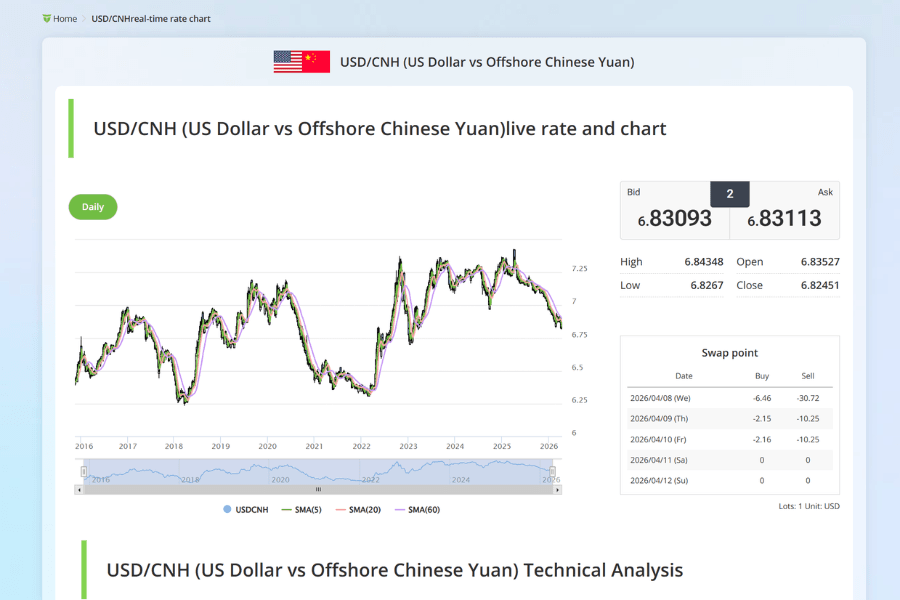
RMB/USD Exchange Rate: H-shares are priced in HKD but corporate earnings are denominated in RMB, so RMB depreciation compresses HKD-denominated earnings, while appreciation is supportive. Since the HKD operates under a linked exchange rate system with the USD, the USD/Offshore RMB (USDCNH) rate is a key exchange rate indicator affecting H-share valuations
- Dividend Policy: State-owned banks and energy companies typically pay stable dividends, and changes in dividend yields affect valuation attractiveness
5. Capital Flows
-
Southbound Capital (Stock Connect): Capital flows from mainland Chinese investors purchasing H-shares through Shanghai-Hong Kong and Shenzhen-Hong Kong Stock Connect programs are an important marginal force affecting HSCEI. Large-scale net southbound inflows typically accompany index rallies
-
Global Capital Allocation: Changes in global funds' allocation to Chinese assets (overweight/underweight), particularly MSCI Emerging Markets Index weight adjustments, generate passive capital flows
-
Short Selling: The Hong Kong market permits short selling, and short-selling pressure can amplify downside moves when market sentiment deteriorates
Use Titan FX's Economic Calendar and China Economic Indicators page to track key data releases and market expectations in real time.
4. Index Comparison and Investment Focus
HSCEI vs HSI vs CSI 300
| Item | HSCEI (H-Share Index) | HSI (Hang Seng Index) | CSI 300 |
|---|---|---|---|
| Tracking Scope | H-shares listed on HKEX | Top 80 companies on HKEX | Top 300 Shanghai/Shenzhen A-shares |
| Constituent Origin | Mainland China-registered companies | HK + China + International | Mainland China A-share companies |
| Trading Currency | HKD | HKD | RMB |
| International Access | Fully open | Fully open | Via Stock Connect/QFII |
| Sector Characteristics | Higher financial + energy weighting | Relatively balanced | Balanced tech + consumer + financial |
| Volatility | High | Medium-high | Medium |
| Titan FX Symbol | HSCEI | HK50 | CN50 |
Investment Strategy Focus
-
Economic Cycle Assessment: HSCEI is highly sensitive to China's economic cycle. During recovery phases, financial and energy sectors tend to benefit first; during structural transformation periods, technology and consumer sectors may outperform
-
Policy Catalyst Capture: Chinese government industry support policies often create sector-level investment opportunities. For example, continued NEV subsidies benefit related supply chains, while the "Chinese characteristics valuation" concept may drive SOE revaluation
-
Risk Management: HSCEI is significantly influenced by policy and geopolitical factors; strict stop-loss discipline and avoiding excessive one-directional exposure are essential when trading
-
Capital Flow Tracking: The scale and direction of southbound capital is an important reference for short-term trend assessment. Sustained net inflows typically support index performance
5. How to Trade HSCEI on Titan FX
On the Titan FX platform, the H-Share Enterprises Index trades under the HSCEI symbol, available on MT4 and MT5 platforms as a CFD (Contract for Difference) with up to 500x leverage. You can also use WebTrader to trade directly in your browser.
Step 1: Log In to Your Trading Account
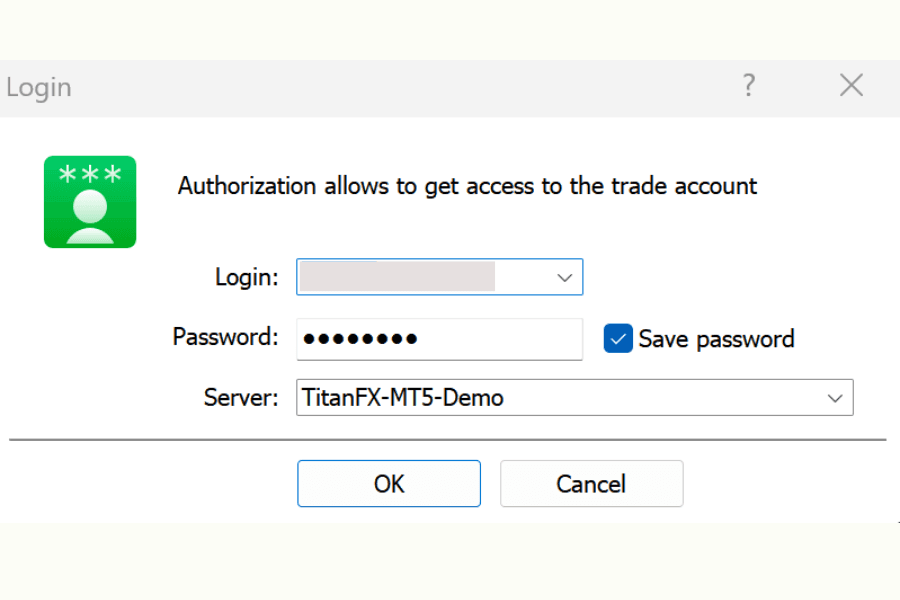
Open a Titan FX trading account (Zero Standard or Zero Blade) and complete your deposit. Download the MT4 or MT5 platform and log in with your account credentials.
Step 2: Add HSCEI Quote
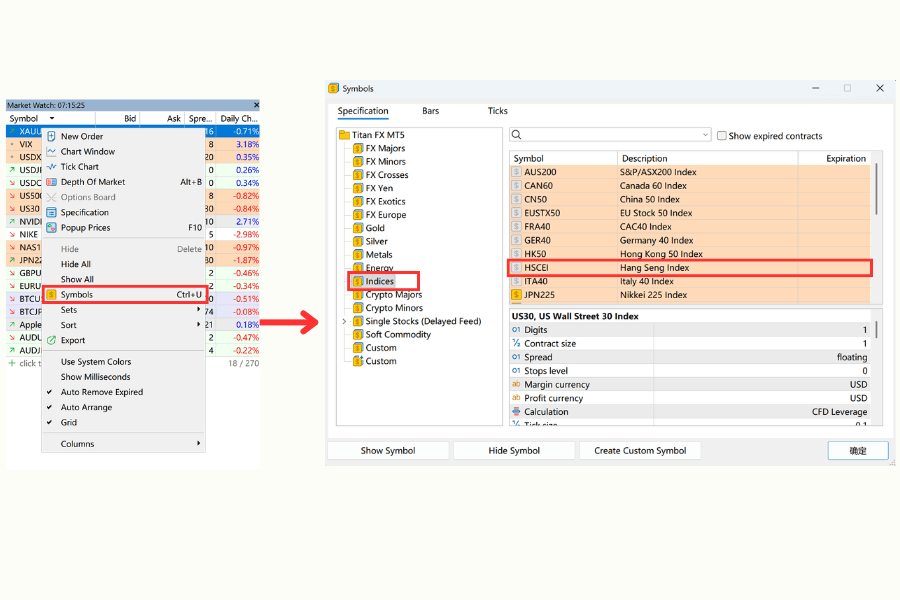
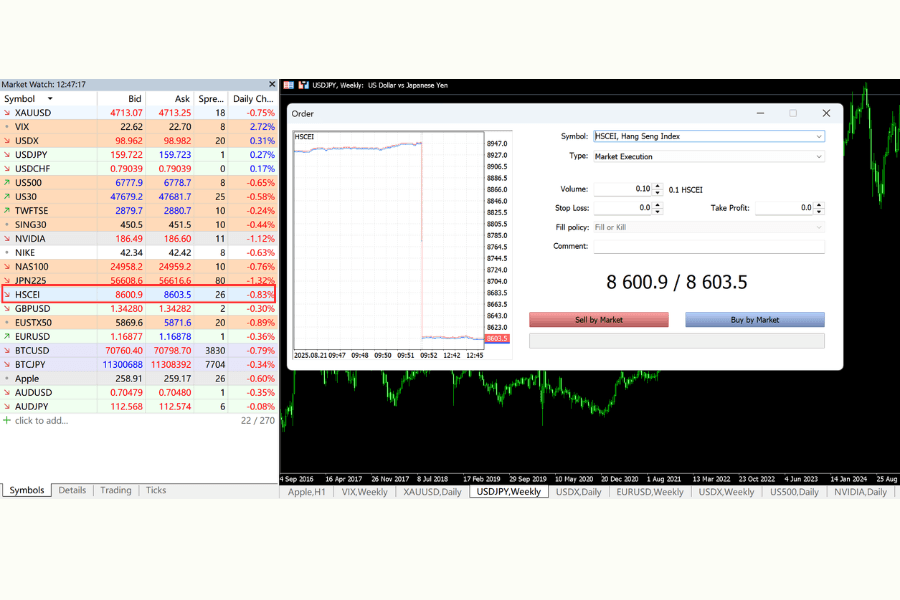
Right-click in the Market Watch window and select "Symbols." Expand the "Indices" category, find HSCEI, and double-click to add it to your quote list.
Step 3: Start Trading
Double-click the HSCEI quote or open a chart to access the order window. Enter the lot size (minimum 0.1 lots), select buy or sell direction, set stop-loss and take-profit levels, and execute your trade.
Trading Hours
HSCEI trading hours are divided into three sessions, corresponding to Hong Kong Stock Exchange trading hours:
| Session | Server Time (GMT+3) | Hong Kong Time (GMT+8) |
|---|---|---|
| Session 1 | 04:15 - 07:00 | 09:15 - 12:00 |
| Session 2 | 08:00 - 11:30 | 13:00 - 16:30 |
| Session 3 | 12:15 - 22:00 | 17:15 - 03:00 next day |
Sessions 1 and 2 cover the Hong Kong market's morning and afternoon trading sessions, offering the highest liquidity. Session 3 is after-hours trading with relatively lower volatility, though it can still be affected by international market news.
Titan FX Analysis Tools
Titan FX provides a comprehensive suite of analysis tools to help traders assess HSCEI's technical conditions:
- Support & Resistance: Identify key HSCEI levels and assess breakout or reversal potential
- Order Book (Position Info): Observe other traders' pending order distribution and long/short ratios
- Trend Analysis: Determine whether HSCEI is in an uptrend, downtrend, or range
- RSI Analysis: Identify overbought or oversold conditions to assist with reversal timing
- Volatility Heatmap: Understand HSCEI's volatility patterns across trading sessions
- Percentage Change Ranking: Compare HSCEI's real-time performance against other indices
- Swap Calendar: Check HSCEI overnight interest rates
- Dividend Calendar: Track ex-dividend impacts on CFD accounts
- Margin Calculator: Calculate required margin and appropriate position sizes
For the latest trading conditions and spreads, visit the official page.
For real-time prices and the latest trading conditions, see the HSCEI instrument page.
Start Trading the HSCEI Index
Trade HSCEI CFDs on Titan FX with up to 500x leverage, low spreads, and flexible long/short positioning. Zero Standard and Zero Blade accounts support index CFD trading (Zero Micro accounts do not support index CFDs).
6. FAQ
Q1. Is HSCEI suitable for long-term investment?
HSCEI constituents are predominantly large Chinese state-owned enterprises that typically offer stable cash flows and relatively high dividend yields, providing some long-term allocation value from an income perspective. However, H-share market valuations are influenced by multiple factors including policy cycles, international capital flows, and geopolitical risks, which can lead to significant price volatility. Long-term investors need a clear view of China's structural economic trends and should be prepared for periodic drawdowns. For CFD traders, capturing medium- to short-term swing opportunities tends to be a more suitable approach.
Q2. What are the main risks of trading HSCEI?
Key risks include: policy risk (Chinese government regulatory and economic policy changes can trigger sharp volatility), exchange rate risk (RMB fluctuations against HKD and USD affect corporate earnings and valuations), international capital outflow risk (global risk-off sentiment can drive capital out of the Hong Kong stock market), and US-China trade uncertainty (while the 2025 90-day tariff suspension provided temporary relief, the long-term trajectory remains unclear). The segmented trading hours also mean that news during market closures can lead to gap openings.
Q3. Can I practice trading HSCEI on a demo account?
Yes. Titan FX offers a free demo account that includes the same trading environment and real-time pricing as live accounts. We recommend that beginners familiarize themselves with HSCEI's volatility characteristics, three-session trading hours, and leverage effects on a demo account before committing real capital.
7. Summary
HSCEI serves as a vital bridge connecting the Chinese economy with global capital markets, bringing together China's leading companies in finance, energy, technology, and telecommunications. In 2025, China continues to advance in financial stability, technological self-reliance, and new energy industry expansion, and these trends are reflected in HSCEI's movements.
Understanding Chinese macro policy direction, tracking RMB exchange rate dynamics and international capital flows, and utilizing technical analysis tools to identify entry and exit timing form the essential framework for trading HSCEI.
Use Titan FX's HSCEI real-time quote and chart page to monitor market conditions, and refer to the CN50 (FTSE China A50 Index) trading guide to explore more China-related index trading strategies.
Further Reading
Titan FX Trade Strategy Research Lab covers forex (FX), commodities (oil, precious metals, agricultural products), stock indices, U.S. equities, and crypto assets, producing educational content for retail investors across asset classes.
Primary Sources (by Category)
- Official Data: Hang Seng Indexes Company
- Market Analysis: Hong Kong and China market analysis from Bloomberg, Reuters, and other financial media