

What Is the FTSE China A50 Index (CN50)? Components & Trading Guide
CN50 is the flagship international index tracking the performance of China's A-share market. Compiled by FTSE Russell in 2003, it comprises the 50 largest A-share companies listed on the Shanghai and Shenzhen stock exchanges. From ICBC and Kweichow Moutai to Ping An Insurance, these constituents represent the most competitive core enterprises in the Chinese economy.
For CFD traders, CN50 offers the most direct international channel for accessing the China A-share market. The index is driven by multiple factors including China's macroeconomic policy, industrial restructuring, RMB exchange rates, and international capital flows, providing abundant trading opportunities. This article provides a comprehensive analysis of CN50's trading logic, covering the index definition, constituents, price drivers, and practical trading methods.
What Is the FTSE China A50 Index (CN50)?
The FTSE China A50 Index is a benchmark stock market index launched in 2003 by FTSE Russell, one of the world's leading index providers. In CFD trading, the FTSE China A50 Index uses CN50 as its trading symbol.
The index selects the 50 largest and most liquid companies from A-shares listed on the Shanghai Stock Exchange and Shenzhen Stock Exchange, making it one of the most important benchmark indices for international investors seeking exposure to China's A-share market.
| Item | Details |
|---|---|
| Official Name | FTSE China A50 Index |
| Trading Symbol | CN50 (CFD) |
| Launch Date | 2003 |
| Index Provider | FTSE Russell |
| Weighting Method | Free-float market capitalization weighted |
| Number of Constituents | 50 |
| Review Frequency | Quarterly (March, June, September, December) |
All A50 Index constituents are sourced from China's mainland A-share market and denominated in Chinese yuan (RMB). Unlike the Hang Seng Index (HK50), which tracks companies listed on the Hong Kong Stock Exchange, CN50 tracks core blue-chip stocks listed on mainland Chinese exchanges, directly reflecting the performance of the A-share market.
Compared to the Hang Seng China Enterprises Index (HSCEI), which tracks H-shares (mainland Chinese companies listed in Hong Kong), CN50 tracks A-share companies listed directly on mainland exchanges. The two indices differ significantly in terms of market environment, regulatory framework, and investor composition.
Index Methodology and Constituents
Constituent Selection Criteria
The A50 Index applies strict screening criteria for constituent selection:
| Criterion | Description |
|---|---|
| Listing Venue | Limited to companies listed on the Shanghai or Shenzhen A-share markets |
| Free-Float Market Cap | Ranked by free-float market capitalization; top 50 selected |
| Liquidity Requirements | Must meet minimum trading volume and frequency thresholds |
| Investability | Must be accessible to international investors (Stock Connect eligible) |
| Quarterly Review | Constituent adjustments in March, June, September, and December |
Representative Constituents by Sector
The A50 Index covers the core sectors of the Chinese economy. Below are representative companies by industry:
Financials
Financial stocks carry the largest weighting in CN50:
| Company | Sub-Sector |
|---|---|
| Industrial and Commercial Bank of China (ICBC) | Commercial Banking |
| China Construction Bank | Commercial Banking |
| Ping An Insurance | Insurance / Financial Services |
Energy and Resources
| Company | Sub-Sector |
|---|---|
| PetroChina | Oil and Gas |
| China Shenhua Energy | Coal and Energy |
Consumer and Healthcare
| Company | Sub-Sector |
|---|---|
| Kweichow Moutai | Spirits / Consumer Goods |
| Anhui Conch Cement | Building Materials |
| Shanghai Pharmaceuticals | Pharmaceuticals |
Construction and Real Estate
| Company | Sub-Sector |
|---|---|
| China Railway Construction | Infrastructure |
| Poly Developments | Real Estate |
| Vanke | Real Estate |
Technology and Manufacturing
| Company | Sub-Sector |
|---|---|
| CRRC Corporation | Rail Transit Manufacturing |
| China Unicom | Telecommunications |
| Sany Heavy Industry | Construction Machinery |
Sector Composition Characteristics
CN50's sector composition reflects the trajectory of China's economic transformation. Traditionally dominated by financial and energy stocks, the index has seen increasing weight from new energy, technology, and consumer sectors as China's economy restructures. As of 2025, new energy and technology sectors account for approximately 35% of the index, higher than the Hang Seng Index (approximately 20%) and the Hang Seng China Enterprises Index (approximately 30%), making CN50 a better reflection of China's emerging growth drivers.
Key Price Drivers
1. Macroeconomic Data and Global Developments
China's GDP growth, industrial production, consumer confidence, and other macroeconomic data directly influence the overall direction of the A-share market.
-
China GDP Growth Rate: Economic growth is the core indicator affecting corporate earnings expectations
-
China Manufacturing PMI: A leading economic indicator; PMI readings above the 50 expansion-contraction threshold are generally positive for CN50
-
China CPI (Consumer Price Index): Inflation data influences the People's Bank of China's (PBOC) monetary policy stance
On the global front, US-China trade relations, global supply chain shifts, and geopolitical events can all have a significant impact on CN50.
2. Policy and Regulatory Environment
Chinese government economic policies have a profound impact on the A-share market:
-
PBOC reserve requirement ratio (RRR) cuts and interest rate decisions directly affect market liquidity and bank stock earnings
-
State Council industrial policies (such as new energy subsidies and technology innovation support) influence specific sector performance
-
CSRC regulatory policies (such as IPO reform and margin trading regulations) affect the market trading environment
3. Industry and Market Dynamics
-
Earnings reports and performance expectations of major constituents (such as Kweichow Moutai and ICBC) have a significant impact on the index
-
Sector rotation: Policy-supported industries (new energy, semiconductors) can drive sector-wide rallies
-
Market sentiment and retail investor capital flows significantly influence short-term volatility
4. Corporate Fundamentals and Exchange Rates
Constituent companies' profitability, dividend policies, and business expansion directly affect index performance. Additionally, RMB exchange rate fluctuations are an important factor for CN50 -- depreciation pressure may reduce foreign capital allocation to A-shares, while RMB appreciation tends to attract international capital inflows.
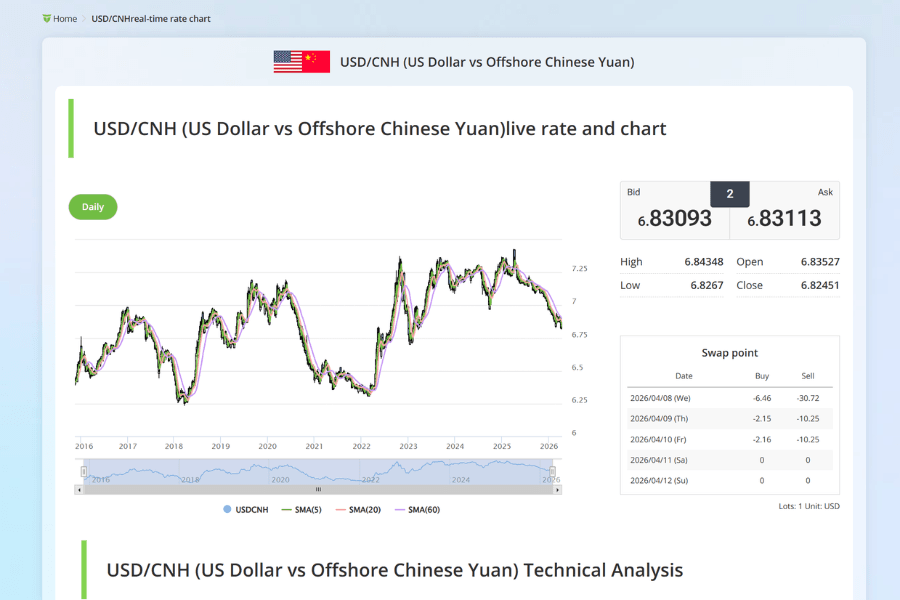
Since the Hong Kong dollar operates under a linked exchange rate system with the US dollar, the USD/CNH (US Dollar vs Offshore Chinese Yuan) exchange rate is an important reference for gauging international capital allocation sentiment toward Chinese assets.
5. Capital Flows
-
Northbound capital (international funds flowing into A-shares via Stock Connect) is an important marginal force influencing CN50
-
Changes in QFII/RQFII (Qualified Foreign Institutional Investor) holdings reflect international institutional confidence in the Chinese market
-
A-share margin trading balances serve as a key reference for assessing market leverage levels
Use Titan FX's Economic Calendar and China Economic Indicators page to track the release times and market expectations of these key data points in real time.
Index Comparison and Trading Strategies
CN50 vs HSI vs HSCEI
| Item | CN50 (FTSE China A50) | HSI (Hang Seng Index) | HSCEI (H-Share Index) |
|---|---|---|---|
| Constituent Scope | Top 50 Shanghai/Shenzhen A-shares | 80+ largest companies on HKEX | China H-shares listed on HKEX |
| Regulatory Framework | CSRC; regulatory system under continuous development | SFC (Hong Kong); transparent disclosure regime | International regulatory system; preferred by foreign investors |
| New Energy & Tech Weighting (2025) | ~35%; new energy + AI as key pillars | ~20%; tech allocation increasing annually | ~30%; new economy share rising |
| Trading Currency | RMB | HKD | HKD |
| International Capital Access | Via Stock Connect / QFII | Fully open | Fully open |
| Volatility | Medium | Medium-High | High |
| Titan FX Symbol | CN50 | HK50 | HSCEI |
Key Trading Strategy Considerations
-
High policy sensitivity: CN50 reacts most directly to Chinese government economic policies. Monitor PBOC RRR cuts and rate decisions, State Council stimulus packages, and industrial policy changes
-
Sector rotation: Rotation among financials, energy, consumer, and technology sectors is pronounced. Policy-favored industries (new energy, semiconductors) often drive index breakouts
-
Currency correlation: When the RMB weakens, northbound capital may decrease, pressuring CN50; when the RMB strengthens, returning international capital supports the index
-
Global market correlation: Although the A-share market is relatively independent, global risk events (such as Fed rate hikes and geopolitical conflicts) still affect CN50 through sentiment and capital flow channels
How to Trade CN50 on Titan FX
On the Titan FX platform, the FTSE China A50 Index is traded under the symbol CN50, available on both MT4 and MT5 platforms via CFD (Contract for Difference) with leverage up to 500:1. You can also trade using WebTrader directly in your browser.
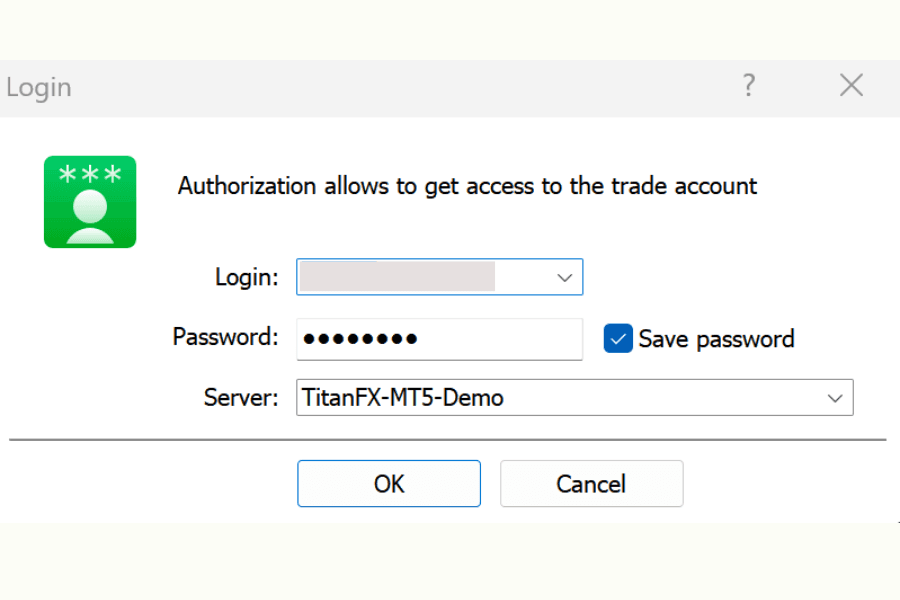
Step 1: Log In to Your Trading Account
Open a Titan FX trading account (Zero Standard or Zero Blade), complete your deposit, then download the MT4 or MT5 platform and log in with your credentials.
Step 2: Add CN50 to Market Watch
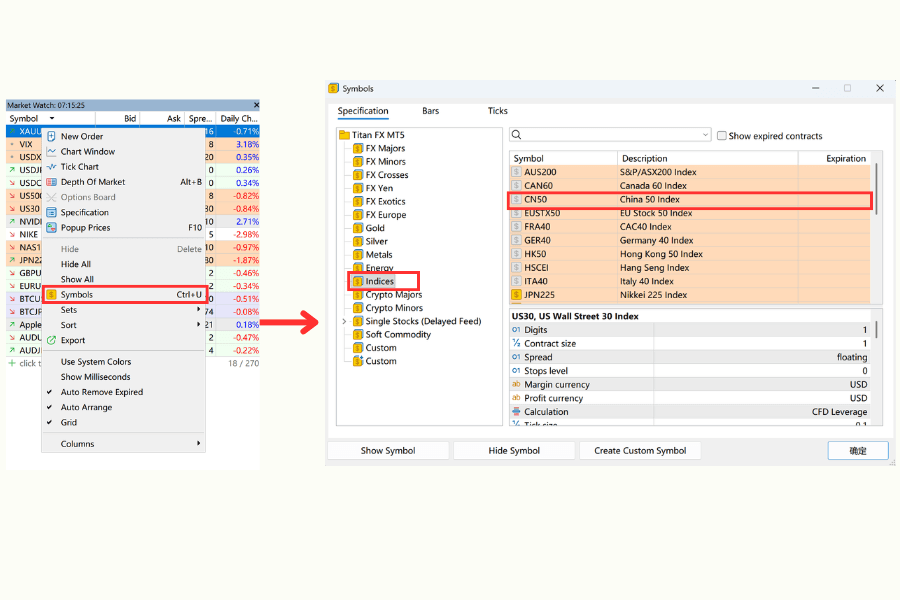
Right-click in the Market Watch window, select "Symbols," expand the "Indices" category, find CN50 (China 50 Index), and double-click to add it to your quote list.
Step 3: Place a Trade
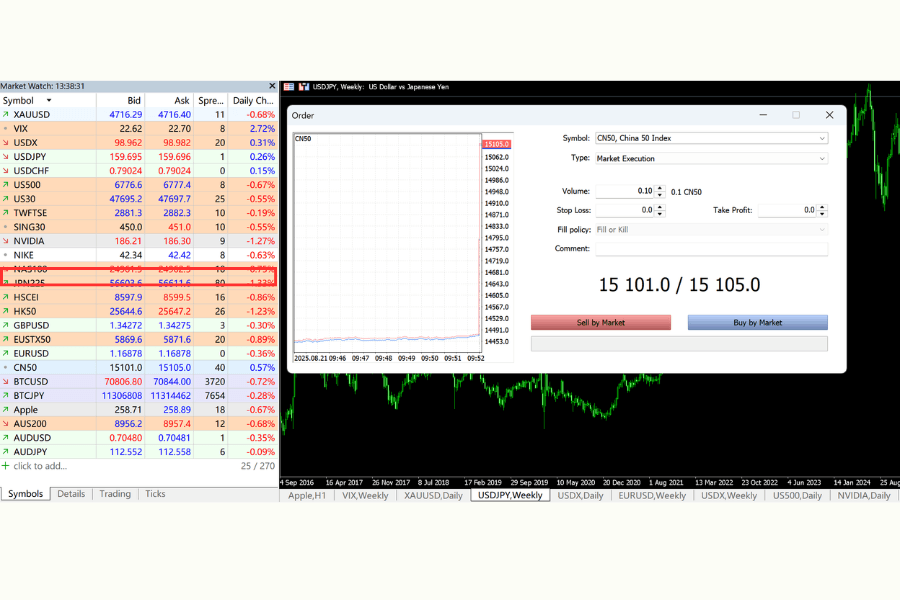
Double-click the CN50 quote or open a chart to access the order window. Enter your lot size (minimum 0.01 lots), select Buy or Sell, set your stop loss and take profit, and execute the trade.
Titan FX offers a free demo account, allowing you to familiarize yourself with CN50 trading procedures and platform operations in a risk-free environment.
Trading Hours
CN50 trading hours are divided into two sessions:
| Time Zone | Standard Time (GMT+2) | Daylight Saving Time (GMT+3) |
|---|---|---|
| MT4/MT5 Server | 03:00-10:30, 11:00-23:00 | 04:00-11:30, 12:00-23:59 |
| Eastern Time (ET) | 21:00-04:30, 05:00-17:00 | 22:00-05:30, 06:00-17:59 |
| Taiwan / Hong Kong / Beijing (GMT+8) | 09:00-16:30, 17:00-05:00 next day | 09:00-16:30, 17:00-05:59 next day |
| Japan (GMT+9) | 10:00-17:30, 18:00-06:00 next day | 10:00-17:30, 18:00-06:59 next day |
The first session covers China A-share trading hours and offers the highest liquidity. The second session extends into international market hours, where volatility may be influenced by global news.
Titan FX Analysis Tools
Titan FX provides a range of analysis tools to help traders assess CN50's technical outlook:
- Support and Resistance: Identify key CN50 price levels to assess breakout or reversal potential
- Order Book (Position Information): Observe other traders' pending order distribution and long/short ratios
- Trend Analysis: Determine whether CN50 is in an uptrend, downtrend, or consolidation phase
- RSI Analysis: Identify overbought or oversold conditions to support reversal timing decisions
- Volatility Heatmap: Understand CN50's volatility patterns across different trading sessions
- Percentage Change Ranking: Compare CN50's real-time performance against other indices
- Swap Calendar: Check CN50 overnight financing rates
- Dividend Calendar: Track the impact of constituent ex-dividend dates on CFD accounts
- Margin Calculator: Calculate required margin and appropriate position sizing
For the latest trading conditions and spreads, please refer to the official page.
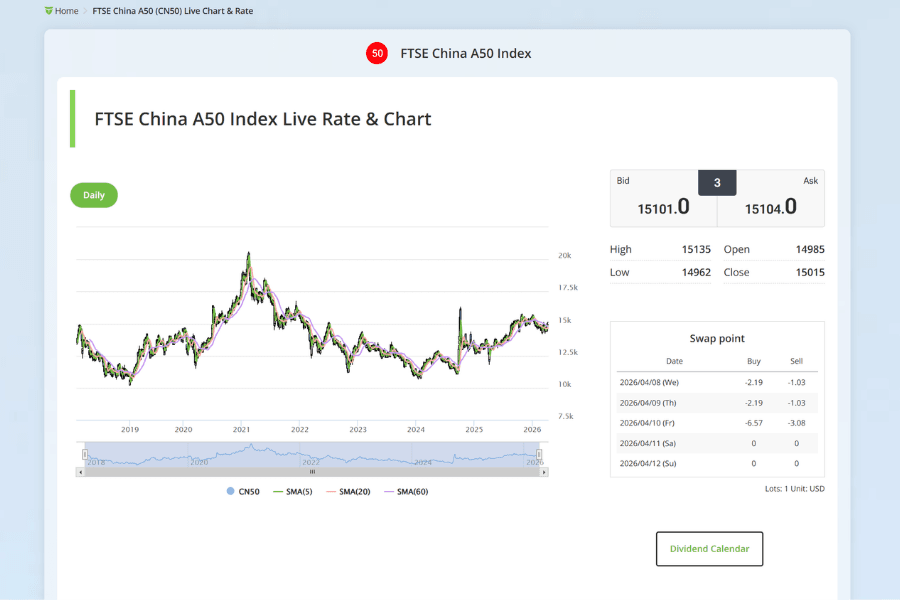
For the latest trading conditions and live prices, see the CN50 instrument page.
Start Trading the CN50 Index
Trade CN50 CFDs with Titan FX and enjoy up to 500:1 leverage, tight spreads, and the flexibility to go long or short. Both Zero Standard and Zero Blade accounts support index CFD trading (Zero Micro accounts do not support index CFDs).
FAQ
Is CN50 suitable for long-term investing?
CN50 is suitable for both long-term investing and short-term trading. From a long-term perspective, the A50 Index constituents cover the core sectors of the Chinese economy, and the index has a foundation for long-term growth as China's economy continues to expand. However, traders should be mindful of policy risk and market volatility -- the A-share market is heavily influenced by government policy, and short-term swings can be significant. Long-term investors are advised to monitor China's economic fundamentals using the Economic Indicators page.
What are the main risks of trading CN50?
The main risks include: (1) Policy risk -- Chinese government industrial policies and regulatory changes can have a significant impact on specific sectors and the overall market; (2) Currency risk -- RMB depreciation pressure may lead to reduced foreign capital allocation to A-shares, weighing on the index; (3) Liquidity risk -- while A50 constituents are relatively liquid, liquidity may be lower during certain sessions (such as international market hours); (4) Leverage risk -- CN50 supports up to 500:1 leverage, and high-leverage trading requires strict stop-loss discipline, keeping risk per trade within 1-2% of account equity.
How does CN50 benefit from Chinese policy support?
Chinese government economic stimulus policies generally provide positive momentum for CN50. For example, PBOC RRR cuts or interest rate reductions increase market liquidity, directly benefiting financial sector constituents. Industrial policy support (such as new energy subsidies and semiconductor localization initiatives) can drive rallies in related sectors. Additionally, capital market reforms (such as the registration-based IPO system and Stock Connect expansion) help improve market efficiency and attract international capital inflows, providing long-term support for CN50 performance.
Summary
The FTSE China A50 Index (CN50) is the most important benchmark index for international investors seeking exposure to China's A-share market, bringing together core enterprises from the financial, energy, consumer, and technology sectors. As China's economy undergoes structural transformation and its capital markets continue to open up, the A50 Index's sector composition is becoming increasingly diversified, offering traders abundant opportunities.
Understanding China's macroeconomic policy direction, tracking international capital flows and RMB exchange rate dynamics, and applying technical analysis tools to time entries and exits form the fundamental framework for trading CN50.
Use Titan FX's CN50 live quotes and charts page to stay on top of market developments, and refer to the Hang Seng Index (HK50) Trading Guide and the Hang Seng China Enterprises Index (HSCEI) Trading Guide to learn more about trading strategies for China and Hong Kong market indices.