

IPO (Initial Public Offering)
Investors have two points at which to take part in an IPO: subscribe before listing and receive shares at the offer price, or buy at the market price after listing. Subscribing does not guarantee an allocation, and listing does not guarantee a rise — a new stock can soar on its first day or open straight below its offer price. Taking 2025 as an example, 119 companies listed on the Hong Kong exchange during the year and raised about HK$286 billion, returning the exchange to first place worldwide, and new listings became a hot topic among Asian investors again.
This guide explains what an IPO is, how the company and its existing shareholders each get paid, the six steps of an IPO, how the offer price is set and why first-day surges and broken IPOs happen, how to subscribe and how participation differs by market, the main risks of new listings, and the five things to check in a prospectus.
- An IPO is a company's first public sale of shares combined with a listing; the shares can be new (money goes to the company) or existing holders' shares (money goes to those shareholders)
- Six steps: underwriters → prospectus → roadshow and book building → pricing → allocation and public offering → listing; lock-ups and the greenshoe operate after listing
- The offer price is set by book building and the opening price by the market; the post-listing price can sit above or below the offer price
- Two ways to buy: subscribe before listing (no guaranteed allocation) or buy at the market price afterward (no ballot needed)
- Subscription and allocation rules differ across the US, Hong Kong, Singapore, Malaysia, Taiwan and Japan; Hong Kong introduced a new allocation regime in August 2025
- Five prospectus checks: use of proceeds and the primary/secondary split, financials and cash flow, valuation, shareholder structure and lock-ups, and risk factors
- 1. What is an IPO? How it differs from a listing
- 2. Why companies go public: primary shares, secondary shares and use of proceeds
- 3. How an IPO works: the six steps from filing to listing
- 4. How the offer price is set: first-day pops, broken IPOs and the free float
- 5. How to buy an IPO: subscribing, allocations and buying after listing
- 6. Should you buy an IPO? Five risks and five prospectus checks
- 7. FAQ: common questions about IPOs
- 8. Conclusion: an IPO is a starting point, not a destination
1. What is an IPO? How it differs from a listing
An IPO is the process by which a private company sells shares to public investors for the first time and has those shares traded on a stock exchange. Before it, the shareholders are usually a small group of founders, employees and venture investors; once the sale is complete and the shares are listed, anyone can buy and sell them in the market, and the company takes on the disclosure obligations of a listed company.
Three terms are easily confused with an IPO:
-
Listing: the state of having shares traded on an exchange. An IPO is the most common route to a listing, but a listing does not have to come through an IPO.
-
Direct listing: the company issues no new shares and raises no money through underwriters; existing shareholders' shares are simply admitted to trading. Spotify listed on the New York Stock Exchange this way in 2018.
-
SPAC listing: a "blank-check company" with no operations raises money in its own IPO and later merges with a target company, which gains a listing through the merger.
An IPO is also the first public offering. When an already-listed company issues more shares or a major holder sells down, that is a follow-on offering. Raising money only from selected investors without a public sale is a private placement.
2. Why companies go public: primary shares, secondary shares and use of proceeds
A company usually has several aims when it goes public: raising a large sum at once for expansion, research or debt repayment; giving founders, employees and early investors a public market in which to sell; retaining staff with stock options and restricted shares; and being able to use its own shares as currency for acquisitions.
The costs are just as clear. Quarterly reporting and prompt disclosure of material events raise compliance costs sharply, issuing new shares dilutes existing holders, and having a share price set by the market every day exposes management to short-term pressure.
What investors need to separate is that the shares sold in an IPO come from two sources, and the money goes to different pockets:
| Source of shares | Seller | Where the proceeds go |
|---|---|---|
| Primary shares (new shares) | The company | The company, for the uses listed in the prospectus |
| Secondary shares (existing shares) | Existing shareholders | The selling shareholders |
Take Figma in 2025: the IPO sold 36.94 million shares, of which the company issued 12.47 million new shares and existing shareholders sold 24.46 million — more than 60% of the offering was shareholders cashing out. Every prospectus sets out this split. A high secondary share is not a reason to avoid an offering, but it changes how convincing the growth story is.
3. How an IPO works: the six steps from filing to listing
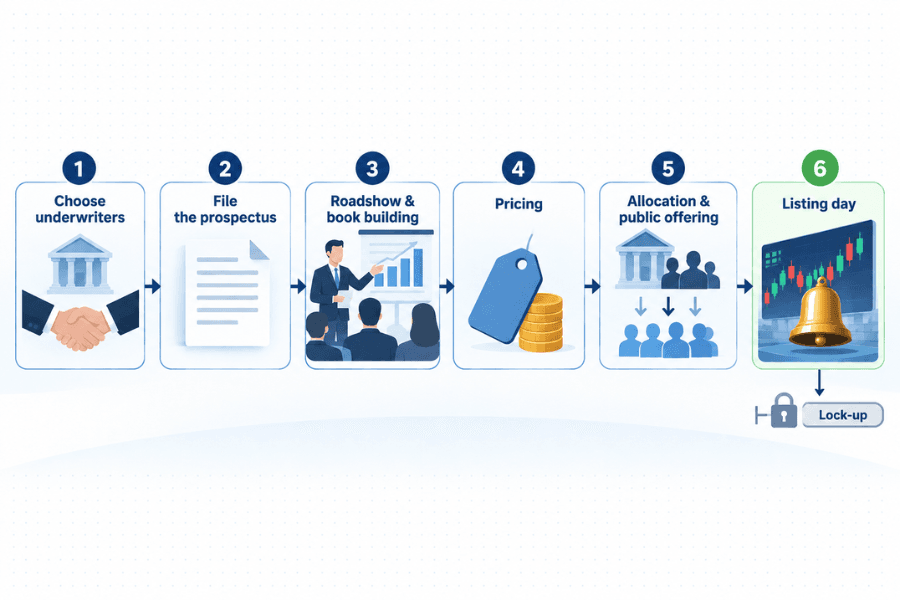
The details vary by market, but an IPO in any major market breaks down into six steps:
-
① Choose underwriters: the company appoints investment banks as underwriters to handle valuation, structure the offering, find buyers and, in most cases, commit to purchase the shares.
-
② File the prospectus: the company files its listing application with the regulator and the exchange. In the US that means a Form S-1 registration statement (F-1 for foreign companies) with the Securities and Exchange Commission (SEC); in Hong Kong and Taiwan, a prospectus. It discloses the business, financials, risk factors, use of proceeds and shareholder structure, and is the most complete document investors will get.
-
③ Roadshow and book building: the underwriters take management to institutional investors to present the company while collecting indications of what price and how many shares each would take — the book-building process.
-
④ Pricing: weighing institutional demand, market conditions, peer valuations and the size of the deal, the company and underwriters set the offer price before listing (usually the evening before trading begins in the US). Strong demand can push the price above the initial range; weak demand can cut it, shrink the deal or delay the listing.
-
⑤ Allocation and public offering: shares are allocated to institutions (placing) and to the public (subscription, often by ballot). The public share and the way it is allocated vary widely by market, as chapter 5 explains.
-
⑥ Listing day: the shares begin trading on the exchange; the first trade sets the opening price, and from then on supply and demand set the price.
What operates after listing
Lock-up: an agreement that existing shareholders and insiders will not sell for a set period after listing. Around 180 days is common in US IPOs; the actual term and any early-release conditions are set out in the offering documents.
Greenshoe (over-allotment option): a mechanism for handling over-allotment and stabilizing the price in the early days of trading. In a typical US IPO the underwriters first over-allot up to about 15% of the offering; if the price falls below the offer price after listing, they can buy shares in the market to cover the over-allotment, and that buying helps steady the price. If the price holds above the offer price, they exercise the option to take the extra shares from the company. It can provide some support early on, but it does not put a floor under the offer price.
4. How the offer price is set: first-day pops, broken IPOs and the free float
A new listing passes through four prices between pricing and trading:
| Price | When it appears | Who sets it |
|---|---|---|
| Price range | During the offer period | Company and underwriters |
| Offer price (IPO price) | Before listing | Company and underwriters, based on the book |
| Opening price | First trade on listing day | The market |
| First-day close | Close of listing day | The market |
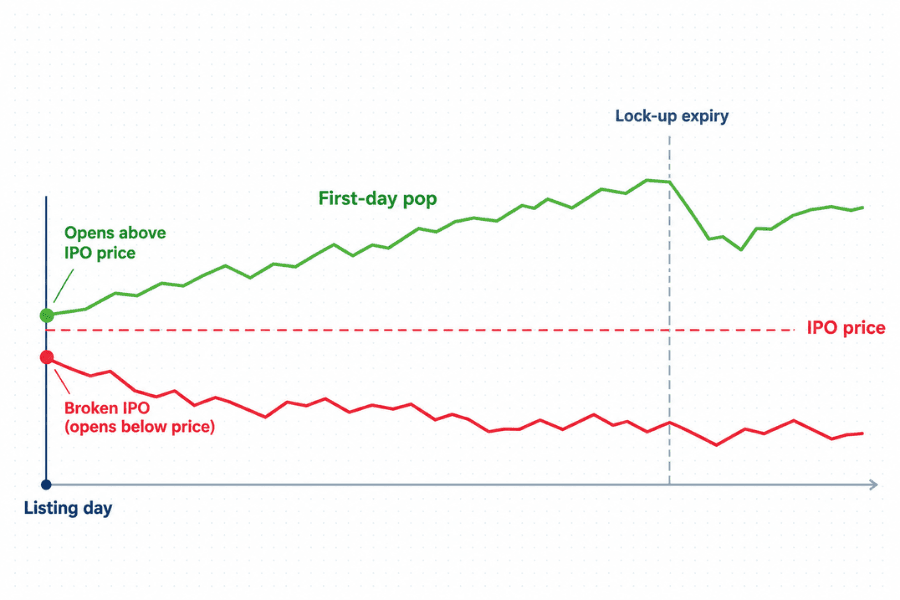
The offer price is only the subscription price set after book building; it does not represent fair value, and the stock can fall through it at any time after listing. Underwriters generally want the company to raise a reasonable sum and the shares to trade healthily afterward, so they may leave some discount in the price; but whether the stock rises or falls after listing depends on final demand, market conditions, the supply of tradable shares and valuation.
A first-day pop: Figma
A discount in the pricing is one reason a stock may rise on day one; when a limited offering meets strong subscription demand and rising risk appetite, the gap between offer price and opening price widens further. Figma in 2025 priced at $33 and closed its first day on the New York Stock Exchange at $115.50.
A broken IPO: Uber
When the price is set too high, the market turns, or investors doubt the company's growth, a stock can fall below its offer price on the first day — a "broken IPO". Uber listed at $45 a share in 2019 and closed its first day at $41.57. For investors who bought at the offer price, a broken IPO is an immediate paper loss.
Why the free float affects how a new stock trades
A company's total shares after listing are not the same as the number that can be freely traded on day one. Shares held by founders, employees and early investors (and cornerstone investors in Hong Kong) may be locked up, so the free float that actually reaches the market in the early days is often only part of the share count. When the float is small and demand is strong, the price moves violently; when the lock-up expires, the number of sellable shares jumps, and if the original holders' cost is far below the market price, selling pressure often follows. The free-float percentage and lock-up terms in the prospectus are required reading for anyone holding a new listing.
5. How to buy an IPO: subscribing, allocations and buying after listing
There are two points at which to buy an IPO: subscribe before listing and receive shares at the offer price, or buy at the market price after listing. The first does not guarantee an allocation; the second needs no ballot, but the price may already be above the offer price.
In the United States, IPO shares are allocated mainly to institutions by the underwriting syndicate. Some brokers offer retail clients access to new issues, but allocations are limited and not guaranteed, so most individual investors buy after the stock starts trading, when the first price they can get is often the opening price. Brokers that do allocate IPO shares to retail clients may also restrict selling them within a short period after listing, so check the terms before subscribing.
Retail subscription rules differ widely elsewhere:
| Market | How retail investors usually take part | Allocation | Notes |
|---|---|---|---|
| Hong Kong | Public offer through a broker or bank | By subscription multiple and allocation mechanism | Margin financing can enlarge an application; grey-market trading the evening before listing |
| Singapore | Applications through participating banks' ATMs, internet banking or brokers | Deal-by-deal rules; ballot when oversubscribed | The public tranche varies by deal |
| Malaysia | Applications through banks, brokers or designated platforms | Deal-by-deal rules; ballot when oversubscribed | The public tranche varies by deal |
| Taiwan | Public subscription through a broker | Ballot when oversubscribed | Some deals use a competitive auction instead |
| Japan | Book-building demand indications and purchase applications through participating brokers | Broker-by-broker lotteries or discretionary allocation | Lead underwriters hold the largest allotments; allotted shares can be sold from listing day |
Hong Kong changed its allocation regime from August 4, 2025: at least 40% of a new issue must go to the institutional book-building tranche, and for the public offer the issuer can choose either "5% initially, clawed back to a maximum of 35% depending on oversubscription" or "a fixed 10% to 60% with no clawback". For retail investors, the practical effect is that the share of a hot new issue available through the public offer may be lower than before.
Shares won in a ballot or allocated can be sold under the market's rules once they land in the account on listing day; those who miss out can buy in the market after listing at the market price. Overseas IPOs follow the same two routes: brokers in most regions offer subscription services for US and Hong Kong new issues, and you can also open an overseas brokerage account and apply directly. Chinese companies listed in the US carry the separate questions of the ADR and VIE structure, explained in full in our guide to Chinese ADRs.
After listing, if a broker adds the stock to its product range, it can also be traded long or short with a contract for difference (CFD) without holding the shares; Uber is one of the US stocks on which Titan FX offers a CFD. A CFD cannot take part in the offer-price subscription and there is no such thing as a "CFD allocation" — it can only be traded once the stock is listed and added as a product — and because it is traded on margin with overnight financing, position size deserves particular care while a new listing is volatile.
6. Should you buy an IPO? Five risks and five prospectus checks
A new listing has no public trading history, so line up the risks before taking part:
| Risk | What it means |
|---|---|
| Pricing risk | The offer price may be above a reasonable valuation |
| Broken-IPO risk | The stock may fall through the offer price right after listing |
| Float risk | A small free float makes the price prone to violent swings |
| Lock-up expiry risk | Supply jumps once the lock-up ends |
| Information risk | No long public record of financials or prices; the prospectus is almost the only evidence |
The five things to check in the prospectus:
-
Use of proceeds and the primary/secondary split: whether the money is going into research and expansion, or into repaying debt and letting old shareholders out.
-
Revenue, profit and cash flow: revenue growth, gross margin, whether the company is profitable, and whether operating cash flow is positive or negative. The financial section reads the same way as any set of financial statements, except that the history usually covers only two or three years.
-
Valuation against peers: take the market capitalization implied by the offer price, divide by earnings or revenue for a P/E ratio or price-to-sales ratio, and compare with listed peers. New listings often carry a premium, and whether it is justified is your call.
-
Shareholder structure, free float and lock-ups: the founders' and venture investors' stakes, the length of the lock-up and how many shares are released at expiry determine the supply pressure in the months after listing. Hong Kong new issues also disclose the cornerstone investors, their subscription amounts and their lock-ups.
-
Risk factors and governance: the risk-factors section lists the material risks the company itself identifies, and weighted voting rights, related-party transactions and controlling shareholders are disclosed here too.
Then add your own position control: keep any single new listing to a small part of your total capital, use only spare funds for subscriptions that may be tied up, and before chasing a stock after listing, check where the opening price sits relative to the offer price and peer valuations.
7. FAQ: common questions about IPOs
Q1: What is the difference between an IPO and a listing?
A listing is the state of having shares traded on an exchange; an IPO is the most common way of getting there. A direct listing or a SPAC merger can also make a company listed, without going through an IPO's public offering process.
Q2: If I miss out on an allocation, can I buy on the first day?
Yes — buy in the market after listing, the difference being that you pay the market price rather than the offer price. First-day prices often sit far from the offer price, so check the valuation before chasing; in Hong Kong, the grey-market price the evening before listing is a useful reference.
Q3: When can I sell shares I was allocated?
Once the shares land in your account on listing day, you can sell them under the local market's rules; retail investors in Hong Kong, Taiwan and Japan can usually trade on the listing day itself. Some US brokers restrict selling shares allocated through them at the offer price for a short period after listing, so check the broker's rules before subscribing.
Q4: What is a broken IPO, and does the stock keep falling afterward?
A broken IPO is a stock trading below its offer price after listing, which means the market did not accept the offer price — because it was set too high, the market turned, or there are doubts about the business. A broken IPO does not necessarily keep falling, nor does it necessarily recover to the offer price; the greenshoe may provide early support, but only for a limited time. Whether to hold on comes back to the prospectus: is it a market problem, or a valuation or business problem?
Q5: Does the stock always fall when the lock-up expires?
Not necessarily. Expiry only allows existing holders to sell; whether they sell, and how much, depends on their cost and their view of the company. But the number of sellable shares jumps at once, and in a new listing with a small float the selling pressure usually shows. Anyone holding a new listing should note the expiry date.
8. Conclusion: an IPO is a starting point, not a destination
An IPO is the moment a company hands its shares to the public market to be priced. The offer price is set by the underwriters after book building and may carry a discount, but every price after the opening is set by the market, and the gap between the two produces the first-day pops and broken IPOs. The free float, lock-ups and the greenshoe determine supply and support in the months after listing, and each market's subscription rules determine whether investors can buy at the offer price at all.
For an investor, an IPO is only the start of a company's public life. The use of proceeds, the primary/secondary split, the financials, the valuation and the shareholder structure in the prospectus say more about whether the stock is worth holding than the first-day gain does. Put capital and position control first, before subscribing or chasing, and a new listing stays an opportunity instead of turning into a trap.
Further Reading
- What is NASDAQ?
- What Is a Unicorn Company? Definition, Traits, and Famous Global Examples
- The Three Major U.S. Stock Exchanges: NYSE, NASDAQ, and AMEX (NYSE MKT)
- What Are Growth Stocks? Valuation, Risks & U.S. Examples
- What Is US Pre-Market Trading? Times, Rules, and Strategy
Titan FX Trading Strategy Lab. We produce investor-education content covering forex, commodities (crude oil, precious metals, agricultural goods), stock indices, US equities, and digital assets.
Primary Sources (by Category)
- Regulators and exchanges: US Securities and Exchange Commission investor-education materials on Form S-1 and F-1 registration and new issues; the Hong Kong exchange's consultation conclusions on optimizing IPO price discovery and open-market requirements, effective August 4, 2025, and its 2025 market statistics; Taiwan Stock Exchange and Taiwan Securities Association rules on public subscription and competitive auctions; Japan Exchange Group materials on the listing process and book building
- Company announcements: Figma's July 2025 IPO pricing announcement (shares offered and the primary/secondary split); Uber's May 2019 IPO pricing announcement; Spotify's 2018 direct listing announcement
- Market rules: FINRA rules on the limit for over-allotment options; general descriptions by major exchanges and underwriters of lock-ups, book building and the greenshoe mechanism
- Investor education: Regulator materials on subscribing to new issues, reading a prospectus and the risks of new listings