

Ex-Dividend Date
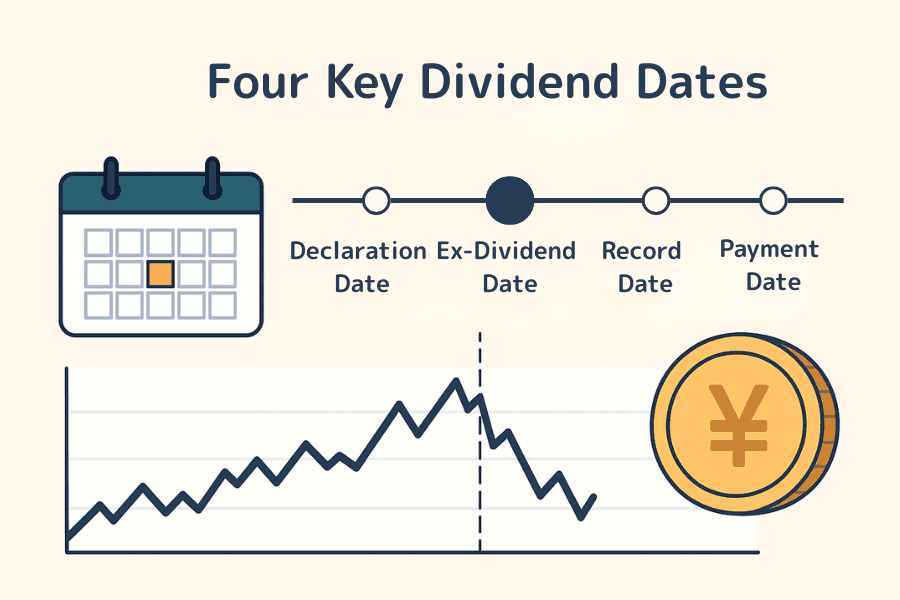
"I bought a high-yield stock but never received the dividend" — this is one of the most common pitfalls for beginners, and it comes down to timing. Whether you actually collect a dividend can hinge on a difference of just one day.
This guide walks through what the ex-dividend date is, the four key dates in the dividend lifecycle, how the ex-dividend date affects share price, and practical advice plus a FAQ — helping you avoid the frustrating "bought on the ex-dividend date, got no dividend" outcome.
- What it is: The cut-off day; buy on or after it and you miss the upcoming dividend
- Four key dates: Last cum-dividend day, ex-dividend date, record date, payment date
- To qualify: Hold the shares by the business day before the ex-dividend date
- Price impact: The share price usually drops by about the dividend amount that day
- Dividend recovery: When the post-drop price climbs back to its prior level
- 1. What Is the Ex-Dividend Date? Core Concept and the Deciding Rule
- 2. The Four Key Dates of Dividend Distribution
- 3. How the Ex-Dividend Date Affects Share Price: Reference Price & "Filling the Gap"
- 4. How Should Investors Act? Practical Playbook Around the Ex-Dividend Date
- 5. Quick Answers: 6 Key FAQs on Ex-Dividend Trading and Dividend Eligibility
- 6. Titan FX Dividend Calendar
- 7. Ex-Dividend Date: Key Takeaways
1. What Is the Ex-Dividend Date? Core Concept and the Deciding Rule
In the equity market, the Ex-Dividend Date is the core date that determines whether an investor qualifies to receive a given dividend. In plain terms, it is the day the right is "stripped away."
Core Logic:
- Buy on or after the Ex-Dividend Date → you cannot receive the dividend.
- Buy on or before the day before the Ex-Dividend Date → you can receive the dividend.
To lock in the dividend, investors must identify the "Last Buy Date" (the business day before the ex-dividend date), complete the purchase before the close, and continue to hold the shares.
Ex-Dividend, Ex-Rights, and Combined: What's the Difference?
Although this guide focuses on cash dividends (ex-dividend), you'll often see these terms in financial reports.
| Term | What Is Paid | What the Investor Receives |
|---|---|---|
| Ex-Dividend | Cash dividend | Cash (credited directly to the account) |
| Ex-Rights | Stock dividend | Additional shares (bonus issue) |
| Ex-Dividend + Ex-Rights | Cash + stock | Cash and additional shares simultaneously |
Three Layers of Meaning for Investors
- (1) Dividend eligibility determination: The legal benchmark for whether you are entitled to the dividend.
- (2) Share-price downward benchmark: On the ex-dividend date, the share price is automatically adjusted down by the dividend amount (ex-dividend adjustment). This reflects the intrinsic-value adjustment after the company distributes some of its assets (cash) to shareholders.
- (3) Tax and cost planning: Some high-net-worth investors sell before the ex-dividend date and buy back after to avoid dividend income tax — a strategy sometimes called "dividend avoidance."
Investor perspective: Receiving a dividend does not immediately increase your assets, because the share price adjusts accordingly. What investors should care about is the "gap-fill ability" after the ex-dividend date. Only when the share price recovers to its pre-ex-dividend level does the dividend truly land in your pocket.
2. The Four Key Dates of Dividend Distribution
Officially, a dividend cycle comprises four key dates. Once investors master these four time markers, they can plan entry timing with precision.
| Official Name | English | Practical Meaning and Operation Tips |
|---|---|---|
| Declaration Date | Declaration Date | The company officially announces the dividend amount, ex-dividend date, and payment date. The starting point of the dividend process. |
| Ex-Dividend Date | Ex-Dividend Date | The most critical day. The share price is theoretically adjusted, and anyone who buys on this day has no right to the dividend. Operation tip: Purchase must be completed by the business day before the ex-dividend date. |
| Record Date | Record Date | The company verifies its shareholder register. Only if you bought before the ex-dividend date will settlement place you on this list. |
| Payment Date | Payment Date | The day the dividend is actually wired to accounts, usually several weeks after the ex-dividend date. |
Practical Demo: How to Make Sure You Get the Dividend
Because securities markets have settlement cycles (e.g., US T+1, Japan T+2), beginners often stumble on "date arithmetic." Let's break it down day by day (simplified example; actual dates always follow company announcements):
| Mon | Tue (Last Buy Date) | Wed (Ex-Dividend Date) | Thu | Fri (Record Date) |
|---|---|---|---|---|
| Watch target | Want dividend: hold by today's close | Right disappears: buying today gets nothing | System settlement in progress | Officially on the register |
Quick-Read Guide
Can I sell on the ex-dividend date?
Yes! As long as you held through the close of the day before the ex-dividend date, selling on the ex-dividend date (Wednesday in this example) after the open still keeps you on the shareholder register — you receive the dividend normally.
Why is the ex-dividend date earlier than the record date?
To leave time for settlement. After you buy, the brokerage needs 1-2 days to complete the legal ownership transfer. The ex-dividend date is placed earlier so the record-date roster is accurate.
What if I miss the Last Buy Date?
If you buy on the ex-dividend date itself, you miss the dividend — but the upside is you enter at the post-ex-dividend lower price and don't pay dividend income tax. Suitable for investors who prioritize capital gains over cash flow.
3. How the Ex-Dividend Date Affects Share Price: Reference Price & "Filling the Gap"
The most direct impact of the ex-dividend date is a price adjustment. After the company distributes cash to shareholders, company assets drop, so the share price is corrected downward on the ex-dividend date — the "ex-dividend adjustment."
Theory: How to Calculate the Ex-Dividend Reference Price
On the ex-dividend date, the exchange subtracts the dividend from the previous close to determine the opening reference price.
Ex-Dividend Reference Price Formula:
Ex-Dividend Reference Price = Previous Close − Dividend Per Share
Example: If the previous close was US$100 and the company pays a US$5 dividend, the ex-dividend opening reference price is: 100 − 5 = US$95
The Core of the Practical Question: Did You Actually Make Money?
Many beginners think "receiving a dividend = making money," but in reality it's more like "moving money from one pocket to another" — the share price drops by US$5, and the account gains US$5. Whether there's a real profit depends on what happens next: the gap-fill action.
Filling the Gap vs. Widening the Gap
- Filling the gap: The share price gradually recovers after the ex-dividend adjustment and eventually returns to the pre-ex-dividend level. "Dividend received, principal preserved" — the ideal outcome for income investors.
- Widening the gap (bleeding below the reference): The share price keeps falling after the adjustment, even below the reference price. "Dividend received, capital lost" — total assets actually shrink.
How Real Markets Diverge from the Theory
| Market Scenario | Actual Move | Common Cause | Implication for Investors |
|---|---|---|---|
| Strong gap fill | Drop is smaller than the dividend, or share price rises | Strong fundamentals, active buying | Most favorable; worth holding long-term |
| Normal adjustment | Trades near the reference price | Calm market sentiment | Normal behavior |
| Widening gap | Drop exceeds dividend, stock keeps falling | Bad news, weak broader market, tax-driven selling | Higher risk; handle with care |
Selection tip: Before entering an ex-dividend trade, check the company's average gap-fill period over the past 3-5 years. If most years are filled within 30 days, the market has strong confidence in the company — suitable for income-focused investors.
Understanding ex-dividend adjustment and gap-fill logic helps you face ex-dividend-date volatility with composure, and avoids the common regret of "received the dividend but lost money."
4. How Should Investors Act? Practical Playbook Around the Ex-Dividend Date
The ex-dividend date means different things to different investor types, and the operational playbook should differ accordingly.
Long-Term vs. Short-Term Investors
| Investor Type | Operation Guidance | Watch-outs |
|---|---|---|
| Long-term investors | Treat the dividend as steady passive income; keep holding to accumulate cash flow | Post-ex-dividend declines are normal; focus on long-term fundamentals |
| Short-term investors | Don't enter just to "chase the dividend" — evaluate total return | Watch price volatility on the ex-dividend date and transaction costs |
Tax Factors
In some markets (such as the US), dividend income is taxed. Investors should judge by after-tax real return, not just the headline number. Tax costs directly affect the final outcome — understand the applicable regime in advance.
Common Ex-Dividend Operational Pitfalls
Pitfall 1: Assuming receiving a dividend always means profit
Share price adjusts for the ex-dividend, so dividend income may be offset (fully or partially) by price declines.
Pitfall 2: Looking only at high headline yields
If fundamentals are deteriorating, a dividend today cannot offset a long-term share-price decline tomorrow — and overall, you lose money.
Pitfall 3: Ignoring taxes and trading costs
Without calculating after-tax returns and commissions, it's easy to overestimate the true benefit of the ex-dividend trade.
Practical reminder: Before engaging with an ex-dividend event, evaluate the company's fundamentals, after-tax return, and post-ex-dividend price performance together to make a rational decision.
5. Quick Answers: 6 Key FAQs on Ex-Dividend Trading and Dividend Eligibility
Q1: When do I need to buy to receive the dividend?
You must complete the purchase and continue holding by the close of the business day before the ex-dividend date. Only then will you be recorded on the shareholder register on the record date and receive the dividend.
Common misconception: Thinking that buying on the record date is enough to qualify.
Q2: If I buy on the ex-dividend date itself, do I still get the dividend?
No. Shareholders who buy on or after the Ex-Dividend Date have already lost the right to the current dividend.
Common misconception: Treating the ex-dividend date and the payment date as the same day. In reality, dividends are paid out weeks or even months later.
Q3: Does the share price always drop after the ex-dividend date?
In theory it drops by the dividend amount. In practice the move depends on supply and demand, investor expectations, company fundamentals, and the broader market — sometimes the drop is less than the dividend; occasionally the stock even rises.
Q4: What are the types of dividends?
- Cash dividend: Direct cash payment; suits investors who need cash flow.
- Stock dividend: Additional shares issued, increasing share count; suits long-term believers in the company.
Q5: Can I arbitrage short-term around the ex-dividend date?
In theory yes, but watch:
- Price adjustment: Usually drops by the dividend amount.
- Trading cost: Commissions and spreads can erase the edge.
- Tax impact: Dividends are taxed, tightening the arbitrage window.
Q6: What's the difference between the ex-dividend date and the record date?
- Record Date: The date the company uses to confirm dividend eligibility.
- Ex-Dividend Date: The date by which investors must have bought to make it onto the record-date roster.
6. Titan FX Dividend Calendar
The Titan FX dividend calendar makes it easy to check dividend adjustment data for US equities and major international stock indices (JPN225, US500, and more).
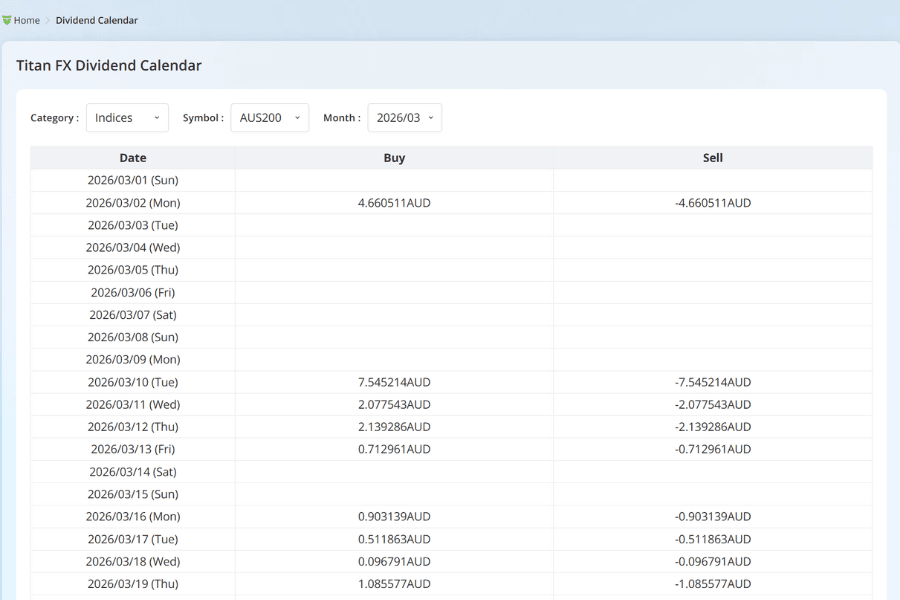
One important note: Titan FX provides a "Dividend Adjustment" mechanism rather than traditional direct cash dividend payments.
On the table:
- Buy column: The dividend compensation you receive when holding a long position.
- Sell column: The dividend cost you pay when holding a short position.
This is because, in contract-for-difference (CFD) trading, investors don't actually hold the underlying stock — they trade price movement. When the underlying pays a dividend, the platform makes a cash adjustment via the account to mirror the real-market dividend impact.
Through the Titan FX dividend calendar, investors can front-run dividend adjustment timing and amounts, and plan entries and exits more precisely — whether for long-term positions or short-term trades.
7. Ex-Dividend Date: Key Takeaways
The ex-dividend date is the core dividing line for dividend investing. To receive the dividend, you must buy and hold by the close of the business day before the ex-dividend date.
Beginner Ex-Dividend Checklist:
- Confirm the ex-dividend date, record date, and last buy date.
- Evaluate the after-tax yield rather than the surface number.
- Be mindful of ex-dividend price adjustments and volatility.
- In long-term investing, prioritize fundamentals over short-term dividend capture.
Master the ex-dividend rules and you'll navigate dividend investing with composure, avoid the common mistakes, and genuinely enjoy the benefits of passive income.
Further Reading
The financial markets research team at Titan FX, producing educational content for investors across forex (FX), commodities (oil, precious metals, agricultural products), stock indices, U.S. equities, and crypto assets.
Primary Sources (by Category)
- Official data: SEC EDGAR, NYSE Listed Companies
- Settlement: DTCC T+1 Settlement
- Media: Bloomberg, Reuters