

Record Date
For many first-time US stock investors, the most anticipated moment is receiving a dividend. Yet a common frustration surfaces quickly: "I already bought the stock, so why hasn't the brokerage deposited the dividend into my account?"
In financial columns, the Record Date - paired with the Ex-Dividend Date - is the legal cutoff a company uses to determine which shareholders are entitled to receive a dividend, attend a shareholder meeting, or cast a vote. Understanding this date and how it interacts with the settlement system is essential for every dividend investor and value investor.
1. What Is the Record Date?
The Record Date is the official cutoff a company sets to confirm which shareholders are entitled to receive a dividend, attend a shareholder meeting, or exercise voting rights.
Because shares trade constantly in the market, the shareholder register is in near-continuous flux. A company therefore picks a specific moment in time, locks in the full roster as of that instant, and uses that list to pay out the dividend. Only those whose names officially appear on the corporate shareholder register at the close of the Record Date are entitled to receive that dividend.
This date is the legal benchmark for the administrative roster the company maintains. From the investor's perspective, it determines whether the company "officially recognizes" your holding. If your name is added to the register after the Record Date, no matter how many shares you hold, you will not receive that particular dividend.
2. The Four Key Dates of a Dividend Issue
A dividend moves through four important stages from announcement to payment. The table below lays out the sequence and role of each date.
| Order | Key Date | Primary Role |
|---|---|---|
| 1 | Declaration Date | The company formally announces the dividend amount and the associated dates. |
| 2 | Ex-Dividend Date | The cutoff that determines whether a purchase qualifies for the dividend. |
| 3 | Record Date | The company reconciles the shareholder register and finalizes eligibility. |
| 4 | Payment Date | The dividend is actually credited to investors' accounts. |
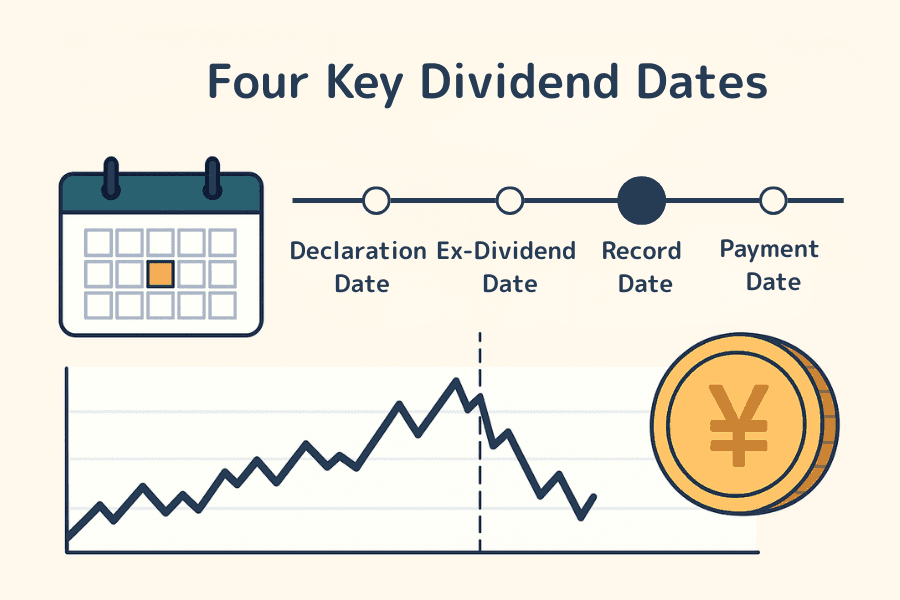
The Declaration Date is the starting point of the entire process. At this point, investors learn the per-share dividend they can expect.
Next comes the Ex-Dividend Date. This is typically the decisive moment for dividend eligibility, and the stock price is also adjusted to reflect the dividend amount.
The Record Date follows. At this point, the company finalizes the list of eligible recipients based on the shareholder register.
Finally, on the Payment Date, the funds are actually credited to investors' brokerage accounts.
3. Record Date vs. Ex-Dividend Date: The Most Common Beginner Confusion
These two dates generate the most confusion. Many investors assume that simply buying on the Record Date is enough to appear on the shareholder register — a significant misconception.
Difference 1: The Settlement Lag
Major global equity markets (US, Taiwan, and others) all run on a standard settlement cycle. US equities have moved to a T+1 cycle since May 2024, meaning ownership transfers take one business day to finalize after the trade. If you buy on the Record Date itself, your name will only appear on the register the following business day (T+1) — by which point the Record Date cutoff has passed.
Difference 2: The True Eligibility Cutoff
What actually determines whether you receive a dividend is the Ex-Dividend Date. The Ex-Dividend Date is typically set one business day before the Record Date.
- Buy before the Ex-Dividend Date: You are considered a holder as of the Ex-Dividend Date, your name lands on the Record Date register, and you qualify for the dividend.
- Buy on or after the Ex-Dividend Date: The trade does not carry the current dividend right, your name arrives on the register after the Record Date, and you do not receive the dividend.
4. Titan FX Dividend Calendar
The Titan FX dividend calendar makes it easy to check dividend data for US equities and major international stock indices (JPN225, US500, and more).
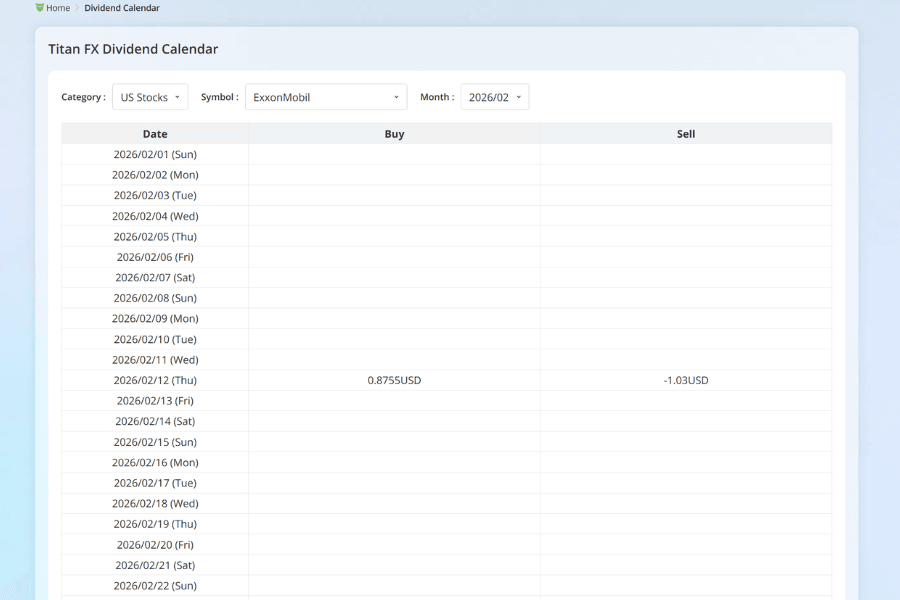
Each month displays the actual dividend amount, so investors can clearly see when different markets are scheduled for dividend adjustments.
Whether you are positioning for long-term investment or short-term trading, the Titan FX dividend calendar gives you a clearer grasp of upcoming dividend dynamics.
5. FAQ: Common Misconceptions About Dividend Eligibility
Beyond the basics, investors frequently run into detail-level questions in practice.
Q1: If I sell on the Record Date itself, do I still receive the dividend?
Yes. Being able to sell on the Record Date means you were a holder at least on the day before the Ex-Dividend Date or on the Ex-Dividend Date itself.
As long as you held the shares at the close of the day before the Ex-Dividend Date, your dividend eligibility is locked in. Even if you sell on the Record Date, the corporate register at settlement will still list you as the dividend recipient.
Q2: What are the advantages of buying on the Record Date?
First, a lower cost basis. You will not collect the current dividend, but because the price usually adjusts down after the Ex-Dividend Date, buying on or after the Ex-Dividend Date (including around the Record Date) typically means a cheaper entry than buying before.
Second, tax considerations. For some high-net-worth investors, receiving a dividend can trigger a substantial income tax bill. Buying after the Ex-Dividend Date (around the Record Date) lets them skip the dividend income and participate purely in the subsequent price appreciation.
Q3: What's the real difference between buying before and on the Ex-Dividend Date?
It is essentially a choice between "cash today" and "cheaper shares." Buying before the Ex-Dividend Date earns you a cash dividend but carries the associated tax liability. Buying on the Ex-Dividend Date skips the cash dividend but lets you hold the same quantity at a lower cost.
6. Summary
The Record Date, at its core, is the moment a company confirms shareholder eligibility — but what investors really need to internalize is the full dividend lifecycle.
Three practical takeaways:
- Whether you receive the dividend depends on whether you were a holder before the Ex-Dividend Date.
- The Record Date is only a roster confirmation point — it is not a buying window.
- The settlement cycle affects the actual delivery timing and, through it, the eligibility determination.
Once you internalize this sequence of events, you can pace your trades more deliberately and avoid the most common misjudgments when building dividend strategies.
Further Reading
- Ex-Dividend Date
- What Are Cash Dividends? Payout Process, Yield, and How to Use Them for US Stocks
- What Are Stock Dividends? US-Stock Payout Logic, Ex-Rights Math, and Pros & Cons
- What Is Dividend Yield? Formula, Payout Ratio, and How to Use It for US Stocks
The financial markets research team at Titan FX. We produce educational content for investors across a wide range of instruments, including forex, commodities (oil, precious metals, agriculture), stock indices, US equities, and crypto assets.
Primary Sources (by Category)
- Regulation & Settlement: SEC EDGAR, DTCC T+1 Settlement
- Market Data: NYSE Listed Companies