

PMI (Purchasing Managers' Index)
In fact, the point of PMI is not a single number, but how it reflects changes in business activity and how the market reassesses the economy and risk environment based on those changes. With the right reading, PMI becomes an important tool for gauging the overall economic mood rather than a hard-to-digest data point.
This article starts with PMI's basic concept and calculation logic, explains the differences between PMI types, then summarises the impact on major economies and markets after PMI is released, and finally — through a supporting FAQ and summary — helps you build a clear, practical framework for understanding PMI.
- PMI (Purchasing Managers' Index): A survey of firms' purchasing and operations managers; a leading indicator of the direction of business activity.
- What 50 means: 50 is the line between expansion and contraction; above 50 leans expansion, below 50 contraction — trend and pace matter more than one reading.
- Types: By sector (manufacturing/services/composite) and by publisher (ISM, Chicago PMI, etc.) — same in essence, different scope.
- Market impact: What matters is the gap versus expectations, not just 50; beating or missing forecasts moves risk appetite and prices.
- How to use it: Watch for surprises, whether the trend persists, and relative changes across economies; value rises when it aligns with other macro data.
- 1. What Is PMI? The Basics of the Purchasing Managers' Index
- 2. How Is PMI Calculated? What 50 Means
- 3. Differences Between PMI Types: Manufacturing, Services, and More
- 4. What Usually Happens to Markets After PMI Is Released?
- 5. Frequently Asked Questions About PMI
- 6. Summary: How Beginners Can Actually Use PMI
1. What Is PMI? The Basics of the Purchasing Managers' Index
The Purchasing Managers' Index (PMI) is an economic indicator compiled through survey methods, used to reflect changes in firms' overall operating activity. Respondents are typically the managers responsible for purchasing, capacity planning, and operating decisions within a company, so PMI is seen as an important indicator that directly shows frontline business conditions.
Unlike price-type economic data, PMI focuses on whether business operations are changing, not on price levels — which is why it is often regarded as a leading indicator in business-cycle analysis.
Purpose: Getting Ahead of Business Trends
The aim of PMI is to judge, through real-time feedback from company management, whether economic activity is leaning toward expansion or slowdown. Before adjusting capacity, staffing, and purchasing plans, firms have usually already formed a view on future demand, and that judgment shows up first in the PMI survey.
So PMI can offer the market an early read on the direction of the economy before official output data or company earnings are released.
Content: Observing Business Activity from Multiple Angles
PMI is not the result of a single question, but a composite index built from several business-activity measures. Common survey items include changes in orders, production, employment, inventory levels, and supplier delivery times.
Together these items make up the core of business operations, so PMI shows the direction of overall economic activity rather than the performance of a single company or industry.
Timing: Why PMI Draws Special Market Attention
PMI is usually released early in the month, ahead of most official economic data such as industrial production or GDP, so it often becomes an important basis for judging that month's economic trend.
For investors, the point of PMI is not predicting short-term moves, but helping understand the direction of change in the economic environment and market mood.
2. How Is PMI Calculated? What 50 Means
When understanding PMI, the focus is not the statistical formula itself, but how the index is formed and what its movements actually convey. Grasp this logic and you avoid misjudging the economy by looking at the number alone.
The Logic: How a Survey Becomes an Index
PMI is compiled through surveys in which responding firms answer, for each operating aspect, whether it "improved," "stayed the same," or "worsened" compared with the previous month. The compiling body then converts these answers into an overall index using fixed weights.
The focus of this design is not how much is actually produced or sold, but whether business activity is changing direction. So PMI reflects trend and momentum, not specific quantities.
The Key Meaning of 50: The Line Between Expansion and Contraction
PMI values usually range from 0 to 100, with 50 seen as the dividing line between economic expansion and contraction.
- ▸When PMI is above 50, a higher share of firms report improving operations, and overall activity leans toward expansion.
- ▸When PMI is below 50, business activity is weakening and momentum leans toward contraction.
It is worth noting that PMI above 50 does not necessarily mean the economy is strong, and below 50 does not mean a recession has begun. In practice, what matters more is whether PMI keeps rising or falling, and whether the pace of change is accelerating — these trend signals are often more valuable than a single reading.
3. Differences Between PMI Types: Manufacturing, Services, and More
When reading economic news or market analysis, PMI appears under various names — manufacturing PMI, services PMI, composite PMI, even the Chicago PMI or ISM PMI. Although they look different, they are all PMIs in essence, differing only in survey scope and the publishing body.
Understanding these differences helps avoid mistaking "different PMIs" for "indicators of a different nature."
By Industry Scope
The most common way to classify PMI is by the type of industry the survey covers. Below are the three PMI types most often cited in the market:
| PMI type | Main target | Key focus | Common use case |
|---|---|---|---|
| Manufacturing PMI | Manufacturing firms | Production, orders, inventory, export demand | Export-led or manufacturing-heavy economies |
| Services PMI | Services firms | Domestic activity, consumption and service demand | Domestic-demand or services-heavy economies |
| Composite PMI | Manufacturing + services | Overview of overall economic activity | Judging the macro economic direction |
- ▸Manufacturing PMI is usually more sensitive to business-cycle changes, so it draws special attention at global turning points.
- ▸Services PMI better reflects domestic demand and consumption momentum, with relatively higher value in services-led economies.
- ▸Composite PMI is used to observe the direction of overall activity, suitable as a macro overview.
By Publishing Body
Beyond industry scope, PMI often carries different names because of different publishers — the point beginners most easily confuse. In fact, these PMIs have no essential difference in survey logic; the main differences are the sample source and the region covered.
| PMI name | Publisher or scope | Characteristics | Common market use |
|---|---|---|---|
| ISM Manufacturing PMI | Institute for Supply Management (ISM) | One of the most representative US PMIs | Judging US manufacturing and the broader economy |
| Chicago PMI | Manufacturing in the Chicago area | A regional PMI | Observing US manufacturing trends in advance |
| National official or private PMIs | National survey bodies | Reflect local business activity | Comparing economic conditions across countries |
Take the US: when the market refers to the "US manufacturing PMI," it usually means the ISM Manufacturing PMI, while the Chicago PMI is often seen as an early signal for US manufacturing changes. Despite different names, they measure the same core concept and should not be read as completely different indicators.
Further reading: What Is the ISM Manufacturing Index?
Bonus: How to Quickly Track PMI Across Countries
For investors, having a stable way to check the data is more useful than memorising every PMI name and publisher. Using the economic indicators list provided by Titan FX, you can view manufacturing, services, and composite PMI data across countries and regions at once, making cross-comparison and trend tracking easier.
This approach helps you focus on the direction and relative position of PMI changes, rather than letting a maze of indicator names scatter your attention.
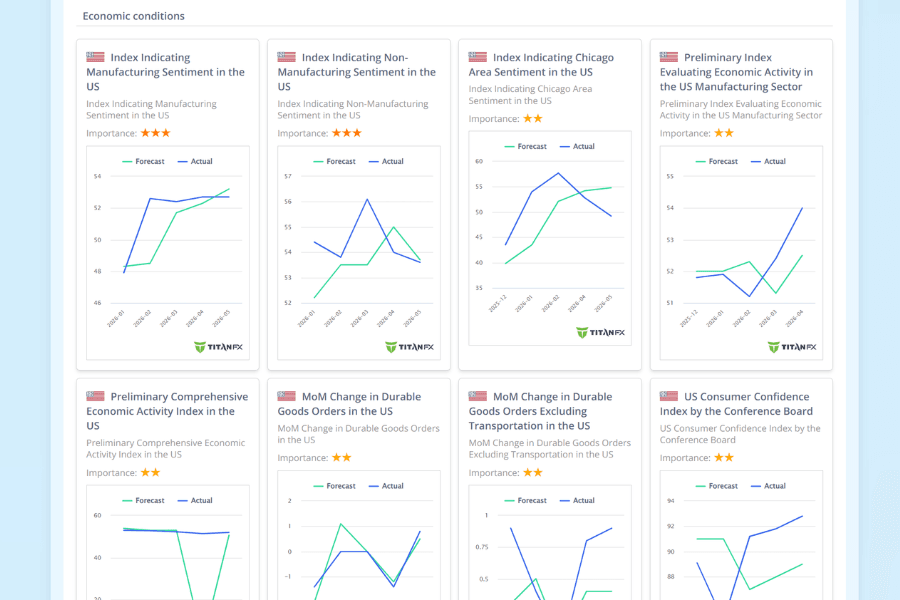
See Manufacturing Purchasing Managers' Index (PMI) | Titan FX Economic Indicators
4. What Usually Happens to Markets After PMI Is Released?
The core of the market's reaction after PMI is released is not the number itself, but how the market reassesses the direction of the economy and the risk environment. Because PMI reflects changes in business activity and confidence, it tends to affect investors' read on growth prospects, and in turn drives adjustments in asset prices.
The Key: Watch the Surprise, Not Just 50
In practice, what the market cares about most is whether PMI is above or below the prior market expectation.
Even if PMI is still above 50, coming in below expectations can make the market reaction more cautious. Conversely, even if PMI is below 50, beating expectations can improve market sentiment.
So whether PMI triggers volatility hinges on the gap versus expectations, not the position of a single number.
PMI Reading and Market Reaction
| PMI situation | Common market read | Overall sentiment |
|---|---|---|
| Above 50 and beats expectations | Steady, expanding momentum | Risk appetite rises |
| Above 50 but misses expectations | Slowing growth momentum | Limited reaction |
| Below 50 but beats expectations | Still weak but improving | Sentiment steadies |
| Below 50 and misses expectations | Rising cooling risk | Leans cautious |
Key Impacts on Major Economies
United States: A Bellwether for Global Markets
US PMI is often seen as an important reference for the global economy. When US PMI strengthens, the market usually upgrades its assessment of global growth and risk appetite improves; if PMI weakens, it tends to spark concern over an economic slowdown, affecting equities and overall market sentiment.
Taiwan: Highly Linked to Exports and Manufacturing
Taiwan is an export-led economy and is highly sensitive to changes in global PMI. When major economies' PMIs improve, it usually helps lift Taiwan's export orders and manufacturing activity; if PMI weakens, it can suppress export performance and affect business confidence.
Eurozone: A Key Area to Watch for Manufacturing
The eurozone, especially Germany, has a high share of manufacturing. A rise in eurozone PMI usually signals a recovery in exports and industrial activity, helping lift market confidence; when PMI falls, the market tends to worry about weakening European momentum.
Japan: A Reflection of External Demand and FX Expectations
Japan's manufacturing and exports are highly linked to global demand. When global PMI strengthens, it usually benefits Japan's exports and business activity; if PMI weakens, it can affect the market's view of Japan's economy and the direction of the yen.
5. Frequently Asked Questions About PMI
Q1: After PMI is revised, do I need to re-interpret it?
Some PMIs publish a preliminary value first and a revised value later. For the market, the initial preliminary value usually has the bigger impact, while the revision is mostly used to confirm whether a trend holds. If the revision is small, the market reaction is usually limited; only when the revision runs counter to the original judgment does it warrant fresh attention.
Q2: PMI swings a lot short term — does that mean the data is unreliable?
PMI reflects firms' current sense of business conditions, so short-term swings are normal, especially at turning points or when uncertainty rises. When reading it, avoid looking at a single month's change alone and instead watch whether a continuous up or down trend is forming.
Q3: Is PMI affected by seasonal factors?
Yes. Holidays, seasonal peaks and troughs, and annual purchasing cycles can all affect firms' responses. So when reading PMI, the market usually compares it with the same period in past years and the trend, rather than interpreting a single month in isolation.
Q4: What is the relationship between PMI and company earnings?
PMI reflects the direction of business activity, while earnings are the results that have already occurred. When PMI improves over the long run, it often means the business environment is getting better, raising the odds that future earnings improve — but there is still a time lag between the two.
Q5: Is PMI suitable for comparing the economic conditions of different countries?
It can be used as a reference, but mind the differences in economic structure across countries. PMI is suited to comparing the "direction of change," not directly comparing the level of values, which helps avoid misreadings caused by different industry structures.
6. Summary: How Beginners Can Actually Use PMI
PMI is not a tool for predicting short-term market moves, but an indicator that helps investors understand the overall direction of the economy and the market mood. What it provides is a signal of whether business activity is improving or weakening, not a precise entry or exit point.
For beginners, when actually using PMI, focus on three things: whether a gap versus expectations appears, whether the trend persists, and the relative changes across economies. When PMI points in the same direction as other macro data, its reference value tends to be higher.
By observing PMI changes over the long run rather than chasing the short-term reaction to a single data point, you can build more stable and rational investment judgment in a complex market environment.
Further Reading
Titan FX Research. Investor-education content covering forex (FX), commodities (oil, precious metals, agricultural products), stock indices, US equities, and crypto assets across global markets.
Primary Sources by Category
- Survey bodies and official data: Institute for Supply Management (ISM); S&P Global PMI; national statistical and survey agencies
- Market data: Titan FX economic indicators page; PMI commentary from major financial media