

THB(Thai Baht)
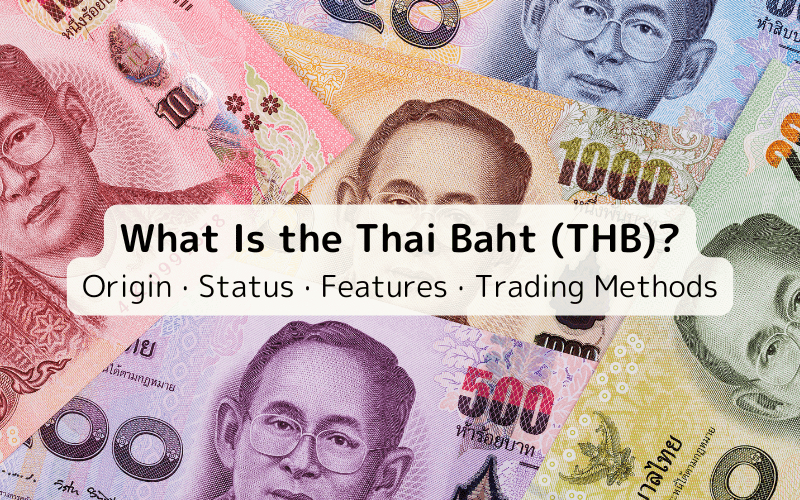
The Thai Baht (THB) is Thailand's official currency — a managed-floating emerging-market currency shaped heavily by tourism, exports, and Bank of Thailand policy; USD/THB is its most-traded pair.
The Thai Baht (symbol: ฿) is the official currency of Thailand and one of the most important currencies in Southeast Asia. It plays a significant role in regional trade, tourism, and financial transactions.
- History of the Thai Baht (THB) and Thailand's economic structure
- Drivers of the THB exchange rate: tourism, exports, BOT monetary policy
- A managed-floating regime and heavy tourism dependency
- Key indicators (CPI, BOT policy rate, tourist arrivals) and how they move THB
- Trading USD/THB and JPY/THB: liquidity windows and risk considerations
1. Thailand's Economy and the History of the Baht
The history of the Thai Baht dates back to the early 19th century. Initially, Thailand used a monetary system based on the weight of silver and gold. In 1880, Thailand introduced modern banknotes, and the first series of Baht notes was issued in 1902.
Throughout the 20th century, Thailand experienced several economic fluctuations, particularly during the 1997 Asian Financial Crisis, which led to a sharp devaluation of the Baht. Since then, the Thai government has implemented various monetary policies to restore economic stability and market confidence. The Bank of Thailand (BOT) played a crucial role during this period by adjusting interest rates and intervening in foreign exchange markets to ensure relative stability of the Baht.
2. Characteristics of the Thai Baht
The Thai Baht has several notable features:
1. Floating Exchange Rate System
Following the 1997 financial crisis, Thailand adopted a floating exchange rate system, where the Baht's value is determined by market supply and demand. This system allows the currency to respond flexibly to international market changes.
2. Key Role in International Trade
As a major player in Southeast Asian trade, the Baht is widely used in regional transactions. Economic integration among ASEAN countries has increased the Baht's usage, contributing to its growing international role.
3. Stable Monetary Policies
The Bank of Thailand actively works to maintain the stability of the Baht, particularly through inflation control. By adjusting interest rates and intervening in foreign exchange markets, the central bank ensures currency stability and bolsters market confidence.
4. Sensitivity to Forex Market Volatility
The Thai Baht is relatively sensitive to foreign exchange market fluctuations. During global economic disruptions, the Baht may experience significant volatility, requiring investors to closely monitor external developments.
3. Key Factors Influencing the Thai Baht Exchange Rate
The exchange rate of the Thai Baht is influenced by multiple factors, including:
1. Thailand's Economic Performance
Thailand's Gross Domestic Product (GDP), inflation rate, unemployment rate, and trade performance are key indicators affecting the Baht's value. Strong economic growth, particularly in tourism and exports, often leads to Baht appreciation. Conversely, economic slowdowns may result in depreciation.
2. Bank of Thailand's Monetary Policy
The Bank of Thailand is responsible for implementing monetary policies, such as adjusting interest rates and intervening in the forex market. These policies directly influence the Baht's stability, particularly during periods of inflation or economic volatility.
3. External Economic Environment
Global economic conditions, international market fluctuations, and geopolitical risks can significantly impact the Baht's exchange rate. During times of uncertainty, investors may seek safer assets, which could increase demand for or pressure the Thai Baht.
4. Tourism Industry
Thailand is a world-renowned tourist destination, and tourism contributes significantly to its economy. The influx of international tourists drives demand for the Baht, particularly during peak travel seasons, boosting its value.
5. Major Trading Partners
Thailand's primary trading partners include China, the United States, and Japan. Economic performance and policy changes in these countries, especially those affecting trade relations, directly influence the Baht's value. For example, a slowdown in China's economy could reduce demand for Thai exports, impacting the Baht.
4. The Thai Baht's Economic Foundation and International Standing
The Thai Baht's value is anchored by a set of core economic indicators, its role across regional and global markets, and the outlook for Thailand's economy.
Key Economic Indicators
| Indicator | Description |
|---|---|
| GDP | Measures Thailand's overall economic output. Strong GDP growth often supports Baht appreciation. |
| Inflation Rate | Represents the percentage increase in price levels. Moderate inflation supports economic growth, while high inflation may lead to depreciation. |
| Unemployment Rate | The proportion of unemployed individuals in the labor force. Low unemployment typically indicates economic strength, boosting demand for the Baht. |
| Trade Surplus/Deficit | Reflects the balance between exports and imports. A trade surplus tends to strengthen the Baht, while a deficit may lead to depreciation. |
| Foreign Exchange Reserves | Total foreign assets held by the central bank. Adequate reserves enhance currency stability and investor confidence. |
The Thai Baht's Global Market Role
The Thai Baht (THB) is actively traded in the international foreign exchange market, particularly against major currencies like the U.S. dollar, euro, Japanese yen, and Singapore dollar. It plays a crucial role in the Southeast Asian economy as one of the region's key currencies.
Thailand's foreign trade and investment activities further promote the international use of the Thai Baht. The country's economic focus lies in agriculture, manufacturing, and tourism. As a major trading currency in the region, the Thai Baht facilitates settlements and payments between trade partners, enhancing economic cooperation and investment flows.
Additionally, the stability and liquidity of the Baht make it a preferred currency for foreign businesses and investors entering the Thai market. This strengthens Thailand's economic influence in Southeast Asia.
Outlook for the Thai Baht
Looking ahead, the performance of the Thai Baht will be influenced by multiple factors:
1. Economic Recovery — As the global economy gradually recovers, Thailand's exports and tourism sector are expected to regain growth momentum. This will positively impact the value of the Thai Baht.
2. Regional Economic Integration — With the progress of economic integration in Southeast Asia, the Thai Baht has the potential to further strengthen its role in regional trade. Enhanced cooperation with neighboring countries will drive greater liquidity and use of the Baht.
3. The Impact of Digital Currencies — The development of digital currencies and financial technology could transform the traditional financial system. Thailand is exploring the potential introduction of a digital Baht, which may enhance its competitiveness in global markets.
4. Changes in the Global Economic Environment — Global economic uncertainties, such as U.S.-China trade tensions and energy price fluctuations, will influence the Thai Baht's exchange rate. Thailand must remain flexible in addressing these external challenges to ensure stable economic growth.
5. How to Trade the Thai Baht (THB)
Trading the Thai Baht can be done through several methods, with forex margin trading being the most common. This approach allows investors to use leverage, enabling them to control larger positions with a smaller amount of capital.
Forex margin trading also supports two-way operations, allowing investors to capitalize on both rising and falling markets. Moreover, as the forex market operates 24 hours a day, it offers exceptional flexibility and liquidity. This makes it suitable for investors with varying strategies and risk tolerance levels.
Further Reading: Introduction to Forex Margin Trading
Titan FX offers leverage up to 1:1,000.
Trading Forex with Titan FX
1. Open a Trading Account:
Titan FX offers a fast and simple account opening process with no requirement for ID or address verification.
Titan FX provides Standard and Blade account types. Traders can choose their preferred type during registration.
Titan FX Account Opening Guide2. Deposit Funds:
After registration, deposit funds into your account. Titan FX supports multiple deposit methods, with credit card deposits being the fastest and most convenient, usually processed instantly.
Titan FX Credit Card Deposit Guide3. Download and Install Trading Platforms (MT4/MT5):
Titan FX offers MT4 and MT5 platforms for Windows, Mac, iOS (iPhone/iPad), and Android.
Titan FX MT5 Installation and Login Titan FX MT4 Installation and Login4. Choose Currency Pair
Titan FX offers around 60 currency pairs, with the most commonly traded pair involving the Thai Baht (THB) being the U.S. Dollar (USD), specifically USD/THB.
Query for all currency pairs5. Place Trades:
Log into the MT4 or MT5 platform, select your trading instrument, and start buying or selling.
MT5 Interface and Order Methods MT4 Interface and Order MethodsTitan FX Provides Free Trading Tools (Custom Indicators and EAs)
Titan FX is dedicated to providing traders with advanced trading support, including free trading tools such as custom indicators and EAs (Expert Advisors). These tools are designed to enhance traders' efficiency and strategy precision.
Custom indicators help traders analyze market trends more accurately and identify potential trading opportunities.
Meanwhile, EAs can automatically execute pre-set trading strategies, avoiding emotional interference and ensuring that each trade is executed accurately.
With these free tools, Titan FX helps you gain an edge in the competitive financial market and improve your trading performance.
All Custom Indicators EA Trading Program Rankings6. Frequently Asked Questions (FAQ)
Q1: Is THB a safe investment currency?
Thailand maintains strong foreign reserves (around 45% of GDP), placing THB among the more stable emerging market currencies. However, heavy tourism dependency means THB can move sharply during pandemics or geopolitical shifts.
Q2: Could Thailand return to a USD peg?
Highly unlikely given the lessons of the 1997 Asian Financial Crisis. Thailand maintains a managed floating regime, balancing market dynamics with occasional BOT intervention.
Q3: Which economic indicators move THB most?
Thai CPI, BOT policy rate, Thailand GDP, tourist arrival statistics, manufacturing PMI, and US NFP/FOMC. Tourism flow is a uniquely strong driver compared to other emerging market currencies.
Q4: Should I trade USD/THB or JPY/THB?
USD/THB has the highest liquidity and reflects US macro and risk sentiment. JPY/THB suits exposure to Japan's investment and tourism flows into Thailand. Beginners typically start with USD/THB.
Q5: How does tourism affect THB?
Tourism (12-15% of GDP) is a major THB driver. Rising arrivals leads to foreign currency inflow and THB appreciation; falling arrivals (pandemic, geopolitical tension) leads to outflow and depreciation. COVID-19 and recovery cycles illustrate this strongly.
7. Summary
The Thai Baht (THB) occupies a unique position in ASEAN financial markets — backed by Thailand's status as the region's second-largest economy and underpinned by robust foreign reserves (~45% of GDP). THB combines emerging-market exposure with a relatively stable risk profile, anchored by the 1997 Asian Financial Crisis lessons that shaped Thailand's managed-floating regime.
For forex traders, the practical playbook is:
- Use USD/THB as the primary instrument for Asia-session strategies; JPY/THB for Japan-Thailand flow exposure
- Track Thai CPI, BOT policy meetings, and tourist arrival statistics as the highest-impact events
- Apply conservative position sizing — THB can move sharply during pandemics or geopolitical shifts
- Combine technical confluence with tourism-cycle and policy overlays for a complete risk framework
Understanding THB as both a regional barometer and a tourism-linked emerging market currency allows traders to capture opportunities that pure G10 strategies cannot offer.
Further Reading
Titan FX Research Team. We cover a broad set of financial instruments — foreign exchange, commodities, equity indices, US equities, and digital assets — producing practical, research-backed educational content for investors.
Primary Sources (by Category)
- Central bank & monetary policy: Bank of Thailand, BIS
- Economic statistics: BOT Indicators, Thailand NSO
- Tourism data: TAT, Tourism Ministry