

Is META a Good Stock? Meta's Business, Drivers, and How to Invest
From a college student's social network to an advertising empire reaching billions—Meta's story is still being rewritten. For investors, is META a steady cash cow or a tech stock betting big on the future?
This article breaks down Meta's company profile, business model, the core factors that move its share price, and key investment points, plus how to trade it via U.S. stocks or CFDs.
- A platform advertising company: Meta (formerly Facebook) runs Facebook, Instagram, WhatsApp, and Messenger; its core is digital-ad monetization.
- Business essence: Not a content producer but a content-distribution and ad-matching platform, using vast user data to lift ad efficiency.
- Five growth engines: AI recommendation raising ad value, short video, messaging commercialization, long-term VR/AR, and in-house AI infrastructure.
- Share-price drivers: Ad demand and the economic cycle, ad efficiency, privacy and regulation, non-core investment costs, and user activity.
- How to trade: Via stocks, ETFs, or CFDs for two-way (long/short) exposure; Titan FX offers META US-stock CFDs with up to 20x leverage.
- 1. Meta Company Overview: Positioning, Pivot, and Core Products
- 2. Meta Share-Price History: From Social Giant to AI + VR Platform
- 3. Key Drivers of Meta's Share Price: Ads, Market, and Policy
- 4. Meta's Growth Engines: AI, Short Video, Commerce, and VR
- 5. How to Trade Meta (META) US-Stock CFDs: Steps and Tools
- 6. Frequently Asked Questions (FAQ)
- 7. Conclusion: Meta's Role in a Portfolio
1. Meta Company Overview: Positioning, Pivot, and Core Products
Meta Platforms (formerly Facebook, ticker META) was founded in 2004 by Mark Zuckerberg and is one of the world's largest social-platform groups by user base. The company started with the Facebook social network, rapidly accumulating users through social graphs and building a revenue model centered on digital advertising.
As the platform scaled, Meta gradually grew into a tech-platform company spanning social interaction, content distribution, and messaging. The 2021 rename to "Meta" reflected that its organization and product lines no longer revolved around a single social network but were supported by multiple platforms together.
Company Positioning and Business Essence
From an operational view, Meta is not a content producer but a platform company that provides content distribution and ad matching. The large amount of user-behavior data the platforms accumulate lets Meta continually optimize content ranking and ad-delivery efficiency — the foundation that keeps its ad model working over the long term.
For investors, the key to understanding Meta is how it steadily converts a huge user base into sustainable ad revenue, rather than the popularity of any single app.
Core Product Ecosystem and Platform Roles
Meta forms a complete user ecosystem across multiple platforms, each playing a different role:
| Platform | Core Positioning | Role in the Overall Ecosystem |
|---|---|---|
| Mass-market social platform | Provides a stable user base and ad traffic | |
| Visual and short-video platform | Hub for younger users and brand advertising | |
| Messaging tool | Global communication base and commerce extension | |
| Messenger | Communication and support | Channel for business-user interaction |
These platforms share underlying technology and the ad system, letting Meta replicate its monetization model across products and improve overall efficiency.
The Core Advantage of the Ad Model
Meta's main revenue still comes from digital advertising, and its edge lies not only in user numbers but in whether it can keep raising the ad value per user. Platform scale and data integration keep Meta in a hard-to-replace position in the global ad market.
2. Meta Share-Price History: From Social Giant to AI + VR Platform
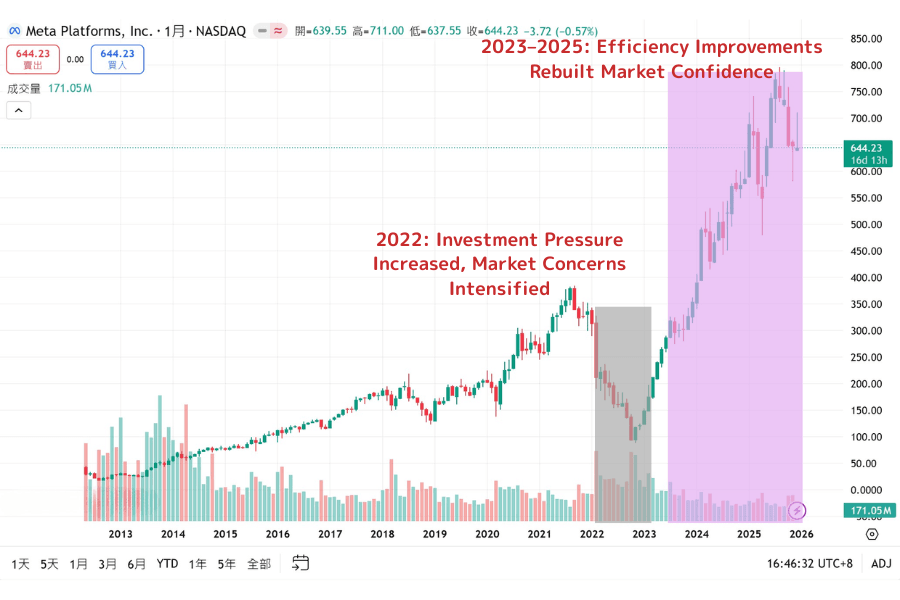
Meta's share-price history reflects the market's evolving views on its business model and investment strategy. Each phase of the move corresponds to the core question the market cared about most at the time.
Growth Phase: Mobile Ads Build an Uptrend (2012–2017)
After listing, Meta successfully shifted social usage to mobile, and mobile ads quickly became the main revenue source. User numbers and ad revenue grew together, leading the market to see it as a high-growth mobile-ad platform, and the share price rose for a long stretch.
Volatile Phase: Regulation and Growth Doubts Emerge (2018–2021)
As user scale matured, privacy incidents and regulatory pressure affected ad-tracking ability, and the market began to reassess Meta's growth ceiling. Volatility increased in this phase, but ad cash flow still provided basic support.
Correction Phase: Investment Burden Amplifies Doubts (2022)
In 2022, a slowing ad market plus higher costs from new-business investment squeezed profitability, and the share price corrected clearly. The market's focus shifted to cost control and the uncertainty of investment payback.
Recovery Phase: Efficiency Gains Rebuild Confidence (2023–2025)
As the operating focus returned to core businesses, ad efficiency and cost structure improved, profitability gradually stabilized, and the share price regained market recognition.
3. Key Drivers of Meta's Share Price: Ads, Market, and Policy
Meta's (META) share price essentially reflects the market's view of its ad-monetization ability, cost structure, and long-term investment direction. Unlike hardware-type tech companies, Meta's value is highly concentrated in platform efficiency and user behavior, so the following factors are especially likely to move the stock.
Driver 1: Ad Demand and the Economic Cycle
Meta depends heavily on ad revenue, and ad budgets usually move with the economy. In slowdowns, companies cut marketing spend and short-term revenue is pressured; conversely, in recoveries, ad demand returns and helps support the share price.
Driver 2: Whether Ad-Delivery Efficiency Improves
The market watches click-through rates, conversion rates, and revenue per user. Higher efficiency means revenue and profit can grow even with limited user growth.
Driver 3: Privacy Policy and Regulatory Risk
Rules on data use and platform responsibility across countries can affect ad precision and operational flexibility. When regulation tightens, the market typically raises its risk discount.
Driver 4: The Effect of Non-Core Investment on Profit
Investment in new technologies or platforms affects the short-term cost structure. When the investment is too large and payback is unclear, the market's profit concerns are easily amplified.
Driver 5: User Scale and Activity
Active user numbers and usage frequency determine ad inventory and pricing power. Even if user growth slows, stable engagement can still support cash flow.
4. Meta's Growth Engines: AI, Short Video, Commerce, and VR
With user scale already mature, Meta's future growth relies more on raising value per user and developing new monetization models. Most of these drivers build on existing platforms and are key reasons the market re-rates Meta.
Engine 1: AI Recommendation Keeps Lifting Ad Value
By optimizing content ranking and ad delivery, Meta can raise the commercial value of each impression even with limited user growth, sustaining revenue momentum.
Engine 2: Short Video Reshapes Usage
Short video has become a major content-consumption format; as its ad model matures further, it can become a new revenue pillar rather than just a retention tool.
Engine 3: Commercialization Potential of Messaging
If messaging services successfully extend to business communication, customer support, and payments, they can bring Meta a revenue source different in nature from advertising.
Engine 4: Immersive Platforms as a Long-Term Option
VR and AR are long-term bets that are hard to monetize in the short term, but if they form a new platform ecosystem, they help reduce reliance on a single business model.
Engine 5: In-House Tech Base Improves R&D and Cost Control
Owning core AI infrastructure lets Meta stay flexible in product-iteration speed and long-term cost structure, forming a dual advantage of technology and scale.
5. How to Trade Meta (META) US-Stock CFDs: Steps and Tools
Investors can choose different ways to participate in Meta's (META) market moves based on their strategy, risk tolerance, and capital. Among them, CFDs (contracts for difference) — with features such as two-way (long/short) trading and flexible leverage — have become a common tool for trading the swings of US tech stocks.
The table below summarizes common ways to invest in META and who they suit:
| Method | Key Features | Suitable For |
|---|---|---|
| Buy META shares directly | Participate in long-term growth and capital appreciation | Long-term investors |
| ETF / index allocation | Diversify via tech or large-cap ETFs | Medium-term allocators |
| Contracts for difference (CFDs) | Leverage and long/short; highly flexible | Those focused on volatility and strategic trading |
Trading Steps: How to Trade Meta CFDs at Titan FX
To participate in Meta's two-way moves with a lower barrier, CFDs (contracts for difference) offer a flexible approach, especially suited to investors who watch earnings, policy news, or shifts in market sentiment.
Titan FX's US-stock CFDs offer up to 20x leverage, letting investors participate in META's price rises or falls with less capital. Here are the basic steps:
| Process | Description |
|---|---|
| Step 1: Register an account | Go to the Titan FX account-opening page, enter your basic details and complete verification to activate your trading account. |
| Step 2: Make a deposit | Log in to the Titan FX Client Cabinet and deposit via credit card, e-wallet, or bank transfer following the prompts. |
| Step 3: Download the MT5 platform | Meta US-stock CFDs are traded on MT5. Titan FX offers MT5 for Windows, Mac, iOS, Android, and Web. |
| Step 4: Start trading Meta CFDs | Launch MT5, log in, search for and add Meta in Market Watch, then choose Buy (long) or Sell (short) to place an order. |
Trading Meta via CFDs lets you participate in price moves without holding the underlying shares, but be mindful that leverage magnifies risk — manage capital and stop-losses carefully.
Free Trading Tools from Titan FX
To help investors track the rhythm of US stocks more effectively, Titan FX offers several practical tools to use alongside analysis:
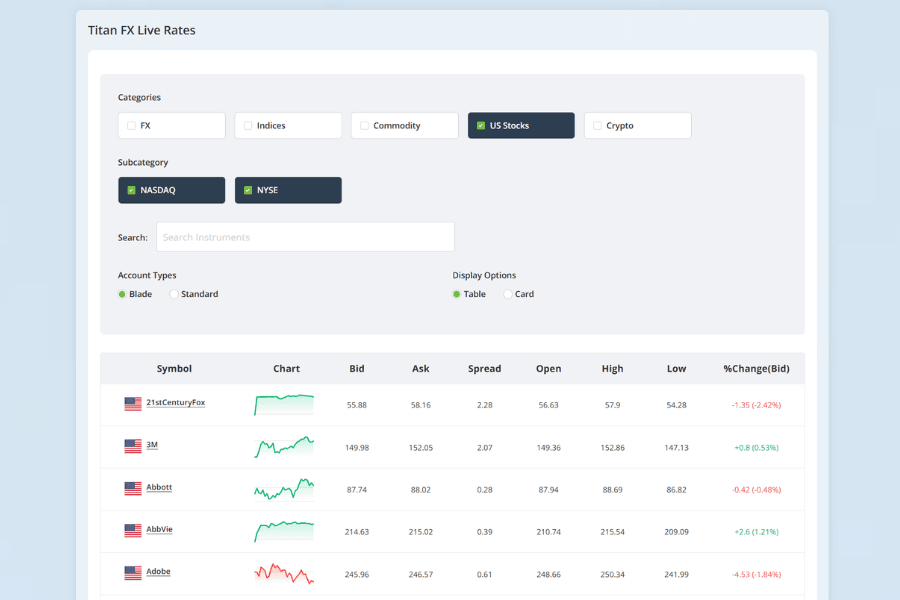
Live Rate
Live Rate provides the latest Bid/Ask, spread, intraday highs and lows, and a mini trend chart — a basic market-data source for short-term trading and strategy statistics.
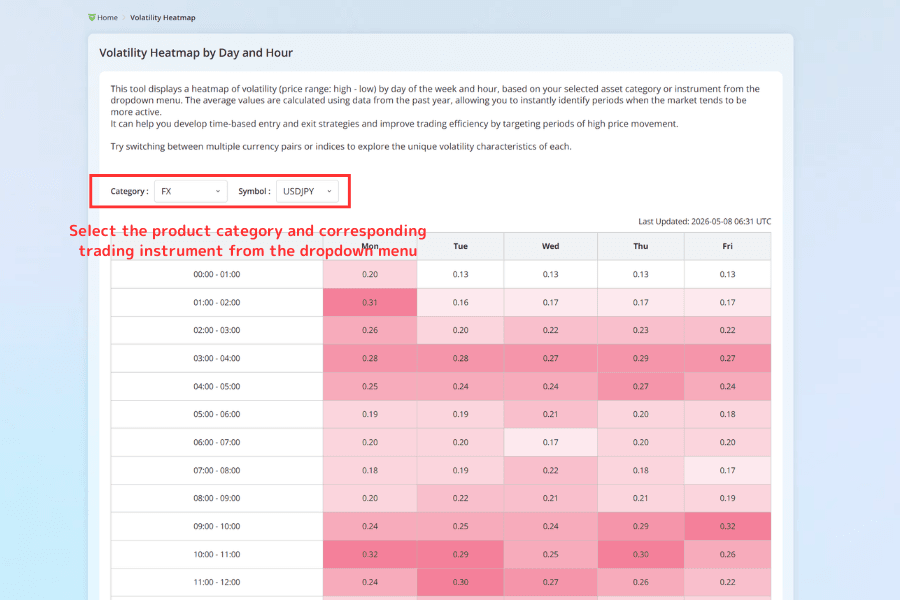
Volatility Heatmap
The Volatility Heatmap uses historical data to show how strongly an instrument moves at different times of day, helping you pick more suitable trading windows.
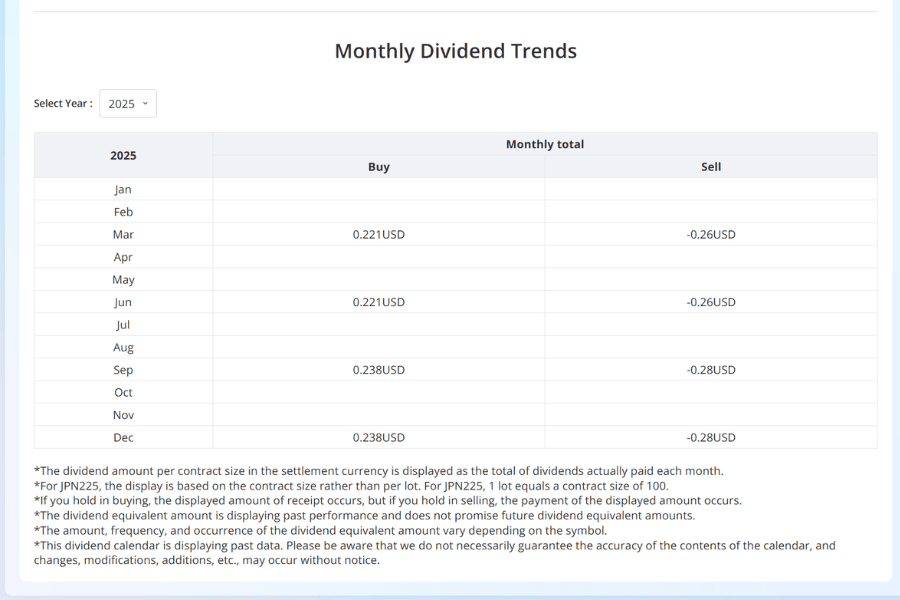
Dividend Calendar
View daily and monthly dividend records for US-stock companies in one place, including the actual dividend amounts at buy/sell, helping you track payout timing, compare yields, or plan a dividend strategy.
Trade META CFDs with Titan FX
Titan FX offers Meta (META) stock CFDs with up to 20:1 leverage, tight spreads, and the flexibility to go long or short without owning the shares.
6. Frequently Asked Questions (FAQ)
Q1. Why is Meta's share price often more volatile than other large tech stocks?
Meta's revenue is highly concentrated in advertising, and ad budgets are quite sensitive to the economic cycle and market sentiment. When the economy slows and companies cut marketing spend, the market reflects it quickly in META's price, so volatility tends to be higher than for subscription- or enterprise-software-focused companies.
Q2. Should you watch "user numbers" or "ad performance" for Meta's share price?
For beginners, ad efficiency matters more than raw user numbers. Even if user growth slows, as long as AI recommendation lifts time spent and conversion, Meta can keep growing revenue. The market currently focuses more on how much ad revenue each user generates than on user scale alone.
Q3. When trading Meta short term, which events most affect the share price?
For short-term or strategic investors, quarterly earnings and guidance, ad-market-related macro data, company comments on AI efficiency or cost control, and changes in regulation or platform rules tend to matter most — often moving short-term price more than a single product news item.
Q4. Is Meta suitable for beginners to trade right away?
If it is your first time with US stocks, it is best to understand Meta's revenue structure and volatility before deciding to enter. META is not a low-volatility stock; it suits investors who can accept price swings and are willing to follow the market and earnings continuously.
Q5. Which metrics should beginners prioritize when reading Meta's earnings?
Start with these four: year-over-year ad-revenue growth (to judge whether the core business is recovering), operating margin (reflecting cost-control results), capital expenditure (CapEx, to gauge AI and infrastructure investment intensity), and management's forward guidance (which often affects the price more than a single quarter's numbers).
Q6. Can you trade Meta (META) at Titan FX?
Yes. Titan FX offers US-stock CFDs on Meta (META) and other US stocks, with up to 20x leverage, two-way (long/short) trading, and no need to hold the underlying shares. US-stock CFDs are traded on the MT5 platform; understand META's volatility and manage stop-losses and capital before trading.
7. Conclusion: Meta's Role in a Portfolio
Meta is a technology company with a distinct character. On one hand, it has the huge user base and stable ad cash flow from Facebook, Instagram, and WhatsApp; on the other, it keeps improving platform efficiency through AI, short video, and commercialization, creating new growth room for mature businesses.
Compared with pure-subscription or hardware-oriented tech companies, Meta's share price usually tracks the economic cycle and market sentiment more closely, so it is not necessarily suited to investors seeking low volatility. But for those who can accept price swings and value cash flow and efficiency gains, Meta still carries meaningful allocation value within the US tech sector.
If you can continuously watch ad efficiency, cost control, and progress in AI applications, Meta can be seen as a somewhat aggressive but fundamentally supported tech name within a portfolio.
Further Reading
- What Is a CFD (Contract for Difference)?
- What Is the Business Cycle?
- What Is Leverage in Trading?
- How to Install MT5
Titan FX Research. Investor-education content covering forex (FX), commodities (oil, precious metals, agricultural products), stock indices, US equities, and crypto assets across global markets.
Primary Sources by Category
- Official data and disclosures: Meta Platforms, Inc. investor relations (10-K annual and 10-Q quarterly reports); U.S. SEC EDGAR filings
- Industry and research: digital-advertising and social-platform market research; major investment-bank tech-sector analysis
- Market data: Titan FX live quotes and US-stock CFD prices; US equity market analysis from major financial media