

Cotton Basics: History, Varieties, Uses, and Market Impact — Full Guide
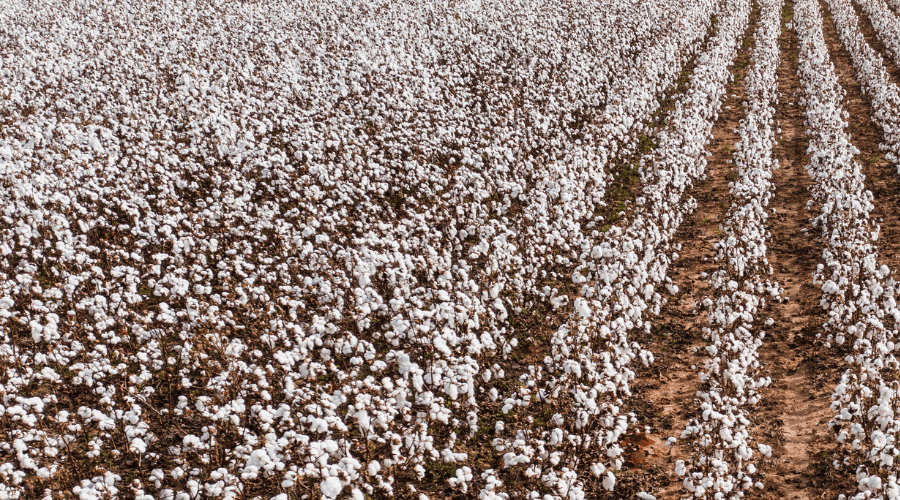
Cotton is one of the world's largest natural-fibre soft commodities, with about 25 million tonnes produced a year; its price is driven by weather and policy in top producers like India, China and the U.S., plus textile demand and crude oil prices.
Among the world's soft-commodity markets, cotton is the second-largest agricultural commodity after sugar (USDA data). From apparel and home textiles to industrial filters, medical supplies, cottonseed oil and animal feed, cotton's supply, demand and price dynamics ripple through economies from emerging-market farming nations to advanced-economy textile supply chains.
This article walks through cotton's botanical definition, history, main varieties and fibre properties, global supply-and-demand structure, the key drivers of cotton prices, futures contract specifications, and how to trade cotton CFDs with Titan FX, with an FAQ at the end.
- What cotton is: cellulose seed-hair fibre from plants of the genus Gossypium, a soft commodity with annual production of around 25 million tonnes
- Four main varieties: Upland (90%) / Pima (premium) / Asian / African — fibre length and commercial value differ
- Top 5 producers: India, China, USA, Brazil, Pakistan — the top three account for roughly 60% of global output
- Key price drivers: weather (Texas drought / Indian monsoon), policy (China reserve auctions, U.S. farm support), textile demand (China/Vietnam/Bangladesh orders), oil (synthetic-fibre substitution and freight)
- How to trade: ICE Cotton No.2 (New York) futures; Titan FX offers Cotton CFD live quotes
- What cotton is: a cellulose seed fibre from the Gossypium plant; a soft commodity with about 25 million tonnes produced a year
- Four main species: Upland (90%) / Sea Island (premium) / Asiatic / African, differing in fibre length and value
- Top 5 producers: India, China, the U.S., Brazil and Pakistan — the top three about 60% of global output
- Key price drivers: weather (Texas drought / India monsoon), policy (China reserve auctions, U.S. subsidies), textile demand (China / Vietnam / Bangladesh), crude oil (synthetic substitution and freight)
- How to trade: ICE Cotton No.2 (New York) futures; Titan FX offers cotton CFDs
1. What Is Cotton?
Cotton is a long, fine cellulose fibre that grows on the seeds of plants in the genus Gossypium (family Malvaceae). After harvesting and ginning (separating fibre from seed), cotton is spun and woven into the most important natural raw material in the textile industry. Its main chemical component is cellulose, accounting for roughly 88-96% of the fibre.
Cotton is a major global commodity with annual production around 25 million tonnes and a market value near US$50 billion. End uses span the textile industry (around 95% of total consumption), cottonseed oil for food, animal feed, medical supplies (gauze, bandages, cotton swabs), industrial filters and nonwovens.
Cotton is traded in two commercial forms:
- Lint cotton: pure ginned fibre, the underlying for international futures contracts; global annual production is about 25 million tonnes
- Seed cotton: unginned, freshly harvested cotton containing both fibre and seeds — the form farmers sell to gins
Cotton fibre quality is measured by three core commercial attributes — staple length, strength and micronaire (fineness/maturity) — which jointly determine grade and price.
2. The History of Cotton
2.1 Ancient Origins
Cotton cultivation dates back about 7,000 years. Archaeological evidence suggests that around 5000 BCE, peoples of the Indus Valley (modern India and Pakistan) were already weaving cotton textiles. Independently, coastal Peru developed cotton agriculture in the same era using the Sea-Island species.
In Ancient Egypt, cotton was woven into fine textiles for pharaohs and nobility from around 3000 BCE. As trade routes expanded, cotton spread from Asia and the Americas into Africa, Europe and beyond.
2.2 Medieval and Early-Modern Diffusion
In the medieval period, Arab merchants brought Indian cotton cloth to the Mediterranean. Between the 13th and 17th centuries, India became the world's centre for cotton-textile exports, and Indian "calico" was widely traded in Europe. Around the same time, large-scale cotton cultivation took hold along China's Yangtze River basin, gradually replacing hemp as the primary clothing fibre.
2.3 The Industrial Revolution Turning Point
Cotton truly became a global mass commodity in the late 18th-century Industrial Revolution:
- 1764: James Hargreaves invents the Spinning Jenny
- 1769: Richard Arkwright invents the water frame
- 1793: Eli Whitney invents the cotton gin, raising upland-cotton ginning efficiency roughly 50-fold
These innovations transformed textile work from craft to industrial production. Manchester in Lancashire, England, became the world's textile centre, while the American South emerged as the leading raw-cotton supplier. The U.S. cotton industry was, however, deeply tied to slavery and only restructured after the Civil War (1861-1865).
2.4 20th-Century Modernisation and Globalisation
The 20th century brought science-driven changes to cotton production:
- Mechanised harvesting: from the 1940s, cotton pickers spread across the U.S., sharply reducing labour needs
- Fertilisers and irrigation: the Green Revolution doubled output in India and China
- Genetically modified (GM) cotton: Bt cotton was commercialised in 1996; pest-resistant varieties became dominant in India, the U.S. and China
- Precision agriculture: satellite remote sensing, soil sensors and drone spraying now widely used
Global cotton output grew from about 4 million tonnes in 1900 to roughly 25 million tonnes today, settling into the modern five-leader structure of India, China, USA, Brazil and Pakistan.
3. Main Cotton Varieties and Fibre Properties
The genus Gossypium contains around 50 wild species, but only four are commercially cultivated. Staple length is the key value driver:
| Variety | Scientific Name | Staple Length | Main Regions | Commercial Role |
|---|---|---|---|---|
| Upland | Gossypium hirsutum | Medium-long (25-32 mm) | USA, China, India, Brazil | About 90% of global output; main futures underlying |
| Pima / Sea-Island | Gossypium barbadense | Extra-long (35-50 mm) | California/Arizona, Egypt (Giza), Peru, Xinjiang | Premium grade (~5-8% of global output); high-end shirts and bedding |
| Asian | Gossypium arboreum | Short (15-25 mm) | India, Pakistan | Traditional handloom weaving; small share |
| African | Gossypium herbaceum | Medium-short | Parts of Africa, India | Suited to drier climates; local textile use |
3.1 Fibre Grading Indicators
Three properties determine commercial grade:
- Staple length: short (≤25 mm) / medium (25-29 mm) / long (29-35 mm) / extra-long (≥35 mm). Longer fibre allows finer counts and more refined fabric.
- Strength: measured in g/tex; affects yarn durability and loom efficiency.
- Micronaire: a measure of fibre fineness and maturity. Optimum is 3.7-4.2; values outside this range trigger price discounts.
The ICE Cotton No.2 futures contract delivers Strict Low Middling, 1-2/32 inch staple upland cotton, equivalent to mid-grade U.S. cotton.
3.2 Cotton's Growing Requirements
Cotton is a tropical to sub-tropical crop with relatively strict requirements:
- Temperature: optimal 21-35°C during the growing season; sensitive to frost
- Rainfall: 500-1,500 mm annually; excess rainfall encourages pests and disease
- Sunlight: at least 6 hours of direct sun per day; under-light degrades fibre quality
- Soil: well-drained, deep loams with pH 6-8 are ideal
The cycle from sowing to harvest takes 150-200 days, divided into seedling, squaring, flowering and boll-opening stages, each with different water requirements.
3.3 Organic and Sustainable Cotton (BCI / GOTS)
Demand from international brands (H&M, Uniqlo, Patagonia and others) for sustainable sourcing has driven the rise of two main certification systems:
- BCI (Better Cotton Initiative): covers about 22% of global cotton output
- GOTS (Global Organic Textile Standard): strict organic certification — small share, large price premium
4. Global Cotton Supply and Demand
4.1 Major Producers
- India: world's largest producer, around 6 million tonnes per year (24% of global output); mainly upland with some extra-long staple
- China: about 5.8 million tonnes per year (23%); Xinjiang accounts for roughly 90% of Chinese output
- USA: about 3.5 million tonnes per year (14%); Texas, the Mississippi Delta and California are the three main regions
- Brazil: about 2.8 million tonnes per year, concentrated in Mato Grosso and Bahia
- Pakistan: about 1.3 million tonnes per year, largely consumed by domestic textile industry
4.2 Major Consumers and Importers
- China: world's largest consumer (~8 million tonnes per year) and largest importer; export-oriented textile industry
- India: about 5.4 million tonnes per year; large population plus significant textile exports
- Pakistan: about 2.3 million tonnes per year, supplementing domestic supply with imports from Australia and the U.S.
- Vietnam, Bangladesh, Turkey: textile-processing hubs that import nearly all the cotton they use
- USA: domestic consumption only about 0.5 million tonnes, but the world's largest exporter (3+ million tonnes per year)
4.3 The Distinct Role of Trade Flows
The U.S. is a "net-export" producer with low domestic consumption — exports run 80-90% of output, making it the central price-setter on the supply side. China, by contrast, is a heavy net importer despite ranking second in production. The U.S. → China / Vietnam / Pakistan flow is the artery of global cotton trade.
5. Key Drivers of Cotton Prices
5.1 Weather
Cotton is highly weather-sensitive, and disruptions in any of the three main producing regions feed quickly into international prices:
- Texas drought (2011, 2022): Texas accounts for about 40% of U.S. cotton output, so drought there often triggers sharp ICE Cotton No.2 rallies
- Indian monsoon: rainfall from June to September largely determines that year's Indian harvest
- Xinjiang snow damage / spring cold snap: affects planting timing and prompts production downgrades, supporting prices
5.2 The Textile Demand Cycle
Cotton is fundamentally an "intermediate good" for the textile industry, so downstream apparel demand is the central variable:
- A strong global economy → higher apparel spending → bigger orders for Chinese and Vietnamese mills → cotton demand pulled higher
- A recession or excess inventory → mills cut output → cotton demand softens
Q1-Q2 each year is the Northern-Hemisphere stocking season for spring/summer apparel and is typically the strongest demand window.
5.3 Policy
- China's reserve cotton auctions: China holds about 40% of the world's strategic cotton reserves; large releases tend to weigh on global prices, while a halt in releases supports them
- U.S. Cotton Program: marketing loans and price-loss coverage support American growers
- India's MSP (Minimum Support Price): lifts domestic prices and influences the willingness of Indian growers to export
- U.S.-China trade frictions and Xinjiang cotton issues: 2021 sanctions linked to Xinjiang cotton reshaped global supply chains and brand sourcing decisions
5.4 Substitute Fibres and Oil
Synthetic fibres — chiefly polyester and rayon — are cotton's main substitutes:
- Higher oil prices → polyester input costs rise → cotton becomes relatively more competitive → prices supported
- Lower oil prices → cheap synthetics → substitution pressure rises → cotton prices weigh
Synthetic fibres now account for roughly 65% of global textile fibre, cotton about 25%, with other natural fibres taking the rest. Synthetics have steadily eroded cotton's market share.
5.5 The U.S. Dollar
Because cotton is priced in U.S. dollars, the Dollar Index (DXY) and cotton prices have a generally inverse relationship: a stronger dollar weakens currencies such as the Indian rupee and Brazilian real, lifting local-currency revenues for producers, encouraging exports and pressuring international cotton prices.
6. Cotton Futures Specifications and Major Exchanges
Cotton is among the most liquid soft commodity futures globally. The main contracts are:
| Contract | Exchange | Underlying | Contract Size | Quote Currency |
|---|---|---|---|---|
| Cotton No. 2 | ICE U.S. (NY) | U.S. upland cotton | 50,000 lbs (22.7 t) | cents/lb |
| Cotton | Zhengzhou Commodity Exchange (ZCE, China) | Domestic Grade 1 white cotton | 5 t | RMB/t |
| Cotton Yarn | Zhengzhou Commodity Exchange (ZCE) | Combed cotton yarn | 5 t | RMB/t |
| MCX Cotton | India Multi Commodity Exchange | Indian cotton | 25 bales (~4.8 t) | INR/bale |
The contract international investors are most familiar with is ICE Cotton No.2 — the most liquid of all cotton futures. Global cotton prices are most often quoted as the "Cotton No.2 close (cents/lb)".
6.1 Contract Months
ICE Cotton No.2 trades March, May, July, October and December contracts, aligned with the Northern-Hemisphere harvest cycle.
6.2 Market Participants
- Hedgers: gins, traders, textile mills (e.g., Hong Kong's Li & Fung, India's Welspun) and brand owners
- Speculators: hedge funds, CTAs and retail traders
- Index funds: long-only positions tracking commodity indices
7. Trading Cotton CFDs with Titan FX
Titan FX offers Cotton CFD trading, allowing participation in global cotton markets with smaller capital and flexible hours, without the expiry pressure or large margin requirements of futures contracts.
Cotton Live Quotes7.1 CFD vs Futures: Which Suits Retail Traders?
| Item | Cotton Futures (ICE Cotton No.2) | Titan FX Cotton CFD |
|---|---|---|
| Minimum margin | About $3,000 per contract | From US$200 |
| Contract size | 50,000 lbs | From 0.01 lots |
| Trading hours | ICE-defined (limited) | 24 hours (Mon-Fri) |
| Expiry | Yes (every 3 months) | None |
| Leverage | Set by exchange | Up to 50x (leverage explained) |
| Suited to | Institutions; textile-industry hedging | Retail short- to medium-term traders |
The CFD format gives retail traders a low entry barrier, flexible leverage and no expiry, well-suited to short- and medium-term swing trading.
7.2 Cotton CFD Trading Strategies
- Trend following: combine moving averages (MA) to identify medium-term trends and trade in the direction
- Seasonality: supply pressure tends to peak in October-December (Northern-Hemisphere harvest); demand strengthens in Q1-Q2 ahead of stocking
- Weather-event trading: positioning around hurricanes, droughts or pest outbreaks
- Synthetic-fibre spreads: when oil drops sharply, synthetic substitutes pressure cotton — a short-cotton stance can be considered
7.3 Why Titan FX
- Tight spreads: the Blade account offers raw spreads, with competitive cotton CFD pricing
- Fast execution: institutional liquidity providers and very low slippage
- MT4 / MT5: support for automated trading (EAs) and a wide range of technical indicators
- Free education: Titan FX Research offers strategy articles and market analysis from beginner to advanced
Trade Cotton CFDs with Titan FX
Titan FX offers cotton CFDs with up to 50:1 leverage and the flexibility to go long or short without holding the physical commodity.
8. Frequently Asked Questions (FAQ)
Q1: How are cotton prices most often quoted?
Global cotton prices are most often quoted as the ICE Cotton No.2 settlement price in cents/lb. For example, "Cotton No.2 = 78.00 cents/lb" means 78 cents per pound, or roughly US$1,720 per tonne. Domestic Chinese prices typically reference Zhengzhou cotton futures (RMB/tonne).
Q2: Why does Texas drought affect global cotton prices?
The U.S. is the world's largest cotton exporter (about 3 million tonnes per year), and Texas accounts for roughly 40% of U.S. output. When Texas suffers a drought (e.g., 2022), forecasts for U.S. cotton output drop sharply, tightening globally tradable supply, and ICE Cotton No.2 typically rallies.
Q3: How are cotton and synthetic-fibre (polyester) prices related?
Synthetic fibres — mainly polyester and rayon — are cotton's main textile substitutes and now make up around 65% of global fibre use. When oil rises sharply, polyester production costs increase and cotton becomes relatively more competitive, supporting its price. When oil falls, cheaper synthetics weigh on cotton demand.
Q4: How can a retail investor participate in cotton markets?
Main routes include: (1) Cotton CFDs (e.g., Titan FX): low entry barrier, 24-hour trading, two-way; (2) Cotton futures (e.g., ICE Cotton No.2): large contracts suited to bigger capital; (3) Agricultural ETFs: indirect exposure, not perfectly correlated with cotton prices; (4) Cotton-related stocks such as India's Welspun or Bangladeshi textile exporters — but these are heavily affected by company-specific factors.
Q5: What is the biggest difference between cotton futures and cotton CFDs?
Cotton futures are listed on regulated exchanges such as ICE, with standardised contracts, fixed expiry dates and high margin requirements (around US$3,000 per contract). Cotton CFDs are over-the-counter contracts on broker platforms, with no expiry, sizes from 0.01 lots and 24-hour trading — though traders should pay attention to spreads and overnight financing. Titan FX does not offer futures; only CFDs.
Q6: What is "China reserve cotton auction"?
China holds the world's largest national cotton reserves (about 40% of the global total), managed by the China National Cotton Reserves Corporation. The Chinese government periodically releases reserve cotton to stabilise domestic prices or adjust supply and demand. Large releases generally weigh on international prices, while a halt or large purchases provide support. It is one of the policy events traders must watch closely.
9. Summary
Cotton is one of the world's largest natural-fibre and soft-commodity markets, with annual production around 25 million tonnes and a market value near US$50 billion. Supply is highly concentrated in five producing countries — India, China, USA, Brazil and Pakistan — and prices are driven by weather, textile demand, policy, synthetic-fibre substitution and exchange rates.
For retail traders, Cotton CFDs are the most accessible route — low entry barrier, 24-hour trading, flexible leverage. Titan FX offers Cotton CFDs with live quotes, tight spreads and institutional-grade execution, alongside MT4 / MT5 platforms and free educational resources.
The high volatility of the cotton market brings opportunity as well as risk. Traders are encouraged to understand contract specifications, the multiple drivers of cotton prices, and to apply disciplined capital and risk management.
Further Reading
- Sugar Basics
- Corn Basics
- Coffee Basics
- Brent Crude Oil Basics
- What Is a CFD?
- Forex Leverage Explained
Titan FX's financial-markets research and analysis team. We cover foreign exchange (FX), commodities (oil, precious metals, agricultural products), stock indices, U.S. equities, crypto assets and other major asset classes, producing educational content for investors.
Primary Sources (by Category)
- Official statistics: USDA Foreign Agricultural Service — Cotton, International Cotton Advisory Committee (ICAC), Cotton Incorporated
- Exchanges: ICE Futures U.S. — Cotton No. 2, Zhengzhou Commodity Exchange (ZCE)
- Educational and research institutions: CFA Institute, Investopedia: Cotton, Wikipedia: Cotton
- Media & research: Bloomberg, Reuters, Financial Times soft-commodity coverage