
 Home
Home- Investment Guide: Strategies for Stocks, Forex, and Metals
- Beginner's Guide to Learning Forex Trading
Beginner's Guide to Learning Forex Trading

The foreign exchange market, as the world's largest financial market, handles trillions of dollars in daily trading volume, attracting the attention of numerous investors. For beginners, learning forex trading is both a challenging process and a crucial step towards achieving financial freedom. Forex trading not only offers diverse investment opportunities but also allows leveraging to amplify potential profits. However, successful forex trading requires solid market knowledge, scientific trading strategies, and a sound psychological approach.
This article will comprehensively introduce methods for beginners to learn forex trading (currency trading), helping you understand the basics of the forex market, master trading techniques, and formulate your trading strategies.
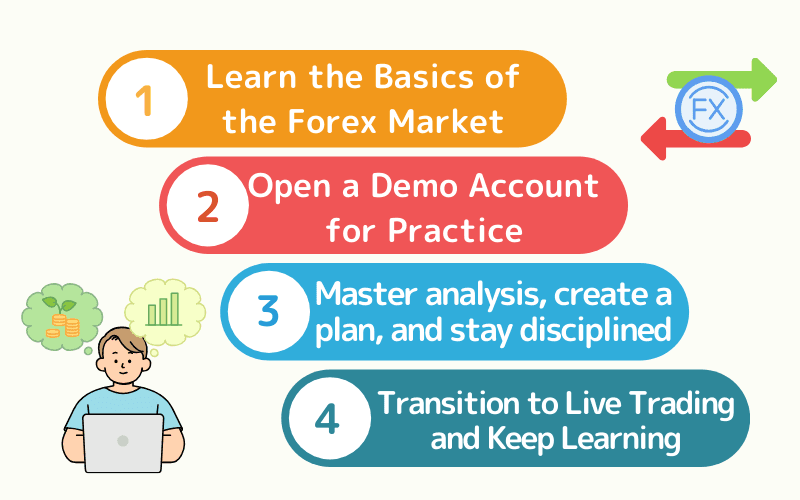
- Learn forex in four steps: basics → demo practice → analysis & plan → live & keep learning
- First understand how the market works, key terms, and who participates
- Get comfortable risk-free on a demo, then move to small live positions
- Technical analysis (candles, indicators) is quick to start; then add fundamentals and discipline
- Titan FX offers demo accounts, a low deposit barrier, and learning tools for beginners
1. Step 1: Learn the Basics of the Forex Market
Understanding the fundamentals of the forex market is crucial before starting trading. These basics will help you better comprehend how the market operates and lay a solid foundation for your trading decisions.
Titan FX Review: Overview, Features, Leverage, Instruments & Platforms"Understanding Forex Market Operations
The forex market, also known as the foreign exchange market, is a global decentralized marketplace where participants trade currencies. It operates without a central exchange, relying instead on electronic networks between banks, brokers, and financial institutions. This enables the forex market to operate 24 hours a day, from the opening of the Asian market on Monday to the close of the American market on Friday, providing traders with constant trading opportunities.
Key Forex Terms
Familiarity with basic terminology is the first step in mastering forex trading:
Currency Pair:
In forex trading, currencies are always traded in pairs, such as EUR/USD. The first currency is the base currency, and the second is the quote currency. The price of a currency pair indicates how much of the quote currency is required to buy one unit of the base currency.
Spread:
The spread is the difference between the bid price (selling price) and the ask price (buying price) and represents part of the transaction cost.
Leverage:
Leverage allows traders to control larger positions with a smaller amount of capital, amplifying both potential profits and risks.
Lots:
A "lot" is a standard unit for measuring the size of a trade. For most forex brokers, 1 lot equals 100,000 units of the base currency.
Margin:
Margin is the portion of funds deposited into your trading account to maintain open positions.
Long and Short Positions:
Long positions involve buying a currency pair with expectations of price increases, while short positions involve selling a currency pair with expectations of price decreases.
Loss Cut/ Loss Out Loss Cut is a risk control mechanism in financial transactions such as foreign exchange and Contracts for Difference (CFD). It is automatically triggered when investors use leveraged trading and the market trend turns unfavorable, causing the margin level of the account to fall below the minimum requirement.
what is loss cutFinancing cost:
Also called swap or rollover interest, this is the cost or earnings incurred for holding positions overnight due to interest rate differentials between currencies.
Main Participants in the Forex Market
The forex market comprises various types of participants, each playing different roles:
Central Banks: Manage national monetary policy, influence currency values through interest rate adjustments and forex interventions.
Banks and Financial Institutions: Provide liquidity and offer trading services to other participants.
Hedge Funds and Investment Companies: Engage in speculative investments and risk hedging.
Corporations: Exchange currencies to manage risks in international trade.
Retail Traders: Individual investors trading via brokers to seek profits.
2. Step 2: Open a Demo Account for Practice
Practicing with a demo account before engaging in real trading is an essential step for new traders. A demo account provides a risk-free environment to familiarize yourself with trading platforms and market operations while testing and improving strategies.
Benefits of a Demo Account
-
Risk-Free Environment:
Use virtual funds to trade without incurring actual financial losses, even for incorrect trading decisions. -
Platform Familiarization:
Learn how to place orders, set stop-losses and take-profit levels, and analyze charts and indicators. -
Strategy Testing:
Evaluate different trading strategies in a realistic market environment to identify the most suitable one. -
Skill Improvement:
Repeated practice can enhance your trading skills and decision-making confidence.
How to Open a Demo Account on Titan FX
Titan FX offers MT4 and MT5模擬帳戶. Follow these steps:
-
Register for a demo account on the Titan FX website and choose between MetaTrader 4 (MT4) or MetaTrader 5 (MT5).
-
Download and install the Titan FX trading platform, then set up your demo account.
Titan FX provides $50,000 in virtual funds for practice, with demo accounts valid for 30 days (renewable if needed).
3. Step 3: Learn Analysis Methods, Develop a Trading Plan, and Maintain Discipline
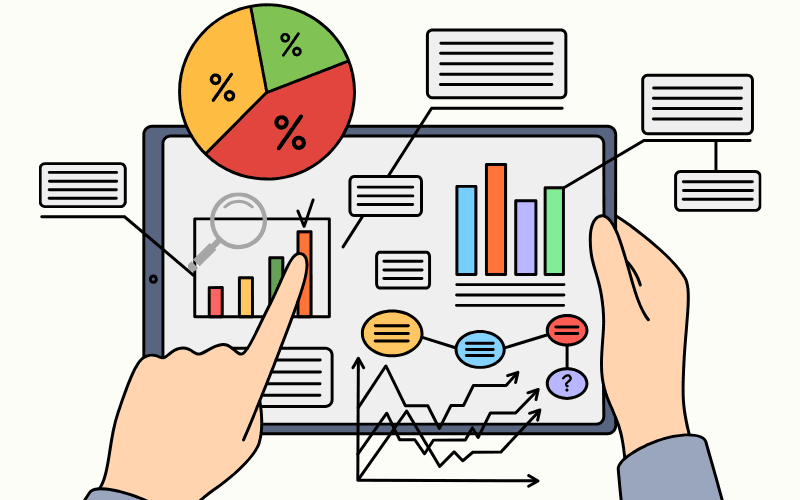
Analysis Methods
Forex analysis typically falls into two categories: technical analysis and fundamental analysis. Each has its strengths and applications:
1. Technical Analysis:
Predicts future price movements using historical price data and volume.
Candlestick Charts: Show price trends and patterns.
Indicators: Tools like moving averages (MA), Relative Strength Index (RSI), and Bollinger Bands.
Trendlines and Support/Resistance Levels: Identify key market trends and reversal points.
2. Fundamental Analysis:
Examines economic and political factors influencing currency values.
Economic Data: Metrics like GDP growth, unemployment, and inflation rates.
Central Bank Policies: Decisions on interest rates and monetary policies.
Political Events: Elections or policy changes that may impact markets.
Develop a Trading Plan
A well-structured trading plan includes:
1. Clear Goals:
Define realistic monthly or annual profit targets.
2. Risk and Money Management:
Set risk limits for each trade and determine capital allocation.
3. Entry and Exit Strategies:
Use analysis to specify trading conditions and follow them strictly.
Psychology and Discipline
Emotional Control: Avoid decisions based on fear or greed. Consistency: Stick to your plan regardless of short-term fluctuations. Continuous Learning: Adapt to market changes by updating your knowledge and skills.
4. Step 4: Transition to Live Trading and Keep Learning
After mastering the basics and practicing with a demo account, live trading and continuous learning are crucial for long-term success.
1. Start Small:
Begin with small investments to minimize risks while adapting to real market conditions.
2. Maintain a Demo Account:
Continue testing new strategies in a risk-free environment.
3. Analyze and Reflect:
Regularly review your trading records to refine strategies and improve decision-making.
5. Leverage Titan FX’s Resources
Titan FX offers extensive educational content, such as tutorials, webinars, and market analysis reports, to help traders at all levels. Advanced tools like MetaTrader 4 (MT4) and MetaTrader 5 (MT5) platforms are also available, equipped with powerful technical analysis features and automated trading options.
Through Titan FX’s resources, you can enhance your trading abilities and achieve consistent success in the forex market.
6. Frequently Asked Questions (FAQ)
Q1: How much capital do I need to start trading forex?
You do not need much to begin; most brokers' minimum deposit is around $100. For better risk control, though, $500–1,000 gives you more flexibility to practice different strategies.
Q2: When is the best time to trade forex?
The forex market runs 24 hours, but beginners find the most opportunities in higher-volatility windows — typically the overlap of the European and U.S. sessions, when liquidity is high and price action is active.
Q3: What is the difference between a demo and a live account?
A demo account uses virtual funds so you can practice orders and test strategies without pressure; a live account uses real money and carries emotional stress. Get comfortable on a demo first, then move to live trading gradually.
Q4: Should beginners learn technical or fundamental analysis first?
Start with technical analysis — candlesticks and indicators are intuitive and help you spot entries quickly. Once you have some experience, add fundamental analysis to understand how data and policy move markets; combining both is most complete.
Further Reading
- Forex Trading Basics
- Forex Trading Hours Explained
- Technical Analysis Explained
- Fundamental Analysis Explained
- Can You Start Forex with $100?
Titan FX Research Team. We cover a broad set of financial instruments — foreign exchange, commodities (crude oil, precious metals, agricultural products), equity indices, US equities, and digital assets — producing practical, research-backed educational content for investors.
Primary Sources (by Category)
- Forex market statistics: BIS Triennial Central Bank Survey
- Platform & education: Titan FX official site