
 Home
Home- Investment Guide: Strategies for Stocks, Forex, and Metals
- Grid Trading: How It Works, Types, Pros, Cons & Risks
Grid Trading Explained: How It Works, Types, Pros and Cons, and Risk Management
Grid trading is a strategy that places a series of buy and sell orders at fixed price intervals inside a set range, so that as the price swings up and down it automatically buys low and sells high, capturing the difference on every round trip. It lays a "grid" over the price chart: each time the market crosses a grid line an order fills, and the strategy stacks up small, repeated profits from the back-and-forth.
Grid trading's defining feature is that it does not try to predict direction. Whether the market goes up or down next, as long as the price keeps oscillating inside the range, the grid can buy low and sell high one line at a time. Seen this way, it is really a systematic, automated form of range trading—it takes the idea of "buy near the bottom, sell near the top" and slices it into many small cells that a program executes mechanically.
This article walks through the core concept and mechanics of grid trading, the common grid types, its advantages and its single most dangerous risk, and the practical work of setting up a grid and managing your capital—so that before you place your first grid, you can see both the profit and the blow-up sides clearly.
- A grid places buy and sell orders at fixed intervals across a price range; as price oscillates it automatically buys low and sells high, with no need to predict direction.
- It is essentially automated range trading, best suited to sideways, choppy markets, and is usually run by an EA (automated trading program) on MT4/MT5.
- Common types are arithmetic grids (a fixed price gap) and geometric grids (a fixed percentage), further split into neutral, long, and short grids.
- The deadliest risk is a one-directional trend: when price breaks out of the range and keeps going, one side stacks up growing floating losses and can blow up the account—just like a martingale.
- Using it well comes down to picking a genuinely ranging market, sizing the grid to your worst-case capital need, setting an overall stop-loss, and choosing a platform with negative-balance protection.
1. What Is Grid Trading? The Core Concept
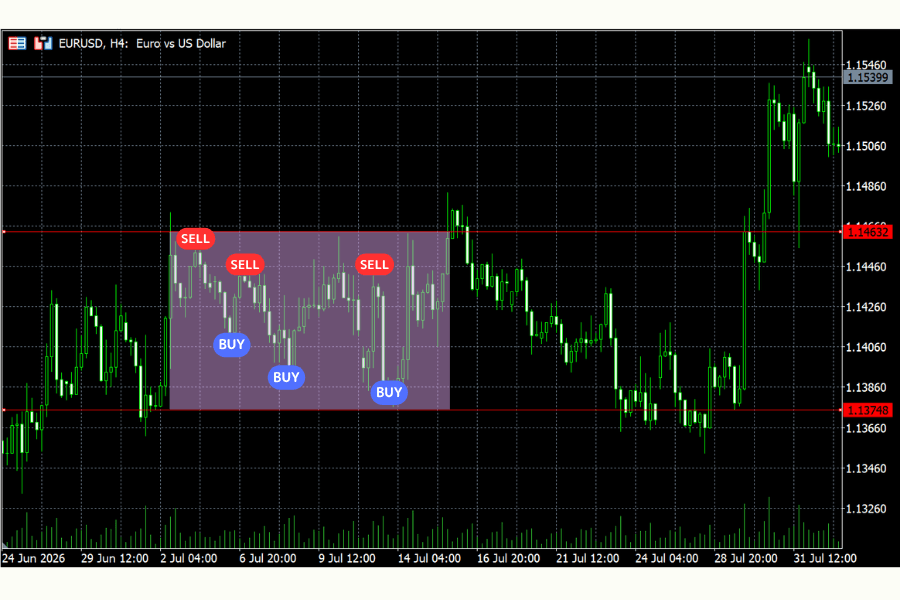
At its core, grid trading draws a row of horizontal lines (the "grid lines") at fixed intervals across a price range, and pre-places orders on each one: buy orders below, sell orders above. When the price falls to a buy line, it buys; when the price then rebounds to a sell line above, it sells for a profit. Every time the price travels back and forth through the grid, it completes another "buy low, sell high."
Unlike a one-shot directional bet, a grid does not forecast the trend—it works the volatility. You decide in advance "which range, how tightly spaced the lines, how much to trade per cell," and from there the rules run mechanically. The more the price swings, the more cells fill, and the more of that spread you collect.
Because the rules are fixed and the strategy has to watch many lines and place and cancel orders continuously, grid trading is almost always run in practice by an automated trading program (an EA) on MT4/MT5. This positioning matters: a grid earns its money from oscillation, and there is an assumption underneath it—that price is mean-reverting, that after wandering away it tends to return to its earlier range. That is exactly why it can harvest the back-and-forth, and also why it is not a risk-free arbitrage. The moment that assumption breaks and the market goes one-way, the grid's logic turns against it—the focus of Section 5.
2. How Grid Trading Works
In practice, setting up a grid involves a few steps:
| Step | What you do |
|---|---|
| ① Set the price range | Frame the upper and lower bounds you expect the price to travel between, usually from recent support and resistance. |
| ② Set the grid spacing | Decide the gap between lines. Tighter spacing fills more often but costs more (spread); wider spacing does the opposite. |
| ③ Set the lot size per cell | Decide how much to trade at each line. Lot size × the number of cells you may hold at once is the capital you need to prepare. |
| ④ Place the grid and run it | Place the buy and sell orders on each line, usually via an EA; the moment price crosses a line it fills, and the opposite order is placed. |
A simplified example: inside a range of 100–110 on some instrument, you set a line every 2 points. Price drops to 102 and triggers a buy, returns to 104 and triggers a sell—that is one cell's worth of profit. Then it falls and buys again, rises and sells again; as long as the price stays in the range, the grid keeps stacking profit trip by trip.
One caveat: your actual profit and loss is also affected by spread, overnight swap, and slippage. With many cells and long holding times, these costs nibble away at profit bit by bit, so factor them in when you choose your spacing and lot size.
3. Common Types of Grid Trading
Grids can be classified by how the spacing is calculated and by direction:
| Type | What it means |
|---|---|
| Arithmetic grid | Each line is a fixed "price" apart (e.g., every 2 points)—the most intuitive and most common. |
| Geometric grid | Each line is a fixed "percentage" apart (e.g., every 1%)—better suited to instruments with large price swings. |
| Neutral grid | Places both buy and sell orders and trades both ways—suited to a range with no clear direction. |
| Long / short grid | Places orders in a single direction only (bullish or bearish); used when you hold a directional view, but it magnifies the risk of being wrong on direction. |
Beginners most often use the "arithmetic + neutral grid": fixed spacing, two-way orders, the simplest logic. Geometric grids and directional grids are more flexible but demand a clearer read of the instrument's volatility and the market.
There is also a split by trend versus counter-trend. What this article describes—and what most people mean by "grid trading"—is the range-type (counter-trend) grid: buy the dips, sell the rallies, betting on a return to the range. There is also a trend (breakout) grid that places orders in the direction of a breakout; its logic is the exact opposite and its risk profile is different. When you see "grid trading," it usually means the former—don't confuse the two.
4. The Advantages of Grid Trading
- No need to predict direction: as long as price oscillates in the range, it profits cell by cell whether it rises or falls first, sparing you the pressure of calling direction.
- Automated and hands-off: with fixed rules and an EA to run them, a grid can operate on its own once set up—ideal for people without time to watch the screen.
- Disciplined execution: entries and exits are decided by the grid lines, avoiding emotional chasing and panic selling, and mechanically enforcing "buy low, sell high."
- Puts volatility to work: in sideways markets where other strategies struggle, a grid can steadily accumulate from the back-and-forth.
All of these advantages rest on one premise: the market really is oscillating inside the range you set. The moment price breaks into a one-way move, the risks below surface.
5. The Risks of Grid Trading
The biggest myth about grids is treating them as a "steady money-printer." They do look beautiful in a range, but the risks are all hidden in the instant the market stops oscillating:
-
A one-directional trend is the number-one killer: once price breaks out of the range in one direction and never looks back, the orders on the wrong side keep getting triggered, floating losses pile up and average down deeper and deeper, and the whole account can be dragged under. This is the grid's deadliest risk.
-
Too little capital gets you liquidated: to hold many cells at once, the account must keep enough margin; if your capital is too thin, even a normal pullback can get you force-liquidated first, with no chance to wait for price to come back.
-
The same root as a martingale: a grid, like a martingale or averaging down, props up its balance by "adding against the trend." The difference is that a grid usually adds fixed lots, while a martingale doubles the stake after every loss and swells far faster—but both fear the same thing: a one-way market that never returns. A grid with no stop-loss is, at heart, a time bomb.
-
Black swans and gaps: in a black swan event or a gap, price can jump several lines at once and blow straight out of the range, magnifying the loss on the accumulated position in an instant.
-
Cost erosion: more cells means more trades, and the spread gets paid over and over; holding overnight also adds swap. Compounded over time, these costs visibly drag down your real return.
6. How to Set Up a Grid and Manage Risk
Whether a grid is safe comes down to picking the right market and protecting your capital. In practice, run through these points:
-
Confirm it's a ranging market—and know when to quit: a grid only works in a sideways market. Before you start, confirm the price really is traveling inside a clear range, and don't force a grid when a trend is obvious. Once it's running, the moment you see signals like a valid breakout of the range, a clearly strengthening trend, a sudden jump in volatility, or a major data release or event, get ready to pause or close the grid—don't wait until floating losses run out of control.
-
Define the range with support and resistance: use support and resistance lines to frame the grid's upper and lower bounds, so the range has an objective basis rather than a gut guess.
-
Match spacing and lot size to your capital: work out the "worst case" first—if price runs all the way to the edge of the range, how many cells will you hold at once and how much margin will that need. Make sure the account can survive it before you start, and err toward wider spacing and smaller lots.
-
Always set an overall stop-loss: give the entire grid a stop-loss line or a maximum-loss cap, so that once price truly breaks out and a trend forms, you close the whole set and take the loss instead of letting floating losses expand without limit. Pairing it with money-management rules like the 2% rule makes it sturdier.
-
Choose a protected trading environment: favor a regulated broker with negative-balance protection (Zero Cut) and segregated funds, so that if an extreme move sweeps through your grid, you at least won't end up owing money.
-
Monitor the EA too: handing execution to an EA doesn't mean you can leave it completely alone—still check regularly whether the market has turned one-way and whether account margin is getting tight.
7. Grid Trading FAQ
Q1: Do I have to use an EA for grid trading?
In theory you can trade one purely by hand, but in practice few people do. A grid has to watch many lines at once and immediately re-place the opposite order after each fill—by hand you can barely keep up, and one lapse means a missed order. So most people use an EA (automated trading program) on MT4/MT5 to place and cancel orders automatically and keep the grid running around the clock. Manual trading only suits a simple grid with very few cells and a very wide range.
Q2: Which instruments suit grid trading?
Any instrument that oscillates within a range and has enough liquidity is a fit—common ones are the major forex pairs, gold, stock indices, and the more volatile cryptocurrencies. What truly matters is whether the market is ranging right now: the same instrument suits a grid while it's sideways and stops suiting one once it trends. Different instruments also vary widely in volatility, so the spacing has to be adjusted—more volatile ones (like gold or crypto) need wider spacing to avoid having profits eaten up by spread and frequent trading.
Q3: How much capital does grid trading need?
There's no fixed amount; the point is being able to "survive the worst case." Before you set up, calculate: if price reaches the edge of the range, how many cells will you hold at once and how much margin will that need—then keep a comfortable buffer on top. Capital that's too thin with too many cells can be force-liquidated by a single normal pullback. The principle is to risk only money you can afford to lose, match lot size to capital, and not force a grid beyond what you can carry.
Q4: Does grid trading require leaving the computer on all the time?
When you run it with an EA, the program has to keep running to place and cancel orders in real time, so many people pair it with a VPS (virtual private server) to keep the grid going 24 hours without interruption, unaffected by their own computer shutting down or losing connection. But whether or not you use a VPS, you still need to check the market and account regularly—you can't leave it entirely unattended.
Q5: What's the difference between grid trading and range trading?
Same direction, different execution. Range trading is mostly manual, entering and exiting near the top and bottom edges of the range; a grid slices the whole range into many cells and uses a program to buy low and sell high in each one automatically—more systematic, and more dependent on automated execution. You could say a grid is the "slice range trading finely and hand it to a machine" version, which is why both its strengths and its weaknesses are magnified.
8. Conclusion
Grid trading uses a "net" laid over the price to slice "buy low, sell high" into many small cells, letting a program mechanically stack up the spread cell by cell through the oscillation. It needs no directional forecast, runs automatically, and performs steadily in sideways markets—that is its real value.
But its logic has one fatal premise: the price has to stay oscillating inside the range. The moment it breaks into a one-directional trend, the position on the wrong side averages down deeper and deeper like a martingale, giving back the accumulated profit all at once and potentially dragging the account down with it. Using a grid well has two layers: first, pick the right market—use support and resistance to confirm it's ranging, and quit when a trend is obvious; second, protect your capital—size spacing and lots to the worst case, set an overall stop-loss, and choose an environment with negative-balance protection.
Treat a grid as a tool for "working the oscillation, but with a strict stop-loss," rather than a money-printer for guaranteed gains, and you can enjoy its automation while keeping its deadliest one-way risk outside the door.
Further Reading
- What Is Trend Following?
- What Is Counter-Trend Trading?
- What Is a CFD?
- 5 Common Stop-Loss Strategies
- Titan FX Review: Safety, Features, and Analysis
Titan FX Trade Strategy Research Lab. We create educational content across a broad range of financial instruments, including forex (FX), commodities (crude oil, precious metals, agricultural products), stock indices, US equities, and crypto assets, for investors.
Primary Sources (by Category)
- Educational resources: Investopedia, BabyPips (general definitions and operational explanations of grid trading, range trading, and money management)
- Market analysis: Bloomberg, Reuters (background on forex and CFD market conditions and volatility)