

What Is a Cold Wallet? How It Works and How to Use It Safely
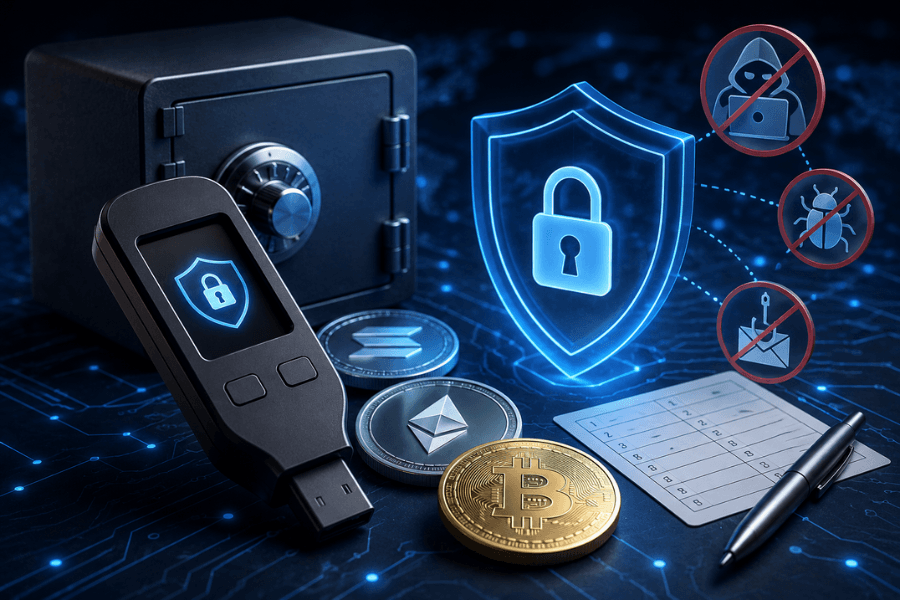
In crypto, exchange hacks and security breaches are a recurring problem. As a result, more and more investors are looking for a more reliable way to protect their assets themselves.
A cold wallet keeps the private key offline, greatly lowering the risk of remote theft, and has become an important tool for holding cryptocurrency over the long term.
This article explains how cold wallets work, the different types, how they differ from hot wallets, their pros and cons, and the practical anti-scam and risk-management points every beginner should know—so you can build safe habits from the start.
- A cold wallet stores private keys offline, sharply cutting the risk of hacks and asset theft.
- The main types are hardware wallets, paper wallets, and offline devices—hardware wallets suit most beginners.
- The key difference from a hot wallet is whether the private key stays connected to the internet.
- Cold wallets offer greater asset control and security, but are less convenient to use.
- Backing up your recovery phrase, setting a PIN, avoiding phishing, and confirming transactions are essential.
- Cold storage best suits long-term holders and anyone managing larger amounts of crypto.
- 1. What Is a Cold Wallet? How It Works, for Beginners
- 2. Types of Cold Wallet: Hardware Wallets vs. Offline Storage
- 3. Cold Wallet vs. Hot Wallet: A Full Comparison
- 4. Pros and Cons of Cold Wallets
- 5. Beginner Tips: Avoiding Scams and Managing Risk
- 6. Cold Wallet FAQ
- 7. Summary: The Right Mindset for Using a Cold Wallet Safely
1. What Is a Cold Wallet? How It Works, for Beginners
A cold wallet is a storage solution that keeps a cryptocurrency's private keys offline—or otherwise avoids exposing them to a networked environment. Unlike a hot wallet, which is always connected to the internet, a cold wallet is built so that the private key is never sitting on a device that is easy to attack remotely.
An important point: your crypto is not actually stored inside the wallet device. The assets live on the public blockchain ledger; what a cold wallet protects is the private key that controls them. That is why the phrase "not your keys, not your coins" is so well known in the crypto world.
How a cold wallet works, step by step
When you set up a hardware wallet, the device typically generates a recovery phrase (seed phrase) and the corresponding private keys. You write the recovery phrase down offline and store it securely, while the private key stays inside the device to sign transactions—it should never be entered into any online website or app. Most hardware wallets also require you to set a PIN code, which acts as the first line of defense if the device is lost or stolen.
To send assets, the cold wallet signs the transaction inside the device or in an offline environment, and only the signed transaction is broadcast to the blockchain by an internet-connected device. Throughout this process, the private key never leaves the wallet. Many devices hold the private key inside a tamper-resistant Secure Element chip and require you to physically confirm the address and amount on the device's own screen and buttons for every transfer.
This design of isolating the private key greatly reduces the chance that a remote hacker, malware, or phishing site can steal it directly. Even so, you still need to store your recovery phrase carefully and check the address, amount, and approval details on the device every time you transact.
2. Types of Cold Wallet: Hardware Wallets vs. Offline Storage
Cold wallets come in several forms that differ in security, convenience, and ease of management. Choose the one that fits your needs.
Hardware wallets
The hardware wallet is currently the most recommended choice for beginners—usually a USB-stick or credit-card-sized physical device. It has a built-in Secure Element chip, a screen, and physical buttons so you can verify the address directly. It is intuitive to use and supports many cryptocurrencies.
Paper wallets
A paper wallet is the simplest form of cold storage: you print the public address and the recovery phrase (or private key) on paper and store it fully offline. It suits small amounts or very long-term storage, but paper is easily damaged or lost, so it must be kept with special care.
Offline computer or mobile device
You can install wallet software on an old computer or phone that never connects to the internet, dedicating it to signing transactions. This is low-cost but harder to manage, and is better suited to users with some technical background.
Cold wallet comparison table
| Type | Security | Difficulty | Best for |
|---|---|---|---|
| Hardware wallet | High | Low | Most beginners |
| Paper wallet | High | Medium | Small, long-term holders |
| Offline device | Very high | High | Advanced users |
Beginners should start with a hardware wallet, which strikes a good balance between security and convenience. Always buy from official channels to avoid counterfeit products.
3. Cold Wallet vs. Hot Wallet: A Full Comparison
Cold and hot wallets are the two main ways to store cryptocurrency. They differ clearly in security, cost, and convenience, and each suits different situations.
Cold wallet vs. hot wallet comparison table
| Item | Cold Wallet | Hot Wallet |
|---|---|---|
| Private key state | Kept offline, or not exposed to a networked environment | Usually stored on a connected device or online service |
| Security | High (greatly reduces remote key-theft risk) | Medium to low (more exposed to phishing, malware, and platform risk) |
| Convenience | Lower (device confirmation needed to send or sign) | High (fast login and use, good for frequent trading) |
| Best for | Long-term storage of larger balances, reducing key-leak risk | Daily trading, DeFi, small payments |
| Main risks | Device loss or damage, poor recovery-phrase storage, signing a malicious transaction | Online hacking, malicious approvals, phishing, platform risk |
| Cost | Higher (hardware wallet purchase) | Lower (most software wallets are free) |
Cold wallets suit long-term holders who value self-custody and security, while hot wallets are better for frequent, everyday activity. Many experienced investors use both—keeping large or long-term holdings in a cold wallet and only small, everyday funds in a hot wallet—to balance security and convenience.
4. Pros and Cons of Cold Wallets
Cold wallets play a key role in storing crypto safely, but they have real-world limits. Weigh your holdings, trading frequency, and habits to decide whether cold storage is right for you.
Advantage 1: Higher security
By keeping the private key offline—or off the network—a cold wallet greatly reduces the risk of remote hacking and malware stealing your keys. Even when a hardware wallet is connected to a PC or phone during a transaction, signing is usually completed inside the device. As long as you store your recovery phrase safely and check each transaction carefully, you can effectively limit the risk of key leakage.
Advantage 2: Self-custody of assets
Using a cold wallet means holding your own private keys, without fully relying on an exchange or third-party platform to safeguard your assets. This aligns with crypto's principle of self-custody and reduces the impact of an exchange collapsing, freezing accounts, or being attacked.
Advantage 3: Ideal for long-term storage of larger balances
For larger crypto holdings you rarely move, a cold wallet offers a safer way to store them—especially well suited to long-term investing or asset preservation. That said, a cold wallet is not entirely risk-free; it must be paired with proper recovery-phrase backup, device storage, and transaction-confirmation habits.
Drawback 1: Lower convenience
Every time you send assets or sign a transaction, you typically need to connect the device and confirm the address and amount—more cumbersome than a hot wallet. Cold wallets therefore suit lower-frequency use and are not always ideal for frequent or real-time trading.
Drawback 2: Physical and human risk
Losing or damaging the device, mishandling the recovery phrase, or buying a counterfeit product can all make assets unrecoverable. In particular, a lost or leaked recovery phrase can be more serious than physical damage to the device itself. Start with a small amount to get comfortable with the workflow and backup process before storing larger sums.
5. Beginner Tips: Avoiding Scams and Managing Risk
Beginners should pay special attention to common security risks and how to guard against them. A cold wallet improves private-key security, but careless use can still lead to losses through human error or fraud.
Buying safely
Always buy a hardware wallet from the official website or an authorized reseller—avoid third-party marketplaces, used items, and devices of unknown origin. When it arrives, check that the packaging is intact and complete the initialization following the official instructions. If the device already comes with a recovery phrase or password card, or the seller asks you to use a specific recovery phrase, stop using it immediately—this is very likely a scam or a pre-configured device.
Recovery-phrase storage
The recovery phrase is the key credential for restoring your cold-wallet assets, so never photograph it, screenshot it, or save it to a computer, phone, cloud drive, or any online service. Record it offline on paper or a metal backup plate, and keep it in a fire- and water-resistant location that others cannot easily reach. For larger amounts you can consider splitting the backup, but avoid spreading it so widely that you can no longer recover it yourself.
Anti-scam tips when transacting
When sending or signing, confirm the address, amount, and approval details on the cold wallet's own screen—don't rely only on what your connected PC or phone displays. Avoid clicking unknown links, downloading suspicious wallet software, or approving smart contracts on unfamiliar sites. If you are ever asked to enter your recovery phrase or private key, or to allow remote operation of your cold wallet, treat it as an almost certain high-risk warning sign.
Other risk controls
Beginners should first test the deposit, transfer, and recovery flow with a small amount, then increase the stored balance once comfortable. Also check for hardware-wallet firmware updates periodically—but always confirm the source through the official software or website, and never download fake update programs. If anything seems off, it is better to pause and re-verify than to rush a transaction.
Trade Crypto CFDs with Titan FX
Titan FX offers 20+ crypto CFDs including BTC and ETH with up to 100:1 leverage — go long or short with no wallet or private-key management.
6. Cold Wallet FAQ
Q1. Are cold wallets really safe? Can they be hacked?
Cold wallets are usually safer than hot wallets. As long as your recovery phrase isn't leaked and you don't mistakenly sign a malicious transaction or approval, a cold wallet greatly reduces the chance that a remote attacker can obtain your private key directly. That said, a cold wallet is not entirely risk-free—you still need to guard against phishing sites, fake wallets, malicious approvals, recovery-phrase leaks, and physical loss.
Q2. What if my cold wallet is lost or damaged—do my assets disappear?
Not necessarily. Your crypto assets are recorded on the blockchain; the hardware wallet is only a tool for managing keys and signing transactions. As long as your recovery phrase remains intact and unleaked, you can usually buy a new hardware wallet, or use a compatible wallet, and restore your assets following the official process. When restoring, be sure to verify the source of the tool so you never enter your recovery phrase into a phishing site or an app of unknown origin.
Q3. Can a cold wallet store every cryptocurrency?
Not necessarily. Most mainstream hardware wallets support major coins like Bitcoin, Ethereum, and Solana plus some tokens, but niche coins or assets on specific blockchains may not be compatible. Before buying, check the official website's support list to confirm it covers the cryptocurrencies you hold or plan to hold.
Q4. Does a cold wallet need to stay plugged into my computer?
No. A hardware wallet usually only needs to connect to a PC or phone when signing transactions, updating firmware, or managing assets. Once you're done, you can unplug it and store it safely. Note that even while connected during use, the private key should remain inside the device and must never be entered into any website, app, or computer program.
Q5. Which cold wallet should a beginner buy?
Start by comparing well-known hardware wallets such as Ledger and Trezor, and confirm they support the coins you hold. Whichever you choose, always buy from the official website or an authorized channel, and avoid devices of unknown origin or secondhand units. Also test the deposit, transfer, and recovery flow with a small amount first, and move larger sums into the cold wallet only once you're comfortable with the process.
7. Summary: The Right Mindset for Using a Cold Wallet Safely
A cold wallet is one of the most important tools for protecting crypto assets. By keeping the private key offline—or off the network—it effectively reduces the risk of remote attacks and key leaks, making it especially well suited to long-term holders and anyone managing larger balances.
Yet even the safest tool only works with the right habits. Storing your recovery phrase properly, buying devices through official channels, confirming every transaction on the device itself, and testing recovery with a small amount are all essential principles you can't skip.
Beginners should practice with small amounts first to get comfortable with the workflow, and use a cold wallet alongside a hot wallet to balance security and convenience. Only by building good security habits does a cold wallet truly become a reliable guardian of your crypto—helping you manage your assets more steadily in the market.
Further Reading
Titan FX Trading Strategy Lab. We produce investor-education content covering forex, commodities (crude oil, precious metals, agricultural goods), stock indices, US equities, and digital assets.
Primary Sources (by category)
- Asset custody & self-custody: Hardware-wallet official documentation (Ledger, Trezor, etc.) on offline private-key storage and Secure Element chips
- Security & anti-fraud: Investor-education material from financial regulators and security bodies on phishing, recovery-phrase storage, and cold-wallet safety
- Blockchain basics: General technical explanations of the public blockchain ledger and public/private-key cryptography