

What Is an Oracle in Crypto? Mechanism, Use Cases, and Risks
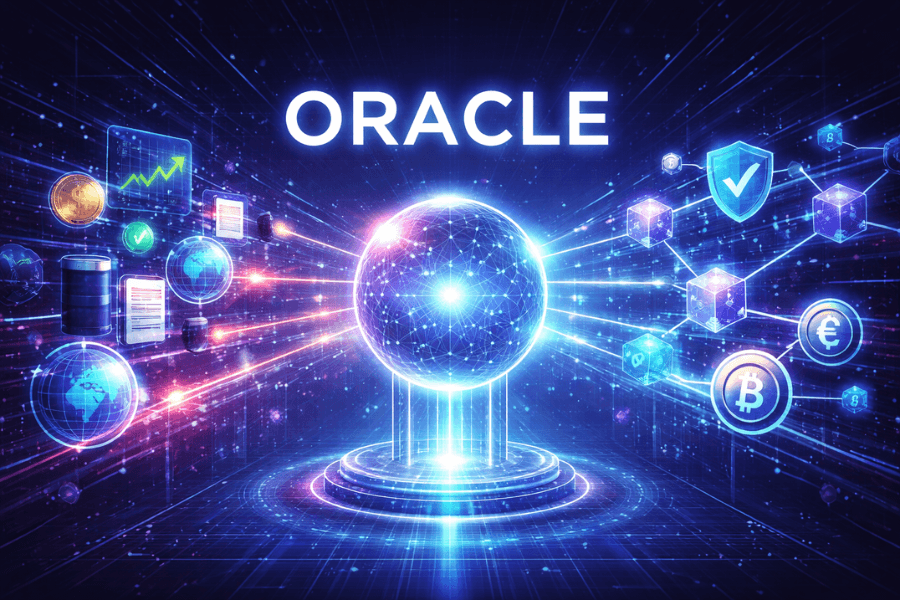
Oracles are an indispensable infrastructure layer in the crypto and blockchain world, powering DeFi, derivatives trading, stablecoins, and a wide range of other use cases.
Put simply, an oracle delivers external market data (such as prices) onto the blockchain so that smart contracts can execute correctly. For traders, the oracle directly affects both the source of price data and the outcome of trades.
This article explains what an oracle is, how it works, and the practical applications and potential risks of oracles in crypto trading.
- How an oracle works as a data bridge between the blockchain and the outside world
- The difference between centralized and decentralized oracles, and how multi-node verification works
- The role oracles play in DeFi lending and liquidation, perpetual contract mark prices, and stablecoin pegs
- Major oracle projects: Chainlink, Band Protocol, Pyth Network, API3
- The risks of oracle attacks (price manipulation) and how to evaluate them
1. What Is an Oracle?
An oracle is a data bridge between the blockchain and the outside world. Its job is to deliver off-chain data—market prices, financial information, event outcomes—onto the blockchain so that smart contracts can execute automatically based on that information.
In plain terms, the oracle's role is to give the blockchain access to real-world information, which in turn powers a wide range of practical applications.
The following types of common data are all delivered through oracles:
- Real-time prices for Bitcoin (BTC), Ethereum (ETH)
- Forex and commodity market quotes
- Interest rates, indices, and other financial data
This information does not exist natively inside the blockchain, so it must be supplied to smart contracts via an oracle.
Why Does Blockchain Need Oracles?
Blockchains are decentralized and tamper-resistant by design, but they also carry an important constraint: they cannot directly access external (off-chain) data.
Without oracles:
- DeFi platforms cannot retrieve market prices
- Lending protocols cannot determine when to liquidate
- Derivatives contracts cannot settle correctly
For example, when a user pledges ETH as collateral on a DeFi platform to borrow funds, the system must know ETH's real-time market price to judge whether the collateral is sufficient. That price information is exactly what the oracle supplies.
Oracles can therefore be considered one of the critical pieces of infrastructure that keep the entire DeFi ecosystem functioning.
2. How Oracles Work
The core function of an oracle is to deliver external data onto the blockchain securely so that smart contracts can use it. Broadly speaking, the oracle handles "data transmission and verification" and serves as the bridge connecting the blockchain to the real world.
In general, an oracle pulls data from external sources—exchanges, financial APIs, and so on—then organizes and verifies that data before sending it to the blockchain. The smart contract then automatically performs the corresponding operation based on that data.
2.1 How Is Price Data Generated?
In crypto trading and DeFi applications, "price" is one of the most critical pieces of data. To avoid bias from any single source, many oracles reference quotes from several exchanges simultaneously and aggregate them through weighted averaging or outlier rejection.
This design effectively dampens the impact of short-term volatility and one-off anomalies on a single platform, so the price ultimately delivered to the smart contract is more stable and closer to actual market conditions.
2.2 Why Do Oracles Need a Verification Mechanism?
If the data an oracle delivers is inaccurate, it directly affects how smart contracts execute—causing, for example, mistaken liquidations or trade outcomes that diverge from market price.
For that reason, many decentralized oracles (such as Chainlink) use multiple nodes that supply data simultaneously and cross-check each other, ensuring data consistency and reliability.
This is why oracles are not merely data-transmission tools but a key piece of infrastructure that keeps the broader blockchain financial system running properly.
3. Oracle Applications in Crypto Trading
Oracles are used widely across crypto markets, especially in DeFi, where almost every price-related mechanism depends on them. For traders, the data oracles supply directly affects trade outcomes and risk management.
3.1 DeFi Lending and Liquidation
On DeFi lending platforms, users typically pledge crypto assets (such as ETH) as collateral to borrow funds. The platform calculates whether liquidation conditions have been met based on the market price of the collateral.
If the market price drops and the value of the collateral falls below the safety threshold, the system automatically triggers liquidation to limit the lender's risk. The "price judgment" behind that decision is supplied by the oracle.
In other words, the speed and accuracy of an oracle's price updates directly determine whether liquidation occurs—and when.
3.2 Perpetual Contracts and Derivatives
Oracles play an important role in crypto derivatives markets too, including perpetual contracts.
Many trading platforms use the oracle price as the "Mark Price" to dampen the impact of short-term volatility and momentary spikes on forced-liquidation mechanisms. This makes liquidations fairer and reduces the risk of market manipulation.
For that reason, when a trader runs high-leverage positions, the price that actually triggers liquidation is typically not the execution price on a single exchange but the aggregated price from the oracle.
3.3 Stablecoins and Price Pegs
Stablecoins (such as USDT and USDC) need to maintain a peg to the U.S. dollar, which also depends on the market data oracles supply.
When the market drifts off-peg, the corresponding mechanisms (arbitrage, supply adjustments, and so on) make corrections based on oracle prices in order to maintain the stablecoin's stability.
This means oracles affect not only individual trades but the overall price stability of the crypto market.
4. Types of Oracles and Major Projects
Oracles can be classified in several ways depending on their design and data sources. The most common distinction is whether they are decentralized.
4.1 Centralized vs. Decentralized Oracles
Centralized oracles are typically supplied by a single institution. The advantage is speed and architectural simplicity, but they carry single-point-of-failure and data-manipulation risks.
Decentralized oracles, by contrast, have multiple nodes jointly supplying and verifying data, with the final result produced through an aggregation mechanism.
This approach costs more, but its advantages in security and reliability have made it the standard in DeFi.
4.2 Major Oracle Projects
A number of well-known oracle projects exist in the market today; representative ones include:
- Chainlink (LINK): Currently the most mainstream decentralized oracle. Multiple nodes supply price data, and it is widely adopted by DeFi protocols.
- Band Protocol (BAND): An oracle built on the Cosmos ecosystem, emphasizing speed and cross-chain applications.
- Pyth Network (PYTH): Focused on high-frequency price data, common in derivatives and trading platforms.
- API3: Lets data providers deliver data on-chain directly, reducing middle-layer risk.
These projects each have advantages in different applications, but their core goal is the same: delivering trustworthy, real-time off-chain data.
5. Oracle Risks and Cautions
Oracles are essential for blockchain applications, but they carry their own risks. For traders, understanding these potential issues helps in evaluating market risk more comprehensively.
5.1 Price Manipulation Risk (Oracle Attack)
If the data sources an oracle relies on are too concentrated or lack effective verification, the oracle can become a target for price manipulation attacks (oracle attacks).
For example, an attacker influences the price on a specific exchange, causing the oracle to read anomalous data, which in turn triggers mistaken liquidations or arbitrage opportunities. Incidents of this kind occurred multiple times in the early DeFi market.
Trade Crypto CFDs with Titan FX
Titan FX offers 20+ crypto CFDs including BTC and ETH with up to 100:1 leverage — go long or short with no wallet or private-key management.
6. Conclusion: Why Traders Should Understand Oracles
Oracles are an important bridge between the blockchain and the real world. Many traders never interact with an oracle directly during their day-to-day trading, but the data oracles supply has a deep effect on market operations and trade outcomes.
Understanding how oracles work and the risks they carry gives a more complete picture of market structure, supporting more rational decisions when markets move.
In actual trading, choosing a stable and transparent trading environment is just as important. For example, using a platform that offers CFD trading allows for more flexible market participation and risk management.
Further Reading
Titan FX's financial market research and analysis team produces investor education content across a wide range of financial instruments, including foreign exchange (FX), commodities (crude oil, precious metals, and agricultural products), stock indices, U.S. equities, and crypto assets.
Primary Sources by Category
- Protocol documentation: Official documentation from Chainlink, Pyth Network, Band Protocol, API3 and other major oracle projects.
- Blockchain reference materials: Ethereum Foundation and major DeFi protocol documentation.
- Market and risk references: CoinGecko / CoinMarketCap market data and public research on DeFi price feeds and oracle attacks.