

Robotics Stocks
Robotics concept stocks are shares of listed companies closely tied to the robotics value chain—spanning upstream core components (such as reducers, servo motors, and sensors), midstream machine manufacturing and system integration, and downstream applications in industry, services, and healthcare. Driven by global automation, AI, and national smart-manufacturing policies, these stocks have been re-rated in recent years, though they also carry risks such as rapid technological turnover, intense competition, and valuation swings. Robotics stocks have become one of the most closely watched themes in financial markets in recent years.
As global automation accelerates, AI technology spreads, and national industrial policies push factory modernisation, capital has increasingly flowed toward shares of robotics-related companies.
This article walks through what robotics stocks are, how the value chain is structured, which companies represent the space, and the opportunities and risks involved — so you can grasp the whole theme quickly.
- Definition: robotics stocks are shares of companies tied closely to the robotics value chain
- Why it is popular: labour-cost shifts, AI and sensor breakthroughs, and supportive industrial policy
- Value chain: upstream components, midstream assembly and integration, downstream applications
- Key players: global leaders like FANUC, ABB and KUKA plus Asia-Pacific names
- Opportunity vs risk: a long automation trend, but watch tech obsolescence and valuation swings
1. What Are Robotics Stocks?
Robotics stocks (Robotics Stocks) are the shares of listed companies whose business is closely linked to the robotics value chain. Those companies may focus on core components, build complete robots, or deploy robotics in applications such as healthcare, logistics, and home services.
Compared with other thematic stocks, robotics stocks share a few distinctive traits:
- Technology-driven: built on AI, machine vision, and control systems
- Broad applications: from industrial manufacturing and surgical assistance to smart warehousing and home cleaning
- Policy support: many governments treat smart manufacturing and automation as strategic priorities
Because of this, robotics stocks are not just a single-industry label — they are an investable proxy for technological innovation and industrial upgrading. They are also referred to as robot stocks or automation stocks.
2. Why It Became a Popular Theme
Several structural forces explain why robotics stocks have drawn capital and attention.
Reason 1: A changing labour structure
With global ageing and rising labour costs, many industries face hiring shortages and higher wage bills. Robots can replace part of the labour input, lifting efficiency while lowering long-run costs.
Reason 2: Technology breakthroughs and wider use
Advances in AI, 5G connectivity, machine vision, and sensing have made robots more flexible and intelligent. Their use has spread from factories into healthcare, retail, and even the home.
Reason 3: Policy tailwinds
Governments increasingly treat smart manufacturing as a core strategy for industrial upgrading. Programmes such as China's "Made in China 2025" and advanced-manufacturing initiatives in the United States have provided policy and funding support to the sector.
Together these factors give robotics stocks a long-term growth logic, which is why they have become a sought-after theme in capital markets.
3. The Robotics Value Chain
The robotics industry is broad. Its value chain splits into upstream components, midstream robot bodies and system integration, and downstream applications.
Upstream: core components
This includes servo motors, precision reducers, control chips, and sensors — the parts that largely determine a robot's performance and cost. Technical barriers are high here, and margins tend to be relatively stable.
Midstream: robot bodies and system integration
This covers makers of industrial, service, and special-purpose robots, plus the system integrators that fit robots into production processes. This layer turns technology into real-world, large-scale deployment.
Downstream: application scenarios
Applications span automotive, electronics, logistics and warehousing, medical, education, and home cleaning. As demand for AI and automation rises, the downstream market has the strongest growth potential.
For investors, upstream offers stability, midstream benefits from demand expansion, and downstream represents growth potential — each layer presents a different opportunity profile.
4. Representative Robotics Stocks
Robotics stocks are not one industry but span the full chain from core components to robot manufacturing to downstream applications. The table below organises representative global and Asia-Pacific companies.
Global and Asia-Pacific players
| Company | Region | Main focus | Market position | Investment angle |
|---|---|---|---|---|
| FANUC | Japan | Industrial robots | Global leader | High reliability and standardisation; widely used in auto and electronics |
| ABB | Switzerland | Automation and smart factory | International major | Broad solutions across energy, automation, and robotics |
| KUKA | Germany | Industrial and service robots | Precision specialist | Strong smart-factory integration; expanding into medical and service robots |
| SIASUN | China | Industrial / service robots | China leader | Deep R&D base; spans logistics, medical, and education |
| ESTUN | China | Industrial robots and control | Growth company | Cost advantage supporting steady share gains |
| Delta Electronics | Taiwan | Industrial automation | Asia-Pacific representative | Power management extending into automation, new energy, and AI |
Company notes
FANUC
A global leader in industrial robots, with stable quality and a high degree of standardisation. Its robots are widely used in automotive and precision manufacturing, and durability plus strong after-sales support have kept its global share among the highest. It is a common reference point for stability-focused investors.
ABB
More than a robot supplier, ABB provides comprehensive automation solutions spanning energy management, smart factories, and power grids. Its broad coverage gives it relatively strong resilience to single-industry swings.
KUKA
A flagship of German manufacturing, KUKA is strong in precision machinery and smart-manufacturing integration. Beyond industrial robots, it has moved into medical and service robotics, including surgical and smart-healthcare solutions, broadening its addressable market.
SIASUN
A leading dedicated robotics company in China, SIASUN has an integrated chain of R&D, manufacturing, and applications. Its products are used in industrial manufacturing, logistics, medical, education, and research, supported by policy backing for smart manufacturing.
ESTUN
A fast-growing Chinese robotics company focused on industrial robots and automation control. A localised cost advantage and R&D capability have helped it expand share in the mid-market segment.
Delta Electronics
Starting from power management, Delta has expanded into industrial automation and smart manufacturing, with active moves in new energy and AI. Its power and electronics base supports integrated solutions and competitiveness in the Asia-Pacific market.
5. Opportunities and Risks
Robotics stocks attract market interest, but investors should weigh growth potential and underlying risk together.
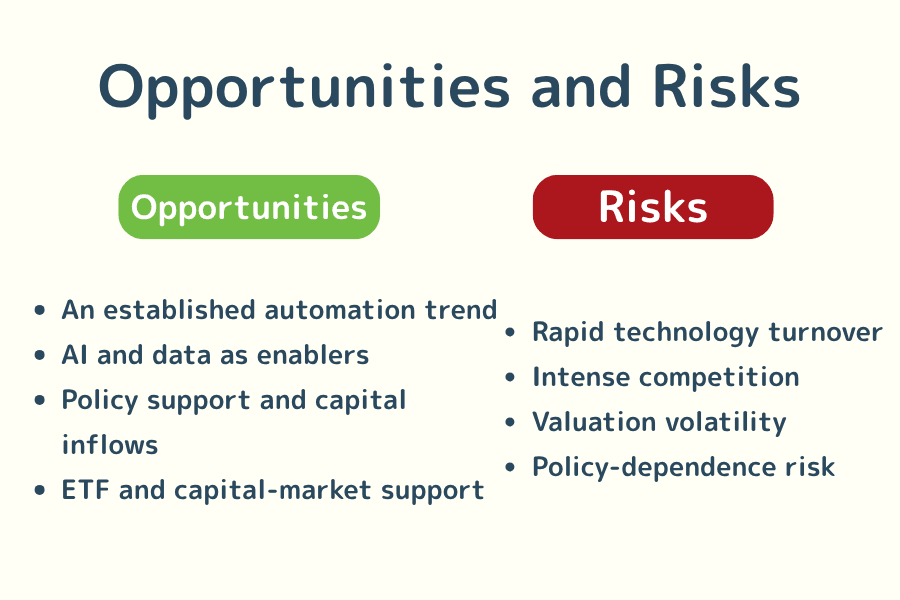
Opportunities
Opportunity 1: An established automation trend
With labour shortages and rising costs, companies are speeding up automated production, sustaining demand for industrial robots.
Opportunity 2: AI and data as enablers
Progress in AI, machine vision, and speech recognition is extending robots from traditional industrial use into medical, logistics, education, and home services, widening the market.
Opportunity 3: Policy support and capital inflows
Many governments treat smart manufacturing as a strategic industry, using tax incentives, subsidies, and R&D support to drive the whole value chain.
Opportunity 4: ETF and capital-market support
Thematic funds and ETFs draw in long-term capital and help keep related names in steady market focus, with diversified exposure across the chain.
Risks
Risk 1: Rapid technology turnover
Robotics is a high-tech field with short product cycles, requiring continuous R&D. Falling behind technically can quickly erode competitiveness.
Risk 2: Intense competition
Global majors and emerging firms compete on the same stage; price wars and homogenisation can compress margins and pressure smaller players.
Risk 3: Valuation volatility
Because the theme runs hot, valuations can become stretched, and shifts in sentiment can trigger sharp corrections. Checking earnings power through financial fundamentals matters here.
Risk 4: Policy-dependence risk
If subsidies shrink or industrial policy tightens, the profitability of some companies may be affected.
6. Frequently Asked Questions (FAQ)
Q1. What is the difference between robotics stocks and automation stocks?
Robotics stocks focus on companies that develop or build robot bodies or core components. Automation stocks are broader, covering smart manufacturing, automated production lines, and industrial software, and do not always involve a robot body directly.
Q2. Is now a reasonable time to invest in robotics stocks?
Over the long run, ageing, labour shortages, and industrial upgrading support structural growth. In the short run, however, the theme can become overpriced, so watch for valuation corrections and shifts in market sentiment.
Q3. Which investors are best suited to robotics stocks?
Long-term investors can focus on value-chain leaders to capture the durable automation trend. Thematic investors can position around AI and smart-manufacturing trends. More volatile phases also create short-term opportunities for investors with higher risk tolerance and disciplined risk management.
Q4. How do you pick quality robotics stocks?
Screen by technical barriers (core technology such as servo motors, reducers, and AI algorithms), industry position (whether the company is a value-chain leader), financial and earnings strength (margins, R&D intensity, cash flow), and fit with policy and demand. Many such names also carry growth-oriented, higher-volatility characteristics, so position sizing matters.
Q5. In what ways can you participate in the robotics theme?
Beyond buying individual shares, you can use thematic ETFs for diversified exposure across the chain, or CFDs to take part in the price moves of related U.S. equities. Each tool has a different risk and cost profile, so choose according to your own risk tolerance.
7. Conclusion
Robotics stocks reflect the long-term trends of automation, artificial intelligence, and industrial upgrading, making them a theme-driven investment.
To participate, investors can choose global leaders, regional representatives, or diversified exposure through an ETF, depending on their own risk tolerance.
Whichever route, it pays to combine fundamental analysis with risk management and engage the market rationally rather than chasing the theme.
Further Reading
- What Is a CFD?
- What Is a Growth Stock?
- What Is a Value Stock?
- What Is an IPO?
- What Is Stock Par Value?
Titan FX Research Hub — investor education across foreign exchange, commodities (oil, precious metals, agriculture), stock indices, U.S. equities, and crypto assets.
Primary Sources (by category)
- Industry and market overview: International Federation of Robotics (IFR) public statistics; public smart-manufacturing policy materials (Made in China 2025, advanced-manufacturing initiatives, etc.)
- Company information: public annual reports and investor-relations materials (FANUC / ABB / KUKA / SIASUN / ESTUN / Delta Electronics)
- Investment-tool concepts: general public knowledge on ETFs and CFDs; Titan FX platform public information