

Trade Surplus
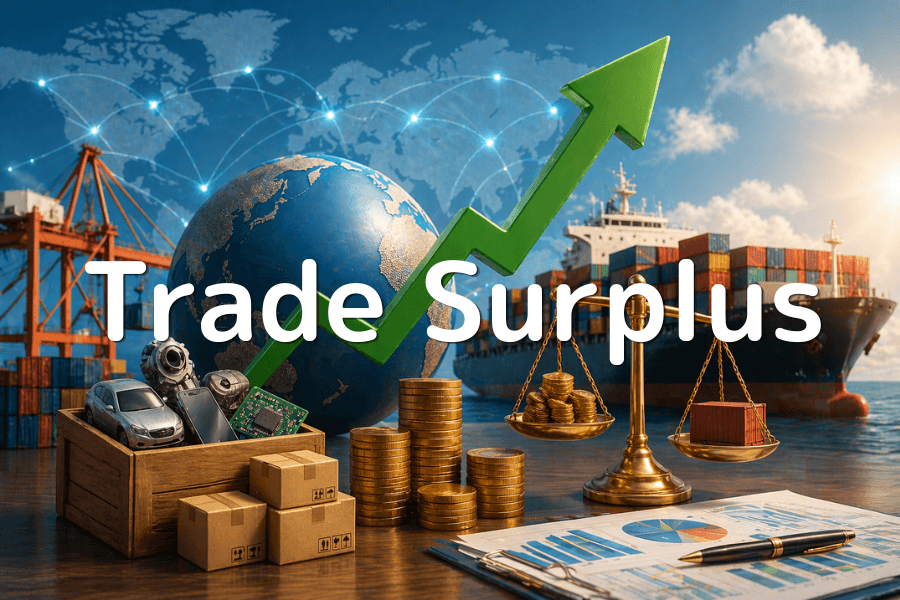
A trade surplus is an economic condition where a country's total exports exceed its total imports.
When export income exceeds import spending, the economy earns a net inflow from external trade, usually bringing foreign-exchange inflows, higher demand for the local currency, and attention to industrial competitiveness. But a trade surplus does not always equal a strong economy — you must judge whether it comes from export growth or shrinking import demand.
This article covers the definition of a trade surplus, how to read the trade balance, common causes, and its possible effects on exchange rates, stock markets, and different industries.
- Definition and calculation: the core of a trade surplus and balance, surplus vs deficit
- Three causes: telling a healthy surplus from a passive one
- Pros and risks: not treating a surplus as a simple positive
- Market impact: typical effects on FX and assets, and macro reading
- Practical watch: optimising allocation when trade data is released
1. What Is a Trade Surplus? Reading the Balance
A trade surplus is a state in which an economy's total value of exported goods and services exceeds its total imports over a period. It is also called "net exports," meaning a net inflow of funds in international trade.
Trade balance formula
Trade balance = total exports − total imports
- Result > 0: trade surplus
- Result < 0: trade deficit
| Term | Alias | Core trait | Fund flow |
|---|---|---|---|
| Trade surplus | Net exports | Exports > imports | Net inflow |
| Trade deficit | Net imports | Imports > exports | Net outflow |
A trade surplus is a key component of the current account and reflects an economy's trade competitiveness in international markets.
2. Why Does a Trade Surplus Occur? Three Causes
A surplus usually relates to industrial competitiveness, the exchange-rate environment, and domestic demand. Judging quality is not about the amount but whether the surplus comes from "export growth" or "import contraction."
| Cause | How it creates a surplus | Common reading |
|---|---|---|
| Strong industrial competitiveness | Higher export value | Healthy surplus |
| Weaker local currency | More competitive export prices | FX-driven |
| Insufficient domestic demand | Lower import demand | Passive surplus |
Cause 1: Industrial competitiveness and technological lead
A country with globally competitive core industries — semiconductors, advanced manufacturing, precision machinery, medical equipment — sees stable demand and can keep export value high. This kind of surplus is relatively healthy because it reflects technology, brand, supply-chain position, and production efficiency.
Cause 2: An export price edge from currency moves
When the local currency is relatively weak, foreign buyers' costs fall and exports become more price-competitive, which can lift export orders and value and widen the surplus. But if firms rely on imported inputs, currency weakness can also raise costs, so FX effects must be viewed both ways.
Cause 3: Relatively weak domestic demand cutting imports
Not every surplus comes from strong exports. Sometimes a surplus widens because weak domestic consumption and lower business investment cut demand for imported materials, equipment, or goods. This "passive surplus" improves the balance on the surface but does not necessarily mean a stronger economy — it may signal weak domestic demand.
3. Is a Trade Surplus Always Good? Pros and Risks
A surplus is often seen as a sign of economic strength, but in practice it is double-edged. A healthy surplus comes from rising export competitiveness; a "passive surplus" from weak demand and falling imports instead hints that the economy is weakening.
| Dimension | Economic advantage | Potential risk |
|---|---|---|
| National finance | Builds FX reserves, resilience to financial swings | Currency-appreciation pressure, weaker long-run export edge |
| Industry | Supports exporters, drives investment and jobs | Over-reliance on external demand; bigger hit when global growth weakens |
| International relations | Reflects competitiveness and supply-chain position | Persistent large surpluses can trigger trade friction and sanctions |
Advantage: FX reserves and national credit
A surplus means export income exceeds import spending, letting a country build ample FX reserves. This is a national "emergency fund," helps stabilise sovereign credit, and gives more policy room in international financial crises.
Risk: Structural imbalance and external pressure
A long surplus can upset trade partners and lead to tariff probes or sanctions. And if growth relies too much on external demand, a downturn in major partners shakes the domestic economy without domestic demand as a defensive backstop.
4. Effects on FX, Exporters, and Stocks
A trade surplus is not just macro data; it can affect exchange rates, corporate profits, and capital flows. But the effect is not one-directional — return to the source of the surplus and FX moves to interpret it.
| Affected | Linkage logic | What to watch |
|---|---|---|
| FX | More inflows can raise local-currency demand | Whether appreciation hurts export competitiveness |
| Exporters | More orders can support revenue | FX gains/losses and gross-margin changes |
| Importers | Appreciation can cut procurement cost | Materials, food, energy-related firms |
| Overall market | FX income and profits can improve | Whether the surplus is high-quality export growth |
Effect 1: Currency strength and purchasing-power change
As a surplus widens, foreign buyers usually need to buy the exporter's currency to pay, which tends to lift the local currency. Appreciation raises international purchasing power and lowers import costs, but if it rises too fast it can weaken export price competitiveness.
Effect 2: Exporters may face FX pressure
Exporters benefit from more overseas orders and FX income, but if the currency appreciates due to the surplus, overseas income shrinks when converted back, creating FX pressure. Beyond orders and revenue, watch hedging ability, cost structure, and gross-margin changes.
Effect 3: Importers and domestic-demand sectors may benefit from appreciation
If the surplus lifts the currency, firms reliant on imported materials, energy, food, or brand distribution may see margins improve as procurement costs fall. The real effect depends on whether they can convert lower costs into profit and whether end demand is stable.
Effect 4: Stock reading depends on the surplus's source
If the surplus comes from high-value-added export growth, the market tends to value its support for profits and competitiveness. But if it mainly comes from import contraction, it may reflect weak demand or slowing investment — not necessarily a positive for stocks. The surplus figure should not be read in isolation.
5. Frequently Asked Questions (FAQ)
Q1. Does a bigger surplus always lift the stock market?
Not necessarily. If the surplus comes from "import contraction" (weak domestic demand), it reflects stalled future growth momentum, and stocks may not respond positively. Also, if the currency appreciates sharply from the surplus, the hit to exporters can offset the positive trade data.
Q2. Why do some countries with a surplus still see prices keep rising?
A trade surplus mainly affects the current account and FX, but inflation is shaped by monetary policy, energy prices, wages, and supply bottlenecks. Large FX inflows boosting domestic liquidity can also add to price pressure.
Q3. What should investors watch when exports hit a record?
Look at the "quality" and "structure" of exports, not just whether the total is a record: whether exports are concentrated in one industry, whether they are high-value-added, whether the currency is appreciating fast, whether profits improve in step, and whether export growth is sustainable.
Q4. Are a trade surplus and a current-account surplus the same?
No. A trade surplus mainly looks at the gap between exports and imports; the current account also includes goods, services, income, and current transfers, a broader scope. So a country with a trade surplus does not necessarily have a current-account surplus.
Q5. Does a trade surplus last forever?
No. A surplus is affected by industrial competitiveness, FX cycles, global growth, and trade policy, and can narrow — or even turn into a trade deficit — as major partners' demand changes, the currency appreciates, or tariffs are imposed. Treat it as a dynamic indicator, not a constant state.
6. Conclusion
A trade surplus is an important gauge of a country's export competitiveness, FX income, and industrial structure, but it should not be reduced to a simple positive. A healthy surplus comes from export growth and high-value-added competitiveness; a passive surplus may come from weak domestic demand or import contraction.
The key to reading it is understanding the source. A surplus from stronger exports usually means real competitiveness in international markets; one from weaker imports may reflect slowing consumption and investment demand.
It should also be viewed alongside FX, corporate margins, industrial structure, and global demand. Only by placing a trade surplus back into the larger economic context can you avoid being led by a single number. In one line: a trade surplus is not always an across-the-board positive — the key is whether exports got stronger or imports got weaker.
Further Reading
- What Is the Current Account?
- What Is a Trade Deficit?
- What Is GDP?
- What Is Fundamental Analysis?
- What Is a CFD?
Titan FX Research Hub — investor education across foreign exchange, commodities (oil, precious metals, agriculture), stock indices, U.S. equities, and crypto assets.
Primary Sources (by category)
- Trade and balance of payments: general public concepts of national trade statistics and the current account
- FX and markets: general public knowledge on the link between exchange rates and the trade balance
- Investment concepts: general public knowledge on fundamental analysis and CFDs; Titan FX platform public information