

Treasury Stock
Treasury stock is an important part of corporate capital strategy, but for most investors it stops at the idea that "a company buying back shares = a positive." In reality, it touches market supply and demand, financial figures, corporate strategy, and capital allocation, and its effect can be positive or carry hidden risk.
To understand it correctly, you need to start from its accounting nature, the reasons a company starts a buyback, the actual impact on price and financial metrics, and how to read the announcement details. This article organises these points so investors can grasp what treasury stock really does and how to interpret it.
- Definition: treasury stock is repurchased, company-held shares — non-circulating, no votes, no dividends
- Company motives: stabilise price, lift EPS/ROE, employee rewards, undervaluation, capital structure
- Metric impact: fewer shares lift EPS/ROE on paper, not a true earnings improvement
- Two-sided effect: can signal confidence, or be a price-prop / window-dressing risk
- Reading it: judge purpose, price and ratio, cash level, and later use together
1. Treasury Stock: Concept and Definition
Treasury stock (also called treasury shares; in Chinese 庫藏股) is shares a company buys back from the market out of its issued shares and then holds itself. Treasury stock does not circulate, carries no voting rights, receives no dividends, and is not counted in shares outstanding, so it directly affects the calculation of earnings per share (EPS), equity structure, and supply and demand, and can indirectly lift return on equity (ROE). Because they are repurchased and held, their disposition is flexible — kept, transferred, or cancelled per company strategy.
Financial nature
Treasury stock is essentially shares a company buys back with its own funds and holds. Excluded from shares outstanding, it affects many metrics including EPS, ROE, book value per share (BVPS), and float. It brings no extra equity and is usually a deduction on the balance sheet, so equity falls relatively on the books. These traits make it an important tool for adjusting financial structure and capital strategy.
Treasury stock vs capital reduction
A buyback itself is not the same as a capital reduction; while held, shares can be kept or repurposed. Only when the company cancels treasury stock does share capital formally fall. A capital reduction, by contrast, directly cancels shares and permanently lowers capital — an irreversible structural change. In short, treasury stock offers flexibility; a capital reduction is a formal, permanent adjustment.
Clearing up a common myth
Many investors assume a buyback always means a positive, but treasury stock is just the financial action of buying back shares; its meaning depends on later use and financial condition. With ample funds and sound finances, it tends to be read as management confidence; large buybacks amid tight cash or scarce investment opportunities can be a risk signal. Read financials, cash level, and strategy together — not the surface wording of the announcement.
2. Why Companies Buy Back Shares
A buyback plan usually has a clear motive tied to market conditions, financial structure, strategy, or valuation. Understanding the reason helps judge whether it is truly a positive and whether the company is addressing a specific issue.
- ▸Reason 1: Stabilise the price and strengthen confidence
- ▸Reason 2: Improve EPS and related ratios
- ▸Reason 3: A share source for employee rewards or future strategy
- ▸Reason 4: Management sees the stock as undervalued
- ▸Reason 5: Adjust capital structure and improve fund efficiency
Reason 1: Stabilise the price and strengthen confidence
When sentiment is weak or the price has detached from fundamentals, a buyback can ease selling pressure and limit price distortion. Management using corporate funds to buy is usually read as recognising the company's value and wanting to stabilise expectations — often seen during sharp short-term swings or unreasonable pullbacks from external events.
Reason 2: Improve EPS and related ratios
After buyback, the shares are excluded from the float, so with unchanged net profit, EPS and ROE naturally rise. For companies this improves financial metrics and capital efficiency; some start buybacks before earnings or when market attention rises to strengthen perceived profitability.
Reason 3: A share source for employee rewards or future strategy
Treasury stock can fund employee equity incentives, RSUs, or share-based rewards. Unlike issuing new shares, repurposing treasury stock does not dilute existing holders. Some firms keep it for M&A, share swaps, or strategic partnerships, adding flexibility.
Reason 4: Management sees the stock as undervalued
With stable earnings and healthy cash, if management believes the market values the firm below its real worth, a buyback can convey confidence. This is usually a long-term strategic judgement based on a value view, not short-term operation, and the market tends to read it positively.
Reason 5: Adjust capital structure and improve fund efficiency
If cash is excessive but attractive investments are scarce short-term, a buyback can raise fund efficiency, turning idle cash into more shareholder-favourable returns. It can also bring the capital structure (equity, debt, shareholders' equity) closer to long-term strategy and improve financial flexibility.
3. Effects on the Company and Investors
A buyback is a financial operation but also affects market price, financial metrics, shareholder structure, and investor expectations. Outcomes differ greatly by motive, so understanding both positive and negative effects is core to reading announcements.
- ▸Effect 1: Short-term support, not a long-term guarantee
- ▸Effect 2: EPS and ratio improvement is a structural change
- ▸Effect 3: A two-sided effect on psychology and valuation
- ▸Effect 4: Using cash lowers financial flexibility
- ▸Effect 5: In certain cases, a negative signal
Effect 1: Short-term support, not a long-term guarantee
A buyback adds buying and usually supports the price short-term and limits excessive falls. But the effect is mostly short-term; the long run still depends on fundamentals, industry outlook, and the market. It is not a guarantee of long-term gains but part of the short-term market reaction.
Effect 2: EPS and ratio improvement is a structural change
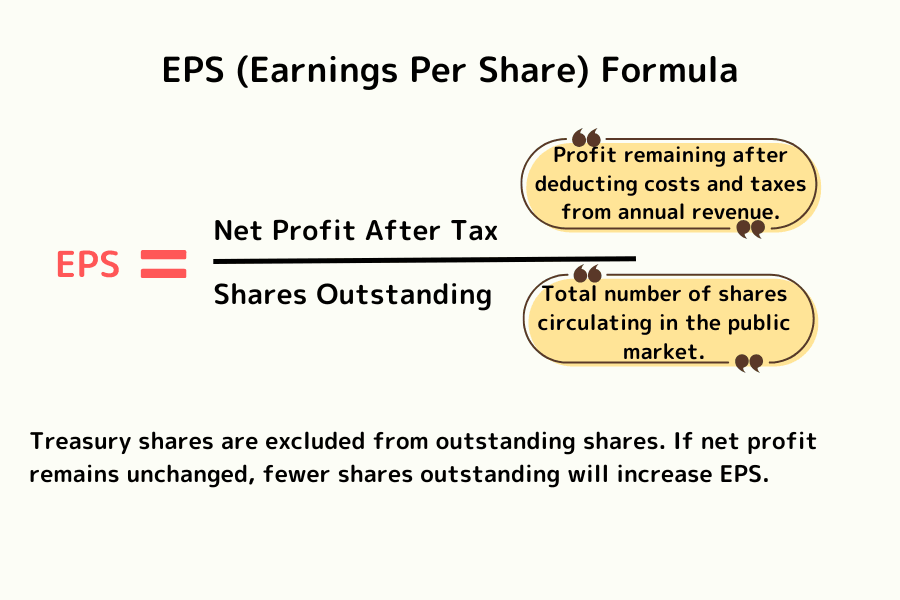
Treasury stock is excluded from the float, so with unchanged net profit, EPS and ROE rise. But this improvement is not better earnings power — it is due to a lower denominator (float or equity). When assessing results, do not mistake a higher book figure for a true operational improvement.
Effect 3: A two-sided effect on psychology and valuation
Treasury stock can strengthen confidence, but if the buyback lacks a clear strategy, has poor timing, or the price stays weak afterwards, the market may question growth or suspect metric window-dressing. This two-sidedness calls for especially careful interpretation.
Effect 4: Using cash lowers financial flexibility
Buybacks are paid in cash; the larger the amount, the more it affects cash flow and flexibility. With limited cash or concurrent heavy capex and debt needs, it can weaken safety and the ability to handle cycles and shocks. Watch free cash flow, debt ratio, and whether buyback size is consistent.
Effect 5: In certain cases, a negative signal
Buying back at high prices, frequent buybacks without improving valuation, or debt-funded buybacks can be read as governance or fund-efficiency problems. Deliberately lifting EPS or short-term price also raises doubts about governance quality and strategy. These can be a long-term investment risk, not a positive.
4. Practical Mechanics and How to Read It
A buyback looks simple but involves strict legal procedures, execution pace, and follow-up use planning. Investors can correctly assess the real meaning for company value and market reaction only by understanding how it is executed (mechanics) and how to read the intent and impact (interpretation).
Practical mechanics
| Item | Description |
|---|---|
| Disclosure, period, price range | Purpose, cap, period, and expected price range disclosed by law. More specific and detailed means more active; vague disclosure warrants caution. |
| Daily ratio and total limit | Many countries cap buybacks to prevent price interference (e.g. a share of prior-day volume). Approaching the limit indicates execution strength and intent. |
| Later use | Cancellation, employee rewards, strategic transfer, or long-term holding. Use greatly changes the impact on supply/demand and EPS, so watch follow-up disclosure. |
How to read it
| Item | What to watch |
|---|---|
| Is the purpose reasonable? | If aligned with finances, industry position, and conditions, credibility is higher. Weak fundamentals plus a buyback may be price-propping or short-term steadying. |
| Are price and ratio effective? | Too high a price raises cost; too low a ratio limits price/EPS improvement. Whether it is actually executed distinguishes a strategic move from a gesture. |
| Cash level and financial structure | Buybacks need much cash. Debt pressure or weak free cash flow can erode flexibility. Check repayment and operating capacity. |
| Is later use clear? | Use for rewards, partnerships, or capital operations suggests long-term planning. Long-unstated use may show a lack of strategy. |
5. Frequently Asked Questions (FAQ)
Q1. Does treasury stock cause dilution?
No. Treasury stock is bought back and held by the company and is not in the float, so it does not dilute. Instead, with fewer shares outstanding, existing holders' proportion relatively rises. Dilution occurs only if the company reissues it or issues new shares.
Q2. Can treasury stock be sold again?
Yes. After holding it, a company may, per rules, resell, transfer, or use it for employee rewards. If the market price exceeds the buyback cost, reselling can even produce a gain, but it increases the float and may affect the price reaction.
Q3. How long until treasury stock must be disposed of?
It depends on market rules, but many markets require disposal within a set period (cancellation, transfer, or incentive plans). Long holding with no clear use should prompt investors to consider whether the firm lacks a capital direction or is deliberately supporting the price.
Q4. Are treasury stock and a share-buyback plan the same?
Close but not identical. A share repurchase is the act of buying back; treasury stock is the shares the company holds as a result. Beginners often conflate them, but understanding the difference helps read announcements.
Q5. Where can individual investors find treasury-stock information?
On statutory disclosure platforms, earnings-call decks, annual reports, and financial notes, including purpose, period, quantity, price range, and later use. Tracking these regularly helps gauge capital strategy and management's direction.
6. Conclusion
A treasury-stock buyback is an important financial tool for adjusting capital structure, managing market expectations, and improving fund efficiency. It is not necessarily a positive, nor merely a price-support tool, but a financial action that should be read by combining cash flow, industry environment, disclosed purpose, and later use.
For investors, what truly matters is not the buyback itself but "why the company buys back" and "how it uses the shares afterward." Grasping the nature, observing disclosure, and understanding short- and long-term effects lets you read capital strategy and market reaction more precisely and build more complete fundamental-analysis ability.
Further Reading
Titan FX Research Hub — investor education across foreign exchange, commodities (oil, precious metals, agriculture), stock indices, U.S. equities, and crypto assets.
Primary Sources (by category)
- Accounting and metrics: general public knowledge on accounting and financial analysis of EPS / ROE / BVPS
- Corporate capital policy: general public knowledge on share buybacks (treasury stock)
- Investment judgement: general educational material on fundamental analysis; Titan FX platform public information