

Daylight Saving Time (DST)

Daylight saving time (DST) is the practice of moving clocks forward by one hour during the summer months to make better use of daylight, and is also known as "summer time." It begins each spring and reverts to standard time (the period markets often call "winter time") in autumn—a long-standing seasonal time adjustment across Europe, North America, and other regions.
Because DST changes the time difference between these regions and places that don't observe it, it can shift the local-time timing of forex, equities, precious metals, and key economic data. For traders in Asia, where DST is not used, sticking to a standard-time routine can mean missing market opens, data releases, or the most liquid trading sessions.
This article explains what DST is, how it differs from standard time (winter time), which countries observe it, and how it shapes trading hours across forex, precious metals, and equities—plus a FAQ to help you build a clear picture quickly.
- Daylight saving time (DST) moves clocks forward one hour in summer, mainly across the US and Europe.
- Most East and Southeast Asian markets—such as Japan, Hong Kong, and Singapore—do not observe DST.
- The US and EU/UK switch on different dates, creating short mismatch periods each spring and autumn.
- Once regions shift to DST, their market hours and data releases fall about an hour earlier in Asian time.
- MT4/MT5 server time switches between GMT+2 and GMT+3, affecting candle closes and session displays.
- 1. What Is Daylight Saving Time? Defining DST
- 2. DST vs. Winter Time: Switch Dates at a Glance
- 3. Which Countries Observe DST? US, Europe, and Asia Compared
- 4. How DST Affects Trading: Forex, Precious Metals, and Economic Data
- 5. What to Watch at the DST Switch: Three Trader Checkpoints
- 6. Daylight Saving Time FAQ
- 7. Conclusion
1. What Is Daylight Saving Time? Defining DST
Definition: What DST Means
Daylight saving time (DST) is the practice of advancing standard time by one hour during the summer months, when daylight lasts longer. The term combines Daylight, Saving, and Time, and it is widely known in many markets simply as "summer time."
During DST, people get more natural light in the evening; in autumn, clocks are set back to standard time (the period markets often call "winter time").
Why Is DST Used?
The system was originally intended to extend usable evening daylight and reduce lighting demand. Its actual energy-saving effect, however, remains the subject of differing research findings and ongoing policy debate.
Even so, most of the US, the EU, the UK, parts of Australia, and New Zealand still use seasonal time changes—so DST continues to have a real impact on the scheduling of cross-border financial trading.
At a Glance: Core Concepts of DST
| Item | Description |
|---|---|
| Other names | Summer time, Daylight Saving Time, DST |
| How it works | Clocks move forward one hour in summer, back to standard time in autumn |
| Main regions | Most of the US, the EU, the UK, parts of Australia, and more |
| Asia | Most East and Southeast Asian markets do not observe it |
DST is only a one-hour difference, but because it changes the time gap between these regions and Asia, it has a significant effect on trading across time zones.
2. DST vs. Winter Time: Switch Dates at a Glance
Summer time (DST) and standard time (commonly called winter time) are two periods that alternate through the year. Because the US and EU/UK use different switch dates, traders need to remember them separately.
The US and EU/UK Switch on Different Dates
| Region | DST begins | DST ends (back to standard time) |
|---|---|---|
| United States | Second Sunday of March | First Sunday of November |
| EU & UK | Last Sunday of March | Last Sunday of October |
The dates below use 2026 as an example; always confirm the actual switch dates against that year's official announcements.
| Event | United States | EU & UK |
|---|---|---|
| DST begins | March 8, 2026 | March 29, 2026 |
| Back to standard time | November 1, 2026 | October 25, 2026 |
The Key Trap: The Spring and Autumn "Mismatch Periods"
Because the US enters DST earlier and exits later than Europe, two brief "mismatch periods" occur each year:
- Spring (e.g., March 8–29, 2026): the US is already on DST, while the EU and UK are still on standard time.
- Autumn (e.g., October 25 – November 1, 2026): the EU and UK have returned to standard time, while the US is still on DST.
During these windows, the overlap between the London and New York sessions—and the relative timing of each market—differs from usual, making these the periods when traders most easily get the time wrong.
3. Which Countries Observe DST? US, Europe, and Asia Compared
DST is not used worldwide; it is concentrated in mid-to-high-latitude regions with large seasonal swings in daylight. Knowing where it applies helps you keep track of trading hours across markets.
Regions That Observe DST
Most of the US, EU member states, the UK, parts of Australia, and New Zealand observe DST. The US, however, is not uniform: Hawaii, most of Arizona (except the Navajo Nation), and some overseas territories do not observe it, and only some Australian states take part.
Regions That Do Not Observe DST
Most East and Southeast Asian markets do not observe DST. Many Asian markets at UTC+8 and UTC+9—for example, Japan at GMT+9 and Hong Kong at GMT+8—keep a fixed time zone all year and do not change their local clocks with Europe or the US.
So whenever Europe and the US move in or out of DST, what Asian traders experience is not a change to their own clocks, but rather "the whole timeline of the US and European markets shifting by one hour." This is the core idea Asian traders most need to grasp.
4. How DST Affects Trading: Forex, Precious Metals, and Economic Data
For traders in Asian time zones, DST mainly shows up in three areas: forex trading hours, the precious metals and commodities markets, and the release times of major economic data. Getting a handle on these shifts helps you avoid missing moves because of the time difference.
Effect 1: Forex Sessions Move Earlier
The forex market generally runs as a relay of major sessions—Sydney/Wellington, Tokyo, London, and New York. Because Asian time zones don't observe DST, once Europe and the US switch to DST, the London and New York sessions both open and close one hour earlier in Asian time.
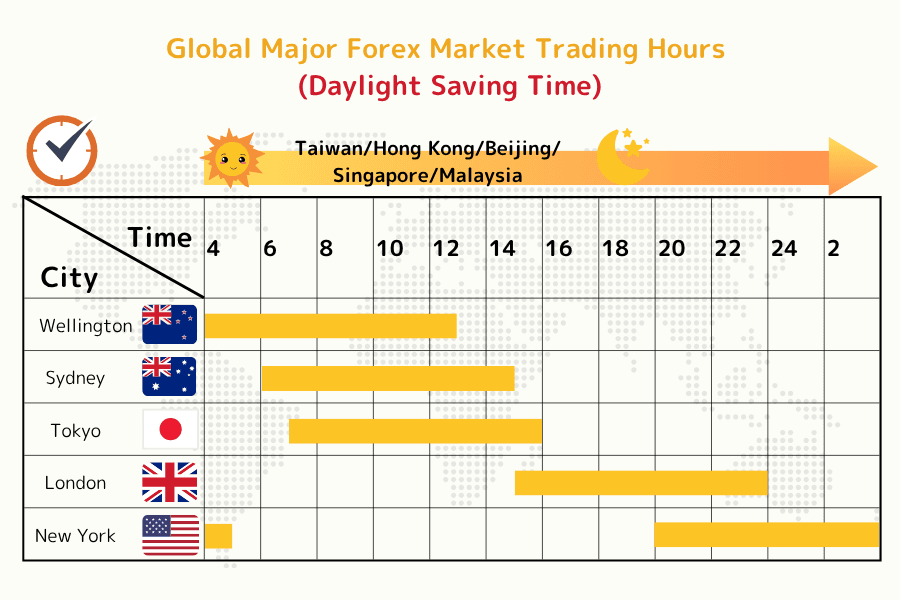
This means the European and US windows with the highest liquidity for major pairs such as GBP/USD and EUR/USD shift earlier overall in Asian time. In addition, during the mismatch periods when US and European dates differ, the London–New York overlap can briefly gain or lose an hour, so it needs to be recalculated for the year in question. Traders used to entering at specific times should move their routine and pending-order times forward by an hour after the switch.
Effect 2: Active Hours for Precious Metals and Commodities Change
Commodities such as gold (XAU/USD), silver, and crude oil also depend heavily on the London and New York sessions for pricing and liquidity. Once DST takes effect, the most active hours for these commodities—and the time when key benchmark prices such as the London Fixing are set—also move one hour earlier in Asian time. Traders running swing or intraday strategies during the European and US sessions should pay close attention to this one-hour shift.
Effect 3: Release Times for Major Economic Data Change
US economic data—such as Nonfarm Payrolls (NFP), the Consumer Price Index (CPI), and the FOMC rate decision—are released in US local time, while European data are released in each region's local time. Converted to an Asian time zone that doesn't observe DST, the release times move by an hour in line with the DST switch of the relevant region.
We recommend using an economic calendar and an economic indicators list to check the latest release times at any moment. If you also follow US equities, the US stock trading hours overview is worth a look too, so you don't wait on a standard-time schedule and miss the sharp moves right at the open.
5. What to Watch at the DST Switch: Three Trader Checkpoints
DST may look like a minor "move the clock forward an hour" event, but it affects every trading session tied to Europe and the US. The three checkpoints below will help you get through each year's switch smoothly.
Checkpoint 1: Confirm Your MT4/MT5 Server Time
Many traders overlook this: the time shown on MT4/MT5 is not your local time but "server time." Titan FX's MT4/MT5 server time is generally GMT+2 during US standard time and GMT+3 during US DST.
This setting lets the daily candle close at the New York close, so the daily chart's boundaries follow the convention of the international forex market. When the season changes, it's worth reconfirming the latest official trading-hours schedule.
Checkpoint 2: Update Your Trading Calendar and Recheck Execution Windows
When DST begins or ends, recheck market opens, data releases, and your strategy's execution windows. Pending orders with an expiry time, and EAs or automated strategies that rely on server time, also need a check. Note that ordinary stop-loss and take-profit orders trigger on price conditions and won't have their trigger prices changed automatically by the clock switch.
Checkpoint 3: Mind the Mismatch Periods and Swaps
The spring and autumn "mismatch periods" are when time is most easily misread, so take extra care. In addition, swaps are usually calculated at the platform's server rollover time; after a DST switch, that moment—converted to your local time—can fall an hour earlier or later, so confirm the latest product specifications and trading hours before holding a position overnight.
6. Daylight Saving Time FAQ
Q1. Are daylight saving time and summer time the same thing?
Yes. "Daylight saving time," "summer time," "Daylight Saving Time (DST)," and "Summer Time" all refer to the same system; only the customary name differs by region.
Q2. If I'm in Asia, do I need to change my own clock when DST switches?
No. Japan, Hong Kong, Singapore, Malaysia, and most other Asian markets don't observe DST and keep a fixed time zone all year. So what you adjust is not your own clock but the local-time conversion of when US and European markets open, close, and release data.
Q3. Will my open positions or pending orders be affected after the DST switch?
Your positions won't be changed by the system. Ordinary stop-loss and take-profit orders trigger on price conditions and won't have their trigger prices changed by the clock switch. What you should watch are pending orders with an expiry time, strategies based on market open times, and time conditions inside EAs or automated programs—these may need rechecking because of the server-time shift.
Q4. Why are the DST dates different in the US and Europe?
Because each region sets its switch dates by its own laws: the US uses "the second Sunday of March to the first Sunday of November," and the EU and UK use "the last Sunday of March to the last Sunday of October." As a result, a mismatch period arises each spring and autumn.
Q5. How can I tell whether it's currently DST or standard time?
Check the date table in this article, or look directly at whether your MT4/MT5 server time is GMT+2 (standard-time period) or GMT+3 (DST period). Titan FX's official trading-hours schedule is also a useful reference.
7. Conclusion
Daylight saving time (DST) may look like a small "one hour forward" event, but it drives the trading hours of the forex, precious metals, commodities, and equity markets, as well as the converted release times of major economic data. For traders in Asian time zones, three things matter most:
- ① Remember the different switch dates in the US and EU/UK, and watch the spring and autumn mismatch periods.
- ② Once DST starts, US and European market and data-release times fall about an hour earlier in local time, so adjust your routine and pending orders accordingly.
- ③ Update your trading calendar and recheck the MT4/MT5 server-time change (GMT+2/GMT+3) so you don't misread server time against your local time.
If, at each year's switch in March and October/November, you proactively update your trading calendar and reconfirm your platform's server time, you can avoid missing moves due to the time difference and keep your trading rhythm in sync with global markets.
Further Reading
- What Is the London Fixing?
- What Is Slippage?
- What Is Volatility?
- Economic Calendar
- US Stock Trading Hours
Titan FX Trading Strategy Lab. We produce investor-education content covering forex, commodities (crude oil, precious metals, agricultural goods), stock indices, US equities, and digital assets.
Primary Sources (by category)
- Law & official: U.S. Uniform Time Act and U.S. Department of Transportation (DOT) DST regulations; EU Directive 2000/84/EC — EU summer-time arrangements
- Standards & time-zone data: IANA Time Zone Database — global time zones and DST switch rules
- Trading platform: Titan FX official trading-hours notices — MT4/MT5 server time (GMT+2/GMT+3) and DST adjustments