

US Stock Market Hours 2026: Regular, Pre-Market, After-Hours and Holiday Calendar

Daylight saving time ends on Sunday, November 1, 2026, so from Monday, November 2, the opening bell rings at 14:30 UTC instead of 13:30 UTC. In Singapore and Hong Kong (UTC+8), that moves the open from 9:30 p.m. to 10:30 p.m.
Outside the regular session, US stocks also trade in pre-market, after-hours and overnight sessions, and US index futures and CFDs trade almost around the clock. The same headline can land in very different liquidity depending on which session it hits.
This guide covers the regular session in ET, UTC and UTC+8, the 2026–2027 daylight saving dates, the pre-market, after-hours and overnight sessions, index futures and CFD hours, the remaining 2026 and full 2027 holiday calendar, and how US hours line up with London, Tokyo, Hong Kong and Singapore.
- The regular session runs 9:30 a.m.–4:00 p.m. ET; that is 14:30–21:00 UTC in winter and 13:30–20:00 UTC in summer
- From Monday, November 2, 2026, US stocks trade on standard time; daylight saving time returns on Monday, March 15, 2027
- Pre-market runs 4:00–9:30 a.m. ET and after-hours 4:00–8:00 p.m. ET; overnight trading is currently offered by brokers through alternative trading systems (ATS)
- NYSE Arca and Nasdaq plan to move to 23-hour trading on December 6, 2026, subject to SEC approvals and industry systems being ready
- Two full holidays remain in 2026, Thanksgiving (11/26) and Christmas (12/25), plus 1:00 p.m. early closes on 11/27 and 12/24
- 1. US stock market opening and closing times
- 2. Daylight saving time: standard time from November 2, 2026
- 3. Pre-market, after-hours and overnight trading hours
- 4. Index futures and CFD trading hours
- 5. US stock market holidays 2026–2027
- 6. US market hours vs London, Tokyo, Hong Kong and Singapore
- 7. The most active hours of the US trading day
- 8. FAQ
- 9. Summary
1. US stock market opening and closing times
US stocks trade mainly on the New York Stock Exchange (NYSE) and Nasdaq. Both run their regular session from 9:30 a.m. to 4:00 p.m. ET, Monday through Friday, for 6.5 hours a day.
Volume is heaviest and spreads are tightest during these hours, and the official opening and closing prices are set in the exchanges' 9:30 a.m. and 4:00 p.m. auctions.
How the two venues differ is covered in our guide to the three major US stock exchanges.
Eastern Time itself shifts with the seasons: EST (UTC-5) in winter and EDT (UTC-4) in summer. The bell rings at the same local time all year, but the UTC time moves twice a year.
| Period | Eastern Time (ET) | UTC | Singapore, Hong Kong (UTC+8) |
|---|---|---|---|
| Standard time (winter) | 09:30–16:00 | 14:30–21:00 | 22:30–05:00 next day |
| Daylight saving time (summer) | 09:30–16:00 | 13:30–20:00 | 21:30–04:00 next day |
2. Daylight saving time: standard time from November 2, 2026
US daylight saving time (DST) starts on the second Sunday of March and ends on the first Sunday of November, with the change made at 2:00 a.m. local time.
Because the switch always falls on a Sunday, the new times apply from the following Monday's session.
| Change | Date | First session affected | Open in UTC | Open in UTC+8 |
|---|---|---|---|---|
| DST ends | Sunday, November 1, 2026 | Monday, November 2 | 14:30 | 22:30 |
| DST begins | Sunday, March 14, 2027 | Monday, March 15 | 13:30 | 21:30 |
| DST ends | Sunday, November 7, 2027 | Monday, November 8 | 14:30 | 22:30 |
The House of Representatives passed the Sunshine Protection Act, which would make daylight saving time permanent, in July 2026. The Senate has not voted on it, so the schedule above stands unless the bill becomes law.
Europe ends summer time a week earlier, on October 25, 2026. From October 26 to 30, London is only four hours ahead of New York instead of the usual five.
Titan FX's MT4/MT5 server time switches with US daylight saving time (GMT+2 in winter, GMT+3 in summer), so the 9:30 a.m. ET open always shows as 16:30 on the platform. Orders and alerts set in platform time need no adjustment in the changeover week.
3. Pre-market, after-hours and overnight trading hours
| Session | Eastern Time (ET) | UTC (winter) | UTC (summer) |
|---|---|---|---|
| Pre-market | 04:00–09:30 | 09:00–14:30 | 08:00–13:30 |
| Regular session | 09:30–16:00 | 14:30–21:00 | 13:30–20:00 |
| After-hours | 16:00–20:00 | 21:00–01:00 | 20:00–00:00 |
| Overnight (ATS) | 20:00–04:00 next day | 01:00–09:00 | 00:00–08:00 |
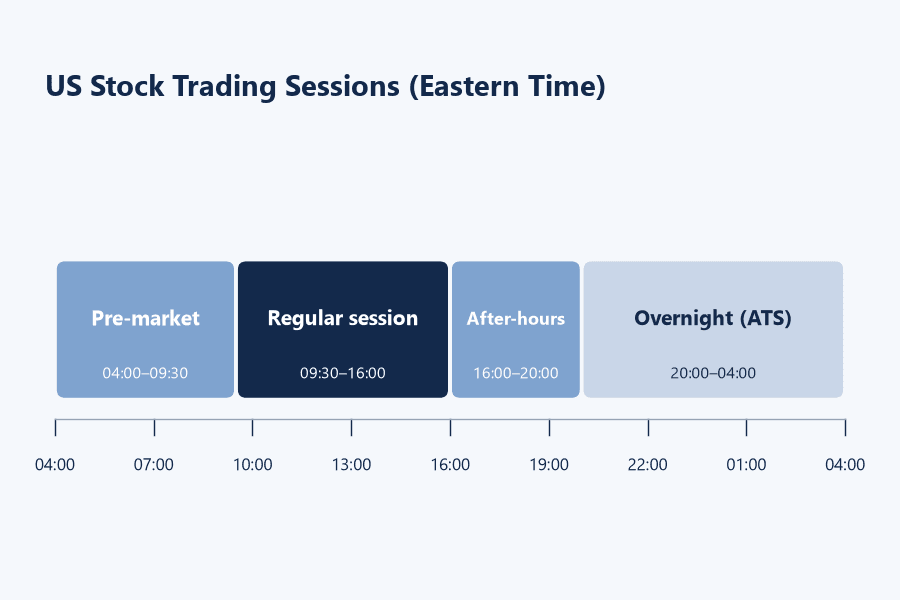
Pre-market trading starts at 4:00 a.m. ET. Earnings, deal news and the economic data released at 8:30 a.m. often hit prices here first.
4:00 a.m. is when Nasdaq and NYSE Arca open their early sessions; the NYSE itself does not match orders until its 9:30 a.m. opening auction. The time you can actually start trading depends on which venues your broker routes to.
After-hours trading continues until 8:00 p.m. ET. Most US companies report after the close, so single stocks often gap in this session, especially during earnings season.
Overnight trading is offered by some brokers through alternative trading systems (ATS), from 8:00 p.m. to 4:00 a.m. ET, Sunday through Thursday nights. That is daytime Monday to Friday in Asia.
Extended sessions have fewer participants and wider spreads, most brokers accept only limit orders, and only a subset of stocks trades overnight.
23-hour trading on the exchanges
NYSE Arca and Nasdaq plan to add an overnight session (9:00 p.m.–4:00 a.m. ET) on December 6, 2026. Trading would then run from 9:00 p.m. Sunday to 8:00 p.m. Friday, with a one-hour pause from 8:00 to 9:00 p.m. ET each day.
According to NYSE, the launch remains subject to SEC approvals, the readiness of the Securities Information Processors (SIPs) and the Depository Trust & Clearing Corporation's (DTCC) systems. Only exchange member broker-dealers can trade the new session directly, so individual investors will access it through a broker.
4. Index futures and CFD trading hours
US index futures such as the E-mini S&P 500 (ES), E-mini Nasdaq-100 (NQ) and E-mini Dow (YM) trade on CME Globex from 6:00 p.m. ET Sunday to 5:00 p.m. ET Friday, with a daily maintenance break from 5:00 to 6:00 p.m. ET.
Futures trade on adjusted schedules around US holidays, so check CME's holiday calendar for specific dates.
News that breaks after the cash close, and trading in the Asian and European sessions, shows up in futures prices first. Traders often use them to gauge where the US market will open.
If you cannot follow the cash market during the regular session, CFDs let you trade index and single-stock price moves on margin without owning the shares, go long or short, and trade for longer hours than the cash market.
Titan FX's US CFD hours, converted from the official schedule:
| Product | Platform time | Eastern Time (ET) |
|---|---|---|
| Index CFDs such as US500, NAS100 and US30 | 01:00–23:59 | 18:00–16:59 next day |
| US stock CFDs | 11:00–23:59 | 04:00–16:59 |
Because the platform clock moves with US daylight saving time, these ET hours are the same all year.
Index CFDs follow the futures session almost exactly. Stock CFDs open with the 4:00 a.m. ET pre-market and close about an hour after the regular session. Both close early on Fridays, at 23:55 platform time.
Titan FX offers CFDs on more than 100 US stocks on MT5, with 20:1 leverage, no commission, and the ability to go long or short.
5. US stock market holidays 2026–2027
The NYSE and Nasdaq close for US federal holidays and close early, at 1:00 p.m. ET, around some of them.
When a holiday falls on a Saturday, the market closes on the Friday before; when it falls on a Sunday, the market closes on the Monday after.
Remaining 2026 holidays and early closes
| Date | Holiday | Schedule |
|---|---|---|
| Thu, Nov 26 | Thanksgiving Day | Closed |
| Fri, Nov 27 | Day after Thanksgiving | Early close, 1:00 p.m. ET |
| Thu, Dec 24 | Christmas Eve | Early close, 1:00 p.m. ET |
| Fri, Dec 25 | Christmas Day | Closed |
2027 market holidays
| Date | Holiday |
|---|---|
| Fri, Jan 1 | New Year's Day |
| Mon, Jan 18 | Martin Luther King, Jr. Day |
| Mon, Feb 15 | Washington's Birthday (Presidents Day) |
| Fri, Mar 26 | Good Friday |
| Mon, May 31 | Memorial Day |
| Fri, Jun 18 | Juneteenth (observed; June 19 is a Saturday) |
| Mon, Jul 5 | Independence Day (observed; July 4 is a Sunday) |
| Mon, Sep 6 | Labor Day |
| Thu, Nov 25 | Thanksgiving Day |
| Fri, Dec 24 | Christmas Day (observed; December 25 is a Saturday) |
The only early close in 2027 is Friday, November 26, the day after Thanksgiving, at 1:00 p.m. ET.
The bond market follows the Securities Industry and Financial Markets Association (SIFMA) holiday recommendations, which do not match the stock market's exactly.
Titan FX publishes a monthly trading hours update; CFD hours around US holidays follow that notice.
6. US market hours vs London, Tokyo, Hong Kong and Singapore
| Market | Local trading hours | UTC (November to March) |
|---|---|---|
| US (NYSE, Nasdaq) | 09:30–16:00 ET | 14:30–21:00 |
| London | 08:00–16:30 | 08:00–16:30 |
| Tokyo | 09:00–11:30, 12:30–15:30 | 00:00–02:30, 03:30–06:30 |
| Hong Kong | 09:30–12:00, 13:00–16:00 | 01:30–04:00, 05:00–08:00 |
| Singapore | 09:00–12:00, 13:00–17:00 | 01:00–04:00, 05:00–09:00 |
Three differences stand out:
-
No lunch break and the longest day: the regular session runs 6.5 hours straight, and with pre-market and after-hours, US stocks trade 16 hours a day
-
A short overlap with London: in winter, London and New York are both open for two hours, from 14:30 to 16:30 UTC
-
No daily price limits: single stocks pause briefly after sharp moves, and if the S&P 500 falls 7% or 13% from the previous close before 3:25 p.m. ET, trading halts market-wide for 15 minutes; a 20% fall ends trading for the day
7. The most active hours of the US trading day
Titan FX's Volatility Heatmap shows the average hourly range (high minus low) for each day-and-hour slot over the past year. Choose the "Indices" category and the US500 symbol:
-
The darkest cells are 16:00–18:00 platform time (9:00–11:00 a.m. ET), the two hours around the 9:30 open, where the range is more than three times that of the Asian midday hours
-
The range picks up again in the last hour before the close (22:00–23:00 platform time, 3:00–4:00 p.m. ET)
-
Wednesday 21:00–22:00 and Friday 15:00–16:00 are darker than the same hours on other days, matching FOMC rate decisions at 2:00 p.m. ET and the jobs report at 8:30 a.m. ET
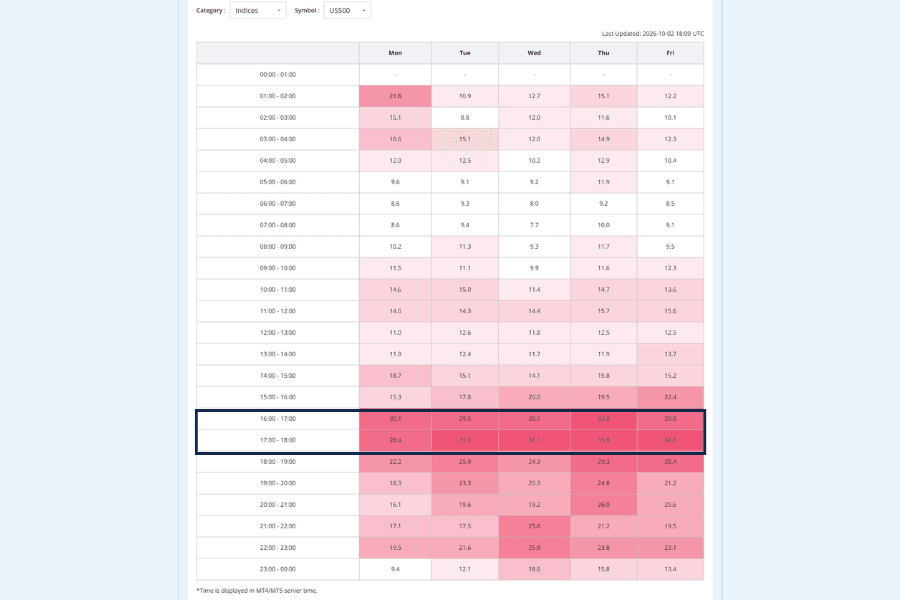
If you only have time for part of the session, the first hour after the open carries the most volume, though prices also move most sharply then.
Most major US data, including nonfarm payrolls and CPI, is released at 8:30 a.m. ET, during the pre-market. FOMC decisions come at 2:00 p.m. ET, late in the regular session.
You can check each week's release times in the Economic Calendar.
8. FAQ
Q1: What time does the US stock market open in Singapore and Hong Kong?
During US standard time (November 2, 2026 to March 12, 2027), the market opens at 10:30 p.m. and closes at 5:00 a.m. the next morning in Singapore and Hong Kong. During daylight saving time, it opens at 9:30 p.m. and closes at 4:00 a.m.
Q2: When does daylight saving time start in 2027?
On Sunday, March 14, 2027. From Monday, March 15, the US market opens at 13:30 UTC.
Q3: Can you trade US stocks on weekends?
No. Cash stocks do not trade on Saturday or Sunday. Broker overnight sessions reopen at 8:00 p.m. ET on Sunday, and CME index futures at 6:00 p.m. ET on Sunday.
Q4: Are pre-market and after-hours trading suitable for beginners?
Extended sessions have low volume and wide spreads, prices can jump on a single headline, and most brokers accept only limit orders. It is worth getting comfortable with the regular session first.
Q5: Can you trade index CFDs when the US stock market is closed?
It depends on the holiday. On Thanksgiving 2025, for example, Titan FX's US500 and other US index CFDs closed early at 1:00 p.m. ET (20:00 platform time), while US stock CFDs did not trade at all. Check Titan FX's monthly trading hours update for each holiday.
Q6: Is the stock market open on Columbus Day and Veterans Day?
Yes. The NYSE and Nasdaq trade normally on both days, but the US bond market closes on SIFMA's recommendation. In 2026, that means stocks trade and bonds are closed on Monday, October 12, and Wednesday, November 11.
9. Summary
The US regular session runs 9:30 a.m. to 4:00 p.m. ET all year. From November 2, 2026 to March 12, 2027, that is 14:30–21:00 UTC, or 10:30 p.m. to 5:00 a.m. in Singapore and Hong Kong.
Pre-market, after-hours and overnight sessions stretch cash trading across most of the day, while index futures and CFDs trade nearly around the clock.
Before you trade, note the Thanksgiving and Christmas closures and early closes, set orders in platform time, and use the Volatility Heatmap and Economic Calendar to find the hours that fit both your schedule and the market's activity.
Further Reading
- Forex trading hours and time zones: global sessions and the best times to trade
- New York session forex trading: characteristics and strategies
- Quadruple witching: how it works and its market impact
- When is forex most volatile? 14 currency pairs measured on the heatmap
- The VIX: the core gauge of US stock market volatility
Titan FX Trading Strategy Lab. We produce investor-education content covering forex, commodities (crude oil, precious metals, agricultural goods), stock indices, US equities, and digital assets.
Primary Sources (by Category)
- Exchanges: NYSE Holidays and Trading Hours; Nasdaq Trader calendar; NYSE Extended-Hours Trading FAQ (August 2026); CME Group E-mini S&P 500 contract specifications; trading-hours rules of the London Stock Exchange, Japan Exchange Group, HKEX and SGX
- Time rules: National Institute of Standards and Technology (NIST) on daylight saving time; EU summer-time directive (2000/84/EC)
- Regulators and bond market: SEC market-wide circuit breaker rules; SIFMA holiday recommendations