

ECB (European Central Bank)
If you read eurozone-related financial news, the name ECB (European Central Bank) shows up again and again. Hikes, cuts, inflation pressure, the euro's path — all of it points back to the ECB's judgement. Yet beginners often see the ECB as a "European Fed" or some kind of super-agency that can move national economies at will.
In practice, the ECB's design and mandate are both more complex and more constrained than people assume. It does not represent any single country and cannot simply paper over fiscal problems for its member states. Within a framework where many countries share one currency, its role is to maintain overall stability. The key to understanding the ECB is not predicting its next move — it is seeing why it can only operate the way it does.
- Position: The ECB was founded in 1998 and is headquartered in Frankfurt; it is the single central bank for the eurozone (not the full EU)
- Single mandate: A symmetric medium-term inflation target of 2%. Price stability is the primary objective; growth and employment come second
- Three-layer structure: ECB (decision centre) → Eurosystem (ECB + eurozone NCBs that execute policy) → ESCB (ECB + all EU NCBs for coordination)
- Decision-making: The Governing Council pools 6 Executive Board members with the governors of all eurozone NCBs — a multi-country co-governance model
- Institutional red line: Monetary financing is prohibited (the ECB cannot directly buy newly issued government debt), keeping price stability free of fiscal capture
- 1. What Is the ECB? Position and Core Objective
- 2. How the ECB and National Central Banks Share Power
- 3. What the ECB Actually Does: Policy Around the 2% Target
- 4. What the ECB Can and Cannot Do: Policy vs Fiscal Red Lines
- 5. Frequently Asked Questions (FAQ)
- 6. Conclusion: When You Should Pay Attention to the ECB
1. What Is the ECB? Position and Core Objective
ECB stands for the European Central Bank. It was founded in 1998 and is headquartered in Frankfurt, Germany. Its constituency is not the whole of Europe but the countries that use the euro — the eurozone.
That distinction matters. The EU is a broader political-economic framework, but not every member state uses the euro: Sweden and Poland, for example, still run their own currencies. The ECB's authority is confined to the eurozone, it is not part of any European government, it is not directed by any single country, and it operates independently under the EU treaties.
Core objective
Unlike the U.S. Federal Reserve, the ECB is built around a single mandate. Its primary objective is one thing: price stability. In practice this is operationalised as a symmetric medium-term inflation target of 2%. Only when this primary objective is not put at risk does the ECB consider supporting other economic policy, such as growth or employment.
The design implies that even if some countries' economies are weak, as long as inflation risk for the eurozone as a whole is above target, the ECB will not necessarily ease right away. Understanding this point is essential for reading the ECB's behaviour.
2. How the ECB and National Central Banks Share Power
The ECB is often imagined as a centralised European central bank, but its real machinery is more layered. In a system where many countries share one currency, monetary policy has to balance overall consistency with national differences, and that makes "who decides" and "who executes" the two key questions for understanding the ECB. The point of this section isn't to grade the design but to lay out the power structure.
Three layers: from the decision centre to the executing edge
To preserve flexibility across many countries, the institutional setup runs in three layers — authority extends outward from the centre, but functions do not overlap.
| Layer | Who's in it | Core role |
|---|---|---|
| ECB | The central institution in Frankfurt | Sets eurozone monetary-policy direction and framework |
| Eurosystem | ECB + the national central banks (NCBs) of all eurozone countries | Executes monetary-policy operations in national markets |
| European System of Central Banks (ESCB) | ECB + the NCBs of all EU member states | Institutional coordination, statistics, and technical exchange |
The layered design lets the ECB focus on overall policy judgement while NCBs run the local-market execution, avoiding excessive concentration of power in any one body.
Governing Council: the co-governance core
The ECB's top decision-making body is the Governing Council: the six Executive Board members plus the governors of all eurozone NCBs. Every country using the euro takes part directly in the final policy decision rather than passively receiving it.
This arrangement ensures policy is not shaped only by a handful of core countries, but it also means decisions must build consensus across very different national contexts. Externally this often looks like slow movement, but institutionally it is the inherent cost of one currency across many sovereigns.
The fragmentation challenge under co-governance
Applying a single policy across many markets creates uneven transmission. When the ECB changes rates, borrowing costs in countries with stable credit conditions — Germany, for example — move quickly. In higher-debt-risk countries such as Italy or Greece, market rates can stay elevated because of a risk premium, weakening policy's reach.
To stop this gap from turning into market fragmentation, the ECB maintains specific tools (such as the Transmission Protection Instrument) to preserve a basic consistency of policy transmission. Their role is closer to "institutional repair" that keeps the system connected — not to bear individual countries' fiscal risk — and the goal remains that a single monetary policy works for the eurozone as a whole.
3. What the ECB Actually Does: Policy Around the 2% Target
In practice, the ECB does not give markets daily instructions. It works through a relatively fixed, predictable policy framework that gradually shapes the eurozone's financial environment. The symmetric medium-term 2% inflation target is less an operating trigger and more an "assessment yardstick" — a way to judge whether monetary conditions have drifted from stability.
How the policy logic works
When the ECB sets policy direction, the focus is whether inflation has shifted away from target in a structural sense — not whether prices wobbled in the short term. If inflation stays below target for a long time, it implies weakness in demand and credit activity, giving room to ease. If pressure is persistently above target and spreads across most goods and services, the focus shifts to tightening financial conditions to keep prices from running away.
The core of this logic is "persistence" and "breadth." A one-month data point usually won't change direction; the ECB cares more about whether the medium-term trend has actually turned.
How the effect transmits
ECB policy does not set market prices directly. It adjusts policy rates, funding costs, and overall liquidity conditions, which then shape banks' willingness to lend and the cost of credit for firms and households. The effect is indirect, and it must move through the financial system step by step.
Because the eurozone is composed of many countries with different financial structures and risk conditions, the policy effect often shows up "at different times in different places." Some markets react quickly, some take longer, and some need other institutional tools to come through. That is why the ECB's monetary policy is often described as relatively slow but institutionally consistent.
4. What the ECB Can and Cannot Do: Policy vs Fiscal Red Lines
Reading the ECB correctly means knowing not only "what tools it has" but also "what it is institutionally forbidden to do." These constraints aren't design flaws that get in the way of efficiency — they are the institutional foundation that allows the eurozone to keep working over time, by stopping monetary policy from being captured by short-term political needs.
The institutional red line
The most important and most overlooked ECB red line is the prohibition on monetary financing. It means the ECB cannot directly print money to buy newly issued government debt and plug national fiscal deficits. Monetary policy cannot serve as a direct funding source for government spending.
This design exists to keep the ECB in control of inflation. If a central bank is forced to serve a government's fiscal needs, price stability struggles to remain the true priority, and the eventual cost is paid by the credibility of the whole currency system.
The line between can and cannot
Within what the framework allows, the ECB can use secondary-market operations, liquidity facilities, and certain stability mechanisms to keep the basic functioning of the financial system intact. That doesn't mean it can solve every economic problem — it cannot guarantee a single country's growth, nor can it take on the consequences of long-running fiscal imbalances on a member state's behalf.
When markets or politics ignore these limits, the ECB is sometimes cast as the "lender of last resort" for everything. From an institutional viewpoint, what it really takes care of is the stability of the currency and the financial system — not making fiscal choices for any national government.
5. Frequently Asked Questions (FAQ)
Q1. Does an ECB hike affect every eurozone country the same way?
No. Different financial profiles, debt levels, and risk premia mean the same rate policy can land very differently across countries. That is why the ECB, in setting policy, watches not only the overall inflation path but also whether financial markets are fragmenting.
Q2. Can the ECB directly bail out a single country?
No. The ECB's mandate is the monetary and financial stability of the eurozone as a whole, not solving any one government's fiscal problem. A national debt or economic crisis is a political and fiscal matter — not something monetary policy can address on its own.
Q3. Which has more power, the ECB or the Bundesbank?
At the monetary-policy level, the final decision sits with the ECB's Governing Council. The Bundesbank, like other eurozone NCBs, takes part as a member of that body — it does not act unilaterally. Even larger economies cannot drive policy direction on their own.
Q4. Where can an ordinary person check the ECB's policy rate?
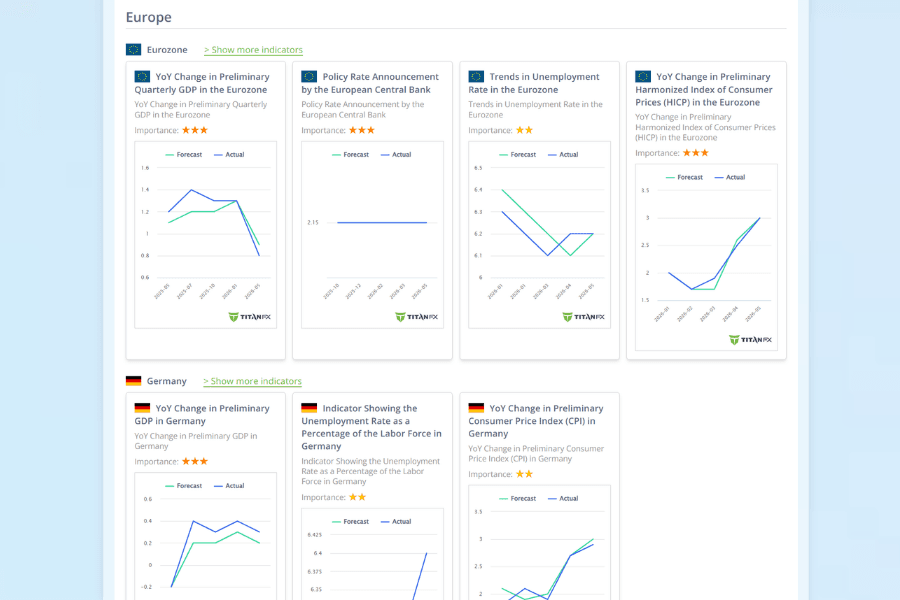
You don't have to read the full policy statement to track the ECB's latest policy rate and history. Titan FX's economic-indicator list lets you see the ECB and eurozone policy-rate data directly — a relatively intuitive entry point for beginners who want a baseline understanding or to follow policy changes.
Q5. How does ECB decision-making differ from the Fed, BOJ, and BOE?
The four big central banks differ in three main ways: (1) Mandate scope — the ECB has a single mandate (price stability only); the Fed has a dual mandate (price stability + maximum employment); the BOJ and BOE target around 2% inflation as a primary mandate. (2) Vote disclosure — the Fed and BOE publish member-by-member votes; the ECB and BOJ usually disclose less individual voting detail. (3) Institutional constraints — the ECB faces an explicit treaty-level ban on monetary financing; the Fed, BOJ, and BOE do not have equally explicit constitutional or statutory prohibitions. For traders, this means ECB policy tends to be driven less by individual-country weakness and more by the eurozone's aggregate inflation trend.
6. Conclusion: When You Should Pay Attention to the ECB
The ECB is not a tool for predicting short-term market direction; it is an institutional window into the eurozone's financial environment. It carries real reference value when you care about the inflation path, whether the rate regime is staying tight, or whether the eurozone is facing structural stress.
Read the ECB back into its institutional position and you'll see neither an omnipotent economic engine nor a faceless technocracy — but a key node trying to keep a single currency stable inside a many-country co-governance constraint.
Further Reading
Titan FX Research Hub — investor education across foreign exchange (FX), commodities (oil, precious metals, agriculture), stock indices, U.S. equities, and crypto assets.
Primary Sources (by category)
- ECB official sources: European Central Bank (ECB), ECB Monetary Policy, ECB Statistics
- EU institutional framework: Treaty on the Functioning of the European Union (TFEU), European Stability Mechanism (ESM)
- Academic and central-bank basics: general public knowledge on single-mandate central-bank design, the prohibition on monetary financing, and policy transmission mechanisms