

GNP(Gross National Product)

Gross National Product (GNP) measures the total market value of all final goods and services produced by a country's residents, regardless of where that production takes place. Unlike GDP, which counts everything produced within a country's borders, GNP follows the nationality of the producer, capturing overseas earnings while excluding output by foreign nationals domestically.
GNP reveals dimensions of economic activity that GDP alone cannot show, from remittance flows and foreign direct investment returns to the global competitiveness of a nation's workforce. Policymakers, researchers, and investors use GNP alongside GDP to build a fuller picture of national economic strength.
This article covers the definition and economic significance of GNP, three calculation methods, the key differences between GNP and GDP, practical applications, and the indicator's inherent limitations.
- What GNP measures and why the "national" criterion matters
- Three calculation methods: expenditure, income, and production approaches
- The fundamental difference between GNP and GDP
- Practical limitations of GNP and the shift to GNI
1. Definition and Economic Significance of GNP
Gross National Product (GNP) is the total market value of all final goods and services produced by a country's residents within a given period, whether that production occurs domestically or abroad. The defining feature of GNP is its focus on nationality: as long as a natural person or legal entity belongs to the country, their economic output is included in the figure regardless of geographic location.
Core Definition
Unlike GDP (Gross Domestic Product), which captures all economic output generated within a country's physical borders, GNP includes income earned by nationals overseas and excludes the output created by foreign nationals within the domestic economy. This distinction makes GNP a stronger indicator of a nation's total productive and income-generating capacity.
For example, if a company headquartered in one country operates a factory in Southeast Asia, that factory's output counts toward the home country's GNP. Conversely, if a foreign corporation establishes a plant inside the country, its output enters the host nation's GDP but not its GNP.
Economic Significance
GNP is an indispensable tool in macroeconomic analysis, quantifying how deeply a nation's citizens participate in the global economy and how much income they earn from that participation.
-
- Measures the total productive capacity of residents across domestic and international economic activity
-
- Serves as a policy reference for adjusting foreign exchange, investment, and labor strategies
-
- Enables cross-country comparisons of national income and economic development levels
Beyond reflecting national economic strength, GNP also reveals the aggregate outcomes of capital exports, remittance flows, and overseas corporate investment.
2. GNP Calculation Methods
GNP can be calculated through three distinct approaches: the income method, the expenditure method, and the production method. Each follows a different logic, but in theory all three converge on the same result, fully capturing the economic value created by a country's residents.
Method 1: Income Approach
The income approach starts from factor payments, summing the total income residents earn from participating in production and adding net factor income from abroad.
Income Approach Formula:
GNP = Wages + Interest Income + Rent + Corporate Profits + Net Foreign Factor Income
| Income Component | Description |
|---|---|
| Wages | Salaries, bonuses, allowances, and other labor compensation |
| Interest Income | Returns on invested capital such as deposit interest and bond yields |
| Rent | Income from leasing land or real estate |
| Corporate Profits | Net earnings after deducting operating costs |
| Net Foreign Factor Income | Income earned by nationals abroad minus income earned by foreign nationals domestically |
Example: Workers employed overseas and corporate investment returns from foreign operations are all included in GNP, reflecting the global economic contribution of a nation's residents.
Method 2: Expenditure Approach
The expenditure approach measures GNP from the demand side, covering domestic consumption, investment, government spending, and net trade.
Expenditure Approach Formula:
GNP = C + I + G + (X - M)
The components break down as follows:
| Component | Description |
|---|---|
| C | Private consumption expenditure (food, housing, transportation, education) |
| I | Gross domestic investment by the private sector and government (factory construction, equipment) |
| G | Government expenditure on public services (defense, education, healthcare) |
| X | Total value of exported goods and services |
| M | Total value of imported goods and services (subtracted because imports are not produced domestically) |
Example: A rise in semiconductor exports, produced locally and shipped by domestic firms, directly boosts GNP.
Method 3: Production Approach
The production approach, also called the output approach, measures total economic output by industry, summing the value added at each stage of production.
Production Approach Formula:
Value Added = Total Sales Revenue - Intermediate Input Costs GNP = Sum of Value Added Across All Industries
| Concept | Description |
|---|---|
| Sales Revenue | Income each industry earns from selling goods and services externally |
| Intermediate Inputs | Raw materials, components, and semi-finished goods purchased for production |
| Value Added | The true value each industry creates, avoiding double counting |
Example: The net output of an electronics contract manufacturing sector counts toward GNP even if some components are imported, as long as the value added comes from domestic labor and technology.
These three methods approach economic measurement from different angles, corresponding to the roles of income creators, expenditure users, and industrial producers, and together they provide a comprehensive methodology for understanding economic output.
3. GNP vs. GDP
GNP (Gross National Product) and GDP (Gross Domestic Product) are both core indicators for measuring the total size of an economy, but they differ in calculation logic and scope.
GNP is based on nationality: regardless of where production takes place, all output by a country's residents enters the statistic. GDP is based on geography: it counts the value of all goods and services produced within a country's borders, regardless of who produces them.
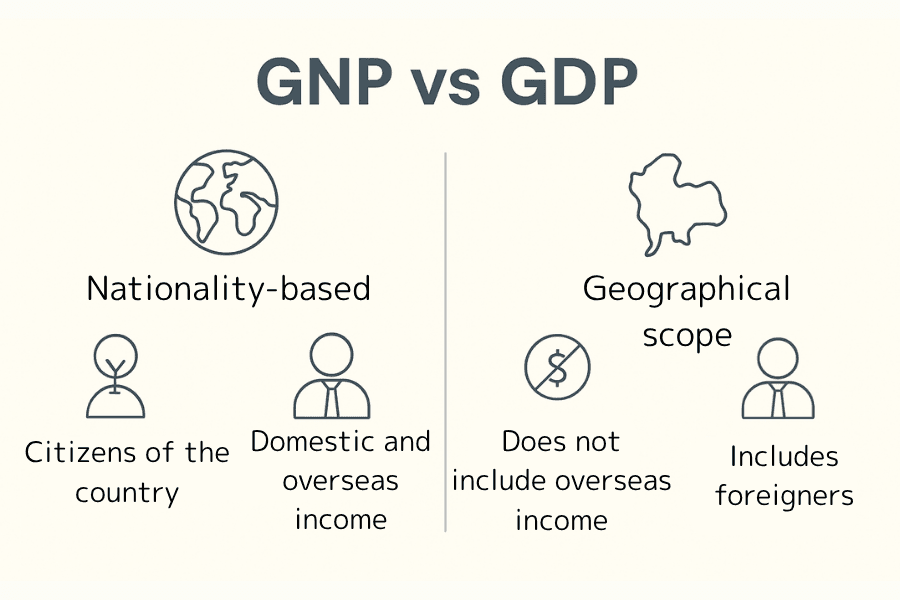
GNP vs. GDP Comparison
| Dimension | GNP (Gross National Product) | GDP (Gross Domestic Product) |
|---|---|---|
| Basis | Nationality or corporate domicile; includes residents' production at home and abroad | Geographic boundary; includes all production within domestic borders |
| Overseas Income | Includes income earned by nationals abroad | Excludes income earned by nationals abroad |
| Foreign Output Domestically | Excludes output created by foreign nationals within the country | Includes all output by foreign entities within the country |
| Primary Use | Measuring national economic strength; suited for international comparison and capital flow analysis | Measuring domestic economic scale and internal demand; commonly used for regional and national economic analysis |
When GNP Exceeds GDP
When a significant portion of a country's residents work or invest abroad and generate stable return flows, GNP exceeds GDP.
Example: Engineers from one country employed by technology firms in another country send regular remittances home. Although this income is not created domestically, it qualifies as national income and is therefore recorded in GNP, not GDP.
When GDP Exceeds GNP
When a country attracts large volumes of foreign direct investment and a high proportion of domestic output comes from foreign-owned operations, GDP exceeds GNP.
Example: A multinational corporation establishes a factory in a host country. The factory's output is included in the host country's GDP, but because profits ultimately belong to the foreign parent company, they are not part of the host country's GNP.
Core Distinction
GNP reflects the results of a nation's economic activity worldwide and is better suited for assessing international competitiveness and total national income. GDP presents the real-time performance of domestic production and is commonly used for evaluating short-term business cycles and the strength of internal demand.
4. Applications and Economic Implications
Gross National Product (GNP) is more than a measure of aggregate economic activity. In practice, it serves as a reference for policy decisions and a basis for global comparison. Understanding GNP helps analysts grasp both the full scope of national wealth creation and the intensity of cross-border economic interaction.
Policy: Understanding National Economic Structure and Global Participation
GNP helps governments gauge the extent to which their citizens participate in overseas investment and employment. For export-oriented economies in particular, GNP is an essential input when formulating trade policies, international agreements, and industrial incentive programs.
For instance, when GNP growth significantly outpaces GDP growth, it often signals that the country's nationals are creating expanding value abroad. This pattern may prompt the government to reassess domestic industrial competitiveness and the dynamics of talent outflows.
Comparison: Revealing International Competitive Advantage and Resource Allocation Efficiency
Where GDP emphasizes regional output, GNP offers another dimension for evaluating national economic power, and is especially useful for comparing wealth-creation capacity among open economies.
If a country's GDP is relatively low but its GNP is noticeably higher, it may indicate a high degree of global participation through channels such as overseas remittances, investment returns, or knowledge exports.
Capital Markets: Supporting Capital Flow and Risk Assessment
In investment analysis, GNP can be used alongside other tools to assess fundamental economic trends and the impact of cross-border capital movements. It holds particular reference value when evaluating monetary policy, sovereign debt servicing capacity, and medium-to-long-term investment strategy. For example, stable GNP growth accompanied by controlled inflation tends to support equity market confidence and attract foreign investment.
5. Limitations of GNP
Although GNP is an important indicator for observing the total volume of a country's economic activity, it has several limitations that prevent it from independently reflecting overall economic well-being or the quality of social development.
Limitation 1: Ignoring Income Distribution
GNP focuses on aggregate national income and does not reveal how wealth is distributed across different segments of society. When GNP growth is concentrated in specific industries or among a small group, it can mask severe internal inequality and lead to misjudgments about economic fairness.
Limitation 2: Failing to Reflect Environmental and Sustainability Costs
GNP records only the value of market transactions and does not account for the depletion of natural resources, pollution, or ecological damage. Economic growth achieved at the expense of the environment can still push GNP higher, meaning the indicator cannot determine whether development is sustainable.
Limitation 3: Vulnerability to International Distortions
Because GNP involves overseas income and exchange rate conversions, the data is susceptible to shifts in international capital flows, currency fluctuations, and financial market conditions. For example, a short-term appreciation of the domestic currency can inflate the converted GNP figure, creating an overstatement of actual economic capacity.
When interpreting GNP, it is advisable to complement it with other indicators such as per capita income, the Gini coefficient, and green GDP to achieve a more complete economic picture.
6. Frequently Asked Questions
Q1: Can GNP reflect the standard of living?
Not entirely. GNP focuses on total output and income without accounting for variables such as income distribution equity or cost of living. A more complete picture requires combining GNP with per capita GNP, the Gini coefficient, and other distributional indicators.
Q2: Why have some countries stopped reporting GNP as a primary indicator?
Many governments and institutions prioritize GDP because it is more directly tied to short-term policy management and domestic market size. However, in countries with significant cross-border investment, labor exports, or remittance flows, GNP remains a critical measure.
Q3: Does GNP include informal economic activity?
No. GNP primarily captures measurable market transactions. Underground economic activity and non-monetary exchanges, such as subsistence farming, are generally excluded from the statistical scope.
Q4: What is the difference between GNP and GNI?
In modern statistics, the two are nearly identical. GNP is the traditional term, while GNI (Gross National Income) is the current terminology adopted by the United Nations, World Bank, and other international organizations, with a stronger emphasis on the income dimension.
7. Summary
Gross National Product (GNP) provides a perspective that extends beyond national borders, capturing the full picture of economic activity by a country's residents. It measures not only domestic economic contributions but also the value generated through cross-border investment, overseas employment, and remittance flows.
GNP holds significant reference value for policy formulation, international comparison, and investment analysis.
However, its inability to reflect income distribution, environmental costs, and non-market activities serves as a reminder that multi-dimensional evaluation using complementary indicators is essential.
As globalization continues to deepen, GNP will remain an indispensable tool for assessing a nation's comprehensive economic strength.
Further Reading
Titan FX Research. We produce educational content for investors, covering a wide range of financial instruments including forex, commodities (crude oil, precious metals, agricultural products), stock indices, U.S. equities, and digital assets.
Primary Sources by Category
- Statistics: World Bank — GNP/GNI data; IMF — National accounts
- Academic: Bureau of Economic Analysis — NIPA tables