

Amazon (AMZN) Stock Investing Guide: Business Model, Growth Engines, and CFD Trading
Amazon (AMZN) has grown from an online bookstore into one of the most influential technology companies in the world, with a business that spans retail, cloud computing, advertising, and subscription services. Whether you view it as a long-term investment or a short-term trading instrument, Amazon offers many layers worth analyzing.
This article organizes Amazon's business model, financial characteristics, growth opportunities, and risks in a structured way. It also covers AMZN CFD trading tools and answers common questions, helping investors build a complete framework for making decisions.
- Four core businesses: e-commerce, AWS cloud, advertising, and Prime subscription/logistics, linked into a reinforcing loop.
- Profits concentrated in high-margin units: retail drives revenue, but AWS and ads drive net income and cash flow.
- Four growth drivers: AI cloud demand, rising ad penetration, logistics automation, and international expansion.
- Main risks: AWS competition, tech regulation, the consumer cycle, and capex pressure on free cash flow.
- How to trade: buy stock or ETFs, or go long/short via CFDs; Titan FX offers AMZN US-stock CFDs up to 20x leverage.
- 1. What Kind of Company Is Amazon? Core Businesses and Business Model
- 2. Amazon's Revenue Sources and Growth Engines
- 3. Amazon's Financial Profile and Valuation Notes
- 4. Growth Opportunities and Key Risks for Amazon Stock
- 5. How to Trade Amazon (AMZN) US-Stock CFDs: Steps and Tools
- 6. Frequently Asked Questions (FAQ)
- 7. Conclusion
1. What Kind of Company Is Amazon? Core Businesses and Business Model
Amazon (ticker: AMZN) was founded in 1994 and started out as an online bookstore. Today it ranks among the most valuable technology companies in the world. What truly turned it into a global tech giant comes down to one thing: using technology to improve efficiency, and turning that efficiency into commercial scale.
Whether in e-commerce, logistics, cloud services, or advertising, every Amazon business runs on data, algorithms, and automation, and each one connects to the others to form a complete operating ecosystem.
Amazon's Four Core Businesses
Amazon's operations today rest on four pillars. The summary below helps clarify how each business fits into the overall structure:
| Business segment | Main function | Role in the whole |
|---|---|---|
| E-commerce | Selling goods and third-party marketplace services | The gateway to the ecosystem, bringing traffic and large volumes of consumer data |
| AWS cloud | Computing, storage, and AI-training capacity | The company's most important source of profit |
| Advertising | Product search and display ads | Uses high-intent searches to lift overall profitability |
| Prime subscription and logistics | Membership program and delivery network | Increases user stickiness and strengthens retail efficiency |
How the Amazon Ecosystem Works
Amazon's business model does not rely on a single product. Instead, it links different businesses together so they form a reinforcing loop:
-
- E-commerce brings in large numbers of users and search activity, providing the foundation for the advertising business.
-
- Advertising raises retail gross margins, improving the otherwise low-margin structure of e-commerce.
-
- AWS supports overall financials with high profitability, allowing Amazon to keep investing in logistics and technology.
-
- Prime subscriptions increase retention, leading consumers to use e-commerce, video, and other services more, which further scales advertising and logistics.
This loop gives Amazon a combined advantage that is hard to replicate. It keeps the company ahead in retail while also creating durable growth momentum in the cloud and advertising markets.
2. Amazon's Revenue Sources and Growth Engines
Amazon earns revenue across several business lines, from retail and logistics to cloud and advertising. Each one has different characteristics in terms of gross margin, scale, and growth, which lets the company maintain relatively steady performance across different stages of the economic cycle.
The following looks at the role and growth momentum of each revenue source from a financial perspective.
E-commerce and Logistics: The Base of Scale-Driven Revenue
Amazon's retail and logistics businesses run on low gross margins, but they provide the company's most stable revenue base and generate vast amounts of user-behavior data, forming an essential foundation for advertising and subscription services.
The expansion of third-party seller services and the delivery network has gradually improved the profitability of retail and lowered overall operating costs as scale increases.
AWS: The Core That Supports Overall Profitability
AWS remains Amazon's most profitable business.
Enterprise demand for cloud computing, data processing, and AI training continues to rise, giving AWS revenue growth long-term visibility.
Its high-margin structure makes AWS a key force behind the company's net income and cash flow, and the foundation that lets Amazon keep expanding its technology and logistics investments.
Advertising: The Key Driver of Margin Improvement
Amazon's advertising business is built on the platform's own shopping-intent traffic, giving it conversion rates far higher than typical social media.
This business not only grows quickly but is also a key source of margin improvement. Ad revenue requires little additional cost, so it has a clear lifting effect on overall profitability.
Prime Subscriptions: The Core Mechanism for Revenue Stability
Prime subscriptions bundle delivery, video, and shopping benefits, encouraging users to build long-term habits.
Subscription revenue is inherently stable, and member stickiness further improves the performance of retail and advertising, making Amazon's overall operations more predictable.
Four Drivers of Future Growth
| Growth driver | Financial significance |
|---|---|
| A sharp rise in cloud demand from AI and large models | Accelerates AWS revenue growth and increases enterprise stickiness |
| Higher penetration of the advertising market | Improves Amazon's overall margin structure |
| Automated logistics that lower costs | Turns low-margin e-commerce from a cost center into an efficiency advantage |
| International and emerging-business expansion | Adds revenue scale and creates new customer segments |
Together these drivers push Amazon's future growth, allowing the company to keep expanding in an intensely competitive technology market.
3. Amazon's Financial Profile and Valuation Notes
When understanding Amazon's financial performance, the most important point is to grasp one trait: the company's profit sources are uneven.
Retail delivers scale, AWS and advertising deliver profit, and the pace of capital spending directly affects free cash flow.
The following looks at three angles that new investors most need to understand: revenue and profit trends, cash flow and the pace of investment, and the core basis for valuation.
Amazon's Profits Are Highly Concentrated in High-Margin Businesses
Although most of Amazon's revenue comes from retail and logistics, the real engines behind overall profitability are AWS and advertising.
The gross margins of these two businesses are far higher than retail, allowing the company to maintain a stable profit structure even when the consumer cycle is weak.
For investors, understanding "AWS growth and advertising growth" gives a better read on the company's profit direction than focusing on short-term retail swings.
Improving Free Cash Flow Is a Key Metric to Watch
Amazon's free cash flow was once compressed by heavy spending on logistics, data centers, and infrastructure. But as that expansion phase ended, capital spending has gradually returned to a more balanced level, and cash flow has started to recover.
This signals that Amazon has moved from a high-investment phase into an efficiency-optimization phase, which has steadied its financial performance. For investors, improving free cash flow is often the starting point for a valuation re-rating.
Amazon's Core Value Is Driven Mainly by AWS and Advertising
Although retail accounts for the bulk of revenue, the market usually ties Amazon's valuation to AWS's long-term growth, because AWS contributes most directly to net income, gross margin, and cash flow.
Advertising acts as a second profit engine, making Amazon's overall profit base more flexible.
In other words, investors who want to assess Amazon's long-term value should focus most on the growth and market-share trends of these two businesses.
Amazon's Valuation Must Be Broken Down by Business to Read Correctly
Amazon's valuation profile is closer to a multi-segment technology company, so the market does not simply use the P/E ratio to gauge its value. Instead, it evaluates the company segment by segment based on each business's characteristics.
Retail is best compared using revenue multiples, AWS is often valued with EV/EBITDA or discounted-cash-flow models, and advertising carries the high-margin valuation logic of other technology platforms.
For investors, the point is not whether "Amazon's valuation is high or low," but "which business is currently driving the valuation."
Disagreement Over Amazon's Valuation Stems From Different Growth Expectations
Some investors view Amazon as overvalued, especially when capital spending is heavy or cloud competition intensifies. Others argue that advertising still has room to grow, and that the potential for AI-model demand to drive AWS expansion is not yet fully reflected in the share price.
These expectations across different time horizons keep Amazon's valuation contested in the market, and they are an important source of share-price volatility.
4. Growth Opportunities and Key Risks for Amazon Stock
Evaluating an Amazon investment mainly comes down to two points: first, the company has structural, long-term sources of growth; second, its core businesses face market competition and regulatory pressure.
Growth Opportunities: The Main Sources of Amazon's Long-Term Growth
Amazon has several growth axes that can keep expanding, with AWS, advertising, and logistics efficiency drawing the most market attention.
| Growth opportunity | Key explanation |
|---|---|
| AWS and AI drive long-term cloud growth | Rising enterprise demand for AI training, inference, and data processing gives AWS clear expansion momentum, the company's most important high-margin source. |
| Advertising becomes a second profit engine | Built on shopping intent, Amazon ads have high conversion and margins far above retail, an important lever for improving overall profitability. |
| Logistics automation improves cost efficiency | Warehouse automation and regional delivery lower operating costs, making e-commerce and Prime more competitive. |
| A diverse ecosystem improves resilience | Spanning cloud, retail, advertising, video, and device services, diversified revenue spreads the impact of the economic cycle. |
Key Risks: The Main Factors That Could Affect Amazon's Growth Pace
Despite its long-term advantages, Amazon still faces uncertainty from cloud competition, regulatory policy, and capital spending.
| Risk | Key explanation |
|---|---|
| Intensifying competition in AWS | The rapid expansion of Microsoft Azure and Google Cloud could affect AWS market share and, in turn, Amazon's overall profitability. |
| Stronger global tech regulation | Antitrust scrutiny could impose more limits on Amazon's pricing, platform strategy, and use of data. |
| E-commerce demand sensitive to the economy | When spending power falls, the retail business comes under pressure, sharpening short-term revenue swings. |
| High capex creating cash-flow pressure | Data centers, logistics equipment, and AI infrastructure require heavy investment; if not converted effectively, free cash flow can come under strain. |
Together these opportunities and risks shape Amazon's share-price performance and reflect the typical investment profile of a large technology company: clear long-term advantages, but still subject to competition and economic shifts over the short to medium term.
5. How to Trade Amazon (AMZN) US-Stock CFDs: Steps and Tools
Investors can take part in Amazon (AMZN) price movements in different ways depending on their strategy, risk appetite, and capital. A CFD (Contract for Difference) has become a common tool for short-term and strategy-focused investors thanks to features such as two-way long/short trading, flexible leverage, and no need to hold the underlying stock.
The table below summarizes common ways to invest in AMZN and who each one suits:
| Method | Key features | Best suited for |
|---|---|---|
| Buying AMZN stock directly | Captures company growth and long-term value accumulation | Long-term investors |
| ETFs / index allocation | Diversifies risk through a sector or broad-market basket | Medium-term asset allocators |
| Contract for Difference (CFD) | Offers leverage and the ability to go long or short, with high strategic flexibility | Traders focused on volatility and strategy |
The Process: How to Trade Amazon CFDs at Titan FX
If you want to take part in Amazon's up-and-down moves with a lower barrier to entry, a CFD (Contract for Difference) offers a highly flexible way to trade.
Titan FX offers US-stock CFDs with up to 20x leverage, letting investors participate in Amazon's rises or falls with smaller capital.
The steps below help you quickly complete account opening, funding, and trade preparation.
| Stage | Instructions |
|---|---|
| Step 1: Register an account | Go to the Titan FX account-opening page, enter your email and password to register. Your account is activated once verification is complete. |
| Step 2: Fund your account | Log in to the Titan FX client portal, choose a funding method (credit card, e-wallet, bank transfer, and so on), and follow the prompts to complete your deposit. |
| Step 3: Download the MT5 platform | US-stock CFDs are traded on MT5. Titan FX provides MT5 downloads for Windows, Mac, iOS, Android, and Web. |
| Step 4: Start trading Amazon CFDs | Launch MT5, log in to your trading account, add Amazon in "Market Watch," then choose Buy (long) or Sell (short) to start trading. |
Titan FX Offers Free Trading Tools
To help investors track the rhythm of US stocks more effectively, Titan FX offers several practical tools you can use alongside your analysis:
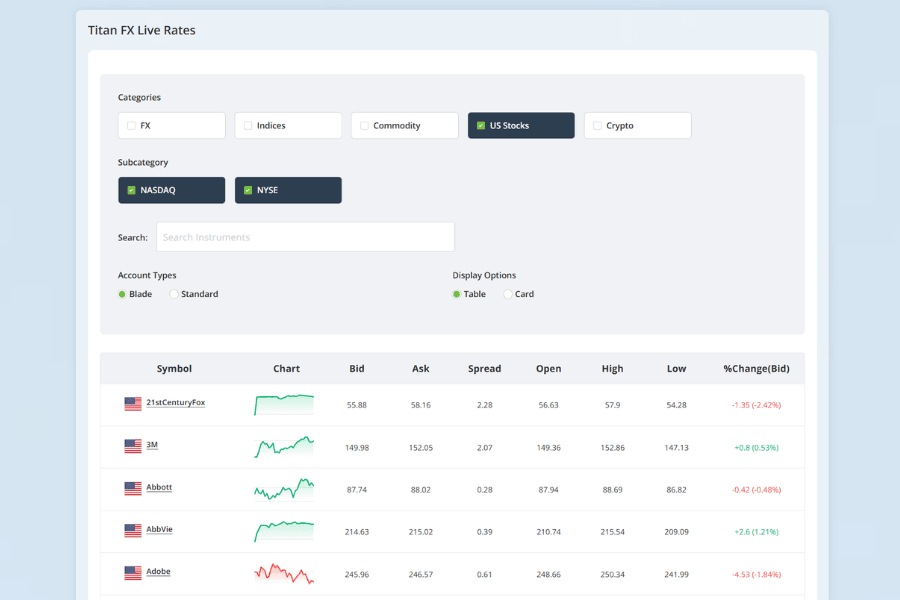
Live Rate
Live Rate provides the latest bid/ask, spread, intraday high and low, and a mini trend chart, serving as a foundational price source for short-term trading and strategy statistics.
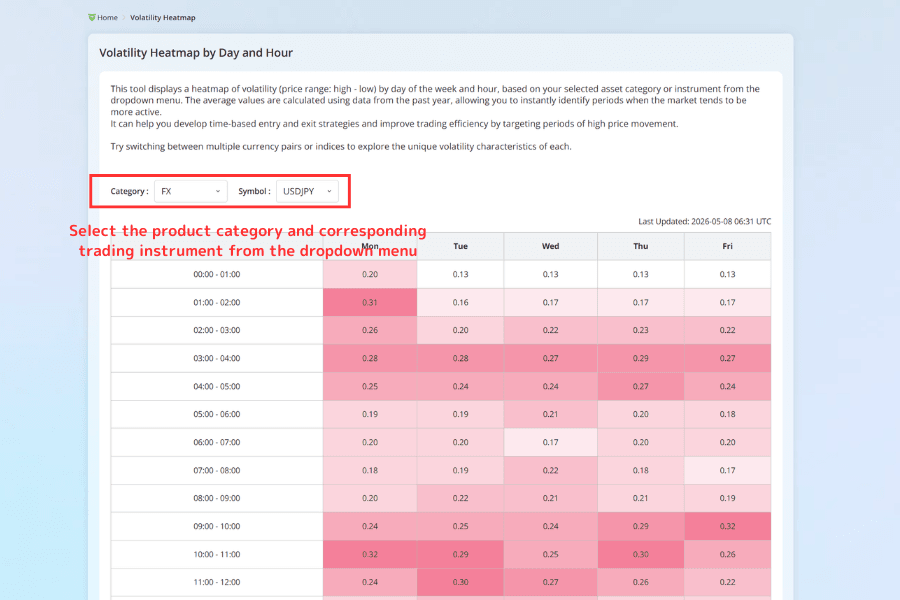
Volatility Heatmap
The Volatility Heatmap uses historical data to show how strong or weak an instrument's movement is across different times of day, helping you pick more suitable trading sessions.
Dividend Calendar
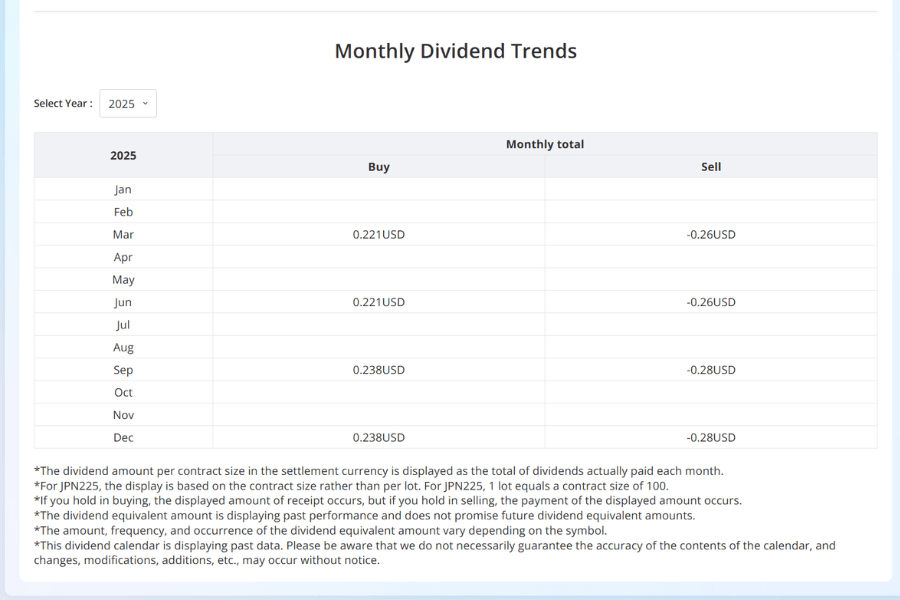
View daily and monthly dividend records for US-listed companies in one place, including the actual dividend amounts on buy/sell positions, helping you track payout timing, compare yields, or plan a dividend strategy.
Trade AMZN CFDs with Titan FX
Titan FX offers Amazon (AMZN) stock CFDs with up to 20:1 leverage, tight spreads, and the flexibility to go long or short without owning the shares.
6. Frequently Asked Questions (FAQ)
Below are the questions investors most often ask, to help you quickly grasp the investment characteristics of Amazon (AMZN) and how to evaluate it.
Q1. Does Amazon's lack of a dividend reduce its appeal as an investment?
Amazon channels most of its resources into cloud, AI, and logistics build-out, so it does not pay a dividend.
This makes it less attractive to investors who prefer cash flow. But if the goal is long-term corporate growth and capital appreciation, Amazon still has structural growth potential, so the absence of a dividend does not weaken its long-term appeal.
Q2. How important is AWS to Amazon's share price?
AWS is Amazon's main profit engine, with gross margins far above e-commerce and logistics, and the market often uses AWS growth as a key basis when valuing Amazon. If AWS faces competitive pressure or slowing growth, the share price usually reacts quickly.
Q3. How does Amazon differ from Microsoft and Google?
All three operate in the cloud, but they are positioned differently:
- Amazon (AWS): the most complete cloud product line, tightly integrated with its retail and logistics ecosystem
- Microsoft (Azure): combines enterprise software with cloud services, with a more stable B2B customer base
- Google (GCP): strongly competitive in AI and data analytics
As a result, their growth sources and valuation logic are not entirely the same.
Q4. Will the economic cycle or rate hikes weigh on Amazon's share price?
They can have an effect. When the business cycle weakens and spending power falls, e-commerce demand softens, and a rising-rate environment usually lifts the discount rate on tech stocks, pressuring valuations. That said, Amazon still has high-margin businesses such as AWS and advertising, giving it some cushion during economic swings.
Q5. Which factors most easily affect Amazon's (AMZN) share price?
Amazon's share price is shaped by several variables, which fall into two broad groups: company-level and market-level factors.
| Factor | Explanation |
|---|---|
| AWS growth rate | Since AWS is the main profit source, its revenue growth and customer expansion are the metrics the market watches most. |
| Advertising performance | Ads carry high margins and strong momentum, and can lift the overall profit structure significantly. |
| Retail and spending-power shifts | The economic cycle affects spending power, which in turn affects e-commerce demand and logistics costs. |
| Market expectations for AI and cloud capex | AI lifts cloud demand, so the market often uses it to gauge future growth potential. |
| Interest rates and the broad tech-valuation environment | Rate hikes raise the discount rate, making large tech valuations prone to pressure. |
| Competitive intensity | Competition from Microsoft Azure and Google Cloud directly affects AWS market share. |
To understand AMZN's short-to-medium-term moves, AWS growth, the rate environment, and consumer-market sentiment are usually the three most immediately influential factors.
Q6. Can I trade Amazon (AMZN) at Titan FX?
Yes. Titan FX offers US-stock Contracts for Difference (CFDs) on Amazon (AMZN) and other US equities, with up to 20x leverage, two-way long/short trading, and no need to hold the underlying stock. US-stock CFDs are traded on the MT5 platform. Before trading, it is wise to understand AMZN's volatility characteristics and set up sound stop-loss and money-management rules.
7. Conclusion
Amazon has evolved from a single-category e-commerce company into a global-scale platform spanning cloud computing, advertising technology, logistics systems, and subscription services. This diverse structure lets the company keep a degree of operating resilience across different stages of the economic cycle, while the high-margin, low-cyclicality nature of AWS and advertising is the core source supporting Amazon's long-term value.
For investors, the focus with Amazon is not on short-term retail swings but on long-term demand in the cloud, AI, and advertising markets. If your investment goal emphasizes corporate growth and structural, technology-driven trends, AMZN has the qualities of a core portfolio holding.
Overall, Amazon's value comes from its long-term competitiveness rather than the swings of any single earnings report. By continuing to watch AWS growth, cost efficiency, and free-cash-flow trends, investors can build a solid framework for investing in AMZN that lets it play its proper role in a medium-to-long-term allocation.
Further Reading
- What Is a CFD (Contract for Difference)?
- What Is the P/E Ratio?
- What Is the Business Cycle?
- How to Install MT5
Titan FX Research. Investor-education content covering forex (FX), commodities (oil, precious metals, agricultural products), stock indices, US equities, and crypto assets across global markets.
Primary Sources by Category
- Official data and disclosures: Amazon.com, Inc. investor relations (10-K annual and 10-Q quarterly reports); U.S. SEC EDGAR filings
- Industry and research: cloud-computing and digital-advertising market research; major investment-bank tech-sector analysis
- Market data: Titan FX live quotes and US-stock CFD prices; US equity market analysis from major financial media