

What Is Delisting? Causes, Process, and Investor Impact Explained
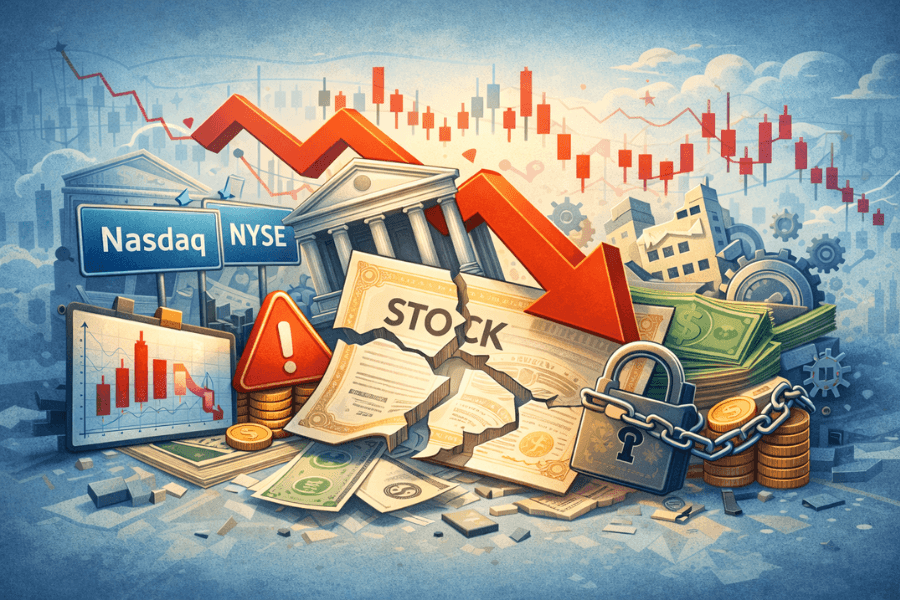
In the U.S. stock market, listed companies must continuously meet an exchange's financial and governance standards. When a company can no longer maintain those requirements, or when a strategic shift leads it to leave the exchange, delisting may occur. For investors, delisting means the stock will exit the primary exchange, and the trading environment, liquidity, and information transparency can change significantly.
Beginners often overlook delisting risk, especially in the small-cap or micro-cap segments. Delisting can happen when a company's share price stays low for too long, when financial disclosures become problematic, or when the company is acquired or taken private. Understanding the causes, process, and aftermath helps investors make more rational decisions during periods of market volatility.
- 1. What Is Delisting? U.S. Exchange System Overview
- 2. Why Do U.S. Stocks Get Delisted? Common Triggers
- 3. The Delisting Process: From Warning Notice to Final Removal
- 4. Where Do Stocks Go After Delisting? The Role of the OTC Market
- 5. What Happens to Investors Holding a Delisted Stock?
- 6. Frequently Asked Questions (FAQ)
- 7. Summary
1. What Is Delisting? U.S. Exchange System Overview
Delisting refers to the formal removal of a company's shares from an exchange, after which the stock can no longer trade on that venue. The primary U.S. exchanges are Nasdaq and NYSE. Both exchanges apply strict listing and maintenance standards. Initial listing requirements include minimum shareholders' equity, market capitalization, public float, and share price. The maintenance standards are equally important — once a company falls short, the exchange issues a warning and provides a cure period.
Delisting comes in two forms: voluntary delisting and involuntary delisting. Voluntary delisting is initiated by the company itself and is common in privatization, mergers, or transitions to the OTC market. Involuntary delisting is executed by the exchange, typically for failing maintenance standards. If the issuer cannot cure the deficiency, the exchange finalizes the removal.
2. Why Do U.S. Stocks Get Delisted? Common Triggers
Delisting is usually driven by a company's operating condition or broader market factors. For investors, recognizing these triggers helps identify risk early.
Trigger 1: Share Price Below $1 for an Extended Period
On Nasdaq, a share price that remains below $1 typically leads to a compliance issue. If the stock closes below that threshold for 30 consecutive trading days, the exchange may issue a deficiency notice and require the company to regain compliance within a set window.
Trigger 2: Insufficient Market Cap or Shareholder Base
Exchanges require listed issuers to maintain a minimum market cap and shareholder base. If the company shrinks continuously, or if the public float becomes too small, it risks losing listing eligibility.
Trigger 3: Late or Non-Compliant Financial Reporting
U.S. listed companies must file periodic reports such as the 10-K annual report and 10-Q quarterly reports. Extended delays or filings that violate regulatory requirements can trigger delisting procedures.
Trigger 4: Acquisition or Going Private
When a listed company is acquired, or when management elects to take it private, its shares stop trading in the public market. This is a strategic decision and is not necessarily linked to financial distress.
Case Studies: Luckin Coffee and Bed Bath & Beyond
The U.S. market has produced several well-known delisting cases that help investors understand the risk concretely.
Luckin Coffee
In 2020, Luckin Coffee was forcibly delisted from Nasdaq following a financial fraud scandal. The stock then moved to the OTC market, where prices swung sharply. Although the company eventually restructured and resumed operations, investors faced substantial liquidity and information risk during the transition period.
Bed Bath & Beyond
In 2023, this U.S. retailer filed for bankruptcy amid financial distress and was delisted from Nasdaq. The shares traded briefly on the OTC market, but as bankruptcy proceedings advanced, common shareholders ultimately recovered almost nothing.
These examples show that delisting does not always mean a company disappears immediately, but liquidity, information transparency, and price stability usually deteriorate significantly for investors. That is why spotting delisting risk in advance matters.
3. The Delisting Process: From Warning Notice to Final Removal
Delisting rarely happens without notice — exchanges typically grant a cure period and appeal mechanism. The process generally proceeds in several stages.
Stage 1: Exchange Warning (Deficiency Notice)
When a company fails to meet listing standards, the exchange issues a Deficiency Notice. This is a formal warning requiring the company to cure the deficiency by a specified deadline.
Stage 2: Cure Period (Typically 180 Days)
In most cases, the company is given about 180 days to cure the deficiency. During this window, it can try to restore compliance through financial improvement, share price recovery, or other measures.
Stage 3: Hearing and Appeal
If the company cannot regain compliance within the cure window, it may request a hearing or appeal. The exchange will reassess the situation and decide whether to extend the deadline.
Stage 4: Final Delisting
If remediation efforts fail, the shares are formally removed from the exchange. From that point on, the stock no longer trades on that venue.
4. Where Do Stocks Go After Delisting? The Role of the OTC Market
When a stock leaves its primary exchange, it may continue trading over the counter. These venues are known as OTC (Over-the-Counter) markets.
Market Tiers: OTCQB / OTC Pink
The OTC market is divided into tiers such as OTCQX, OTCQB, and OTC Pink. OTCQB requires a certain level of financial disclosure, while OTC Pink is less regulated and offers lower information transparency.
Characteristics: Liquidity and Information Gaps
Compared with Nasdaq or NYSE, OTC trading volumes are typically much lower. Spreads may widen and price swings can become more dramatic.
Constraints: Broker Trading Rules
Some brokers place restrictions on OTC securities — for example, allowing only sell orders, disabling new purchases, or requiring additional risk disclosures. These rules can make trading delisted stocks considerably harder.
5. What Happens to Investors Holding a Delisted Stock?
When a stock is delisted, the investor's legal equity interest still exists, but how that interest expresses itself in value changes dramatically.
Holding Status
Your share count does not change; only the ticker suffix may be modified. You can continue to hold, but because the company is no longer supervised by a primary exchange, obtaining operating information becomes far more difficult.
Risk of the Value Going to Zero
If the delisting is tied to a bankruptcy liquidation, the capital structure priority places common shareholders at the bottom of the recovery order. After creditors and preferred shareholders are paid, common stock often ends up nearly worthless, with shares eventually canceled entirely — asset value effectively goes to zero.
Trade US Stock CFDs with Titan FX
Titan FX offers 100+ US stock CFDs on MT4/MT5 with up to 20:1 leverage, tight spreads, and full long/short flexibility.
6. Frequently Asked Questions (FAQ)
Q1: If a stock drops below $1, will it definitely be delisted?
Not necessarily. The exchange typically issues a warning first and provides a cure period. If the company regains compliance or meets other standards within that window, the listing can be maintained.
Q2: Can a reverse stock split prevent delisting?
Reverse splits raise the per-share price, which is why many companies use them when the price is too low to meet listing standards. Whether the share price can then be sustained depends ultimately on the company's underlying business.
Q3: Can a delisted stock be relisted?
Some companies can reapply for listing after improving their financial and governance standing. Relisting requires meeting all of the exchange's listing standards and completing the review process.
Q4: How can retail investors spot delisting risk early?
Investors can monitor share price, financial filing status, and exchange announcements. Warning signs include receiving compliance notices or trading below listing thresholds for extended periods.
7. Summary
Delisting is part of how the U.S. stock market functions — it reflects the quality and transparency standards that exchanges impose on listed companies. When a company can no longer maintain those standards, its shares may leave the primary exchange and move to another venue.
For investors, delisting risk is more common in the small-cap and micro-cap segments. Understanding the causes and process of delisting helps investors evaluate financial stability and market standing when selecting stocks. By continuously tracking listing standards and company announcements, investors can identify potential issues earlier and avoid taking on unnecessary risk during market volatility.
Delisting is the reverse of listing; for how a company reaches the exchange in the first place, see What is an IPO (initial public offering)?.
Titan FX Trading Strategy Research Institute
The financial market research team at Titan FX. We produce educational content for investors covering a broad range of instruments including forex (FX), commodities (crude oil, precious metals, agriculture), stock indices, U.S. equities, and cryptocurrencies.
Primary sources: BIS, IMF, FRED, CME Group, Bloomberg, Reuters