

What Is US-Stock Sub-brokerage? Pros, Cons, and How It Differs from CFDs

As interest in global markets grows, "US stocks" have become a top choice for many people building international assets.
However, in Taiwan and other Asian markets, participating in US stocks can be done not only by opening an overseas brokerage account but also through "sub-brokerage" or CFDs.
This article explains what sub-brokerage is and its pros and cons, and introduces the US-stock CFD trading option from Titan FX, helping you find the investment approach that suits you best.
- Sub-brokerage defined: An indirect approach where a local broker routes your order to an overseas partner broker — no need to open an overseas account or wire money internationally.
- Main advantages: Simple to use, deposit in local currency, covers common US stocks and ETFs, local-language support, and funds stay onshore.
- Main limits: Trading is not real-time, no advanced orders, information lags, higher fees and FX spreads, and some shareholder rights are limited.
- Three-way comparison: Sub-brokerage vs overseas broker vs CFD differ clearly in cost, immediacy, flexibility, and leverage.
- The CFD alternative: Titan FX does not offer sub-brokerage but offers US-stock CFDs with two-way (long/short) trading, up to 20x leverage, no commission, and instant MT5 execution.
1. What Is "Sub-brokerage"?
As the idea of global asset allocation spreads, more investors want to access overseas markets such as US stocks and ETFs. But not every region's broker can place orders directly on US exchanges, which is where the common indirect method of sub-brokerage comes in.
Sub-brokerage is a mechanism where a local broker routes an order to an overseas partner broker for execution. The investor places an order on a familiar local broker's platform, and the instruction is then passed to its overseas partner to complete the trade in the US market.
Why "Sub" (Two-Layer) Brokerage?
"Sub" reflects two layers of brokerage in the trade:
- (1) Investor ➝ places an order with the local broker
- (2) Local broker ➝ delegates execution to an overseas broker
This arrangement lets investors participate in international markets without opening an overseas account or arranging international wire transfers, which is relatively convenient for beginners and offers a more localized experience.
Basic Sub-brokerage Flow (US-Stock Example)
The basic flow is as follows: the investor places an order via the local broker, the broker routes it to an upstream overseas broker for execution, and it is finally placed on a US exchange (such as NYSE or NASDAQ).
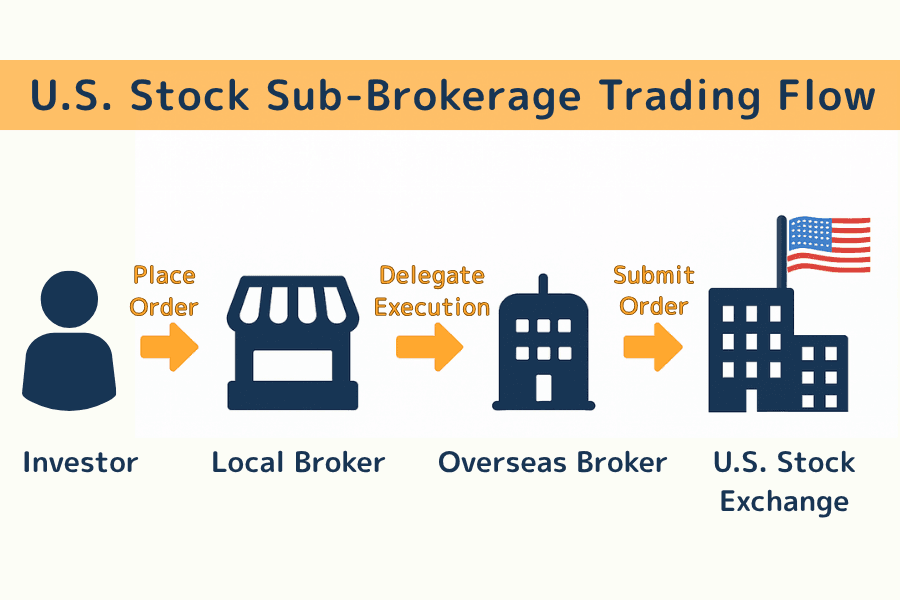
This structure gives sub-brokerage certain advantages in entry barrier and convenience, but also brings limits such as fees, time differences, and immediacy, explained below.
2. Advantages of Sub-brokerage
Sub-brokerage offers a simple way for investors to participate indirectly in the US-stock market, a relatively friendly entry option for those unfamiliar with overseas brokers.
Advantage 1: No Need to Open an Overseas Brokerage Account
Investors can take part in US-stock trading using only a local broker, without handling the complex processes of overseas account applications, tax documents, or English platforms.
Advantage 2: Deposit and Operate in Local Currency
Sub-brokerage supports deposits and trading in local currency, with the broker automatically handling FX conversion and settlement, effectively lowering the funding and technical barriers.
Advantage 3: Covers Common US-Stock Names
Through sub-brokerage you can trade most well-known US stocks and ETFs, such as Apple, Microsoft, and Tesla, suiting allocation-focused investors with a medium- to long-term horizon.
Advantage 4: Familiar Interface, Local Language and Service
Local brokers often provide a local-language interface and local customer support, making them more approachable for users not used to English trading platforms.
Advantage 5: No Need to Remit Funds Overseas
With sub-brokerage you do not need to wire funds to an overseas brokerage account, reducing cross-border transfer risk and avoiding high fees and tax-filing procedures.
Keeping funds onshore also helps with flexible cash management and risk control — a major advantage for investors who value fund security and convenience.
3. Risks and Limits of Sub-brokerage
Although sub-brokerage has certain advantages in convenience, its indirect nature still carries potential risks and usage limits. Here are the key points investors should note:
Limit 1: Trading Is Not Real-Time
Because sub-brokerage involves multi-layer routing, there can be a delay from order to execution, so the actual execution price may differ from the quote seen when ordering, especially during high volatility.
Limit 2: Cannot Set Advanced Order Conditions
Some sub-brokerage platforms do not support conditional orders, take-profit/stop-loss, or automatic price triggers, offering less flexibility than using overseas brokers or CFD platforms directly.
Limit 3: Information Updates Lag
Updates to execution records, holdings, and dividend postings may lag the actual market, which is unfavorable for short-term trading or strategies that need real-time information.
Limit 4: Higher Fees and FX Costs
Sub-brokerage usually involves more layers of fees, including trading commissions, offshore processing fees, and FX conversion spreads, so the overall cost can be higher than with overseas brokers or CFD platforms.
Limit 5: Cannot Participate in Certain Shareholder Rights
Some sub-brokerage accounts cannot vote at US shareholder meetings and do not support certain corporate actions such as stock dividends or preemptive rights — a potential limit for long-term holders.
4. Sub-brokerage vs Overseas Broker vs CFD: A Three-Way Comparison
There is more than one route to invest in US stocks. Besides sub-brokerage, investors can also open an overseas brokerage account directly or trade US stocks and indices via contracts for difference (CFDs).
Each of the three has pros and cons and suits different operating styles and capital allocations.
The table below summarizes the core differences:
Comparison of Three Ways to Invest in US Stocks:
| Item | Sub-brokerage | Overseas Broker | CFD (e.g., Titan FX) |
|---|---|---|---|
| Account opening | Local broker platform, quick and simple | Open with an overseas platform, somewhat complex | Quick online application, no bank statements or tax docs |
| Order method | Indirect; local broker routes to overseas broker | Direct order to a US exchange | Matched with the platform, referencing market price |
| Trade immediacy | Delayed, possibly non-instant execution | Instant order and matching | Instant execution, transparent pricing |
| Fees | Usually a fixed amount per order plus a percentage | Mostly low fixed fees ($0–$5/order) | No trading commission; included in the spread |
| Transfers and FX | Local currency; broker converts FX, may include spread cost | Wire USD yourself and bear transfer fees | Use account currency (USD, JPY); no FX conversion |
| Fund flow | Funds stay onshore, no need to remit abroad | Wire to an overseas account, may involve tax and review | Funds at the CFD broker, multi-currency deposits/withdrawals |
| Tax filing | Usually broker withholds tax, simple process | File tax forms like W-8BEN yourself | No actual holdings, no US shareholder taxes |
| Instruments | US stocks and some ETFs, basic range | Full US stocks, ETFs, options | US index and popular single-stock CFDs, long and short |
| Shareholder rights | Some brokers don't support meetings/voting | Full shareholder rights | No shareholder status, no physical rights |
| Leverage and flexibility | No or very low leverage (usually cash trading) | No leverage or high margin rates | Flexible leverage (Titan FX up to 20x) |
Summary: Clear Differences in Cost and Flexibility
Sub-brokerage's strength is simple operation, local currency, and no need to send funds abroad, suiting investors new to US stocks.
However, in terms of fee structure, trade immediacy, and flexibility, CFDs and overseas brokers are usually more efficient — especially for advanced traders who value cost control or seek flexible operation, where CFDs better deliver an active-strategy edge.
5. Titan FX Does Not Offer Sub-brokerage, but You Can Trade US Stocks Flexibly via CFDs
Although Titan FX does not offer sub-brokerage, investors can still participate in the US-stock market through contracts for difference (CFDs), with flexible operation and transparent costs — a preferred choice for many advanced traders and active investors.
CFDs do not involve holding physical shares but trading the price difference with the broker, suiting investors who want to flexibly go long or short, use leverage, and pursue short-to-medium-term opportunities.
Advantages of trading US-stock CFDs with Titan FX include:
| Advantage | Description |
|---|---|
| Flexible leverage | Choose up to 1:20 leverage for flexible capital use |
| No commission, no account fee | No minimum deposit and no platform fees, lowering overall trading cost |
| Instant execution, low latency | Use the MT5 platform for institutional-grade liquidity and fast execution |
| Diverse instruments | US indices (NASDAQ, S&P 500), popular US stocks, and other global-market products |
| Long or short | Respond flexibly to up and down moves, capturing short-term swings |
| Supports technical analysis and EA automated trading | Combine with Titan FX's free tools and indicators to strengthen strategies and automation |
Trade US Stock CFDs with Titan FX
Titan FX offers 100+ US stock CFDs on MT4/MT5 with up to 20:1 leverage, tight spreads, and full long/short flexibility.
6. FAQ on US-Stock Investing and Sub-brokerage
Q1. Which investors are Titan FX's US-stock CFDs suited for?
The CFD platform suits people who: prefer short-term or swing trading; value real-time quotes and fast execution; want to use leverage flexibly to capture up and down moves; are familiar with technical analysis or EA automated trading; and do not need physical shares or shareholder rights.
Q2. Does sub-brokerage have hidden costs?
Although simple to use, it may involve: commissions and trading taxes (plus possible minimum charges); FX conversion costs (brokers often use their own rate, which can be higher than the bank's spot rate); dividend taxation (a 30% US withholding tax that cannot be refunded); and slippage risk from trade delays. These costs are not always itemized as "extra fees" but do affect returns.
Q3. What should you watch out for in sub-brokerage trading?
US trading hours, the circuit-breaker mechanism, trading units, settlement currency, and dividend-posting currency all differ from some Asian markets. Most sub-brokerage platforms also do not support margin trading, so understand these differences and limits before trading.
Q4. Do I need to submit a W-8BEN form?
No. You do not need to submit a W-8BEN form to Titan FX. We collect identity-verification data during KYC, which is sufficient to identify a user's non-US status and comply with US tax rules.
Q5. Does stock CFD trading also have negative-balance protection?
Yes. Titan FX in principle provides negative-balance protection, applicable to stock CFD trading. The specific application depends on individual trading behavior and is reviewed and confirmed by the trading operations team.
Q6. What are the minimum and maximum trade sizes for stock CFDs?
Titan FX's stock CFDs support flexible trade-size settings: a minimum of 0.1 and a maximum of 1,000.
7. Conclusion
Whether you are new to US stocks or comparing investment methods such as sub-brokerage, overseas brokers, and CFDs, understanding the characteristics and costs of each route is the first step toward international markets.
Titan FX offers a flexible CFD trading option, letting investors participate in popular global US stocks and indices more efficiently and capture more opportunities. Choosing the approach that suits you is the key to steady long-term operation.
Further Reading
- What Is a CFD (Contract for Difference)?
- What Is Leverage in Trading?
- How to Install MT5
- U.S. Stock Trading Guide
Titan FX Research. Investor-education content covering forex (FX), commodities (oil, precious metals, agricultural products), stock indices, US equities, and crypto assets across global markets.
Primary Sources by Category
- Official data and market bodies: New York Stock Exchange (NYSE) and NASDAQ trading rules; U.S. SEC filings
- Industry and research: fee comparisons between sub-brokerage and overseas brokers; research on CFD trading mechanisms
- Market data: Titan FX live quotes and US-stock CFD prices; US equity market analysis from major financial media