

How to Invest in Tesla (TSLA)? Positioning, Price Cycles, and CFD Trading
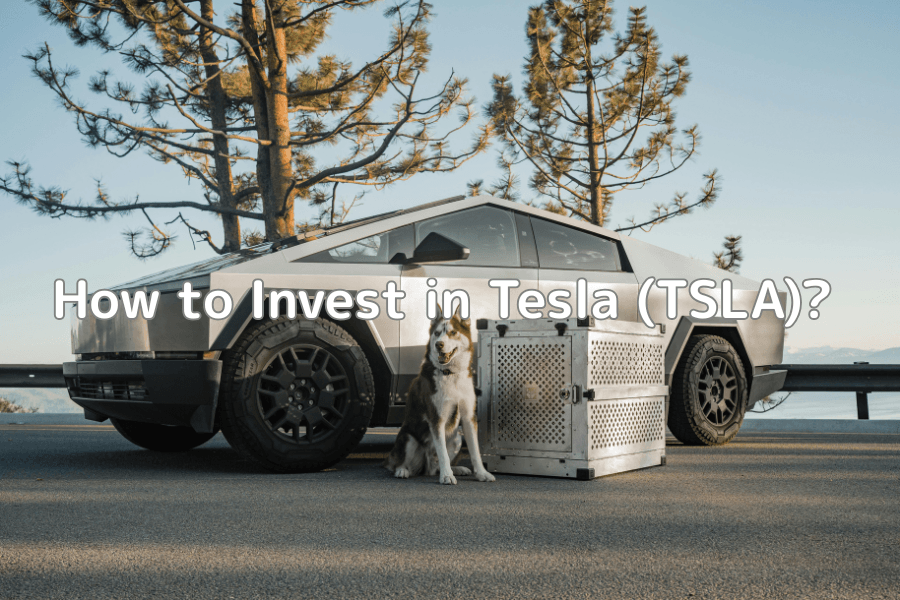
Tesla (TSLA) has long been one of the most talked-about stocks in the US market. Seen as the leader of the EV industry, it also carries high expectations for energy transition, artificial intelligence, and autonomous driving, giving its share price the dual character of high growth and high volatility.
For beginner investors, Tesla is not just a stock but more like a comprehensive case combining "tech narrative, industry competition, and market sentiment." This article systematically analyzes Tesla's role in US-stock investing — from company positioning, share-price history, and core drivers to practical trading methods and risks — to help you build a clearer basis for understanding and judgment.
- EV + energy + AI: Tesla (TSLA) has shifted from an EV maker to a tech company combining manufacturing, software, energy, and AI, with high vertical integration.
- High growth, high volatility: The share price reflects both fundamentals and tech narrative/market sentiment, with swings clearly larger than typical large caps.
- Core share-price drivers: Deliveries, auto gross margin, production efficiency, FSD (autonomy) progress, energy/storage, and competition and price pressure.
- Multi-track growth story: Manufacturing innovation and gigacasting, 4680 battery cost reduction, FSD/Robotaxi, the Optimus robot, and energy/storage.
- How to trade: Via stocks, ETFs, or CFDs for two-way (long/short) exposure; Titan FX offers TSLA US-stock CFDs with up to 20x leverage.
- 1. Tesla Company Overview: Positioning, Mission, and Energy Strategy
- 2. Tesla Share-Price History: A Classic High-Growth, High-Volatility Cycle
- 3. Core Drivers of Tesla's Share Price: Where Fundamentals Meet Expectations
- 4. Tesla's Growth Engines: A Long-Term Story Beyond EVs
- 5. How to Trade Tesla (TSLA) US-Stock CFDs: Steps and Tools
- 6. Frequently Asked Questions (FAQ)
- 7. Conclusion: Tesla's Real Role in a Portfolio
1. Tesla Company Overview: Positioning, Mission, and Energy Strategy
Tesla (ticker: TSLA) was founded in 2003 and is led by CEO Elon Musk; it is one of the world's most talked-about EV and energy-technology companies. Tesla's mission is to accelerate the world's transition to sustainable energy, which means car sales are not its only growth goal.
Unlike traditional automakers, Tesla has adopted a highly vertically integrated strategy since its founding, controlling most key links from vehicle design, battery technology, and software to its charging network. This gives Tesla a competitive model distinct from incumbents in iteration speed and cost structure.
From EV Maker to Energy-Technology Company
Early on, the market viewed Tesla as an EV startup, but as its business expanded, it has gradually been positioned as a tech company combining manufacturing, software, and energy management.
EVs remain the main revenue source, but energy storage, grid solutions, and autonomous-driving software are becoming important parts of how the market assesses its long-term value.
Core Product Lines and Market Roles
Tesla's main models cover different price points and use cases:
| Product | Market Positioning |
|---|---|
| Model 3 / Model Y | Mass-market core models, the heart of deliveries |
| Model S / Model X | High performance and brand image |
| Cybertruck | A new-form pickup, expanding the North American market |
| Semi | Commercial EV truck, entering logistics and enterprise markets |
Strategic Significance of the Energy and Storage Business
Beyond cars, Tesla's energy business includes Powerwall, Megapack, and solar systems, mainly serving residential, enterprise, and utility markets.
As global grid loads rise and renewable penetration increases, storage demand is seen as a long-term trend, so Tesla is no longer fully bound by the auto business cycle.
Overall, Tesla has high visibility in the global EV market while gradually building an "energy + AI" corporate image — the fundamental reason its valuation has long been higher than traditional automakers.
2. Tesla Share-Price History: A Classic High-Growth, High-Volatility Cycle
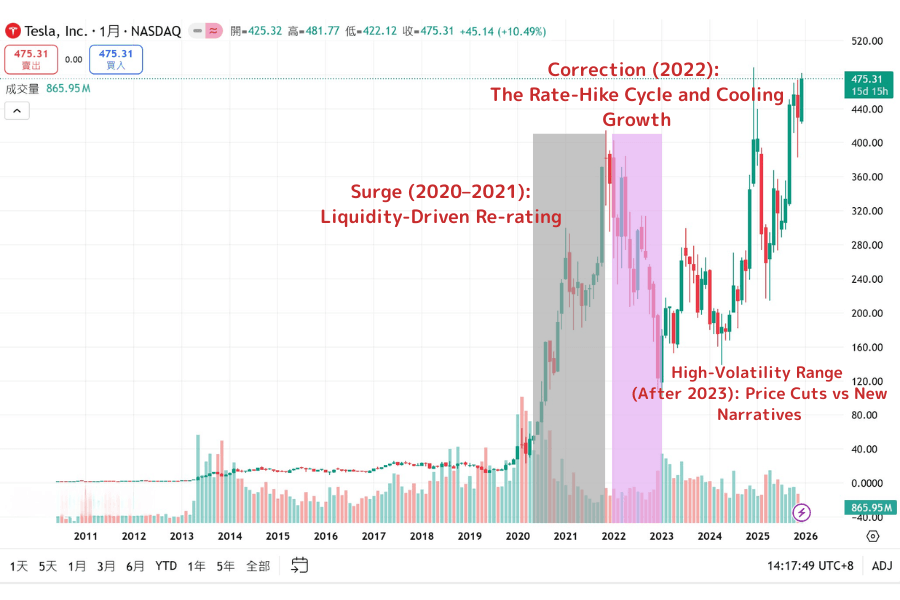
Tesla's (TSLA) share-price history is one of the most representative high-volatility cases in the US market. Its moves reflect not only changes in the company's fundamentals but are deeply influenced by market sentiment, the funding environment, and the future-growth narrative. For beginners, understanding the backdrop to price swings in each phase helps avoid misjudging risk by looking only at short-term moves.
Startup and Validation (2010–2018): Doubts Over Mass Production
In its early listed years, Tesla long sat in a phase of "gap between concept and reality." It had not yet established stable mass production, cash flow and deliveries were repeatedly scrutinized, and the share price mainly traded in a range.
The core question for the market then was not growth speed but whether Tesla could really become a sustainable automaker.
Inflection (2019): Model 3 Ramp and Building Confidence
2019 is seen as a key turning point. As Model 3 production and deliveries gradually improved, the market began to realize Tesla had crossed the "mass-production threshold," its survival risk fell clearly, and the share-price structure broke higher.
That year, the market's view of Tesla shifted from doubt to re-pricing.
Surge (2020–2021): Liquidity-Driven Re-rating
Amid global easing and low rates, Tesla became one of the representatives of tech growth stocks. Model Y ramped successfully, and with high attention on the long-term EV trend, the market began to value Tesla as a tech company rather than a traditional automaker, and the share price rose sharply.
This phase was characterized by "expectations running ahead of fundamentals," with valuations expanding rapidly.
Correction (2022): The Rate-Hike Cycle and Cooling Growth
From 2022, as the US entered a rate-hike cycle, high-valuation growth stocks generally faced corrections. Tesla was also affected by slowing demand growth, intensifying competition, and falling gross margins, and the share price pulled back clearly.
The market refocused on actual profitability rather than mere future imagination.
High-Volatility Range (After 2023): Price Cuts vs New Narratives
After entering 2023, Tesla cut prices multiple times to stimulate demand, and deliveries and gross margin entered a tug-of-war. Meanwhile, the market keeps watching whether FSD, autonomy, the energy business, and AI applications can become the next growth driver, keeping the share price highly volatile.
This phase's moves often swing between "short-term earnings pressure" and "the long-term tech narrative."
Overall, Tesla's price cycle clearly reflects the typical traits of a high-growth stock: when the market sees certainty, valuations are quickly revised up; when uncertainty rises, volatility and corrections also amplify. Understanding these phases helps investors view price swings more rationally.
3. Core Drivers of Tesla's Share Price: Where Fundamentals Meet Expectations
Tesla's (TSLA) valuation does not rely solely on traditional automaker metrics but combines manufacturing data with the growth expectations of a tech stock. For investors, understanding what the market "cares about most" is often more important than any single financial figure. Below are the key factors that most easily affect Tesla's share price in practice.
Driver 1: Global Deliveries and Order Momentum
Quarterly deliveries are the front-line indicator of Tesla's actual demand. When data beats expectations, it usually means the price strategy is working or demand is resilient; if growth slows, the share price tends to be pressured in the short term.
For beginners, whether deliveries "meet market expectations" often matters more than the year-over-year rate itself.
Driver 2: Auto Gross Margin and the Impact of Price Cuts
Gross margin is one of the core indicators of Tesla's profit quality. In recent years the company has cut prices to boost sales, which helps expand share but also compresses per-vehicle profit.
The market focuses on whether margins can stay relatively stable amid price competition, not the ups and downs of a single quarter.
Driver 3: Capacity Efficiency and Manufacturing Cost Control
The utilization and efficiency of major plants in Texas, Berlin, and Shanghai directly affect unit cost structure. When capacity ramps smoothly and processes are optimized, the market usually gives a more positive view.
Conversely, if a new line's progress lags expectations, it tends to be a source of short-term volatility.
Driver 4: FSD Progress and Regulatory Variables
Full self-driving is seen as one of the important imaginative spaces for Tesla's long-term valuation. Whenever FSD makes new progress or a major update, market sentiment tends to react clearly.
However, the actual pace of commercialization and regulators' stances in various countries remain uncertain, which is why related news easily amplifies share-price swings.
Driver 5: Visibility of the Energy and Storage Business
Compared with the auto business, energy and storage are less affected by the economic cycle. When Megapack and similar products show clear shipment growth, the market re-evaluates the diversity of Tesla's revenue structure.
This factor rarely triggers sharp short-term swings but provides stable support for medium- to long-term valuation.
Driver 6: The Competitive Environment and Industry Price Pressure
As BYD and traditional automakers accelerate electrification, price competition in the EV market has become the norm. The market keeps comparing whether Tesla's cost structure still has an edge and whether its brand premium can hold.
When the industry enters fierce competition, the share price's reaction to news also tends to be more sensitive.
Overall, Tesla's share-price swings often happen when "actual data" and "market expectations" diverge. Understanding these core factors helps investors stay rational amid sharp moves.
4. Tesla's Growth Engines: A Long-Term Story Beyond EVs
Valuing Tesla only by "how many cars it sold" tends to underestimate its long-term value. The reason the market grants Tesla higher valuation flexibility is that it positions multiple potential growth paths at once, and these drivers may not show up immediately in short-term earnings.
Improved Manufacturing Efficiency and Production Innovation
Tesla keeps optimizing its manufacturing in ways different from traditional automakers, such as large castings, integrated design, and highly automated line planning. The goal of such innovation is not a single model but lowering overall production complexity and unit cost over the long term.
For investors, this means Tesla's competitiveness comes not only from products but from the replicability of its manufacturing model.
Cost-Reduction Potential of Key Technologies
In battery and materials technology, Tesla keeps investing to lower costs through technology-route adjustments. The 4680 battery is seen as an important medium- to long-term link; its real value lies not in short-term output but in whether it can support larger-scale future product deployment.
Such technical progress usually affects the share price over the medium to long term rather than immediately.
The Long-Term Imaginative Space of FSD and Robotaxi
Autonomous-driving technology is an important factor in whether the market sees Tesla as having "platform company" potential. If commercialization advances smoothly, Tesla's revenue model may no longer rely only on one-off car sales but extend to software and service revenue.
However, this path still carries high uncertainty and reflects more of a long-term option than a confirmed profit source.
The Strategic Significance of the Optimus Humanoid Robot
Optimus is still in an early development stage, far from actual commercialization. The market's focus is not short-term revenue contribution but whether it represents Tesla's potential to extend AI capability to physical applications.
For most investors, this is more of a long-term bet than a core business that immediately affects valuation.
Structural Support from the Energy and Storage Business
Compared with the cyclical swings of the auto market, energy and storage have structural demand. Advancing large storage projects helps Tesla build a revenue source with a rhythm different from the auto business, improving overall operating stability.
This growth curve draws less attention than EVs and autonomy but has real meaning for long-term cash-flow structure.
Overall, Tesla's growth story is not a single-direction bet but multiple paths developing in parallel. This is why the market's valuation often considers not just current performance but also growth potential over the coming years.
5. How to Trade Tesla (TSLA) US-Stock CFDs: Steps and Tools
Investors can choose different ways to participate in Tesla's (TSLA) market based on their strategy, risk tolerance, and capital. Among them, CFDs (contracts for difference) — with features such as two-way (long/short) trading and flexible leverage — are especially suited to trading high-volatility US tech stocks like Tesla.
The table below summarizes common ways to invest in Tesla and who they suit:
| Method | Key Features | Suitable For |
|---|---|---|
| Buy TSLA shares directly | Participate in long-term growth and capital appreciation | Long-term investors |
| ETF / index allocation | Diversify single-stock risk via EV or tech ETFs | Medium-term allocators |
| Contracts for difference (CFDs) | Leverage and long/short; highly flexible | Those focused on volatility and strategic trading |
Trading Steps: How to Trade Tesla CFDs at Titan FX
To participate in Tesla's two-way moves with a lower barrier, CFDs (contracts for difference) offer a flexible approach, especially suited to investors who watch earnings, delivery data, or market news.
Titan FX's US-stock CFDs offer up to 20x leverage, letting traders participate in TSLA's price rises or falls with relatively little capital. Here are the basic steps:
| Process | Description |
|---|---|
| Step 1: Register an account | Go to the Titan FX account-opening page, enter your basic details and complete verification to activate your trading account. |
| Step 2: Make a deposit | Log in to the Titan FX Client Cabinet and deposit via credit card, e-wallet, or bank transfer following the prompts. |
| Step 3: Download the MT5 platform | Tesla US-stock CFDs are traded on MT5. Titan FX offers MT5 for Windows, Mac, iOS, Android, and Web. |
| Step 4: Start trading Tesla CFDs | Launch MT5, log in, search for and add Tesla in Market Watch, then choose Buy (long) or Sell (short) to place an order. |
Trading Tesla via CFDs lets you participate in price moves without holding the underlying shares. But note that leverage magnifies both gains and losses, so set a stop-loss and manage capital risk before trading.
Free Trading Tools from Titan FX
To help investors track the rhythm of US stocks more effectively, Titan FX offers several practical tools to use alongside analysis:
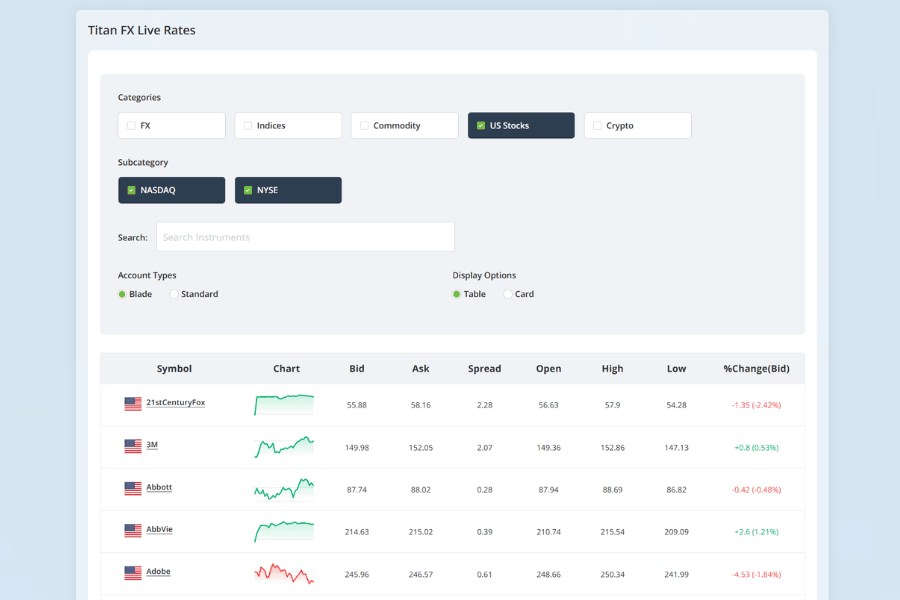
Live Rate
Live Rate provides the latest Bid/Ask, spread, intraday highs and lows, and a mini trend chart — a basic market-data source for short-term trading and strategy statistics.
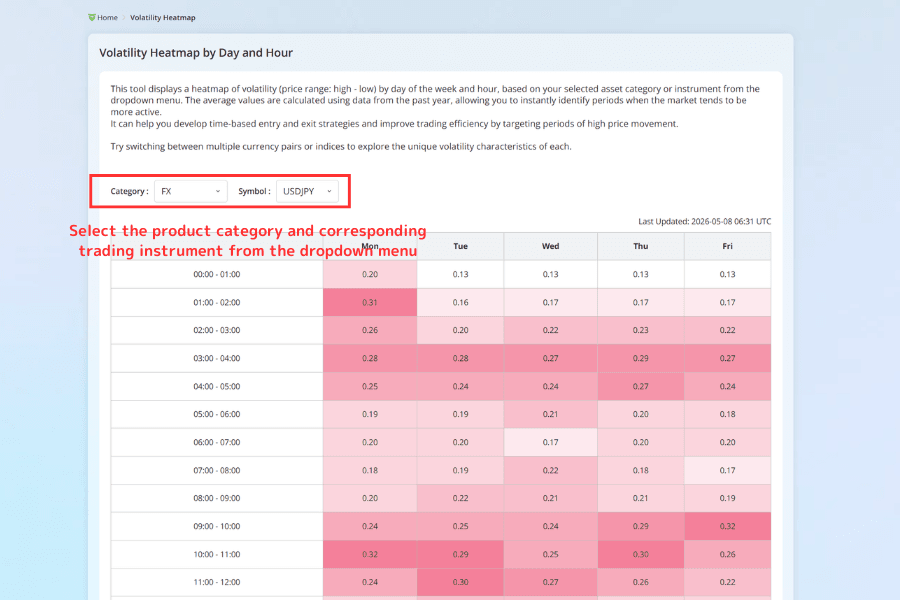
Volatility Heatmap
The Volatility Heatmap uses historical data to show how strongly an instrument moves at different times of day, helping you pick more suitable trading windows.
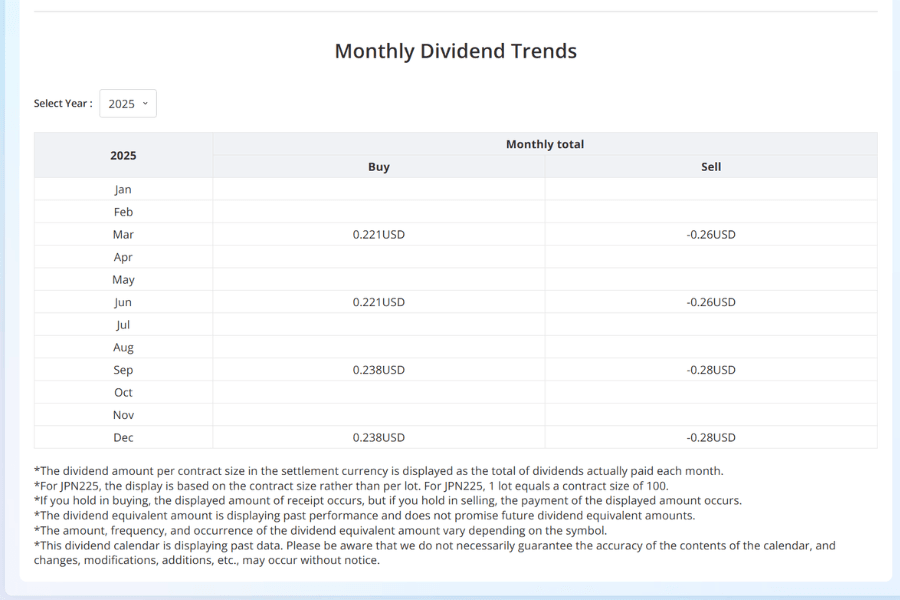
Dividend Calendar
View daily and monthly dividend records for US-stock companies in one place, including the actual dividend amounts at buy/sell, helping you track payout timing, compare yields, or plan a dividend strategy.
Trade TSLA CFDs with Titan FX
Titan FX offers Tesla (TSLA) stock CFDs with up to 20:1 leverage, tight spreads, and the flexibility to go long or short without owning the shares.
6. Frequently Asked Questions (FAQ)
Q1. What is the most important risk to watch when investing in Tesla?
Tesla's main risks come from demand changes, price competition, and uncertainty over future technology rollout. The EV market is highly competitive and price strategy can affect profitability; meanwhile, autonomy and AI applications still need time to prove out and may not translate into stable earnings in the short term.
Q2. Is Tesla suitable as a long-term investment?
For investors who can accept high volatility, Tesla has long-term positioning potential, but it does not suit those seeking stable income or low volatility. Its investment logic leans toward growth allocation, requiring a longer time horizon and the readiness to bear price swings.
Q3. When evaluating Tesla, should you weigh revenue or future themes more?
The market often watches both actual revenue and the future-growth narrative. Short-term price is easily swayed by delivery data and gross margin; the medium to long term depends on the market's confidence in autonomy, energy, and AI applications. Understanding this difference helps avoid overreacting to short-term news.
Q4. Should beginners take a large Tesla position right away?
For less experienced beginners, it is not advisable to allocate a large share to Tesla from the start. A better approach is to treat it as one growth position, combined with other more stable assets to diversify risk; those who prefer short-term trading should also set clear stop-loss and capital-management rules.
Q5. Which metrics are most useful when reading Tesla's earnings?
Beginners can prioritize: whether vehicle deliveries meet market expectations, the trend in auto gross margin, revenue growth in the energy and storage business, and management's guidance for upcoming quarters and the year. These often reflect the market's actual view of Tesla better than a single earnings figure.
Q6. Can you trade Tesla (TSLA) at Titan FX?
Yes. Titan FX offers US-stock CFDs on Tesla (TSLA) and other US stocks, with up to 20x leverage, two-way (long/short) trading, and no need to hold the underlying shares. US-stock CFDs are traded on the MT5 platform; understand TSLA's volatility and manage stop-losses and capital before trading.
7. Conclusion: Tesla's Real Role in a Portfolio
As the analysis above shows, Tesla is not a stock to view through a "stable dividend" or "defensive allocation" lens. Its share price is influenced over the long term by industry competition, technical progress, and changing market expectations, with swings clearly larger than typical large caps.
For investors, a more reasonable positioning is to treat Tesla as an aggressive growth position rather than the sole core of a portfolio. Whether holding long term, building in tranches, or participating in short-term swings via CFDs, this should be based on a clear understanding of its risk sources and growth logic.
As long as you can balance expectations and risk, Tesla can still play the role of "raising overall growth potential" in a portfolio, rather than being a source of emotional stress.
Further Reading
- What Is a CFD (Contract for Difference)?
- What Are Technology Stocks?
- What Is Leverage in Trading?
- How to Install MT5
Titan FX Research. Investor-education content covering forex (FX), commodities (oil, precious metals, agricultural products), stock indices, US equities, and crypto assets across global markets.
Primary Sources by Category
- Official data and disclosures: Tesla, Inc. investor relations (10-K annual and 10-Q quarterly reports); U.S. SEC EDGAR filings
- Industry and research: EV, energy-storage, and autonomous-driving market research; major investment-bank tech-sector analysis
- Market data: Titan FX live quotes and US-stock CFD prices; US equity market analysis from major financial media