

Technology Stocks
From smartphones to the cloud, AI, and electric vehicles, technology has reshaped daily life and the business models of nearly every industry. The companies at the forefront of that change are technology stocks — and they have become some of the most influential names in global equity markets.
Yet while technology stocks carry huge long-term potential, they also come with high volatility and valuation risk. For investors, understanding their structure, valuation logic, and market cycles is the key to steady returns in this high-growth space.
This article analyses technology stocks end to end — definition, classification, core traits, drivers, and practical investment strategy — covering their investment nature and long-term value.
- Definition: technology stocks are shares of firms that develop, make, or sell tech products and services
- Classification: IT services, semiconductors, internet and cloud, consumer AI, new energy
- Core traits: high growth, high volatility, innovation-driven, long structural growth
- Drivers: rates and inflation, tech cycles, regulation, and capital flows
- Investing and trading: hold leaders long-term, diversify via ETFs, disciplined risk control, CFDs for two-way
1. What Are Technology Stocks? (Definition)
Technology stocks are the shares of companies primarily engaged in the research, production, and sale of technology products or services. These firms put innovation at the core, driving industrial upgrading and economic growth through technical breakthroughs.
Their scope is wide: information technology (IT), cloud computing, artificial intelligence (AI), semiconductors, electric vehicles, communications, digital media, and software services. They lead global industrial change and shape the stock market's long-term growth momentum.
In capital markets, technology stocks are seen as a symbol of innovation and growth. Compared with traditional industries, tech firms usually have faster revenue growth and greater future expectations, but also higher volatility — a classic high-risk, high-reward profile. They are also called tech stocks.
Understanding the concept helps investors grasp the arc of modern economic development. From the apps and cloud services we use daily to the chips and servers behind computing, almost every innovative industry has technology stocks behind it.
2. Main Classification and Representative Industries
Technology spans from base hardware to application services, forming a complete technical ecosystem. Major categories and representative firms:
| Category | Main areas | Representative firms | Industry traits |
|---|---|---|---|
| IT services | Software, servers, cloud | Microsoft, IBM, Oracle | Stable profit, high share, steady enterprise demand |
| Semiconductors | Chip design and fabrication | NVIDIA, Intel, TSMC | High barriers, core of global supply chain |
| Internet & cloud | Platforms, cloud infrastructure | Amazon, Google, Meta, Alibaba | High stickiness, strong platform economics |
| Consumer tech & AI | Smart devices, AI apps, EV tech | Apple, Tesla, Samsung | Innovation-driven, strong brand influence |
| EV & clean tech | EVs, storage, green solutions | Tesla, BYD, Enphase Energy | Policy support, high potential but volatile |
Category 1: IT services
These firms provide software, data management, enterprise solutions, and cloud infrastructure, and are key drivers of corporate digital transformation. Microsoft set the enterprise standard via Office and Azure; Oracle is known for databases and ERP; IBM expands enterprise services with AI and hybrid cloud. Long-term contractual revenue gives them both defensiveness and growth.
Category 2: Semiconductors
Semiconductors are the bedrock of modern tech — phones, cars, and AI servers all rely on chips. NVIDIA (GPU/AI chips), Intel (general processors), and TSMC (the most important foundry) are representative. Barriers and R&D are very high, but once an advantage forms it brings near-monopoly and high margins. Geopolitics and supply-chain security also affect prices.
Category 3: Internet & cloud
These firms build the digital economy's infrastructure — search, social, e-commerce, and cloud. Amazon leads cloud via AWS; Google builds an ecosystem of search, ads, and cloud; Meta dominates social media; Alibaba grows e-commerce and cloud in Asia. Their models centre on "data" and "network effects," giving high scalability.
Category 4: Consumer tech & AI
This links innovation with everyday life — phones, wearables, smart home, and AI applications. Apple is known for its hardware-software ecosystem; Samsung leads in displays and memory; Tesla reshapes autos with AI, autonomy, and energy. Prices track product cycles and expectations.
Category 5: EV & clean tech
Combining EVs, renewables, and storage, this is a closely watched emerging field. Tesla, BYD, and Enphase Energy are representative, cutting energy costs and improving efficiency to push global decarbonisation. It depends heavily on policy and raw-material costs, so it is volatile but has long-term structural growth potential.
Major technology stocks by region
| Region | Main areas | Representative firms | Market traits |
|---|---|---|---|
| U.S. | Cloud, AI, semis, consumer electronics | Apple, Microsoft, NVIDIA, Amazon, Alphabet, Meta | Core of global innovation, strong capital liquidity |
| China | E-commerce, cloud, AI, hardware | Alibaba, Tencent, Baidu, Huawei, BYD | Policy-led, huge domestic demand, app/manufacturing focus |
| Taiwan | Semis, electronics contract, IC design | TSMC, MediaTek, Foxconn | Key to global chip supply, strong in manufacturing |
| Japan | Robotics, auto electronics, displays | Sony, Panasonic, Toyota, Renesas | Quality and stability, industrial-application innovation |
| South Korea | Memory, displays, consumer electronics | Samsung, SK Hynix, LG Electronics | Highly vertically integrated, strong supply-chain edge |
The diversity of the industry lets investors choose by risk tolerance — from steady enterprise IT to high-growth new-energy tech, technology stocks are one of the most representative growth engines in global markets.
3. Core Traits and Investment Style
The value of technology stocks comes from "innovation and future growth potential," not current stable earnings, and differs clearly from traditional sectors such as finance, energy, and utilities.
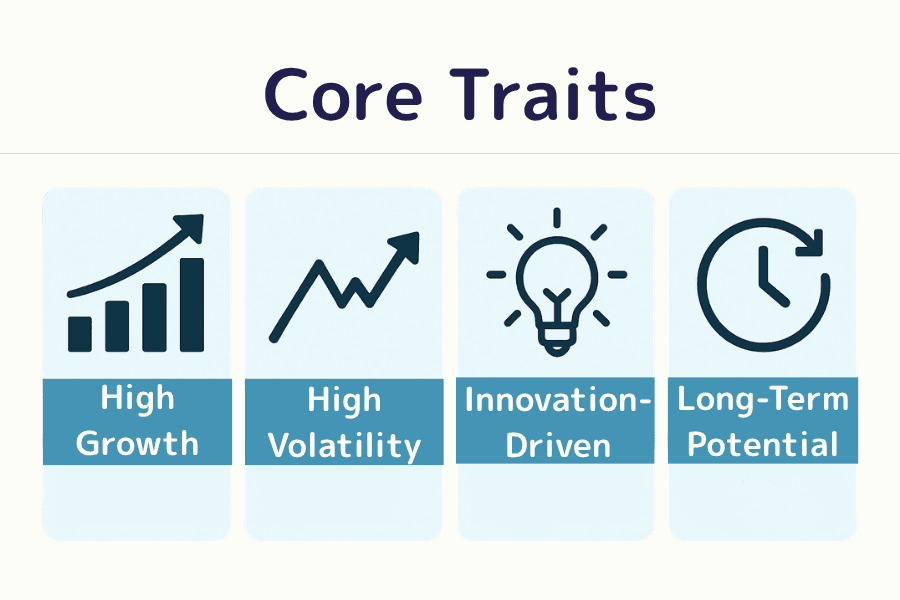
Trait 1: Growth-oriented
Often in the early or rapidly expanding stage, these firms put most capital into R&D, M&A, and market expansion rather than dividends. Software and AI firms often use "user growth" as a core metric, so short-term profit may be modest, but if innovation succeeds the upside is large.
Trait 2: High volatility
Highly sensitive to expectations: an earnings miss, rising rates, or tighter policy can cause sharp swings. This demands patience and resilience for long holding; volatility is also opportunity — buying dips during panic can yield high returns.
Trait 3: Innovation-driven
Competitive advantage comes from technical and product innovation. A breakthrough (AI chips, cloud architecture, EV batteries) can change industry structure and re-rate a company. But innovation cuts both ways: stalled R&D or displacement can shrink value fast, so watch R&D spend, patents, and technical lead.
Trait 4: Long-term potential and structural growth
Value comes not only from product sales but from "structural trends" — digitalisation, AI, electrification, energy transition. Even with sharp short-term swings, these give cross-cycle growth potential, making tech a primary way for long-term investors to capture the global transition.
In short, the core traits are high risk, high potential, innovation-driven, and long-term-oriented.
4. What Moves Technology Stocks
Performance is set by the interaction of economic conditions, policy, and sentiment.
Driver 1: Rates and inflation
Rates and inflation are key to valuation. When market rates or Treasury yields rise, the discount rate rises and the present value of future cash flows falls, pressuring high-valuation growth stocks. Conversely, under low rates or quantitative easing, cheaper funding lets investors pay up for growth, and tech tends to be strong.
Driver 2: Industry innovation and tech cycles
Growth pace depends on innovation speed. Each major breakthrough (AI, semiconductor processes, 5G, cloud, quantum) can trigger a new investment wave. Valuations surge during demand booms and fall when innovation hits a ceiling, so watch the technology life cycle.
Driver 3: Regulation and global supply-chain shifts
Antitrust, data privacy, export controls, and geopolitical tension directly affect operations. Supply-chain adjustments (chip fabrication, key components) also reshape structure and cost. As globalisation turns regional, balancing compliance and supply security affects price stability.
Driver 4: Capital flows and liquidity
Market easing and tightening amplify volatility. When liquidity is ample and risk appetite high, money flows into high-growth sectors; when tightening or risk-off, tech is often trimmed first. Tracking flows and sentiment is key to short-term moves.
Overall, technology stocks move along four axes: policy environment × technical innovation × capital cycle × investor sentiment.
5. Investment Strategy and Risk Management
The core is balancing growth and risk. Despite long-term structural opportunity, the sector is volatile and valuation-sensitive, so a strategic, disciplined approach is essential.
Strategy 1: Hold leaders long-term
Large firms (Apple, Microsoft, NVIDIA) have stable cash flow, strong R&D, and global share — "core assets." Holding leaders long-term participates in the whole cycle and diversifies single-technology or policy risk; they are relatively defensive during slowdowns.
Strategy 2: Diversify via ETFs
For those who cannot track single names, tech ETFs offer a low-cost way to join, covering sub-industries (semis, cloud, AI) and diversifying single-company or theme risk. Regular investing smooths volatility and timing risk.
Strategy 3: Track the rate cycle and discounting
Valuations are very rate-sensitive. In hiking cycles the discount rate rises and growth valuations are cut; in cutting or easing phases tech usually leads. Watch Treasury yields and inflation data and adjust holdings and weights to the macro backdrop.
Strategy 4: Emphasise fundamentals and R&D
Competitiveness rests on innovation and R&D. Watch EPS growth, gross margin, and R&D intensity (R&D/Sales). Firms with stable growth and continuous innovation tend to have higher long-term potential and resilience; technical barriers, ecosystem, and market penetration also gauge core strength.
Strategy 5: Risk control and defence
High potential carries valuation-bubble and innovation-failure risk. Set stop-loss and take-profit ranges, keep any single industry or stock within 20%–25% of total capital, and review the portfolio regularly. In high-volatility markets, controlling risk matters more than chasing return; steady positioning and discipline are the key to long-term success.
Strategy 6: Combine cycle judgement with industry trends
Tech is closely tied to rates and liquidity. In easing cycles it usually leads the rebound; in tightening or risk-off it cedes to defensives. Watch macro policy alongside long-term trends — AI, semiconductors, automation, clean energy — to find the intersection of growth momentum and lower valuation.
6. How to Trade Technology Stock CFDs
The stock CFDs Titan FX supports can be traded long (buy) or short (sell), letting you trade the price difference without owning the underlying share — suited to fast, convenient day trading.
Open a Titan FX trading account, fund it, and on the MT5 platform you can trade 100+ U.S. stock CFDs listed on NASDAQ and the NYSE, with Titan FX supporting up to 20x leverage.
U.S. stock CFD trading hours (Eastern Time)
Trading hours switch with daylight saving. Below is the MT5 server time mapped to U.S. Eastern Time.
| Session | MT5 server time | U.S. Eastern Time |
|---|---|---|
| DST (approx. 2nd week of Mar – 1st week of Nov) | 11:00–23:59 (GMT+3); Fri ends 23:55 | 04:00–16:59; Fri ends 16:55 |
| Standard (approx. 1st week of Nov – 2nd week of Mar) | 10:00–23:59 (GMT+2); Fri ends 23:55 | 03:00–16:59; Fri ends 16:55 |
Technology stocks tradable with Titan FX
| Ticker (MT5) | Company | Main area | Exchange |
|---|---|---|---|
| Adobe | Adobe Inc | Software & digital media | Nasdaq |
| ADP | Automatic Data Processing Inc | Cloud payroll & enterprise software | Nasdaq |
| Alibaba | Alibaba Group | E-commerce & cloud | NYSE |
| Alphabet | Alphabet Inc (Google) | Search, cloud, AI | Nasdaq |
| Amazon | Amazon.com Inc | E-commerce, cloud (AWS) | Nasdaq |
| AMD | Advanced Micro Devices Inc | Semiconductors & AI chips | Nasdaq |
| Apple | Apple Inc | Consumer electronics, AI, ecosystem | Nasdaq |
| Cisco | Cisco Systems Inc | Network gear & enterprise comms | Nasdaq |
| Comcast | Comcast Corp | Internet & media tech | Nasdaq |
| ElectronicArts | Electronic Arts Inc | Video games & digital entertainment | Nasdaq |
| Equinix | Equinix Inc | Data centres & cloud infrastructure | Nasdaq |
| Facebook / Meta | Meta Platforms Inc | Social media & metaverse | Nasdaq |
| Intel | Intel Corp | Semiconductors & computing | Nasdaq |
| Intuit | Intuit Inc | Financial & tax software | Nasdaq |
| IntuitiveSurgical | Intuitive Surgical Inc | Medical robotics | Nasdaq |
| JD.com | JD.com Inc | E-commerce & logistics tech | Nasdaq |
| MicronTechnology | Micron Technology Inc | Memory chips | Nasdaq |
| Microsoft | Microsoft Corp | Software, cloud, AI | Nasdaq |
| Netflix | Netflix Inc | Digital streaming | Nasdaq |
| NVIDIA | Nvidia Corp | GPU, AI, computing chips | Nasdaq |
| Oracle | Oracle Corp | Database & cloud | NYSE |
| PayPal | PayPal Holdings Inc | Fintech payments | Nasdaq |
| QUALCOMM | Qualcomm Inc | Comms chips & 5G | Nasdaq |
| RegeneronPharmaceuticals | Regeneron Pharmaceuticals Inc | Biotech & AI drug analysis | Nasdaq |
| Spotify | Spotify Technology SA | Music streaming | NYSE |
| Tesla | Tesla Inc | EV, AI, autonomy | Nasdaq |
| TexasInstruments | Texas Instruments Inc | Semiconductors & sensors | Nasdaq |
| TMobile | T-Mobile US Inc | Telecom & mobile | Nasdaq |
| UBER | Uber Technologies Inc | Platform & ride-hailing | NYSE |
| Zoom | Zoom Video Communications Inc | Video conferencing & collaboration | Nasdaq |
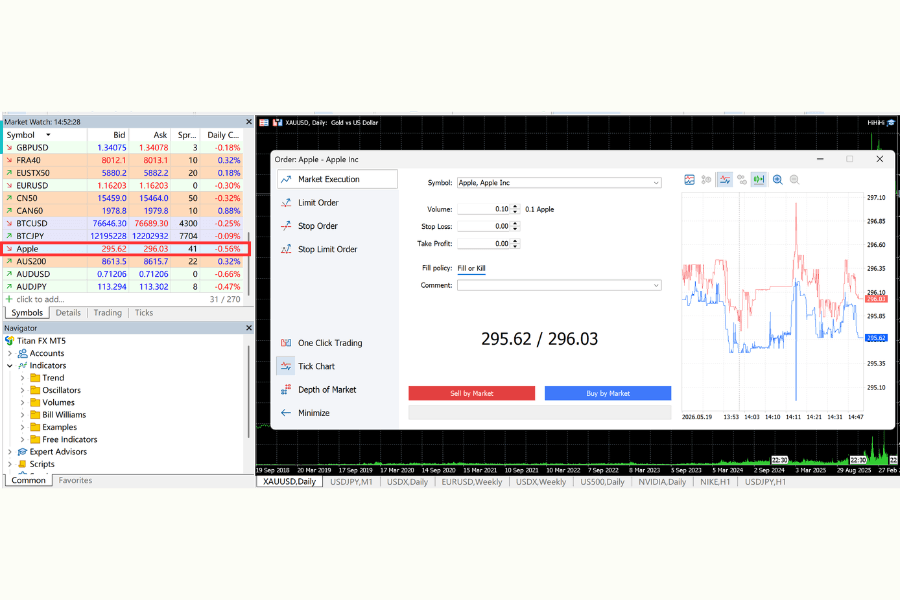
Next, using Apple as an example, here is how to trade a U.S. stock CFD on MT5.
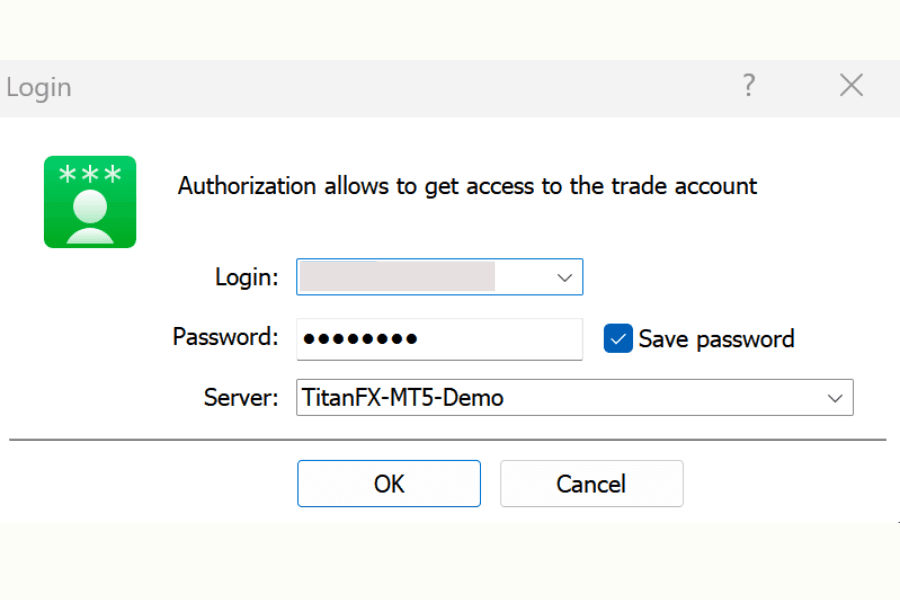
Step 1: Log in to the trading account
Download MT5 and log in with your ID and password.
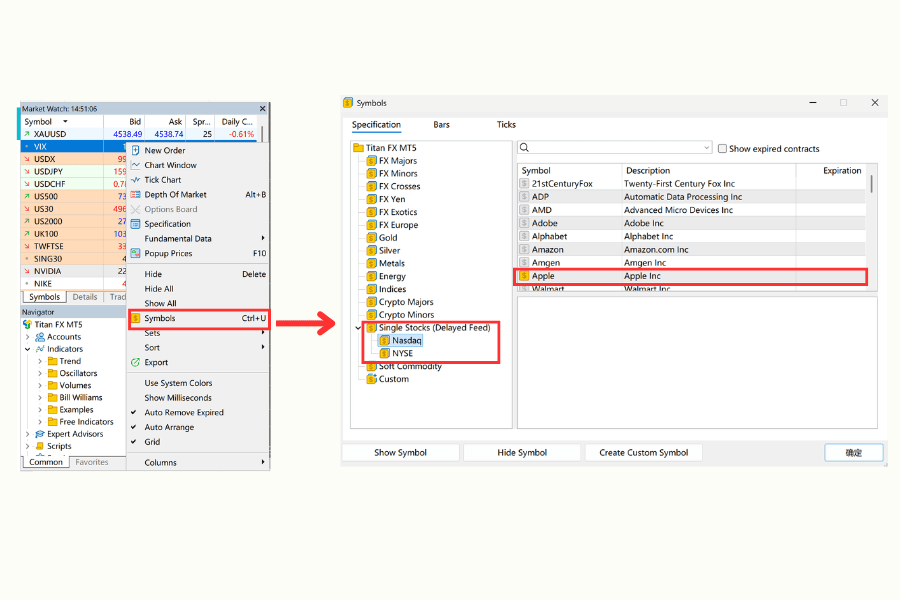
Step 2: Add the Apple quote
Right-click in "Market Watch," choose "Symbols," expand "Single Stocks (Delayed Feed)," select "Nasdaq," and double-click "Apple" to add it to the quote list.
Step 3: Start trading
Open the Apple quote or chart, enter the order screen, input lot size, choose buy or sell, set stop-loss and take-profit, then trade.
7. Frequently Asked Questions (FAQ)
Q1. Are technology stocks the same as growth stocks?
They overlap heavily but are not identical. Most tech stocks are growth stocks, but growth stocks also include non-tech industries, and some mature tech leaders also have value-stock traits. Judge by growth stage and valuation structure, not industry label alone.
Q2. Why are technology stocks especially sensitive to rates?
Much of their valuation comes from future cash flows; when rates (the discount rate) rise, present value falls, pressuring high-valuation growth stocks. So hiking cycles tend to be highly synced with tech corrections.
Q3. Should beginners buy single stocks or a tech ETF?
For those who cannot track single names long-term, a tech ETF diversifies single-company and theme risk at low cost and smooths volatility via regular investing. Single stocks require research into earnings, technical barriers, and competition, which is harder.
Q4. Are technology stocks suitable for long-term holding?
Digitalisation, AI, and electrification are structural long-term trends, so industry leaders suit long-term holding to participate in the full cycle. Still, watch valuation cycles and displacement risk and limit single-name weight.
Q5. Can I trade technology stocks with CFDs?
Yes. A CFD lets you join price moves two-way with a lower barrier and without owning the underlying share. But leverage amplifies both gains and losses, so stop-losses and position control are essential.
8. Conclusion
Technology stocks reflect the innovation and transformation direction of the future economy. From semiconductors to AI, from cloud to EVs, the technology industry keeps lifting global productivity and capital-market growth.
But high return comes with high volatility. If investors understand the nature of tech stocks, grasp valuation patterns, and control risk, they can stay grounded through the tech cycle.
The core belief of tech-stock investing is: take the long view, stay steady, and trade time for return. It is both an insight into the market and trust in, and participation in, future technological development.
Further Reading
- What Is Inflation?
- What Is Quantitative Easing (QE)?
- What Is Quantitative Tightening (QT)?
- What Is Geopolitics?
- What Is a CFD?
Titan FX Research Hub — investor education across foreign exchange, commodities (oil, precious metals, agriculture), stock indices, U.S. equities, and crypto assets.
Primary Sources (by category)
- Industry and companies: public annual reports and IR materials of listed tech firms (general concepts for Apple / Microsoft / NVIDIA / TSMC, etc.)
- Market and policy: general public knowledge on rates, QE/QT, and regulation
- Trading concepts: general public knowledge on stock CFDs and leverage; Titan FX platform public information