Martingale Strategy: Complete Guide to Doubling-Down, Probability Math, and Historical Blowups

The martingale strategy — double your bet after every loss, reset after a win — is the single most misunderstood idea in retail trading. First formalised by French mathematician Paul Levy in 1934 (extended by Jean Ville in 1939), the system is mathematically elegant: given infinite capital and infinite time, any single win recoups every prior loss plus the original stake. In practice neither condition ever holds, and the strategy has a decorated history of catastrophic blowups — from Nick Leeson collapsing Barings Bank in 1995, to Long-Term Capital Management losing USD 4.6 billion and forcing a Federal Reserve-brokered bailout in 1998, to Amaranth Advisors losing USD 6.6 billion in a single week in 2006, to Bill Hwang erasing USD 20 billion at Archegos Capital in a 2021 forced liquidation that contributed directly to the collapse of Credit Suisse two years later.
This guide is written for the global English-speaking retail trader who has encountered "grid" or "smart-grid" expert advisors on MT4 / MT5 marketplaces, or has seen forex Telegram groups pitch martingale as a guaranteed-win system, and wants to understand — rigorously — why the mathematics breaks down, what regulators have done about it (US NFA Rule 2-43(b), Japan FSA 25:1 cap, EU ESMA 30:1, UK FCA), and how the Kelly Criterion approaches the same risk-management question from the opposite direction. For foundational concepts referenced throughout, see Forex Trading Basics, Averaging Down, Stop-Loss Orders and Loss Cut.
- 1. Why Understanding Martingale Matters
- 2. What Is Martingale Strategy? Origins and Core Mechanics
- 3. Mathematical Foundations: Levy, Gambler's Ruin, and Probability
- 4. Martingale in Financial Markets: Forex, CFD, Crypto
- 5. Why Beginners Love Martingale: Two Core Psychological Traps
- 6. Three Critical Flaws: Exponential Capital, Margin Calls, Skewed R/R
- 7. Historical Case Studies: LTCM, Amaranth, Archegos, Barings
- 8. Kelly Criterion: The Mathematical Opposite of Martingale
- 9. Regulatory Landscape: Leverage Caps and Structural Constraints
- 10. Implementation Principles: When Martingale Concepts Are Partially Adopted
- 11. Frequently Asked Questions
- 12. Summary and Risk Management Takeaways
1. Why Understanding Martingale Matters
In any given month, an estimated 60 to 80 percent of all expert advisors (EAs) listed on the MetaQuotes MQL5 marketplace embed martingale or grid-trading logic — whether or not the product description mentions it. The reason is purely commercial: martingale strategies backtest beautifully over calm, range-bound periods because they almost always win small amounts, booking hundreds of profitable cycles before the first losing cycle materialises. Only when a single sustained trend arrives does the floating drawdown balloon to many multiples of account equity and the EA triggers a forced loss cut — frequently wiping the account in hours.
This is not a theoretical concern. Every few years, a high-profile blowup reminds markets that even sophisticated professional investors fall into the same trap under different labels: "convergence trade", "mean-reversion hedge", "total return swap exposure", "yield grab". What unites Barings 1995, LTCM 1998, Amaranth 2006, the XIV volatility ETN collapse of February 2018 and Archegos 2021 is the same underlying behaviour — increasing position size into adverse price action, funded by a belief that reversion is inevitable. The difference between a retail MT5 grid bot and a Nobel-prize-winning hedge fund is principally one of notional scale and leverage ratio, not of risk structure.
Before committing a single dollar to a martingale or grid system, a trader should be able to answer five questions:
- What is the probability of N consecutive losses in the targeted strategy?
- Given finite capital, at which loss number does margin exhaust (the "gambler's ruin" cutoff)?
- What is the reward-to-risk ratio of the full cycle, not just the winning trade?
- Under what regulatory regime (US NFA, Japan FSA, EU ESMA, UK FCA) does the broker operate, and do its rules permit the required hedging and position-sizing?
- What event-risk profile (central-bank surprise, war, SNB-style peg break) could trigger an uninterrupted directional move that exceeds the capacity of the bankroll?
The remainder of this guide answers these questions rigorously, using the framework professional risk managers apply when evaluating any leveraged systematic strategy.
2. What Is Martingale Strategy? Origins and Core Mechanics
The martingale strategy is a negative-progression betting or position-sizing system in which the trader doubles the stake after every loss and resets to the initial stake after every win, so that the first winning cycle recovers all prior losses plus one unit of profit. The name traces to 18th-century casinos in France, where a group of systems collectively known as "martingales" promised guaranteed profit on fair-odds games. The modern mathematical treatment begins with Paul Levy's 1934 paper introducing martingale processes as a formal object in probability theory, with continuous-time extensions published by Jean Ville in 1939. Joseph Doob's post-war work then established the martingale as one of the three pillars of modern stochastic calculus, alongside Markov processes and Brownian motion.
2.1 The Core Algorithm
For a single unit of initial stake $s_0$ and a sequence of independent bets each with win probability $p$ and payoff ratio $1:1$, the stake on trade $n$ (after $n-1$ consecutive losses) is:
$$s_n = s_0 \cdot 2^{n-1}$$
After any winning bet the stake resets to $s_0$. The cumulative net profit after a winning cycle of length $k$ is always exactly $s_0$, regardless of how many losses preceded the win. Mathematically this appears deceptively simple — the profit is bounded above by $s_0$ per cycle and the probability of eventually winning is $1$ under fair-odds assumptions.
2.2 Coin-Toss Example
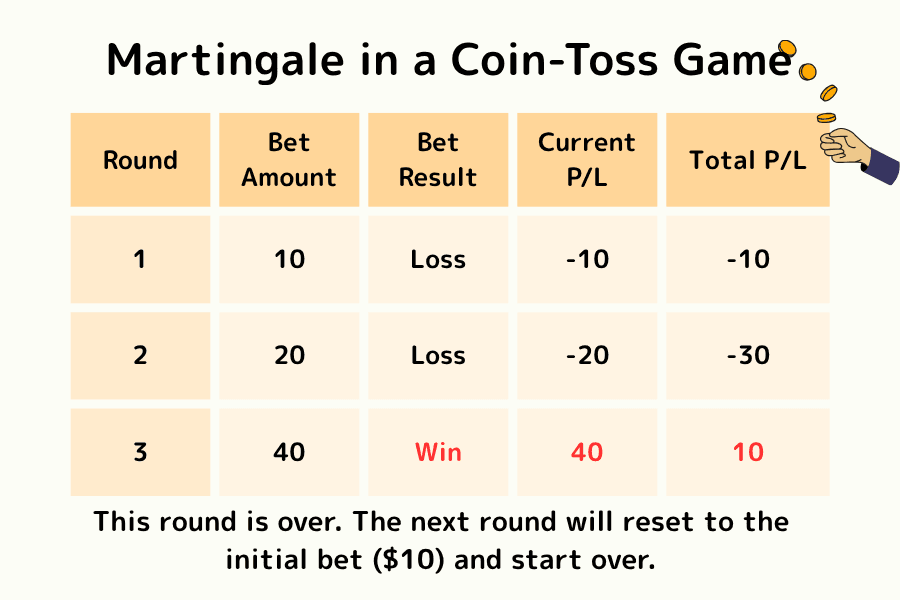
Consider a fair-coin game with USD 10 initial stake:
Round 1: Bet USD 10 on heads. Result: tails. Loss: USD 10.
Round 2: Bet USD 20 on heads. Result: tails. Cumulative loss: USD 30.
Round 3: Bet USD 40 on heads. Result: heads. Win: USD 40.
Net profit this cycle: USD 40 minus USD 30 = USD 10 (exactly the initial stake).
Reset to USD 10 and repeat. Every completed cycle — regardless of the number of losses required to reach the win — books exactly USD 10 of locked profit. This is the seductive property of the system and the reason it retains its appeal across four centuries.
2.3 The Embedded Assumption: Infinite Bankroll and Infinite Time
The mathematical elegance hides two assumptions that never hold in practice:
- Infinite capital: the trader must be able to fund the bet $2^{n-1} \cdot s_0$ for arbitrarily large $n$.
- Infinite time and unbroken access to the market: the trader must survive arbitrarily long losing streaks without being forcibly liquidated by margin calls, circuit breakers, venue halts or regulatory intervention.
Removing either assumption breaks the strategy — and in any real market, both are violated by design. Brokers impose maximum position sizes, regulators cap leverage, exchanges trigger circuit breakers, and account equity is finite. The rest of this guide is an unpacking of the specific mechanisms through which these finite-world constraints bind.
2.4 Martingale, Anti-Martingale, and Paroli
Several closely-related systems are often confused with martingale in popular discussions:
- Martingale (classical): double after loss, reset after win. Profit per cycle = initial stake.
- Anti-Martingale (Paroli): double after win, reset after loss. Profit is concentrated in winning streaks; losses are bounded by the initial stake. This is the structural opposite of classical martingale and is favoured by trend-following traders.
- Grand Martingale: double-plus-one after loss. More aggressive; each cycle locks in two units of profit but exhausts bankroll faster.
- D'Alembert: add one unit after loss, subtract one unit after win. Arithmetic rather than geometric progression, slower ruin but smaller per-cycle profit.
- Kelly Criterion: size bet proportional to edge (discussed in detail in chapter 8). This is the mathematically correct anti-martingale and is the system used by professional quantitative investors.
3. Mathematical Foundations: Levy, Gambler's Ruin, and Probability
The single most important mathematical result relevant to retail martingale traders is the Gambler's Ruin theorem, which states that a player with finite wealth playing any fair or unfavourable game against an opponent with effectively infinite wealth will, with probability one, eventually go broke. This is not a subtle result or an asymptotic approximation; it is a cast-iron theorem of discrete-time random-walk theory, formalised in the MIT 6.042 mathematics-for-computer-science curriculum and in every standard probability text (Grinstead and Snell, Ross, Feller).
3.1 Paul Levy 1934 and Jean Ville 1939
The formal concept of a martingale process was introduced by Paul Levy in the 1934 paper "Sur l'independance des variables lineaires non gaussiennes". In modern notation, a stochastic process ${X_n}$ is a martingale relative to a filtration ${\mathcal{F}_n}$ if:
$$E[X_{n+1} | \mathcal{F}_n] = X_n$$
In plain English: conditional on everything known up to time $n$, the expected value at time $n+1$ equals the current value. The name "martingale" was coined and continuous-time extensions were given by Jean Ville in his 1939 doctoral thesis "Etude critique de la notion de collectif". Joseph Doob's 1953 textbook then cemented the martingale as a central object of modern probability theory.
A common misattribution places the introduction of the martingale concept in 1939 (Ville) rather than 1934 (Levy). The correct historical sequence — Levy introduces, Ville formalises and names — matters because it establishes that the roulette-doubling system known to 18th-century gamblers and the stochastic process used in 21st-century quantitative finance are the same mathematical object.
3.2 Gambler's Ruin Theorem
Consider a random walk on the integers ${0, 1, \ldots, N}$ where the gambler starts at position $i$, steps right with probability $p$ and left with probability $q = 1 - p$. The state $0$ represents the gambler being bankrupt; the state $N$ represents the gambler breaking the bank. Let $P_i$ be the probability of reaching $N$ before $0$ when starting at $i$. Standard difference-equation analysis yields:
For a fair game ($p = q = 0.5$): $P_i = i / N$
For an unfavourable game ($p < q$): $P_i$ decreases exponentially in the ratio $(q/p)^{N-i}$ — even tiny house edges translate into near-certain ruin for the finite-bankroll player.
The practical implication for the retail martingale trader is severe. Against a broker offering genuinely even odds (already optimistic, since spread and commission create a real negative edge), the probability of reaching an arbitrarily high stake before bankruptcy equals the ratio of current bankroll to target. Against any broker with a realistic negative edge, ruin becomes near-certain over long time horizons.
3.3 Probability of N Consecutive Losses
Independent binary outcomes with win probability $p = 0.5$ produce a run of $N$ consecutive losses with probability $(1 - p)^N = 0.5^N$. The following table shows the raw probability and the cumulative-stake requirement for a trader starting at USD 10:
| N losses | Probability | Stake on trade N+1 | Cumulative bankroll required |
|---|---|---|---|
| 3 | 12.5% | USD 80 | USD 150 (15x) |
| 5 | 3.125% | USD 320 | USD 630 (63x) |
| 7 | 0.781% | USD 1,280 | USD 2,550 (255x) |
| 10 | 0.098% | USD 10,240 | USD 20,470 (2,047x) |
| 12 | 0.0244% | USD 40,960 | USD 81,910 (8,191x) |
| 15 | 0.00305% | USD 327,680 | USD 655,350 (65,535x) |
The 10-loss row is particularly instructive. The probability of 10 consecutive losses on a fair coin is approximately 0.098 percent — rare, but meaningful. A trader running one cycle per hour during a typical London-New York overlap (roughly nine hours) encounters this event with non-trivial frequency over months of operation. When it arrives, the 11th bet alone is 1,024 times the initial stake, and the cumulative bankroll requirement to survive all 10 losses plus the 11th bet is 2,047 times the initial stake.
The often-cited figure "1,023x bankroll for 10-loss survival" refers specifically to the cumulative stake of the first 10 bets alone ($\sum_{i=0}^{9} 2^i = 2^{10} - 1 = 1023$), before considering the 11th bet needed to actually win the cycle. The conservative figure that includes the 11th bet is therefore 2,047x.
3.4 Real-World Markets Are Not Fair Coins
The above mathematics assumes independent, fair-odds trades. Real markets violate both assumptions in ways that strongly disfavour the martingale trader:
- Volatility clustering: losses tend to arrive in runs (GARCH effect). A period of trending market behaviour produces many consecutive losses of the same sign, increasing N-loss probabilities far above $0.5^N$.
- Fat tails: empirical return distributions have kurtosis far in excess of the normal distribution. Six-sigma moves, which a Gaussian assumption declares once-in-a-million, occur several times per decade in currency and equity markets.
- Spread and commission: every trade has a negative expected value equal to the bid-ask spread plus commission. On a typical MT5 EUR/USD pair with 0.8 pip spread, this is already a -0.00008 percent edge on a 1 pip stop — cumulatively ruinous over thousands of trades.
- Liquidity evaporation in stress: precisely when the martingale trader needs to execute the next doubled bet, spreads widen dramatically and stops are slipped unfavourably. This is the operational mechanism through which gambler's ruin manifests in practice.
4. Martingale in Financial Markets: Forex, CFD, Crypto Applications
Translating the martingale algorithm from coin-toss betting to financial markets converts it into a position-sizing rule rather than a stake rule — but the core vulnerability (exponential exposure growth) is preserved and amplified by leverage.
4.1 Core Application in Forex and CFD
In Forex and CFD contexts, martingale is typically implemented as an extreme form of averaging down / dollar-cost-averaging. The sequence:
- Open buy position of 0.1 lots on EUR/USD.
- Price moves adversely by $X$ pips (e.g. 50 pips) without triggering a stop-loss.
- Open additional buy of 0.2 lots. New blended entry is closer to current market.
- If price moves another 50 pips adversely, open 0.4 lots; then 0.8, 1.6 lots and so on.
- Take profit for the entire position sits a fixed small distance above the blended entry. Any minor retracement books the full cycle at one-initial-stake of profit.
The martingale trader refuses to cut losses. Every adverse move triggers further accumulation. The premise is that, eventually, price will retrace far enough that the blended breakeven is exceeded — at which point the full position is closed.
4.2 Grid Trading: The Martingale Variant
Grid trading is a closely related but structurally distinct system frequently sold as "smart-grid" or "grid-bot" EAs:
- Pre-defined price levels (the "grid") set a fixed distance apart.
- At each level below the current price, the bot enters a new buy order; at each level above, a new sell order.
- Position size doubles (pure martingale grid) or scales linearly (D'Alembert grid).
- Take-profit is small and per-leg; the grid collects many small wins in sideways markets.
Grid trading inherits all the failure modes of martingale. It performs excellently when price oscillates inside a range — exactly the conditions chosen for marketing backtests — and fails catastrophically when price exits the range in a sustained trend. The February 2020 COVID crash, the Swiss franc shock of 15 January 2015, and the March 2020 crude oil move to negative prices are three periods in which the vast majority of live grid-bot accounts were wiped.
4.3 Crypto-Specific Applications
Crypto perpetual-futures exchanges (Binance, Bybit, OKX, Deribit) offer up to 125:1 leverage on Bitcoin and Ethereum, plus "isolated margin" and "cross margin" modes that interact dangerously with martingale sizing. A typical retail failure pattern:
- Trader opens long BTC/USDT perpetual at 10:1 leverage.
- Price drops 3%. Trader uses "cross margin" to avoid liquidation, allocating more account equity.
- Trader adds to position ("average down") to improve breakeven. Leverage now 20:1 on a larger notional.
- Price drops further 5%. Additional capital allocation, further size increase.
- Single funding-rate-driven move or exchange cascade liquidates the entire portfolio.
Crypto exchanges have no overnight halt, no circuit breaker equivalent to equity markets, and frequently experience 10%-30% single-candle moves during deleveraging cascades. The March 12-13 2020 Bitcoin crash (nearly 50 percent intraday) and the May-June 2022 Terra Luna collapse (peer-to-peer contagion wiping more than USD 60 billion) are the two canonical case studies in crypto martingale failure.
4.4 Expert Advisor (EA) Ecosystem
The MetaQuotes MQL5 marketplace lists thousands of EAs, a large majority of which use martingale, grid or related negative-progression logic. Typical marketing pattern:
- Backtest curve: smooth upward line, frequently 500 percent-plus return over 12 months.
- Live-track performance: looks strong for 3 to 9 months.
- Single macro event (central-bank surprise, commodity shock, risk-off episode) causes 80 to 100 percent drawdown in hours.
The structural reason is that martingale EA backtests pass a 12-month test because 12 months is rarely long enough to see a single sustained trend that exceeds the grid's capacity. Tested over 2008-2009, 2015 SNB, 2020 COVID or 2022 sterling crisis, the same EAs routinely wipe accounts. This is why professional quantitative firms use 20-year-plus out-of-sample backtests with explicit stress-scenario overlays before deploying capital.
Regulated broker categories also materially change the EA landscape. Retail forex brokers operating under tighter regulatory regimes frequently impose restrictions on grid-trading EAs and "smart-grid" systems in light of past retail blowups, while other venues market martingale-compatible products with adjusted margin rules. These structural differences affect how much doubling exposure any given account can sustain before forced liquidation.
5. Why Beginners Love Martingale: Two Core Psychological Traps
The appeal of martingale to retail traders is not primarily intellectual — it is emotional. The strategy resolves two of the most difficult cognitive problems in discretionary trading: fear of loss and uncertainty of forecasting. Both resolutions are illusory.
5.1 The Illusion of High Hit Rate
Martingale strategies book the majority of completed cycles as winners, because the strategy closes the position only when the net position is profitable. A retail trader monitoring the account equity curve over a month of range-bound market behaviour sees a near-monotone upward slope — hundreds of small green bars punctuated by zero red bars. This produces a dopamine-driven feedback loop indistinguishable from the behavioural pattern of a successful slot-machine player.
The technical term is "loss concealment". Accumulated unrealised floating drawdown does not appear on the equity curve until the position is closed — but it appears in real time on the margin level indicator as used-margin dollars. A trader who monitors only equity and not free margin can sit on a 90 percent drawdown in unrealised terms while seeing a smooth upward equity line, until the moment of margin call (loss cut) when both numbers collapse simultaneously.
Academic behavioural-finance literature has documented this specific pattern in the "disposition effect" (Shefrin and Statman 1985) and related work by Barber and Odean: retail traders are structurally biased to close winners and hold losers. Martingale strategies automate the pathological behaviour — they are, mathematically, the extreme form of the disposition effect as a system.
5.2 The Reduction of Forecasting Burden
Most active trading strategies require the trader to make a directional forecast: will EUR/USD be higher or lower in 30 minutes, 8 hours, 2 weeks? Technical analysis, fundamental analysis and macro-economic modelling each demand years of study and consistent cognitive effort for marginal edge.
Martingale strategies substitute a much weaker assumption: that price will eventually retrace, somewhere, sometime. This is a nearly costless forecasting burden — nearly every price series retraces at some point. The trader no longer needs to predict direction; they only need to predict that mean reversion will occur within the time and capital budget available.
The hidden catch is the two embedded qualifiers ("within the time and capital budget"). These qualifiers carry all the risk, and the retail trader is poorly equipped to estimate either. Historical volatility-of-volatility analysis, regime-switching models and Markov-chain stress tests are the professional tools used to estimate bounded retracement windows — none of these appear in retail trading education, and ignoring them is the path to the 60 to 80 percent EA-failure rate observed in marketplace post-mortem studies.
5.3 The Narrative Fallacy
Nassim Nicholas Taleb's work on the narrative fallacy (The Black Swan, 2007) provides the third psychological lever. Every winning cycle generates a coherent story: "I bought the dip, price retraced, I booked profit. I am skilled". Every losing cycle, if the account survives, generates the same story. Only the first cycle that wipes the account generates a different story, and by then the trader no longer has capital to continue.
This structure — a long sequence of confirmations of skill, followed by a single disconfirmation that ends the experiment — is precisely the shape of every career in martingale-style strategies from Nick Leeson at Barings to Bill Hwang at Archegos. The skill narrative survives indefinitely in track-record form until the terminal event, and there is no intra-career signal that reliably distinguishes durable skill from compounding exposure. This is why professional fund allocators apply strict Sharpe-ratio, maximum-drawdown and Ulcer-index filters even to apparently outstanding track records.
6. Three Critical Flaws: Exponential Capital, Margin Calls, Skewed Risk/Reward
The three structural flaws of martingale are interlocking: exponential capital requirements force confrontation with broker margin rules, margin rules trigger loss cuts before the winning bet arrives, and the risk/reward ratio of the full cycle is catastrophically skewed against the trader.
6.1 Flaw One: Exponential Capital Requirements
Starting from a modest 0.01-lot position and doubling each adverse move, by round 10 the cumulative position size is 10.23 lots. The table below uses a fixed 50-pip grid and ignores spread / commission / swap for clarity. In reality, these costs compound the problem:
| Round | Lot this round | Cumulative lots | Total-size multiple |
|---|---|---|---|
| 1 | 0.01 | 0.01 | 1x |
| 2 | 0.02 | 0.03 | 3x |
| 3 | 0.04 | 0.07 | 7x |
| 4 | 0.08 | 0.15 | 15x |
| 5 | 0.16 | 0.31 | 31x |
| 6 | 0.32 | 0.63 | 63x |
| 7 | 0.64 | 1.27 | 127x |
| 8 | 1.28 | 2.55 | 255x |
| 9 | 2.56 | 5.11 | 511x |
| 10 | 5.12 | 10.23 | 1,023x |
Just 10 rounds of doubling inflate the initial tiny 0.01-lot exposure into 10.23 lots — more than a thousand-fold increase. On EUR/USD this corresponds to USD 1.023 million of notional exposure from an initial USD 1,000 of notional. Most retail accounts cannot support this position size under any regulatory regime.
6.2 Flaw Two: The Margin Call (Loss Cut) Guillotine
Every regulated broker enforces a maintenance margin requirement. When unrealised losses erode free margin below the maintenance threshold, the broker's risk system automatically closes all positions — commonly called a margin call, stop-out or loss cut. For the martingale trader, this is invariably a single-event catastrophe.
In standard Forex, a trader with 20:1 leverage starts to burn usable margin rapidly once exposure exceeds the account equity. Consider a USD 10,000 account with 0.01 lot initial position on EUR/USD. By round 6 (0.63 lots cumulative), floating drawdown against a 300-pip adverse move is approximately USD 1,890. By round 8 (2.55 lots), the same 400-pip cumulative adverse move on the combined position produces floating drawdown around USD 10,200 — mathematically, the entire account equity is consumed. Under Japan FSA 25:1 maximum leverage, this happens sooner. Under US NFA 50:1 (major pairs) it takes slightly longer, but the outcome is identical.
A black swan event — an exchange rate re-peg, a central-bank surprise, a geopolitical escalation, a flash crash — accelerates the timeline from weeks to minutes. In the SNB franc shock of 15 January 2015, EUR/CHF moved 3,947 pips in a matter of minutes; retail forex brokers Alpari UK, Alpari US, and a number of Japanese retail venues were rendered insolvent in the same afternoon. Any martingale grid long CHF (or short EUR/CHF) at that moment was wiped beyond the account balance — many account holders received negative-equity bills from their brokers.
6.3 Flaw Three: Asymmetric Reward to Drawdown
The most misleading aspect of martingale is the headline profit number. Each winning cycle books one unit of initial stake — USD 10 in the canonical coin-toss example. To reach that USD 10, the trader has historically risked hundreds or thousands of dollars of floating drawdown.
Consider a trader who has survived 20 consecutive martingale cycles, each producing USD 10 profit, for a total of USD 200. If the 21st cycle encounters an adverse trend and requires 10 rounds of doubling, the trader puts USD 20,470 of bankroll at risk to recoup a USD 10 gain. This is a reward/risk ratio of 1/2,047 on the incremental bet — a structure so skewed that no professional risk-adjusted performance metric produces a positive score:
- Sharpe ratio over the long run is negative (large losing cycles dominate).
- Sortino ratio is even more negative (downside volatility is extreme).
- Maximum drawdown to annualised return is unbounded (any martingale system has an undefined maximum drawdown because the next bad cycle ends the experiment).
- Ulcer index (a measure of drawdown duration and depth) diverges to infinity over long time horizons.
The industry technical term is "picking up pennies in front of a steamroller". The strategy produces reliable, small wins during quiet periods, and one catastrophic loss during stress. Professional risk managers recognise this payoff as equivalent to writing uncovered options — selling tail risk for premium — and apply hedging and capital requirements accordingly. Retail martingale traders are writing the same tail risk without any compensating hedge.
7. Historical Case Studies: LTCM 1998, Amaranth 2006, Archegos 2021, Barings 1995
Every decade produces a martingale-shaped blowup at the sophisticated end of finance. The following four cases form the canonical teaching set — two convergence-trade failures (LTCM, Amaranth) and two outright concentration blowups (Barings, Archegos) — each reaching nine- to eleven-figure losses through the same fundamental dynamic: increasing exposure into adverse moves, funded by a belief that reversion is inevitable.
7.1 Barings Bank 1995: Nick Leeson, GBP 827 Million, 233-Year-Old Bank Bankrupt
Nick Leeson was the Singapore-based general manager of Barings Futures. Between 1992 and 1995 he accumulated unauthorised long Nikkei 225 futures positions in an error account numbered 88888, doubling exposure into every adverse move in an effort to recoup mounting losses. The Kobe earthquake of 17 January 1995 produced a sharp drop in the Nikkei; Leeson doubled long futures exposure repeatedly over the subsequent weeks, also selling short Nikkei straddles to generate premium.
When the loss was discovered in February 1995, the total was GBP 827 million — more than twice the total equity of Barings Bank, which had been founded in 1762 and held accounts for Queen Elizabeth II. The bank was sold to Dutch bank ING for a token GBP 1. Leeson served four years in Singapore's Changi Prison.
The Barings episode is the purest retail-martingale mechanic visible at institutional scale. Leeson was not attempting convergence or hedging; he simply increased directional long futures exposure after every loss in the conviction that the market would retrace. It did not.
7.2 LTCM 1998: Nobel Laureates, USD 4.6 Billion Loss, 130:1 Leverage, Fed Bailout
Long-Term Capital Management was founded in 1994 by John Meriwether (formerly of Salomon Brothers arbitrage desk) with academic partners Myron Scholes and Robert C. Merton — both 1997 Nobel laureates in Economics for their work on option pricing. The fund pursued fixed-income convergence trades: long on-the-run Treasury bonds short off-the-run, long emerging-market sovereign debt short developed-market sovereigns, long low-liquidity bonds short high-liquidity equivalents.
By mid-1998 the fund operated with approximately USD 4.8 billion in equity, more than USD 125 billion in borrowings and over USD 1 trillion in derivatives notional — an initial leverage ratio of about 25:1. When Russia defaulted on rouble-denominated debt on 17 August 1998, global investors fled to quality: US Treasury yields compressed, emerging-market spreads blew out, liquid instruments outperformed illiquid ones. Every one of LTCM's convergence positions moved against the fund simultaneously — the textbook correlation spike in stress.
As equity eroded, leverage ratio mechanically rose. By end of August 1998, LTCM's leverage had climbed to roughly 50:1. By the third week of September 1998, as losses compounded, effective leverage reached approximately 130:1. The fund had returned USD 2.7 billion of capital to investors at end-1997 while maintaining the same positions — mathematically identical to doubling leverage on existing exposure. This is the martingale pattern at institutional scale: not doubling new bets, but doubling leverage on existing bets by depleting the equity base.
Total loss in four months (July-September 1998) reached USD 4.6 billion, with 44 percent of the fund's remaining value erased in August 1998 alone. On 23 September 1998 the Federal Reserve Bank of New York brokered a USD 3.625 billion rescue financed by 14 global banks — not a taxpayer bailout, but Fed-coordinated private recapitalisation — to avoid a disorderly unwind that would have triggered cross-market contagion.
7.3 Amaranth Advisors 2006: USD 6.6 Billion in One Week, Natural Gas Spread Trades
Amaranth Advisors was a Greenwich-based multi-strategy hedge fund managing approximately USD 9.2 billion at peak. Lead energy trader Brian Hunter built very large natural gas spread positions — long March 2007 futures, short April 2007 futures — betting on a seasonal winter-to-spring roll pattern that had been profitable in 2005.
From late August through mid-September 2006, natural gas prices declined sharply. Rather than cut exposure, Hunter added to positions, believing the winter demand would reverse the trend. By mid-September the spread had moved against Amaranth to the point where the fund had lost approximately USD 6.6 billion in a single week — then the largest hedge fund loss in history. Amaranth liquidated operations within days and the remaining positions were transferred to JPMorgan and Citadel for a fraction of book value.
Amaranth's failure mechanism was identical to LTCM's in structure: increase concentration into adverse price action, funded by the belief that fundamental drivers will eventually reverse the trend. The natural gas market did not reverse; the position was large enough that Amaranth's own liquidation worsened the adverse move, producing a self-reinforcing loss spiral.
7.4 Archegos Capital 2021: Bill Hwang, USD 20 Billion, 18-Year Prison Sentence
Archegos Capital Management was the family office of Bill Hwang (previously convicted of insider trading at Tiger Asia Management in 2012). By early 2021 Hwang had built concentrated long positions in ViacomCBS, Baidu, Vipshop, Farfetch, GSX Techedu and Discovery through total return swaps (TRS) with prime brokers — a structure that leaves the legal owner of the shares as the prime broker, keeping Hwang's economic exposure invisible to public filings.
Estimated peak leverage was approximately 20:1 on USD 10 billion of family-office equity, producing total economic exposure of roughly USD 200 billion across six to eight names. Nomura reportedly offered Hwang roughly 4x the leverage it typically offered long/short hedge fund clients.
On 23 March 2021 ViacomCBS priced a large secondary equity offering at USD 85 per share; the stock opened the next day near that level and began declining. Hwang directed approximately USD 1 billion in additional ViacomCBS and related purchases on 23 March specifically to support the price — the SEC and DOJ later characterised this as market manipulation through "coordinated doubling-down". When prices continued to fall, Credit Suisse, Nomura, Goldman Sachs and Morgan Stanley issued margin calls that Archegos could not meet.
On 26 March 2021 the prime brokers began a USD 20 billion forced-sale programme. The resulting price moves — ViacomCBS fell roughly 27 percent in the week (Bloomberg/WSJ data) — triggered cascading losses across the prime-broker ecosystem:
- Credit Suisse: USD 5.5 billion loss — the single event that began the chain of capital deterioration culminating in the emergency UBS takeover of Credit Suisse in March 2023.
- Nomura: USD 2 billion loss, temporarily reducing the prime-brokerage unit globally.
- Morgan Stanley: USD 911 million loss.
- Goldman Sachs, UBS, MUFG, Mizuho: combined several-billion additional losses.
Bill Hwang was indicted on 27 April 2022 on charges of racketeering conspiracy, securities fraud and wire fraud. On 20 July 2024 a Manhattan federal jury convicted Hwang on ten counts. On 20 November 2024 he was sentenced to 18 years in federal prison — one of the longest sentences ever imposed for financial market manipulation.
7.5 XIV February 2018: USD 3 Billion Evaporated in One Day
A different flavour of martingale-style failure: the inverse-volatility exchange-traded notes. Credit Suisse's VelocityShares Daily Inverse VIX Short-Term ETN (ticker XIV) and ProShares' SVXY were designed to return the inverse of the daily change in front-month VIX futures. During 2017's historic low-volatility period, retail investors poured capital into XIV; at peak, the ETN held approximately USD 3.2 billion in assets.
On 5 February 2018, the VIX spot index spiked 115 percent in a single session — the largest single-day VIX move in history. XIV's net asset value fell approximately 96 percent after the close. Credit Suisse invoked an early-termination clause in the prospectus and redeemed the notes at approximately USD 5.30 against an earlier-day level of USD 115 — wiping roughly USD 1.9 billion of retail capital in hours (XIV pre-crash AUM Feb 2 2018).
XIV was not a martingale per se, but its structural design — short volatility funded by long-volatility writers — embeds a martingale-shaped payoff: small daily gains during calm markets, one catastrophic loss during stress. The failure mode is identical to the retail martingale grid, scaled to exchange-traded product.
7.6 Summary of Case Studies
| Year | Actor | Loss | Mechanism | Key data |
|---|---|---|---|---|
| 1995 | Nick Leeson (Barings) | GBP 827M | Doubled long Nikkei futures into 1995 fall | 233-yr-old bank bankrupt, sold for GBP 1 |
| 1998 | LTCM | USD 4.6B | Convergence trades, leverage 25:1 to 130:1 | Fed-brokered USD 3.625B bailout by 14 banks |
| 2006 | Amaranth / Brian Hunter | USD 6.6B | Doubled natural gas calendar spreads | One-week loss, largest hedge fund collapse at time |
| 2018 | XIV / VelocityShares | USD 1.9B | Short-vol product, 5 Feb VIX spike | XIV NAV down 96% in one day |
| 2021 | Bill Hwang / Archegos | USD 20B+ | TRS + doubling down, USD 1B Mar 23 buying | 18-yr prison sentence Nov 2024; CS USD 5.5B |
Each case shares three features: (a) increased exposure into losses, (b) a reversion narrative justifying the increase, and (c) a single idiosyncratic event that rendered reversion mathematically impossible given the capital available. The retail martingale trader is running the same strategy on a smaller scale.
8. Kelly Criterion: The Mathematical Opposite of Martingale
The Kelly Criterion, derived by John L. Kelly Jr. at Bell Labs in 1956 and popularised in finance by Edward O. Thorp from 1962 onwards, solves the position-sizing problem that martingale fails. It instructs the bettor to size positions in proportion to the edge, not to previous results — making it, structurally, the anti-martingale.
8.1 The Kelly Formula
For a binary bet with payoff ratio $b$ (win-odds to 1), win probability $p$ and loss probability $q = 1 - p$, the Kelly fraction $f^{*}$ of bankroll to wager is:
$$f^{*} = \frac{bp - q}{b} = \frac{p(b+1) - 1}{b}$$
Kelly showed that this fraction maximises the long-run geometric growth rate of the bankroll. Any systematic deviation — over-betting or under-betting — produces lower long-run growth:
- Below Kelly (fractional Kelly): lower growth rate but smaller drawdowns. Practical professionals typically use 1/2 Kelly or 1/4 Kelly for safety margin.
- At Kelly: theoretically optimal growth rate. Typical drawdown of 50 percent is expected in a Kelly-sized portfolio over meaningful time horizons — psychologically very difficult to sustain.
- Above Kelly (over-betting): growth rate declines, drawdown rises; beyond 2x Kelly the long-run growth rate becomes negative with probability one. This is the region in which pure martingale operates.
8.2 Worked Example
A trader with an edge of 55 percent win probability on an even-money bet ($b = 1$, $p = 0.55$, $q = 0.45$) has Kelly fraction:
$$f^{*} = \frac{1 \cdot 0.55 - 0.45}{1} = 0.10 = 10%$$
The Kelly trader wagers 10 percent of current bankroll on each trade — this fraction declines automatically after losses (because bankroll is smaller, the dollar amount shrinks) and rises after wins. The martingale trader does the exact opposite: increases dollar wager after losses, decreases after wins. The two systems are mirror images across the "respect-edge" axis.
8.3 Edward Thorp, Princeton-Newport Partners, 1969-1988
Edward Thorp applied the Kelly Criterion to blackjack (Beat the Dealer, 1962) and then to markets at Princeton-Newport Partners from 1969 to 1988. Over 19 years the fund generated approximately 19.1 percent annualised return after fees and 15.1 percent net to investors, with no losing year, very low volatility and no month worse than approximately minus 3 percent. Thorp's performance remains one of the most-cited risk-adjusted track records in quantitative finance; it is the empirical counter-example to the claim that systematic trading cannot consistently beat the market.
Thorp's later book A Man for All Markets (2017) describes in operational detail how Kelly-sized position sizing — supplemented by careful arbitrage-identification and transaction-cost discipline — produced stable compounding. The contrast with martingale is total: every structural feature of Thorp's approach (respect edge, reduce size after losses, refuse concentrated exposure) is the inverse of the martingale playbook.
8.4 Fractional Kelly in Practice
Full Kelly implementation produces theoretically optimal growth but psychologically intolerable drawdowns (often 40 to 60 percent intra-period). Industry practice is fractional Kelly:
- 1/2 Kelly: 75 percent of full Kelly growth, with roughly 1/4 of the drawdown volatility. Standard for long-only hedge funds.
- 1/4 Kelly: slightly less than half of full Kelly growth, with much smaller drawdowns. Standard for risk-parity multi-asset funds.
- Regime-dependent Kelly: scale Kelly fraction by measured confidence in the edge, reduced further in volatile regimes.
Retail traders interested in applying Kelly should start with 1/4 Kelly or smaller and only increase fraction once they have verified that their edge is real rather than backtest over-fitting. The exact opposite policy — doubling size after losses, betting more than the edge warrants — is the signature of martingale and the path to terminal loss.
9. Regulatory Landscape: Leverage Caps and Structural Constraints on Martingale
Leverage regulations across major jurisdictions and their structural impact on martingale strategies:
| Regulator | Maximum Leverage | Hedging / FIFO Rules | Impact on Martingale |
|---|---|---|---|
| US NFA / CFTC | 50:1 (majors) / 20:1 (minors) | FIFO mandatory, hedging banned (2009) | Structurally nonfunctional |
| Japan FSA | 25:1 | Hedging banned (2011) | Capital requirements escalate rapidly |
| EU ESMA | 30:1 (majors) / 20:1 / 2:1 (crypto) | Restrictions since 2018 | Operating space compressed |
| UK FCA | 30:1 | Restrictions since 2019 | Same as above |
| Australia ASIC | 30:1 (retail) | Restrictions since 2021 | Same as above |
| Offshore (Vanuatu VFSC, Seychelles FSA, FSA Saint Vincent, etc.) | 100:1 to 1000+ | Few restrictions | Theoretically executable, but Gambler's Ruin applies identically |
Each jurisdiction has its own client-fund protection rules, licensing requirements, and advertising regulations. In high-leverage environments, martingale appears "theoretically executable," but the mathematics of Gambler's Ruin (Section 3) operates independently of regulatory form — as long as capital is finite, the strategy breaks down in the long run.
The Swiss franc shock of 15 January 2015 is a paradigmatic example that regulators of every form could not prevent: EUR/CHF dropped 3,947 pips in minutes, Alpari US and Alpari Japan collapsed into insolvency, and FXCM only survived after receiving a $300M emergency loan. Client-fund segregation, liquidity access, and market-maker risk capacity cannot be guaranteed by a single regulatory framework alone.
10. Implementation Principles: When Martingale Concepts Are Partially Adopted
Given the mathematical limitations of martingale, the following five principles apply if any of its concepts are incorporated into a broader money-management approach:
- Minimize initial position sizing — Initial lot size at 0.1% or less of account balance. After 10 consecutive losses, total drawdown should remain within 10–20% of account equity.
- Fix maximum step count in advance — Hard stop at 3–5 levels. Infinite doubling is strictly forbidden.
- Always apply a master stop-loss — Abandon the entire strategy when cumulative drawdown hits a preset threshold (e.g., 20% of capital).
- Pause during strong trends — Use ADX, ATR, and moving-average filters to avoid entries in markets with strong directional bias. Operate only in range conditions.
- Long-horizon backtesting plus stress tests — Test across at least 10–15 years of historical data, including tail events such as the 2015 Swiss franc shock, 2020 COVID crash, 2022 GBP flash move, and other flash crashes to verify that the account survives the worst historical stress scenarios.
Even with all five principles enforced, tail risk cannot be eliminated. Using martingale as a primary strategy has collapsed repeatedly in financial history — LTCM 1998, Archegos 2021, Amaranth 2006, and Barings 1995 all demonstrate that scaling up martingale-style doubling statistically guarantees eventual ruin. The mathematically correct endpoint of capital management is expected-value frameworks such as the Kelly Criterion (Section 8).
11. Frequently Asked Questions
Q1. Is there any situation in which martingale is provably profitable in the long run?
No. Given finite capital, finite time and positive transaction costs (spread, commission, swap), the expected long-run outcome of a martingale strategy is bankruptcy with probability approaching one. This is the direct implication of the Gambler's Ruin theorem combined with the negative edge introduced by costs. The short-term appearance of profitability — often lasting 6 to 18 months — is a feature of the strategy, not a contradiction of the result.
Q2. Why do martingale EAs show strong backtests?
Two reasons. First, most backtest windows (1 to 3 years) are shorter than the typical interval between severe trend events that break martingale grids. Second, common backtest software (MetaTrader Strategy Tester on "Every Tick" mode) does not accurately model spread widening during stress, stop-loss slippage, or liquidity evaporation — the exact conditions under which martingale fails. Out-of-sample stress-scenario backtests spanning 2008 GFC, January 2015 SNB, 2020 COVID and 2022 sterling crisis show catastrophic drawdown in essentially all grid EAs.
Q3. Can I reduce martingale risk by using an automated EA rather than manual execution?
No. Automation reduces emotional error (closing too early, hesitating to add) but does not change the underlying mathematics. Worse, a set-and-forget EA may fail to detect regime changes (e.g. a market transitioning from range-bound to trending) that a discretionary trader might notice. Most EA-based retail blowups originate in the gap between a system that reliably adds to positions and a human operator who is not monitoring during the breakdown event.
Q4. How much capital do I need to run a "safe" martingale strategy?
No capital amount makes martingale mathematically safe. However, practical industry guidance suggests initial position size should be below 0.1 percent of account equity, and maximum grid depth should be capped at 5 to 7 levels with hard basket stop-loss. Under those constraints, the capital requirement per USD 1 of initial position is typically USD 10,000 to USD 50,000 of account equity.
Q5. What is the relationship between martingale and the Black-Scholes / Merton framework?
Martingale processes are a core mathematical object in Black-Scholes / Merton option pricing (the Fundamental Theorem of Asset Pricing uses martingale measures). This is a different application of the same mathematical term — the "martingale" in option pricing refers to the behaviour of the underlying price process under the risk-neutral measure, not to a betting strategy. The probability-theory sense and the betting-strategy sense share the same mathematical root (Levy 1934) but operate on different layers of the financial stack.
Q6. How do professional hedge funds control risk where retail martingale traders fail?
Five specific mechanisms: (a) explicit VaR, CVaR and stress-scenario risk limits; (b) position-size limits per name and per strategy; (c) hard mandated daily loss limits ("risk budgets") that trigger position reduction; (d) separate risk-management reporting lines independent of portfolio manager; (e) capital allocations recalibrated quarterly based on trailing Sharpe / drawdown metrics. LTCM 1998 and Archegos 2021 both failed despite having some of these mechanisms — the failures were specifically around bypass of position limits under concentration and leverage pressure. Retail martingale traders typically have none of these controls.
Q7. Is Anti-Martingale / Paroli a better strategy?
Anti-Martingale (double after wins, reset after loss) has structurally superior drawdown properties — losses are bounded by the initial stake plus any accumulated winning-streak profit. However, Anti-Martingale still requires a real positive edge to produce long-run positive expectancy. Without an edge, Anti-Martingale simply preserves the initial bankroll with zero expected growth; with an edge, it is approximately equivalent to a fractional-Kelly system.
Q8. Can martingale work on cryptocurrency markets specifically?
Cryptocurrency markets are arguably the worst environment for martingale due to extreme volatility, weekend trading, exchange outages, funding-rate skew and periodic 30 to 50 percent single-session moves. Crypto-specific failure modes include: Binance funding-rate-driven cascade liquidations (Sunday Asia session is particularly prone), exchange API outages during stress preventing order execution, and the March 2020, May 2021, and May 2022 multi-hour flash drops. Every retail crypto martingale grid in existence at 1 April 2024 experienced meaningful stress from the 30 April to 6 May 2024 rally that drove many short-grid bots to liquidation.
Q9. What is the difference between averaging down and martingale?
Averaging down in its classical Graham-and-Dodd value-investing sense is fundamentally different from martingale. A value investor with conviction that a stock is undervalued may add to position as price falls, because the fundamental valuation gap widens. This is a deliberate, research-driven increase of position size in a thesis that the investor believes is more attractively priced. Martingale is a mechanical, research-free doubling rule that increases position size simply because price has moved adversely. The former is a thesis-driven accumulation; the latter is pure progression betting. The psychological appeal is similar but the structural rationale is different. See Averaging Down for further detail.
Q10. What is the single best action for a retail trader currently running a martingale EA?
Stop running the EA. Close all open positions at current market, accepting whatever realised loss applies. Then, if you want to stay in automated trading, redesign the system with bounded per-trade risk (fixed dollar stop-loss, typically 0.5 to 1.0 percent of equity per trade), a real positive expectancy from a tested signal, and Kelly-fraction position sizing based on verified edge. This shift — from negative-progression to signal-plus-Kelly — is the difference between retail-style wipeout and professional-style compounding.
12. Summary and Risk Management Takeaways
Martingale is a mathematically elegant system that fails in every real-world market because real markets have finite capital, finite time, positive transaction costs and non-stationary volatility. Four centuries of examples — from 18th-century French casinos to 21st-century hedge funds — confirm this pattern without meaningful exception.
12.1 The Core Mathematical Facts
- Paul Levy introduced martingale processes as a formal object of probability theory in 1934; Jean Ville named and extended them in 1939; the betting-strategy and modern-stochastic-calculus uses share this common root.
- The Gambler's Ruin theorem guarantees, with probability one, that a finite-bankroll player of any fair or unfavourable game against an opponent with larger bankroll will eventually go bankrupt.
- The 10-loss-streak capital requirement is approximately 1,023x the initial stake for the streak itself, and approximately 2,047x to include the winning bet that resolves the cycle.
- Kelly Criterion ($f^{*} = (bp - q)/b$), developed by Kelly at Bell Labs in 1956 and applied systematically by Edward Thorp from 1962, is the mathematical opposite of martingale and produces 19.1 percent annualised over 19 years in the Princeton-Newport Partners track record.
12.2 The Historical Record
Every decade since the 1990s has produced a martingale-shaped blowup at the institutional frontier: Barings 1995 (GBP 827 million, 233-year-old bank bankrupt), LTCM 1998 (USD 4.6 billion, Fed-brokered bailout), Amaranth 2006 (USD 6.6 billion, one-week loss), XIV February 2018 (USD 1.9 billion pre-crash AUM, 96 percent NAV drop in one day), Archegos 2021 (USD 20 billion-plus, 18-year prison sentence for Bill Hwang in November 2024, Credit Suisse collapse triggered in 2023). The retail MT5 grid EA is running the same strategy at smaller scale with less sophisticated risk management.
12.3 The Regulatory Reality
Every major retail-trading regulator since 2009 has imposed rules that constrain martingale and grid strategies: US NFA Rule 2-43(b) FIFO (2009), Japan FSA 25:1 leverage cap (2011), EU ESMA 30:1 cap + negative balance protection (2018), UK FCA equivalent (2019), Australian ASIC (2021). The Swiss franc shock of 15 January 2015 — 3,947 pips in minutes, several retail brokers rendered insolvent — remains the canonical case study for how a single central-bank surprise destroys martingale systems.
12.4 Practical Principles for the Global Retail Trader
If, after reading this guide, you are still interested in deploying a martingale-adjacent strategy:
- Cap maximum grid depth at 5 to 7 levels with a hard basket stop-loss. Convert unbounded loss into bounded loss.
- Use sub-martingale multipliers (1.2x to 1.5x) rather than pure doubling. Accept lower profit per cycle in exchange for drastically lower catastrophic-loss risk.
- Gate martingale entries on technical indicators (RSI oversold, Bollinger touch, support/resistance) rather than blind mechanical entry. This is not a cure but a partial hedge.
- Suspend operation around announced high-risk macroeconomic events. Blind operation through NFP, FOMC, ECB or central-bank surprise announcements is the single most common path to terminal loss.
- Monitor margin level continuously; exit entire basket at 200 percent margin level, no exceptions.
- Consider whether the same bankroll deployed in a Kelly-sized fractional-edge strategy — trend-following with stop-losses, mean-reversion with position limits, or a rules-based overlay on a macro forecast — would produce superior risk-adjusted returns. For most retail traders the answer is yes.
12.5 The Fundamental Message
In financial markets, surviving is more important than winning fast. The sophisticated investor's goal is to compound capital over decades, not to maximise the hit rate over quarters. Every martingale-style track record — retail, institutional or otherwise — ends the same way: a long period of reliable small wins followed by a single event that terminates the series. The Kelly-sized, edge-driven, stop-loss-disciplined approach — Thorp at Princeton-Newport, the trend-following Commodities Corporation alumni, the risk-parity multi-asset funds — has produced four decades of compound-interest wealth for the managers willing to accept lower per-period hit rates in exchange for unbounded capital durability.
The choice between these two paths is the single most consequential strategic decision a trader will make. The mathematics, the historical record, and the regulatory landscape all point the same direction. See Stop-Loss Orders and Loss Cut for the discipline mechanisms that make Kelly-style compounding operationally feasible in retail practice.