
 Home
Home- Investment Guide: Strategies for Stocks, Forex, and Metals
- News Trading: How It Works, Key Events & Risk Control
News Trading Explained: How It Works, Key Events, Pros and Cons, and Risk Management
News trading is a strategy that aims to profit from the sharp price moves triggered by a major economic release or event, in the moments right before and after it goes public. When a number the market cares about—jobs, inflation, an interest-rate decision—drops, price can lurch within seconds, and the news trader is trying to catch that burst of movement set off by the headline.
Unlike a chart-only technical approach, news trading is built on the gap between the news and what the market expected. What actually moves price is usually not how "good" or "bad" a number is on its own, but how far it lands from the market's prior expectation: a beat, a miss, or a genuine shock tends to decide direction more than the raw figure does.
This article covers the core idea and mechanics of news trading, which events are worth trading, its advantages and its trickiest risks (slippage, spread widening, and fakeouts), and the practical work of scheduling around events and managing risk—so you can judge whether this "race the headline" style actually suits you.
- News trading profits from the violent moves when a major release or event hits; what drives price is the gap between the actual figure and the market's forecast, not the number's raw good-or-bad.
- The events that matter most are the high-impact ones: Non-Farm Payrolls (NFP), the FOMC rate decision, CPI inflation, and central-bank meetings—all of which you can schedule in advance.
- Two main approaches: position before the release (betting on direction), or wait for the reaction after the release and enter with the confirmed move (betting on continuation).
- The trickiest risks come mostly from execution—the slippage, spread widening, thinning liquidity, and fakeouts at the moment of release—which distort stops and fill you far from your intended price.
- Risk-control keys: know each event's timing, cut leverage and size, set a stop with room to breathe, choose a platform with negative-balance protection, and be willing to stand aside when unsure.
1. What Is News Trading? The Core Concept
At its heart, news trading means entering around the moment a major release goes public, to capture the burst of movement the news sets off. Where technical analysis usually waits patiently for a pattern to form, news trading revolves around one clear point in time—a data print, a central-bank meeting—and completes a trade within a short window.
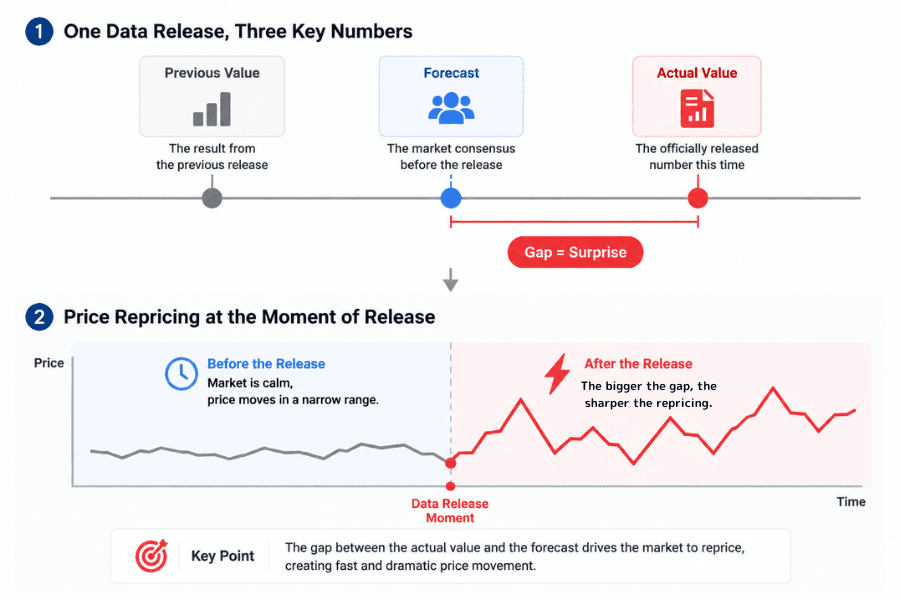
To understand it, first separate the three numbers in any release:
| Number | What it is |
|---|---|
| Previous | The result from the last release—the baseline this reading is compared against. |
| Forecast | The market consensus before the release, already priced in. |
| Actual | The number officially published this time. |
Whether price moves, and which way, comes down to the gap between the Actual and the Forecast: even a great jobs print can send price lower if it falls short of the market's already-high expectations. And that gap is only the first layer—how big a move it ultimately unleashes also depends on whether it's enough to shift the market's expectations for the path of rates, growth, or inflation.
2. How News Trading Works
In practice, a single news trade runs through a few stages:
| Stage | What you do |
|---|---|
| ① Schedule ahead | Find the upcoming high-impact events in advance, and note the release time and the market's forecast. |
| ② Map the scenarios | Think through how price might move under each of "beats / misses / meets" the forecast. |
| ③ Choose your entry | Decide whether to position before the release, or wait until after and enter once the reaction is clear. |
| ④ Set risk, then execute | Fix your stop, size, and exit conditions in advance; at the moment of release, follow the plan instead of improvising. |
By timing, news trading splits into two camps. Trading before means placing orders ahead of the release, betting on your read of direction or the gap—the potential reward is high, but you're taking a directional bet at the least certain moment, so the risk is highest. Trading after means waiting for the data and the first wave of reaction, then entering in the direction already confirmed, trading a slice of the profit for more certainty; the downside is that the sharpest leg is often already gone.
There's also the idea of betting on "whether there's a move" rather than the direction: you expect the event to spark a big move but aren't sure which way, so you place orders on both sides of the range and follow whichever side breaks. It looks clever, but it's especially prone to the fakeouts and spread widening below, and is harder to execute well than it sounds.
3. Which News Is Worth Trading
Not every headline is worth trading. What truly moves the currency market is a handful of high-impact events tied directly to monetary policy:
| Event type | Why it matters |
|---|---|
| Non-Farm Payrolls (NFP) | The headline of the US monthly jobs picture; it shapes expectations for Fed policy, and the dollar often swings hard on release. |
| FOMC rate decision | The Fed's rate and policy statement changes the cost of money directly—one of the most far-reaching events there is. |
| CPI (Consumer Price Index) | The core inflation gauge, which drives expectations for hikes or cuts. |
| Central-bank meetings | Policy moves from the ECB, the Bank of England, and others—track them with the Central Bank Watch tool. |
| GDP, retail sales, PMIs, etc. | Second-tier readings on the strength of the economy; their impact depends on what the market is focused on at the time. |
A couple deserve extra care: for NFP, beyond the current beat or miss, watch the revisions—a large upward or downward revision to the prior two months can flip how the market reads the jobs trend; for FOMC, the move often comes not from the rate itself but from the policy statement, the dot plot, and the Chair's press conference, whose wording can matter more than whether the rate changed.
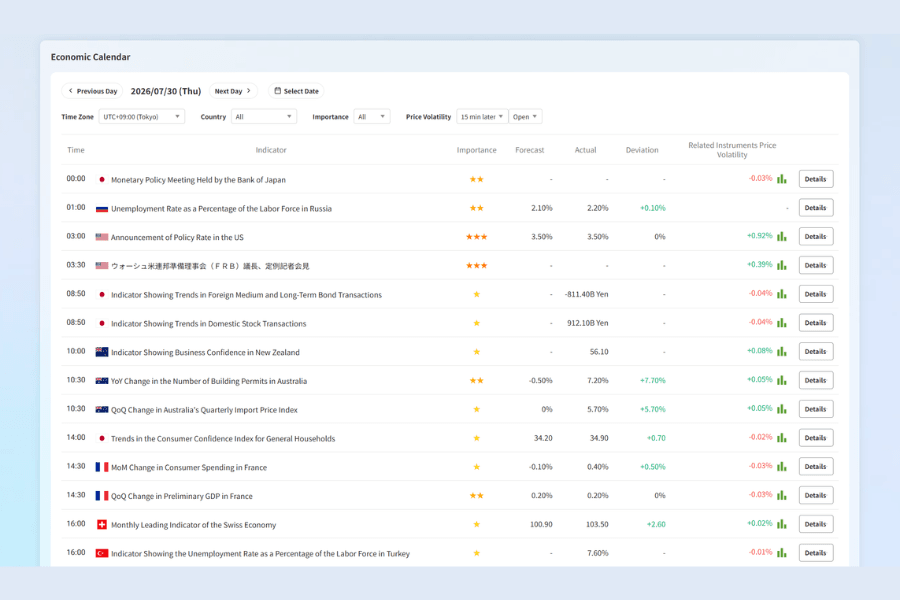
To judge whether a release is worth trading, look at its impact rating (usually shown as stars or colors): the three-star / red, high-impact events are where news trading actually happens; low-impact data often can't even produce a decent move. Before you trade, schedule the week's high-impact events and their release times—that's the basic groundwork for every news trader. You can use the Titan FX Economic Calendar to filter the events worth watching by impact level:
4. The Advantages of News Trading
- Clear, schedulable opportunities: the release times of major data are public, so you know days ahead "when the show starts"—no need to watch the screen all day waiting.
- Big moves, high potential reward: the action at the moment of release is fast and forceful, and one clean trade can cover a lot of ground in a short time.
- No long holding needed: most news trades are done within the short window around the event, sparing you the overnight swap and gap risk of holding long term.
- Intuitive logic: reasoning along the single thread of "the expectation gap" keeps cause and effect relatively clear, making it easier to state a reason for entry than with pure technical signals.
The flip side of these advantages is that they compress all the pressure into a very short span. Almost every risk in the next section stems from that word: fast.
5. The Risks of News Trading
The biggest myth about news trading is thinking "get the direction right and you'll make money." In reality, even with the direction right, execution risk can leave your order unrecognizable:
-
Spread widens in an instant: around the release, brokers widen spreads to reflect the risk, and a cost that was 1 pip can jump to several—so you're down a stretch the moment you enter.
-
Slippage moves your fill: as price lurches at the instant of release, your order often fills at a price away from what you intended; this slippage is especially severe in a fast market, and even a stop can trigger at a worse price.
-
Liquidity dries up suddenly: in those critical seconds, market liquidity can thin out abruptly, and sparse orders make price move in gap-like jumps—you want to fill but can't find a counter-price.
-
Fakeouts and two-way stop hunts: after the release price often surges one way, then snaps back in an instant; this "fakeout" can take out the stops on both sides, and the two-way straddle that bets on a move is especially likely to get double-killed.
-
Volatility and black swans: sudden, unexpected events (an unexpected policy turn, say) create volatility far beyond the everyday, and in the extreme it becomes a black swan move that puts risk completely out of control.
6. How to Trade the News and Manage Risk
Whether you survive news trading comes down less to "how accurately you guess" and more to keeping execution risk to a minimum. In practice, run through these:
-
Know each event's timing ahead of time: line up the release times of the week's high-impact events, and decide for each one whether to take part or sit out; entering without a schedule is like stepping on landmines blindfolded.
-
Cut leverage and size: news moves are far bigger than usual, so trading them at your normal size and leverage multiplies your risk several times over. Trimming down before the event is the most practical protection.
-
Widen the stop and shrink the size together: always set a stop-loss, and give it room so the normal back-and-forth of a fast market doesn't sweep it. But when you widen the stop distance, you must shrink your position accordingly—so the worst-case loss from "stop distance × size" still stays within your original risk limit (the 2% rule, say), so a wider stop doesn't end up enlarging your risk.
-
Choose the right trading environment: favor a regulated broker with stable spreads, fast execution, and negative-balance protection (Zero Cut), so that if an extreme jump sweeps through you, at least you won't end up owing money.
-
Stand aside when unsure: news trading carries no obligation to bet on every event. When you can't read the scenario, or the swings are too big to have any conviction, staying on the sidelines is itself a correct move.
7. News Trading FAQ
Q1: Should I enter before the data release or after?
Both are done; the trade-off is "certainty" versus "reward." Entering before means betting on direction and the gap—high potential reward but the highest risk, because you're betting at the most uncertain moment. Entering after means waiting for the first wave of reaction and a clearer direction before following—more certainty, but the sharpest leg is often already gone. If you want to try it, starting from "after the release, direction confirmed" is usually the more controllable path.
Q2: Why does price fall when the data is good?
The key, again, is expectations. If the market already expected a strong number and priced it in, an actual print that merely "meets"—or falls short of that high bar—can trigger profit-taking and a drop instead. On top of that, revisions to the prior figure, contradictions among the sub-components, or the data simply not changing the market's view on central-bank policy can all send price against the number's intuitive direction. This is the thing news trading most needs you to grasp: you're trading the expectation gap, and the raw good-or-bad is only the surface.
Q3: Why do slippage and spreads suddenly balloon on a release?
Because those few seconds are the most chaotic the market gets. The moment the data lands, a flood of orders hits at once and quotes lurch, the immediate liquidity a broker can offer thins out—so fills drift from the price you clicked (slippage), and brokers widen spreads to reflect the risk of that window. This is normal behavior in a fast market, not the platform cheating you, but it does erode profit, so build this cost in before you trade the news.
Q4: What tools does news trading need?
The core one is an economic calendar—use it to track each event's release time, impact level, and market forecast. Next is a tool for following central-bank policy, plus fast, real-time quotes and execution on your own platform. What really matters isn't having lots of tools, but whether you've prepared "when it's released, what the market expects, and how I'll respond" ahead of time; the number of tools is secondary.
Q5: Can I trade breaking news that isn't on the calendar?
You can, but it's harder. Geopolitics, an unexpected policy remark, and other breaking news can't be scheduled in advance, and the move tends to be more erratic and more violent. This kind of action is closer to a black swan and its direction is very hard to read, so for most traders the priority should be protecting existing positions and controlling risk, rather than rushing in to take a shot.
Q6: Is news trading suitable for beginners?
Frankly, it's a fairly demanding strategy and not well suited as a beginner's main approach. It asks you to handle fast price jumps, slippage, and spread widening all at once, and to decide within seconds, with little room for error. If a beginner is interested, start small and only trade "after the release, direction confirmed," treating it as a way to practice reading the market's reaction rather than a shortcut to quick gains.
8. Conclusion
News trading is a strategy built around major events, profiting from the move a headline sets off. It offers clear, schedulable opportunities and big swings without long holding—that's its appeal. And the key to understanding it fits in one line: the market trades expectations, and what really moves price is the gap between the actual data and those expectations.
But its difficulty lies not in guessing direction—that's rarely the hardest part—so much as in those few seconds of execution. Slippage, spread widening, thinning liquidity, and fakeouts can all leave a directionally correct trade at a loss anyway. So using news trading well means putting risk management ahead of profit: know each event's timing, cut leverage and size, set a stop with room to breathe, choose an environment with negative-balance protection, and stand aside decisively when you have no conviction.
Treat news trading as a test of preparation and discipline, rather than a gamble on the headline, and you can stand on the safe side of the risk even in its fast, fierce markets.
Further Reading
- What Is Trend Following?
- What Is Grid Trading?
- What Is a CFD?
- 5 Common Stop-Loss Strategies
- Titan FX Review: Safety, Features, and Analysis
Titan FX Trade Strategy Research Lab. We create educational content across a broad range of financial instruments, including forex (FX), commodities (crude oil, precious metals, agricultural products), stock indices, US equities, and crypto assets, for investors.
Primary Sources (by Category)
- Educational resources: Investopedia, BabyPips (general definitions and operational explanations of news trading, economic data, and money management)
- Market analysis: Bloomberg, Reuters (background on how the forex market reacts to economic data and central-bank policy, and on volatility)