

What Is Mining? A Complete Guide to Crypto Mining Mechanics, Methods, and Profitability
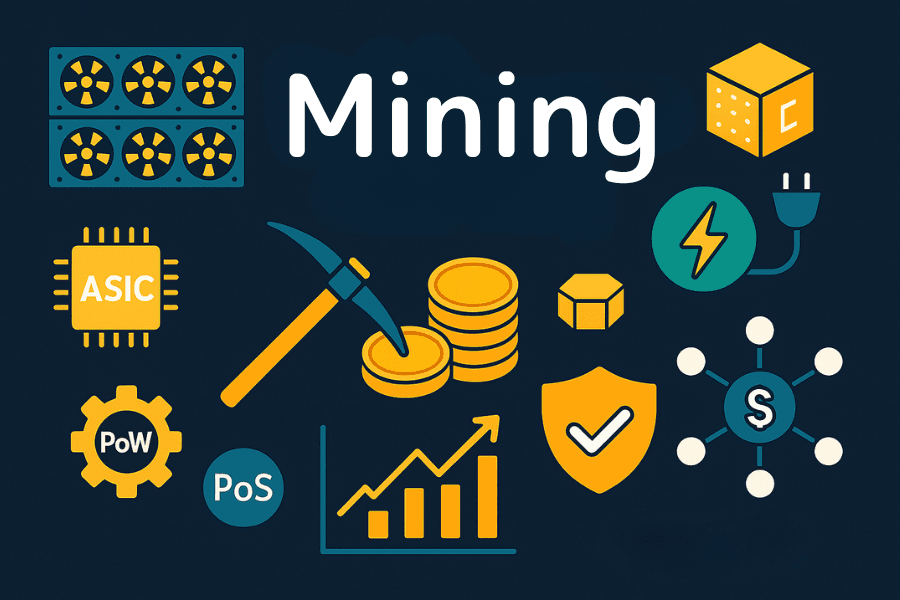
Mining is the core mechanism a blockchain uses to verify transactions, issue new coins, and secure the network: miners take part in record-keeping through computing power (PoW) or staking (PoS) and earn cryptocurrency as a reward.
It is not just a way to obtain digital currency — it is the core process that verifies transactions, maintains network security, and achieves decentralization.
Whether it is Bitcoin, Ethereum's early PoW (Proof of Work), or the later PoS (Proof of Stake) and liquidity mining, mining has always played the role of "system guardian."
For beginners, understanding mining's operating logic, cost structure, and risks is the first step into the crypto world.
This guide covers everything from basic concepts, mechanics, main mining methods, revenue and cost analysis, to practical entry steps — equipping you with both the operational core and investment thinking needed for mining.
- Essence: validate transactions and secure the network via compute or staking
- Consensus: PoW (BTC/LTC) and PoS (ETH/ADA), plus liquidity mining
- Hardware: ASIC, GPU, CPU, and cloud mining — each with its own cost/risk
- Profit drivers: coin price, hashrate, difficulty, and electricity cost
- Key risks: power costs, price swings, policy shifts, protocol changes, scams
1. What Is Mining?
Mining is one of the most important foundational mechanisms in cryptocurrency operations — responsible for maintaining blockchain security and stability.
In the blockchain world, there is no traditional bank or central institution to verify transactions, so the network must rely on "miners" for verification. These miners use computer power to solve specific mathematical problems, ensuring that every transaction is legitimate and tamper-proof.
The Core Significance of Mining
Mining is more than a way to "earn coins" — its true significance lies in:
- Securing transactions: Every transaction must be verified by miners to prevent double-spending.
- Maintaining network operation: Miners package new blocks, allowing the blockchain to continuously extend.
- Issuing new coins: The birth of new cryptocurrency typically accompanies each block being mined — the starting point of token circulation.
A Brief Look at the Mining Principle
The mining process can be understood as a "digital puzzle competition."
Miners run repeated calculations trying to find a hash value (Hash) that meets specific conditions. Once the correct answer is found, they can add a new block to the blockchain and receive a reward.
This process is called Proof of Work (PoW) — currently the most classical and widely applied consensus mechanism.
Why Mining Matters
Mining is the "security gatekeeper" of the entire decentralized system.
Without miner participation, the blockchain cannot verify transactions or ensure data authenticity and consistency.
For beginners, understanding the meaning of mining is the first step toward understanding the cryptocurrency market — it is not just about returns, but represents the foundation of blockchain's trust mechanism.
2. How Mining Works
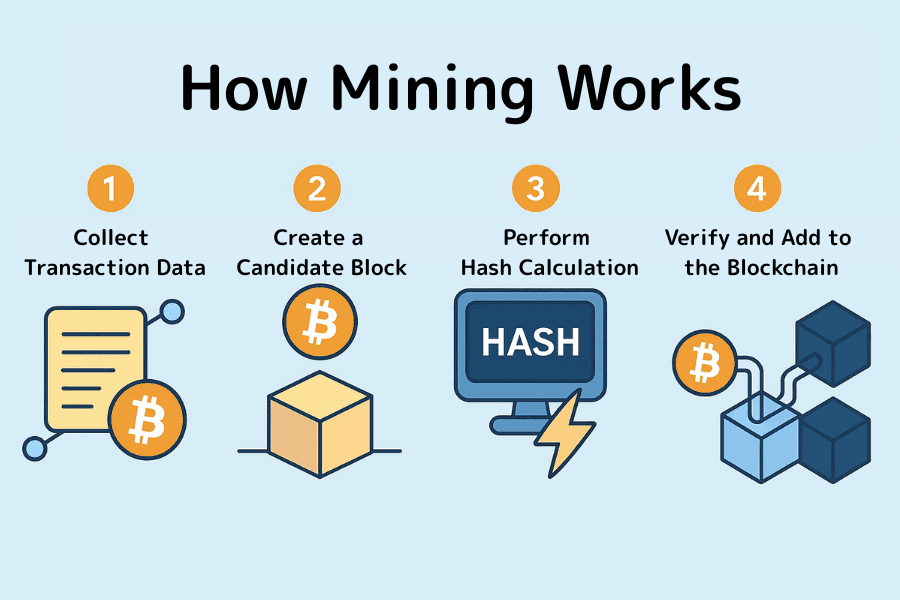
Understanding how mining works is a key step into the cryptocurrency world.
This process is essentially a "compute-and-verify" race: whichever computer first completes block verification gets the reward.
Step 1: Collecting Transaction Data
When a user sends a transaction (such as a Bitcoin transfer), it is broadcast to all network nodes, waiting for miners to package it.
Step 2: Building a Candidate Block
Miners aggregate these unconfirmed transactions into a "candidate block" and include the previous block's hash to maintain chain continuity.
Step 3: Performing Hash Calculation
Each miner repeatedly tries different random numbers (Nonces) to make the resulting hash satisfy the system's difficulty condition.
This process is extremely energy-intensive, requiring massive hash-rate support.
Step 4: Verification and Adding to the Blockchain
When a miner finds the correct hash, all network nodes immediately verify its legitimacy. If verified, the block is added to the blockchain, and the miner receives the reward.
3. The Main Types of Mining
Mining types can be classified along two axes:
- Technical level (the equipment used)
- Mechanism level (the blockchain operating model)
The following sections introduce the most common types.
Type 1: PoW Hash Mining (Proof of Work)
This is the most traditional and classical form of mining. Miners use computer power to perform hash calculations, competing to be first to complete block verification.
Representative coins: Bitcoin (BTC), Litecoin (LTC).
| Aspect | Strengths | Limitations |
|---|---|---|
| Security | High attack cost, defends against malicious nodes | Massive energy consumption, requires large amounts of power |
| Decentralization | All network miners participate together | Hash-rate centralization trend is pronounced |
| Investment threshold | Anyone can participate, low technical bar | Heavy equipment cost and electricity-price burden |
Type 2: PoS Coin-Holding Mining (Proof of Stake)
PoS no longer relies on hash rate — instead, it determines mining rights based on "amount of coins held and holding duration."
The more coins a node stakes, the better its chance of receiving block rewards.
Representative coins: Ethereum (ETH 2.0), Cardano (ADA).
| Aspect | Strengths | Limitations |
|---|---|---|
| Energy efficiency | No high-power computation needed, energy-efficient | Only coin holders participate, higher entry threshold |
| Maintenance cost | No specialized mining hardware needed | Coin-price volatility affects actual returns |
| Security | Staking mechanism prevents malicious attacks | If tokens concentrate, "rich-get-richer" effect can emerge |
Type 3: Liquidity Mining
A new mining method that emerged with the DeFi (Decentralized Finance) ecosystem.
Users deposit crypto assets into a Liquidity Pool to provide trading capital to the market and receive platform rewards.
Representative platforms: Uniswap, PancakeSwap.
| Aspect | Strengths | Limitations |
|---|---|---|
| Entry threshold | No mining hardware needed, just provide capital | Requires familiarity with DeFi operations and wallets |
| Revenue sources | Platform-token rewards + trading fees | Carries Impermanent Loss risk |
| Security | Fully executed by smart contracts | Contract vulnerabilities or hacks can cause fund loss |
Type 4: Airdrop Mining
Airdrop mining is a "marketing-oriented" reward method.
Project teams encourage users to complete specific tasks (registration, transactions, referrals) to obtain token rewards.
| Aspect | Strengths | Limitations |
|---|---|---|
| Participation cost | No equipment or capital investment needed | Limited returns, some projects carry fraud risk |
| Educational use | Suitable for beginners learning blockchain applications | Cannot generate stable long-term returns |
Type 5: Hardware-Based Mining Methods
Beyond the mechanism level, the technical level offers multiple hardware options:
| Type | Characteristics | Suitable For |
|---|---|---|
| GPU Mining | Medium cost, can flexibly switch coins, high power use | Small-to-medium miners, beginner enthusiasts |
| ASIC Mining | High efficiency but single algorithm, suited for long-term operation | Professional mining farms, large investors |
| Cloud Mining | Lease online hash rate, no need to build mining hardware | Beginner investors (must watch platform risk) |
| Home / Mobile Mining | Mainly for learning experience, real returns are minimal | Beginners wanting to understand mining principles |
4. Mining Revenue and Cost Analysis
Whether mining is profitable depends on the balance between input cost and actual revenue.
For beginners, understanding cost components and revenue sources is the core step in evaluating mining feasibility.
Cost Components
Mining costs primarily consist of three parts that directly affect investment payback speed and return rate.
| Cost Item | Description | Characteristics |
|---|---|---|
| Equipment Cost | Includes mining rigs, GPUs, motherboards, power supplies, and cooling systems. | High initial investment; hardware depreciates rapidly and requires periodic upgrades. |
| Electricity Cost | Mining rigs consume large amounts of power during prolonged operation. | The largest item in long-term expenses; differences in electricity rates substantially affect profitability. |
| Maintenance Cost | Includes network connectivity, cooling equipment, site rent, and repair expenses. | The larger the mining farm scale, the higher the maintenance and management costs. |
In different regions, electricity rates and climate conditions create significant differences in mining costs. For example, Iceland and Canada have become popular mining-farm locations due to cold climates and low electricity rates.
Revenue Sources
Miners' revenue mainly comes from two sources:
| Revenue Source | Description | Stability |
|---|---|---|
| Block Reward | When a miner successfully mines a new block, the system automatically issues new coins as a reward. | Varies by coin design and halving mechanism (e.g., Bitcoin halves rewards every four years). |
| Transaction Fee | Fees that users pay when making transfers or smart-contract operations, collected by miners. | Affected by network usage; revenue rises during peak periods and falls during idle ones. |
In most blockchains, block rewards are the primary revenue source; but as issuance gradually decreases, transaction-fee revenue is becoming increasingly important.
Mining revenue is also affected by multiple factors including coin price, total network hash rate, mining difficulty, and electricity cost. When coin prices fall or difficulty rises, miners may produce the same number of coins but see actual revenue decline.
Therefore, a stable mining strategy should focus on:
- Controlling power and equipment costs;
- Selecting mainstream coins with long-term potential;
- Regularly evaluating coin price and network difficulty changes.
Mining profitability depends not just on technology and hardware but on market environment and risk management.
5. How Beginners Can Start Mining
Mining may seem complex, but beginners who follow a step-by-step approach can quickly enter the field and understand its operating principles. The following is an entry guide for beginners.
Step 1: Choose a Coin and Mining Mechanism
Different cryptocurrencies adopt different consensus mechanisms; an appropriate mining method must be selected:
- Bitcoin (BTC): Uses PoW, requires ASIC mining hardware.
- Monero (XMR): Can be mined with CPU or GPU, suitable for individual players.
- Kaspa (KAS): Suitable for GPU mining, high energy efficiency, lower investment threshold.
When choosing a coin, consider input cost, coin-price stability, and mining difficulty together.
Step 2: Prepare Mining Hardware and Wallets
Mining hardware is the core equipment for mining; depending on the coin, choose ASIC, GPU, or CPU.
You also need to set up a secure digital wallet to receive block rewards and transaction fees.
Common wallet types include hardware wallets (such as Ledger, Trezor) and software wallets (such as Metamask, Exodus).
Step 3: Install and Configure Mining Software
Mining software allows mining hardware to connect to the blockchain network and perform calculations. Common options:
- NiceHash: User-friendly interface, suitable for beginner auto-mining.
- CGMiner / BFGMiner: Veteran open-source software, allows manual parameter setting.
- HiveOS: Provides farm-level management features, suitable for large-scale operations.
During setup, you need to enter wallet address, mining pool server information, and algorithm type.
Step 4: Join a Mining Pool
The chance of solo-mining success is low, so most beginners choose to join a mining pool.
A mining pool is a collaborative platform where multiple miners share hash rate to compete for block rewards.
Revenue is distributed proportionally based on contributed hash rate, which provides more stable returns.
Common mining pools include F2Pool, ViaBTC, AntPool, NiceHash Pool, and others.
Step 5: Monitor Hash Rate and Revenue
After mining begins, periodically check:
- Hash-rate stability: Ensure mining hardware operates stably long-term;
- Power and temperature: Prevent overheating and energy waste;
- Revenue changes: Watch coin-price and difficulty adjustments to adjust strategy.
Through mining-pool or software interfaces, you can view hash-rate curves and revenue reports in real time.
After becoming familiar with the workflow, beginners can gradually scale up mining operations based on capital, electricity costs, and risk tolerance — even moving toward multi-coin or farm-level deployments.
6. Risks and Challenges of Mining
Although many regard mining as a source of "passive income," it actually carries multiple layers of risk and uncertainty.
Before investing capital and equipment, investors must clearly understand the following potential challenges.
Risk 1: Cost Increases
Mining's main expenses are electricity and equipment. When electricity prices rise or mining-rig prices increase, overall returns are compressed.
Especially in regions with severe energy-price volatility, even with stable coin prices, "the more you mine, the more you lose" can occur.
In addition, mining hardware iterates rapidly; older equipment depreciates quickly, extending payback periods.
Risk 2: Market Volatility
Mining revenue is highly correlated with coin prices. When the market enters a bear phase and coin prices fall sharply, profit margins can quickly evaporate even at the same hash rate.
Some miners choose to "shut down and wait" during low-price periods, causing network hash rate to fall and block-time variance to widen.
Risk 3: Policy and Regulatory Changes
Countries differ greatly in their attitude toward crypto mining.
For example, China previously imposed a full ban on mining; the US, Canada, Kazakhstan, and others permit it but with energy regulations and tax policies.
Investors must understand local laws, taxes, and import/export restrictions before committing — to avoid losing capital due to policy risk.
Risk 4: Technical and Algorithm Changes
Blockchain protocol updates can change mining methods or terminate mining mechanisms outright.
The most typical example is Ethereum, which transitioned from PoW (Proof of Work) to PoS (Proof of Stake) in 2022 — instantly rendering massive amounts of GPU mining hardware obsolete.
Miners who fail to switch coins or strategies in time may suffer equipment write-offs and losses.
Risk 5: Fraud and Security Issues
Cloud-mining platforms, mining pools, and community projects host substantial fraud and opaque operations.
Common risks include:
- Fake mining returns and Ponzi schemes;
- Mining-pool operators with malicious fee skimming;
- Wallet addresses being compromised by hackers.
Therefore, beginners should choose reputable mining pools and official software, and properly safeguard private keys and wallet security.
Trade Crypto CFDs with Titan FX
Titan FX offers 20+ crypto CFDs including BTC and ETH with up to 100:1 leverage — go long or short with no wallet or private-key management.
7. FAQ: Common Questions
Q1. Can a personal computer still mine Bitcoin today?
Essentially no. Bitcoin's current network difficulty is extremely high — a personal computer's hash rate is tens of thousands of times weaker than a professional ASIC miner. Even mining continuously for a year, a regular PC's chance of receiving a block reward is essentially zero. For beginners who want to experience mining, the recommended approach is choosing CPU/GPU-friendly coins like Monero (XMR) or Kaspa (KAS), or joining a mining pool to contribute hash rate.
Q2. Is PoW or PoS more suitable for beginners?
By entry threshold, PoS is more suitable for beginners — you only need to hold and stake tokens (such as ETH or ADA) to participate, without mining hardware or electricity costs. However, PoS returns are tied directly to coin price, so if the coin falls, you can net-lose even when receiving new coins. PoW requires specialized hardware and electricity; returns are affected by both coin price and difficulty, but hash-rate revenue can be relatively stable through hardware selection and electricity-cost optimization.
Q3. What is "Impermanent Loss" in liquidity mining?
Impermanent Loss occurs when, after depositing two tokens into a liquidity pool, the relative price of the two tokens changes — and your portfolio at withdrawal is worth less than if you had simply held the two tokens. The greater the price volatility, the larger the impermanent loss. The platform-token rewards plus trading fees from liquidity mining must exceed the impermanent loss to actually profit — which is why many beginners in DeFi mining "earn coins but lose USD."
Q4. Are cloud-mining platforms reliable?
Generally not recommended. The core issues with cloud mining: (1) it is hard to verify whether the platform actually owns the corresponding hash rate; (2) contracts are usually locked-in, making exit during price drops impossible; (3) historically, many cloud-mining platforms have been accused of Ponzi schemes or have run away with funds. If you must try, choose platforms with publicly listed company backgrounds or long reputations (such as NiceHash), and only invest small amounts you are willing to fully lose.
Q5. Are mining earnings taxable?
It varies by country, but the answer in most major jurisdictions is "yes." For example, the US IRS treats mining rewards as "ordinary income" (taxed at the market price at the time of receipt); Japan classifies them as "miscellaneous income"; Taiwan's current law treats them as property-transaction income. It is recommended to keep records of every block reward's time, quantity, and coin price at receipt for filing. Specific tax handling should be discussed with a local accountant.
8. Conclusion
Mining is the core mechanism that maintains blockchain security and trust. From PoW to PoS, the form may differ, but the essence is the same — participating to keep the network running.
Mining offers potential returns but also carries high risk. Investors should first understand the mechanism, control costs, and follow regulatory developments.
The future of mining is no longer about pure hash-rate competition — it is about strategy and efficiency. With long-term planning, mining remains an instructive source of value in the crypto world.
Further Reading
- Bitcoin (BTC) Complete Guide
- Ethereum (ETH) Complete Guide
- What Is Cryptocurrency?
- What Is a Stablecoin?
- What Is CBDC?
Titan FX Research and Review Team — covering forex (FX), commodities (oil, precious metals, agricultural products), stock indices, US equities, and crypto assets, producing educational content for retail and institutional investors.
Primary Sources by Category
- Academic and technical references: Satoshi Nakamoto, "Bitcoin: A Peer-to-Peer Electronic Cash System" (2008, the foundational PoW paper); Vitalik Buterin, "Ethereum Whitepaper" (PoS and EIP-1559 design); Cambridge Centre for Alternative Finance, "Cambridge Bitcoin Electricity Consumption Index."
- Market data: BitInfoCharts, CoinWarz, F2Pool and other mining-pool data; CoinDance Bitcoin hash-rate distribution; DefiLlama TVL and liquidity-mining statistics.
- Regulatory references: People's Bank of China 2021 crypto-mining ban; US Treasury Department / IRS Notice 2014-21 (mining taxation); EU MiCA compliance requirements for crypto-asset service providers.
- Industry and third-party references: Investopedia (Mining entries); CoinDesk, The Block, Decrypt mining coverage; Titan FX internal observations on crypto assets and blockchain technology.