

Ask

In forex trading, the ask price is the price at which a broker offers to sell a currency pair to a trader. From the trader's perspective, the ask is the price you pay when placing a buy order.
The counterpart to the ask is the bid price, which is the price at which the broker buys the currency from the trader -- effectively the price a trader receives when selling.
This article explains the ask price definition, how it is displayed on trading platforms, its relationship to trading costs, and answers common questions.
What You Will Learn
- The definition of the ask price and its relationship to the bid price
- How price quoting works from both the broker's and the trader's perspective
- How ask prices appear on MT4/MT5 platforms
- The connection between spreads and the ask price, and how it affects trading costs
1. Ask Price Definition
In FX trading, the ask price (also called the "offer") is the price a broker quotes for selling a currency pair. Because the trader buys at this price, it functions as the trader's purchase price.
The opposite side is the bid price -- the price at which the broker is willing to buy the same currency pair from the trader.
How the Ask and Bid Work
| Term | Broker's Perspective | Trader's Perspective |
|---|---|---|
| Ask | Selling price | Buying price |
| Bid | Buying price | Selling price |
On trading platforms, the ask and bid are typically displayed together in a two-way price (or "two-way quote") format, giving traders a clear view of both sides of the market at any given moment.
2. Ask vs. Bid
The ask and bid represent the two sides of every FX quote. Their meaning depends on whose perspective you take.
Broker's Perspective
- Ask (selling price): The price the broker offers to sell a currency pair to the trader.
- Bid (buying price): The price the broker is willing to pay when buying the currency pair from the trader.
Trader's Perspective
- Ask (buying price): The price the trader pays to buy a currency pair. A market buy order executes at the current ask.
- Bid (selling price): The price the trader receives when selling. A sell order or position close executes at the current bid.
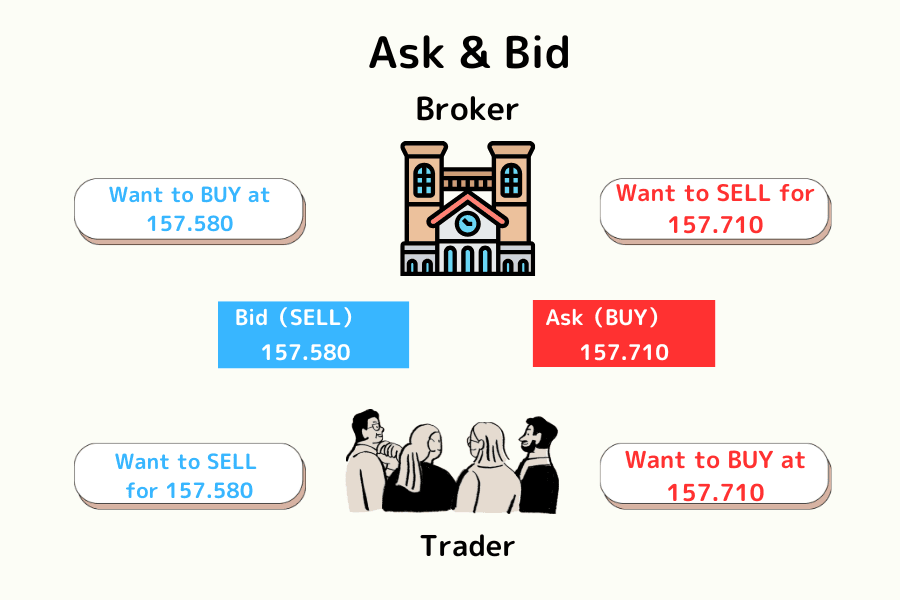
Understanding this distinction helps traders know exactly which price applies when they open or close a position.
3. Related Terms
The ask price goes by several names depending on the platform and context. Below are common synonyms and related terms from the trader's perspective.
- Buy price: The most direct label. It is the price the trader pays to purchase a currency pair.
- Offer / Offer price: Used interchangeably with "ask" on some platforms and in interbank markets.
- Buy quote: Refers to the real-time buying price displayed on a trading platform.
- Limit buy price: The price a trader sets when placing a limit order, which may be below the current ask.
Because terminology can vary between platforms, it is worth confirming which label your broker uses to avoid confusion.
4. Display Methods
Trading platforms display the ask price prominently so traders can act on it quickly. Below are the main formats.
Two-Way Price
The ask and bid are shown side by side in a two-way quote. This standard format lets traders see both the buying and selling prices in a single view.
Platform Display Examples
MetaTrader 4 (MT4) and MetaTrader 5 (MT5)
On MT4/MT5, the ask price appears in the Market Watch window and the Quick Order tool. It is typically labeled as the buy price.
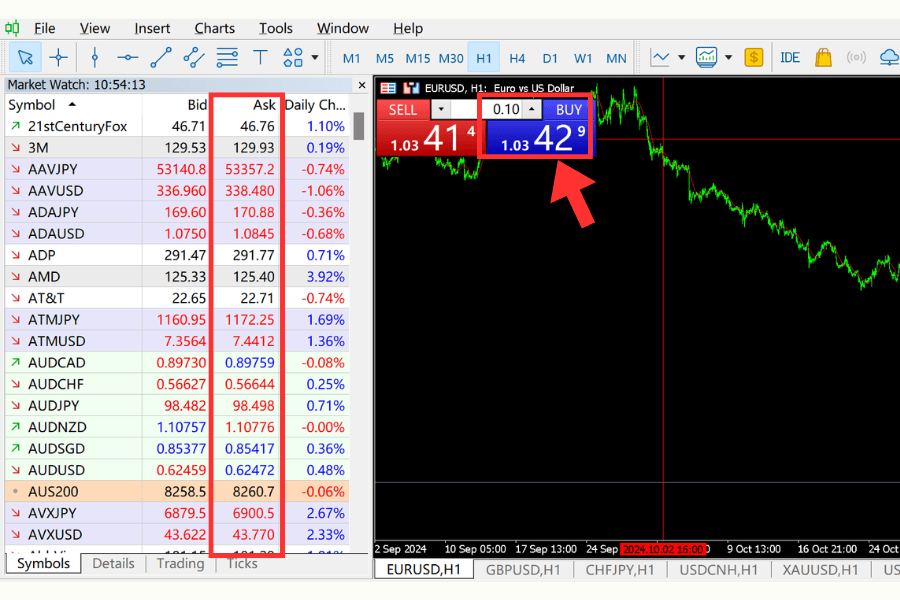
5. Ask and Trading Costs
What Is the Spread?
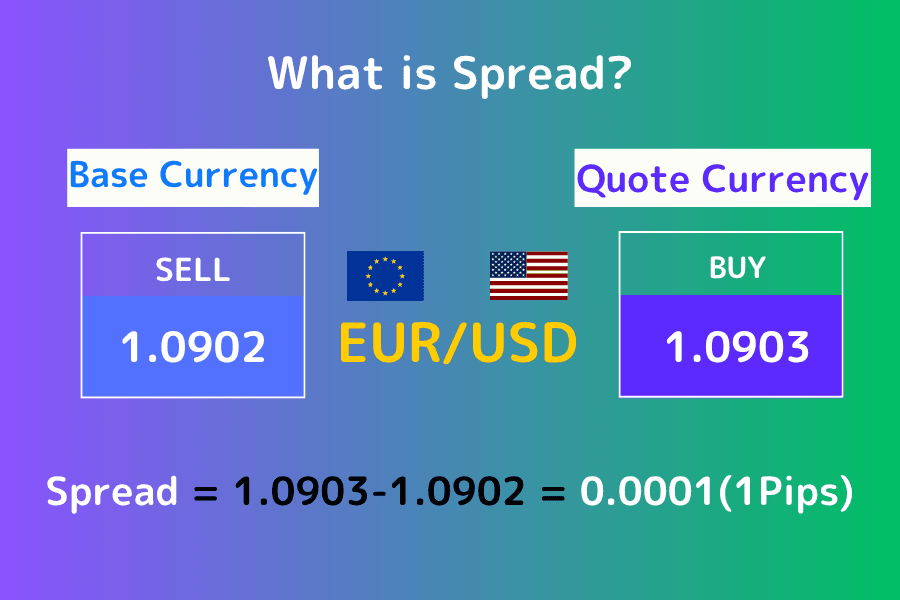
The spread is the difference between the ask and the bid. It is one of the main costs in FX trading. For example, if the ask for a currency pair is 1.0903 and the bid is 1.0902, the spread is 1 pip.
How the Spread Affects Trading
Tight spread: Favored by scalpers and short-term traders because costs per trade are lower.
Wide spread: More common during high-volatility or low-liquidity conditions. Long-term traders may be less affected because they hold positions over larger price moves.
Traders should evaluate the spread relative to their strategy and time horizon when choosing a broker or account type.
6. Common Use Cases
Below are practical situations where the ask price plays a direct role.
Market Buy Orders
When a trader places a market buy order, the order executes at the current ask price. This is the most common interaction with the ask.
Limit Orders
A buy limit order lets a trader set a target price below the current ask. The order executes only if the market drops to that level.
Market Sentiment Analysis
Watching how the ask moves over time can provide clues about buying pressure. A steadily rising ask may indicate bullish sentiment in the market.
7. FAQ
Q1: Why is the buy price higher than the current market price?
This is due to the spread. The ask (buy price) is always higher than the bid (sell price). The spread between the two is a core trading cost.
Q2: Why does the ask price differ between platforms?
Each platform connects to different liquidity providers and may apply its own pricing model. These differences typically result in small variations in the ask.
Q3: How can I judge market liquidity from the ask and bid?
Narrow spread: Indicates high liquidity and active trading.
Wide spread: Suggests lower liquidity or elevated volatility.
8. Summary
The ask price is a foundational concept in FX trading. It determines the price a trader pays when buying a currency pair and directly affects trading costs through the spread. By understanding the ask, its relationship to the bid, how it is displayed on platforms such as MT4/MT5, and how it interacts with spreads, traders can time entries more precisely and manage costs effectively.
Further Reading
- Forex Trading Basics
- What Is Bid? The Sell Price in Forex Trading
- What Is Spread? Definition, Calculation, and Impact on Trading Costs
- What Is FOMC? Meeting Schedule and Policy Decisions
Titan FX's financial market research and analysis team produces investor education content across a wide range of financial instruments, including foreign exchange (FX), commodities (crude oil, precious metals, and agricultural products), stock indices, U.S. equities, and crypto assets.
Titan FX Trading Strategy Research. We produce educational content for investors covering forex, commodities (crude oil, precious metals, agricultural products), stock indices, U.S. stocks, and digital assets.
Primary Sources by Category
- Market structure and data: BIS (Bank for International Settlements) -- Triennial Central Bank Survey; CME Group -- FX market structure documentation
- Regulatory and educational resources: CFTC -- Forex Trading guidance; NFA -- Forex glossary and investor education