

CHF(Swiss Franc)
The Swiss Franc (CHF) is Switzerland's official currency and one of the world's premier "safe-haven" currencies. Backed by political neutrality, low inflation, sound public finances, and the SNB (Swiss National Bank), the CHF tends to attract inflows during risk-off periods and is bought in times of crisis.
The Swiss Franc (CHF) has long been regarded as one of the safest currencies in the world. Behind it stand not only Switzerland's robust economy and political system, but also a long tradition of being the safe-haven destination of choice for global capital.
This article breaks down the historical background of the franc, the drivers of its exchange rate, its core monetary characteristics, and its role in global financial markets — giving you a working framework for understanding CHF's value and how to approach trading it.
- CHF is one of the world's three major safe-haven currencies.
- 1971: gold standard exit; 2015: SNB abandons the EUR floor — pivotal moments.
- Main drivers: safe-haven flows, SNB policy, eurozone economy, Swiss CPI/GDP.
- Headline pairs: USD/CHF (inverse safe-haven) and EUR/CHF (tied to eurozone).
- Margin FX is standard — watch liquidity, swaps, and SNB policy tail risk.
1. Swiss Franc (CHF): Overview and Historical Background
The Swiss Franc (CHF, symbol ₣) has been Switzerland's official currency since the 19th century, and its monetary regime has been known for stability ever since. From 1971 onward, Switzerland left the gold standard and moved to a floating regime, allowing the franc to be set by market supply and demand.
Switzerland's long-standing neutrality, combined with a highly developed manufacturing sector (watches, pharmaceuticals) and an internationally recognised banking system, has made the franc a top choice for capital seeking refuge and asset preservation.
2. Characteristics of the Swiss Franc
The Swiss Franc enjoys a distinctive position in global FX markets, rooted in Switzerland's economic and institutional advantages. The following five characteristics explain why traders and international capital favour CHF:
Characteristic 1: A leading global safe-haven currency
Switzerland's commitment to neutrality plus a long-stable fiscal and social system have made CHF one of the world's primary safe-haven currencies. During geopolitical conflict or financial crises, capital tends to flow into CHF for safety, pushing its rate higher.
Characteristic 2: Very low inflation, stable purchasing power
Swiss inflation has run below most major economies for years. That preserves the franc's real purchasing power and reinforces its long-term store-of-value role, attracting both global investors and central banks.
Characteristic 3: Negative rates as a tool to curb appreciation
To prevent excessive capital inflows from pushing the franc too high, the Swiss National Bank (SNB) has run negative-rate policy for extended periods. This unconventional stance helps protect Swiss export competitiveness while reducing the franc's appeal as a speculation vehicle.
Characteristic 4: Floating regime, but with policy steering
Switzerland formally adopted a floating regime in 1971, leaving the rate to the market. But when the franc rises too quickly or threatens economic stability, the SNB has been willing to intervene in the FX market — a hallmark of pragmatic monetary-policy management.
Characteristic 5: Reserve currency status
According to the IMF (Q1 2025), the Swiss Franc accounts for roughly 0.76% of global foreign-exchange reserves. The share is small, but most central banks still keep CHF in their reserve mix because of its low volatility and safe-haven properties — a useful diversification ingredient.
| Currency | Reserve amount (USD bn) | Share |
|---|---|---|
| US Dollar (USD) | 6,720.31 | 57.74% |
| Euro (EUR) | 2,334.62 | 20.06% |
| British Pound (GBP) | 603.70 | 5.19% |
| Japanese Yen (JPY) | 599.10 | 5.15% |
| Other currencies | 573.42 | 4.93% |
| Canadian Dollar | 306.13 | 2.63% |
| Chinese Yuan (CNY) | 246.31 | 2.12% |
| Australian Dollar | 167.74 | 1.44% |
| Swiss Franc (CHF) | 88.39 | 0.76% |
| Allocated reserves total | 12,537.00 | - |
| Unallocated reserves | 897.28 | - |
| Denominator for share calc | 11,639.72 | - |
3. Key Factors Driving the Swiss Franc
Although CHF carries safe-haven and stability traits, its rate still fluctuates due to a set of domestic and external drivers. The following are the main influences traders should track:
Factor 1: Domestic Swiss economic stability
Switzerland has long enjoyed low inflation, low unemployment, and steady growth — the foundation of the franc's long-term stability.
When macro indicators are firm, CHF tends to attract capital. When domestic demand or exports lose momentum, CHF can come under pressure.
Factor 2: SNB policy direction
The SNB targets stable inflation while preventing excessive franc appreciation. Its toolkit includes interest-rate adjustments and FX market intervention. When the franc rises sharply, the SNB may step in to limit appreciation and protect export competitiveness — these moves often dominate short-term sentiment.
Factor 3: Global risk appetite and capital flows
As one of the world's recognised safe-haven currencies, CHF is sensitive to shifts in market risk appetite.
When geopolitical tension, financial-market stress, or global uncertainty rises, CHF tends to act as a refuge.
When investors swing back to risk assets (equities, high-yielders), CHF can come under pressure.
Factor 4: Major trading-partner dynamics
Switzerland is closely tied to the EU, the United States, and several Asian economies. Eurozone economic performance in particular has notable spill-over effects on CHF. For example, when European data is weak, capital may rotate into the franc for stability — and that, in turn, may trigger SNB policy responses.
Global economic events calendar
4. Major Economic Indicators for the Swiss Franc
CHF moves are heavily influenced by domestic and global macro indicators. The following table summarises the indicators traders should watch most closely and their likely impact:
| Indicator | What it shows | Likely CHF impact |
|---|---|---|
| GDP growth | Health of the Swiss economy; steady growth signals strong demand and exports | Strong economy supports CHF demand and appreciation |
| Inflation rate (CPI) | Stability of price level; too low risks deflation, too high erodes purchasing power | Moderate inflation supports CHF; deflation risk weakens it |
| Unemployment | Labour-market health; low unemployment signals economic resilience | Low unemployment lifts confidence in CHF |
| Policy rate | SNB-set rate; affects funding costs and carry-trade attractiveness | Low or negative rates dampen CHF appreciation |
| Trade balance | Exports vs imports; surplus signals external strength and capital inflow | Surplus tends to lift CHF |
| FX reserves | SNB-held FX assets; changes signal intervention posture and scale | Reserve shifts can foreshadow short-term CHF moves |
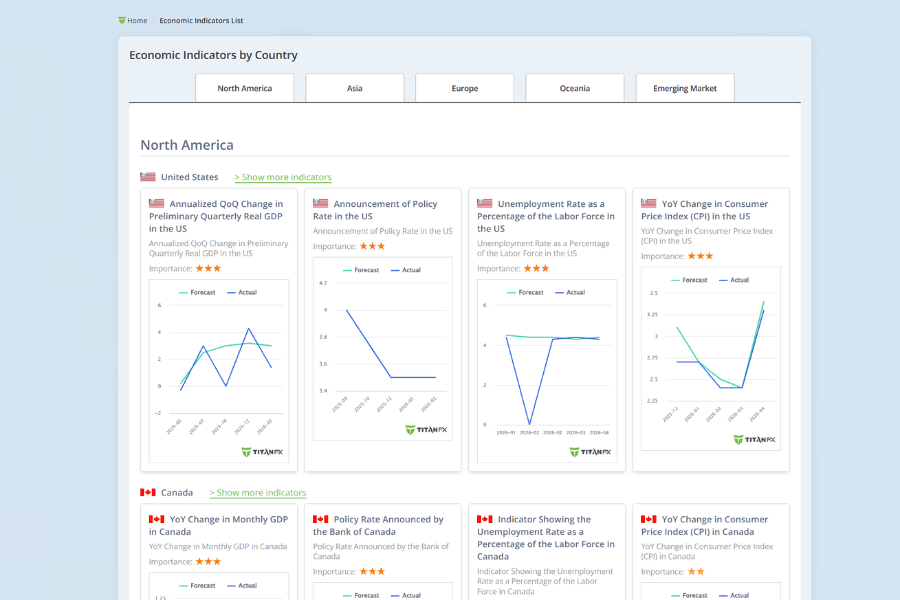
Free economic-data lookup on Titan FX
Titan FX provides macroeconomic indicators for the US, Europe, Japan, China, and other major economies. You can filter by release time, country, and importance.
5. How to Trade the Swiss Franc (CHF)
CHF can be traded in several ways, and margin FX trading is by far the most common. The format offers leverage, letting investors control a larger position with relatively limited capital.
Margin FX also supports two-way trading — long or short — depending on market direction.
In addition, the FX market runs 24 hours a day, making it one of the world's largest by volume. That gives the format flexibility and depth, suiting a wide range of strategies and risk profiles.
Further reading: FX margin-trading primer
Titan FX offers leverage of up to 1,000x.
Trading FX margin on Titan FX
Step 1: Open an account
Account opening on Titan FX is simple and quick — no identity or address documents required to register online.
Titan FX offers Standard and Blade account types; you can pick the one that fits your strategy at signup.
Step 2: Deposit
After registration, fund your account. Titan FX supports several deposit methods, with credit-card deposits typically credited instantly.
Step 3: Download and install the trading platform (MT4 / MT5)
Titan FX provides both MT4 and MT5. The platforms are available on Windows, Mac, iOS (iPhone / iPad), and Android.
MT5 install and login guide MT4 install and login guideStep 4: Pick a currency pair
Titan FX offers around 60 currency pairs. The most common pair traded against CHF is the US dollar — i.e. USD/CHF.
This is one of the most heavily traded pairs in the world and is often viewed as a safe-haven pair, since CHF itself carries safe-haven properties while the dollar serves as the global reserve currency.
All currency pairs on Titan FXStep 5: Place an order
Once logged in to MT4 or MT5, pick the instrument and you can submit buy or sell orders.
MT5 interface and order placement MT4 interface and order placementFree trading tools on Titan FX (custom indicators and EAs)
Titan FX provides free trading tools, including custom indicators and Expert Advisors (EAs, automated trading programs), designed to improve efficiency and the precision of strategies.
Custom indicators help traders analyse market behaviour more accurately and surface trading opportunities.
EAs execute predefined strategies automatically, eliminating emotional bias and helping ensure orders are placed precisely as designed.
These free tools help you compete more effectively in financial markets and lift overall trading performance.
All custom indicators EA ranking6. Swiss Franc Q&A
Q1: Why does CHF sometimes show "irrational" appreciation?
Because CHF is a major global safe-haven currency, when market risk sentiment spikes, capital can pour into CHF even when Swiss domestic data has not changed — pushing the franc higher quickly. This kind of "decoupling from fundamentals" often forces the SNB to intervene in the FX market, and is itself a source of risk for traders.
Q2: When does the SNB intervene in the FX market?
When CHF appreciation gets aggressive enough to hurt export competitiveness or threaten deflation, the SNB may intervene through direct foreign-currency buying, balance-sheet expansion, or even rate cuts. Around periods of heightened safe-haven demand, traders should pay particular attention to SNB statements and policy turns.
Q3: Is CHF a good fit for carry-trade strategies?
Generally yes — because of its long-running low- or negative-rate stance, CHF is often used as the funding currency in carry trades (i.e., sell CHF and buy a higher-yielder). But during risk-off episodes, those positions can get stopped out, producing sharp short-term CHF strength. So carry positioning has to be combined with risk management and macro monitoring.
Q4: Is CHF tightly correlated with EUR?
Yes. Switzerland is closely tied to the EU economically (about 60% of Swiss trade is with the eurozone), so CHF and EUR are highly correlated. The EUR/CHF pair in particular drew enormous attention in the past when the SNB set a floor on the rate. European data is often viewed as an indirect driver of CHF.
Q5: Why does CHF sometimes look unusually quiet?
When market volatility is low, safe-haven demand fades, and the SNB strongly signals stability, CHF can enter low-volatility phases. Verbal intervention, stable rate expectations, or balanced capital flows can all cause CHF to range-trade — a setting where range-trading strategies can suit the environment.
7. Conclusion
The Swiss Franc (CHF), a leading global safe-haven currency, combines economic stability, political neutrality, and a tightly governed financial system. It plays a key role in international FX markets, is highly sensitive to global risk sentiment, and is steered to a notable degree by SNB policy. CHF's volatility may be relatively contained, but it cannot be ignored.
Whether you are running short-term trades or longer-term allocation, traders should track how CHF moves with global macro momentum, eurozone dynamics, and central-bank communications.
Mastering the core logic of CHF helps you read where global capital is flowing — and is a key foundation for navigating international FX markets with confidence.
Further Reading
- Safe Haven Currency — How CHF, JPY, and gold function as safe-haven assets.
- USD/CHF (US Dollar / Swiss Franc) — Live rate and product page for the most common CHF pair.
- EUR/CHF (Euro / Swiss Franc) — The CHF cross most tightly correlated with the eurozone.
- FX margin-trading primer — Foundational concepts for FX / CFD trading.
- Inflation — A foundation for understanding the link between SNB policy and CPI.
- GDP (Gross Domestic Product) — The basic indicator of Swiss economic scale.
The Titan FX Research team covers global macroeconomic indicators, foreign exchange (FX), commodities (oil, precious metals, agriculture), equity indices, US stocks, and crypto assets, producing educational content for investors and traders.
Primary Sources by Category
- Official data and regulators: Swiss National Bank (SNB) — Monetary Policy Reports / Quarterly Bulletin; State Secretariat for Economic Affairs (SECO) — Swiss GDP / CPI / unemployment statistics; Swiss Federal Statistical Office (FSO); FINMA — Swiss Financial Market Supervisory Authority.
- International institutions and research: International Monetary Fund (IMF) — Currency Composition of Official Foreign Exchange Reserves (COFER); Bank for International Settlements (BIS) — Triennial Central Bank Survey of FX; OECD — Economic Surveys: Switzerland.
- Media and historical references: Bloomberg; Reuters; Financial Times; the SNB's 15 January 2015 decision to abandon the EUR/CHF 1.20 floor (the "Swiss Franc Shock"); CHF behaviour in safe-haven episodes including LTCM 1998, the 2008 GFC, and the COVID 2020 episode.