

Credit Rating Agencies
When a country is downgraded, its currency and bonds can drop in response—and the verdict usually comes from three agencies: S&P, Moody's, and Fitch. Why do their ratings carry such weight?
This article explains the role of the big three credit rating agencies, their rating scales and methods, and how credit ratings affect FX and global financial markets.
- What CRAs do. S&P, Moody's, and Fitch produce sovereign and corporate credit ratings that drive bond yields, FX flows, and risk appetite as a top-tier macro factor.
- How the three differ. S&P set the global standard with broad coverage; Moody's leans on quantitative models; Fitch has deep expertise in emerging markets and banking.
- Rating scale shorthand. AAA/Aaa is the highest; BBB−/Baa3 is the lowest investment-grade tier. Below that, many institutional investors are forced to sell.
- Three transmission channels. Currency strength, sovereign-bond yields, and overall risk sentiment.
- Trader workflow. Use ratings as a macro backdrop, not a direct signal—combine with economic data and technical analysis.
- 1. What Are the Big Three CRAs? Role and Importance
- 2. S&P, Moody's, and Fitch: Positioning and Differences
- 3. How Ratings Are Determined: Logic and Comparison Table
- 4. How Ratings Impact Global Markets and FX Pricing
- 5. How Traders Can Use Rating Information
- 6. Limitations and Common Criticisms
- 7. FAQ: Credit Ratings and Trading
- 8. Summary: The Core Value of Credit Ratings
1. What Are the Big Three CRAs? Role and Importance
The Big Three credit rating agencies are the most authoritative and influential sources of credit assessment in the world: S&P (Standard & Poor's), Moody's Investors Service, and Fitch Ratings. Their ratings are widely referenced by governments, banks, corporates, and institutional investors as a core tool for assessing "credit risk."
At its heart, a credit rating is a measure of whether a country or company can reliably service its debt. Higher ratings imply lower default risk; lower ratings imply more repayment pressure. For investors, ratings provide a fast and consistent yardstick for comparing credit conditions across countries and firms.
In FX, sovereign ratings (country credit ratings) carry particular weight. Upgrades tend to lift market confidence and support the currency, while downgrades typically raise funding costs, move sovereign-bond yields, and put pressure on the currency.
CRAs do not produce short-term trading signals. What they offer is a macro framework for reading long-term risk trends—essential background for understanding the forces moving currencies and market sentiment.
2. S&P, Moody's, and Fitch: Positioning and Differences
The Big Three carry global influence not just because of their history but because their ratings are baked into the financing and pricing infrastructure of governments, corporates, and financial institutions worldwide.
S&P (Standard & Poor's)
S&P traces its origins to the 1860s, when it provided financial data on railroads and infrastructure. It became S&P after the 1941 merger with Poor's Publishing.
Beyond ratings, S&P is famous for index construction—the S&P 500 Index is the most-cited benchmark for the US equity market globally.
In ratings, S&P uses a 22-step scale from AAA to D, with clear categorization and global recognition. Its ratings are treated as the financial-market baseline and feed into the cost of capital for sovereigns, banks, corporates, and major infrastructure projects.
Moody's
Moody's was founded in 1909, when founder John Moody published analyses of railroad bonds—laying the foundation for modern credit ratings.
Moody's scale runs from Aaa (highest) through Aa, A, Baa, … to C, with numeric modifiers (1, 2, 3) for finer precision.
Moody's leans heavily on quantitative data and risk models, often pairing ratings with long-term economic and fiscal outlooks. Its ratings are deeply embedded in corporate bonds, sovereign debt, and structured finance.
Fitch Ratings
Fitch Ratings was founded in 1914 and is the smallest of the Big Three by size, but its global influence remains significant. It uses the same AAA–D notation as S&P, which makes cross-agency comparisons straightforward for investors.
Fitch has particularly strong research depth in emerging markets, banking systems, and financial-risk monitoring. Many sovereigns and companies are simultaneously rated by Fitch and S&P as part of risk-management and lending decisions.
The three agencies use slightly different methodologies but together form the most authoritative credit-assessment ecosystem in the world. In FX, bonds, and equities, an update from any one of them can shift market sentiment.
3. How Ratings Are Determined: Logic and Comparison Table
The core purpose of credit ratings is to measure default risk—whether a country or company can meet its obligations on time. The Big Three analyze fiscal, economic, political, and financial dimensions, with the resulting rating representing market consensus on relative risk.
Rating Inputs: What Drives Credit Risk
Methods vary slightly across the three, but all three weigh the following dimensions:
- ▸Fiscal health: government balance, debt burden, and the stability of tax revenue.
- ▸Economic structure and growth: GDP growth, sector composition, and position in the business cycle.
- ▸Political and institutional stability: continuity of policy, transparency and credibility of the legal framework.
- ▸External dependence: trade openness, sensitivity to external demand, and resilience to external shocks.
- ▸Financial-system resilience: banking capital, regulatory rigor, and financial-market stability.
These inputs collectively determine where a credit sits, which in turn shapes financing costs for the government and corporates, and the market's confidence in the country's currency and assets.
Rating Scale: Side-by-Side Comparison
| Credit Tier | S&P | Moody's | Fitch | Meaning |
|---|---|---|---|---|
| Highest investment grade | AAA | Aaa | AAA | Extremely low risk, exceptional repayment capacity. The safest sovereigns and blue-chip names. |
| High investment grade | AA+ / AA / AA− | Aa1 / Aa2 / Aa3 | AA+ / AA / AA− | Slightly below top tier; risk still very low; solid fiscal and sector base. |
| Upper-medium grade | A+ / A / A− | A1 / A2 / A3 | A+ / A / A− | Stable repayment capacity; relatively low risk; mainstream investment target. |
| Lowest investment grade | BBB+ / BBB / BBB− | Baa1 / Baa2 / Baa3 | BBB+ / BBB / BBB− | Floor of investment grade; below this triggers institutional-investor selling rules. |
| High-yield (non-investment grade) | BB+ and below | Ba1 and below | BB+ and below | Higher risk; often called "high-yield"; higher returns but more volatility. |
| Lowest / default | D | C | D | Default already occurred or extremely likely; highest market-risk tier. |
Across the three scales, BBB−/Baa3 is the investment-grade floor. Below that threshold, the market typically re-prices the country's or company's risk, and many institutional mandates require divestment—triggering forced flows that can move FX and bond prices materially.
4. How Ratings Impact Global Markets and FX Pricing
Credit ratings rarely move markets the way a rate decision or jobs print does. But they shape market confidence in a country or company, and that translates into capital flow, risk appetite, and currency trends. For FX traders, the impact pathway is worth understanding.
Channel 1: Currency Strength
Upgrades signal improving economic and fiscal conditions; foreign capital tends to add exposure to that country's assets, supporting the currency.
Downgrades flag rising risk; foreign capital often pulls back or trims exposure, putting downward pressure on the currency. These flow shifts influence medium- to long-term FX trends.
Channel 2: Sovereign-Bond Yields and Funding Costs
An upgrade implies lower country risk; sovereign-bond yields tend to fall, lowering financing costs and making investment more attractive.
A downgrade prompts the market to demand a higher risk premium; yields rise, and government and corporate borrowing costs go up—weighing on the growth outlook and, ultimately, on the currency.
Channel 3: Risk Sentiment
Rating reports are widely tracked as a barometer of market risk. When multiple countries are downgraded in close succession, market positioning often turns defensive, with capital rotating into safe havens like the US dollar, the Japanese yen, and gold.
In the opposite scenario, broadly improving ratings tend to boost confidence in global growth, supporting risk assets and select commodity currencies.
Credit ratings are not a short-term trading indicator, but they have structural influence on long-term risk perception and capital flow—an essential input for any macro FX framework.
5. How Traders Can Use Rating Information
Credit ratings are not a short-term trade trigger, but they help map market sentiment, the risk environment, and capital flow. Combined with other tools, they sharpen the strategic picture.
Tip 1: Watch the Timing of Upgrades and Downgrades
Sovereign rating changes typically produce clear market reactions. Upgrades signal financial improvement and support the currency; downgrades trigger exposure reduction and push the currency lower. Price reactions are sharpest when the move was not previously priced in.
Tip 2: Combine Ratings with Other Macro Indicators
A single rating can't capture the full picture, so combine it with GDP, inflation, and employment data for a fuller read.
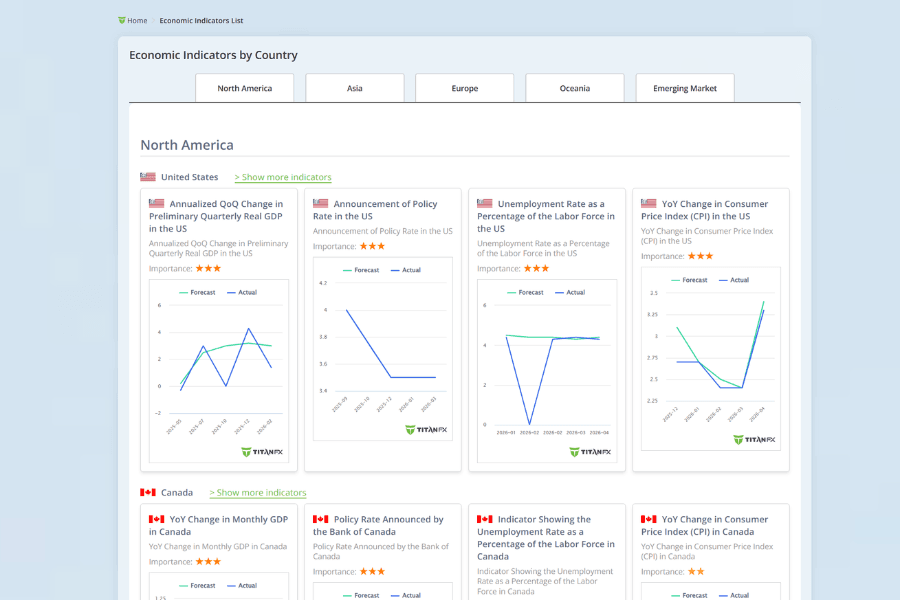
Titan FX's global economic indicators page consolidates data across countries, helping traders understand the macro backdrop behind rating changes.
Tip 3: Use Outlook and Watchlist as Forward Signals
Beyond formal upgrades and downgrades, all three agencies publish Outlook (Positive/Stable/Negative) and Watchlist alerts. A move to Negative Outlook is typically read as a likely future downgrade and the market starts to re-price ahead of the formal change; a shift to Positive often signals a coming upgrade.
These forward-looking signals usually drive early market reactions and are well-suited to planning mid-term trade direction.
Tip 4: Pair with Titan FX Technical Tools
Ratings provide directional context, but entry and risk management still depend on technical analysis.
Trend lines, support and resistance, chart patterns, and multi-timeframe analysis help define entry and stop-loss levels. Titan FX supports a full set of technical indicators, designed to work alongside macro analysis.
Combining the macro backdrop from ratings with technical signals connects "direction" and "timing"—the two halves of a disciplined trading strategy.
6. Limitations and Common Criticisms
The Big Three are widely authoritative in international finance, but their methodologies and influence have been challenged on multiple fronts over the years.
Limitation 1: Ratings Are a Lagging Indicator
Rating changes typically happen after fiscal deterioration or economic weakness has become visible. That makes ratings a trend-confirming lagging signal—market prices often re-price risk before the rating change formalizes it.
Limitation 2: Commercial Structure and Conflict of Interest
Ratings are usually commissioned and paid for by the rated company or government. Critics have long argued this can create a conflict of interest, with ratings becoming either overly conservative or overly optimistic depending on the commercial relationship.
Limitation 3: Models Struggle With Extreme Events
Rating agencies depend on historical data and statistical models, which makes tail risks and regime changes hard to capture. The 2008 financial crisis exposed this clearly—many highly rated structured products turned out to mask significant fragility.
Credit ratings remain an important risk tool, but they work best as macro context rather than as a standalone decision criterion. Combined with market data, fundamental analysis, and technical signals, they help build a more reliable risk-reading framework.
7. FAQ: Credit Ratings and Trading
Q1. If a sovereign is downgraded, does the currency sell off immediately?
The currency does tend to weaken, but the size of the move depends on surprise versus consensus. If the downgrade was already largely priced in, the reaction can be muted; if it is a genuine surprise, the move can be sharp. Outlook changes often see the market start to position before the formal action.
Q2. What if the three agencies disagree on a rating?
Disagreement is common. Markets typically treat the most conservative rating as the working reference. For instance, if S&P and Fitch say AA but Moody's is at Aa3 (the equivalent of AA−), markets often anchor on Aa3. Understanding why the agencies differ (model differences, weighting of metrics) is also part of the read.
Q3. What is a "fallen angel"?
A fallen angel is a bond that has been downgraded from investment grade (BBB−/Baa3) to high-yield (BB+/Ba1 or below). Many institutional mandates only permit investment-grade holdings, so a cascade of fallen-angel downgrades forces large-scale selling, putting strong downward pressure on bond prices and the sovereign currency—a classic risk-off pattern.
Q4. Are corporate ratings linked to sovereign ratings?
Yes, generally. Country ceiling rules tend to cap corporate ratings at the sovereign level, so a sovereign downgrade often pulls domestic corporate ratings down in tandem. This is one of the reasons FX traders pay close attention to sovereign rating moves.
Q5. How should retail investors use rating information in practice?
Three practical use cases. Position sizing: when one side of a currency pair faces downgrade risk, that is a reason to reduce exposure. Country risk awareness: check the sovereign rating and Outlook before allocating to emerging-market currencies. Macro context: tracking rating moves across multiple countries gives a sense of the global risk-cycle direction.
8. Summary: The Core Value of Credit Ratings
The Big Three's credit ratings are not short-term indicators, but their impact on market sentiment, capital flows, and currency trends is substantial. Upgrades and downgrades reflect changes in the underlying economic constitution; Outlook and Watchlist actions act as forward signals for shifts in risk.
For traders, the most useful role of credit ratings is as a macro reference framework—a clearer view of which currencies are likely to be supported on improving risk and which assets are likely to face pressure from downgrades. Combined with Titan FX's economic indicators, real-time pricing, and technical tools, ratings help align strategic direction with entry timing, lifting the consistency and reliability of trading decisions.
Titan FX Economic CalendarFurther Reading
- GDP (Gross Domestic Product): the master gauge of the economy
- Business cycle: the four phases and key indicators
- Monetary policy: central bank tools and market transmission
- Global central banks: governors and policy stances
- Technical analysis: reading charts and indicators
Titan FX Research and Review Team — covering forex (FX), commodities (oil, precious metals, agricultural products), stock indices, US equities, and crypto assets, producing educational content for retail and institutional investors.
Primary Sources by Category
- Official data and regulators: S&P Global Ratings, Moody's Investors Service, and Fitch Ratings official sites; ESMA regulatory framework for credit rating agencies; SEC Office of Credit Ratings.
- Market data and liquidity: Bloomberg Markets, Reuters, Bank for International Settlements (BIS) statistics, IMF Global Financial Stability Report.
- Academic research: Sylla, "A Historical Primer on the Business of Credit Rating"; White, "Markets: The Credit Rating Agencies"; Kiff, Nowak, and Schumacher, IMF Working Papers on Sovereign Ratings.
- Industry and third-party references: Investopedia (Credit Rating Agencies); Council on Foreign Relations briefings; CFA Institute reading materials; Titan FX Research economic indicators calendar.