

Global Central Banks
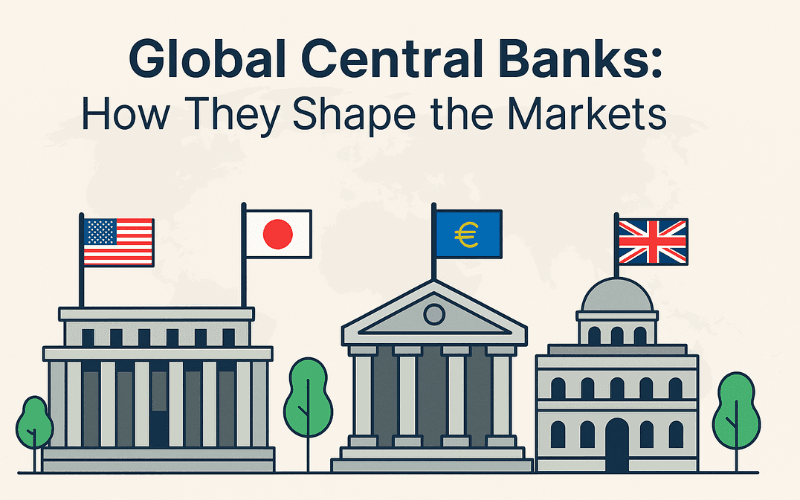
The rhythm of global markets is set by central banks. Whether they raise rates, expand asset purchases, or change a single word in their statement, that move ripples through FX, rates, and commodity prices.
For traders, understanding the role and policy style of each major central bank is groundwork for reading market direction. This article walks through the world's leading central banks, how their policies actually travel into markets, and what a practical workflow looks like for a retail trader.
- Nine major central banks at a glance. Fed, ECB, BOJ, PBOC, BOE, CBC (Taiwan), HKMA, MAS, RBA—one table with governors, policy stance, and trading impact.
- Three transmission channels. Rates → currency, QE → asset prices, policy expectations → front-running.
- Hawkish vs dovish. A quick language map for reading statement tone in real time.
- Pair-level reactions. USD/JPY, EUR/USD, AUD/USD—where central-bank divergence shows up most clearly.
- Trader workflow. Pre-event calendar prep, day-of liquidity awareness, post-event minutes review.
1. Why Central Banks Drive the Market
In global financial markets, central banks are not just policy authorities—they are the engine that drives capital flow. Rate changes, money-supply adjustments, and even subtle revisions to economic projections can each trigger meaningful market moves. For traders, every statement and every decision is potential trading material.
Take the Federal Reserve as the prime example: when the market starts pricing in faster hikes, the dollar index tends to climb, and USD/JPY and EUR/USD respond quickly. Conversely, when the Bank of Japan (BOJ) holds an ultra-accommodative stance, the Japanese yen often becomes the funding currency of choice for carry trades, leading to extended periods of weakness.
Reading central-bank stance is not just an analyst skill. For traders at every level, it is a practical fundamental—the way to feel the market's tempo before placing a position.
2. Major Central Banks and Governors (2025)
Each central bank tailors its monetary policy toolkit and operating style to local conditions and mandates. Below is a snapshot of the world's most influential central banks, their current governors, and their policy character.
| Central Bank | Governor (as of 2025) | Appointed | Policy Stance | Operating Style and Market Impact |
|---|---|---|---|---|
| 🇺🇸 Federal Reserve (Fed) | Jerome Powell | 2018 | Hawkish with dovish edges | The world's most influential central bank. Policy rate and balance sheet are its primary tools; statements and decisions consistently move global volatility. |
| 🇪🇺 European Central Bank (ECB) | Christine Lagarde | 2019 | Slightly dovish | Covers 19 euro-area members. Focuses on inflation and financial stability; uses negative rates and asset purchases when needed. |
| 🇯🇵 Bank of Japan (BOJ) | Kazuo Ueda | 2023 | Accommodative-leaning | Multi-year ultra-easy regime (negative rates, YCC). Exit management is the live story; major influence on the yen and global carry trades. |
| 🇨🇳 People's Bank of China (PBOC) | Pan Gongsheng | 2023 | Stable and neutral | Doubles as a regulator. Uses reverse repos and MLF for fine-grained liquidity management; ripples into Asian markets and commodity prices. |
| 🇬🇧 Bank of England (BOE) | Andrew Bailey | 2020 | Slightly hawkish | Focused on inflation control and pound stability; adjusts rates flexibly with data and directly drives GBP/USD. |
| 🇹🇼 Central Bank of Taiwan (CBC) | Yang Chin-long | 2018 | Conservative and stable | Supports an export-led economy through FX-rate stability; intervenes in rates or FX when needed. |
| 🇭🇰 Hong Kong Monetary Authority (HKMA) | Eddie Yue | 2019 | Tracks the Fed | Linked Exchange Rate Regime pegs HKD to 7.75–7.85 USD; rates effectively shadow the Fed. |
| 🇸🇬 Monetary Authority of Singapore (MAS) | Lawrence Wong (MAS chair, succeeding Ravi Menon's framework) | — | Technical and neutral | Uses an exchange-rate-centric framework with S$NEER band adjustments as the main tool. Strong control over the Singapore dollar. |
| 🇦🇺 Reserve Bank of Australia (RBA) | Michele Bullock | 2023 | Cautious, slightly hawkish | Dual mandate on inflation and employment; sensitive to commodity prices and the Chinese yuan. |
Further reading:
- BOJ Monetary Policy Meeting—mechanics and schedule
- RBA—operations and policy tools
- RBNZ—operations and policy tools
3. How Central-Bank Policy Travels Into Trading Markets
Central-bank decisions ripple deeply into global markets—especially FX, precious metals, equity indices, and commodities. A shift in statement tone alone is often enough to reverse a trend.
Rate Policy and Currency Moves
When a central bank hikes, capital tends to rotate toward that country's currency, pushing it higher.
For example, the Fed's aggressive hiking cycle starting in 2022 pushed the dollar index to a 20-year high, lifted USD/JPY decisively, and pressured emerging-market currencies.
In the opposite direction, when the BOJ holds rates near zero, the yen acts as the funding currency for carry trades, and longer stretches of yen weakness tend to follow.
Easing and Asset Prices
When a central bank deploys quantitative easing (QE) or cuts rates, liquidity expands and risk assets—equities, commodities, EM assets—tend to attract flows.
The impact shows up most clearly in gold, crude oil, and stock-index CFDs. When the ECB or PBOC signals easing, risk appetite usually returns and related assets test the upside.
Policy Expectations and Trade Timing
What the market is pricing for the next policy move often matters more than the current stance. This is a recurring pattern in FX.
Traders monitor minutes, governor and member speeches, and inflation and employment prints continuously to update their view on the policy path.
When the RBA's chances of an earlier hike start being priced in, AUD/USD tends to rally before the decision—the textbook "buy the rumor, sell the fact" cycle plays out around central-bank events.
4. FAQ: Central Banks and Trading
Q1. Where can I track rate decisions and economic data from major central banks?
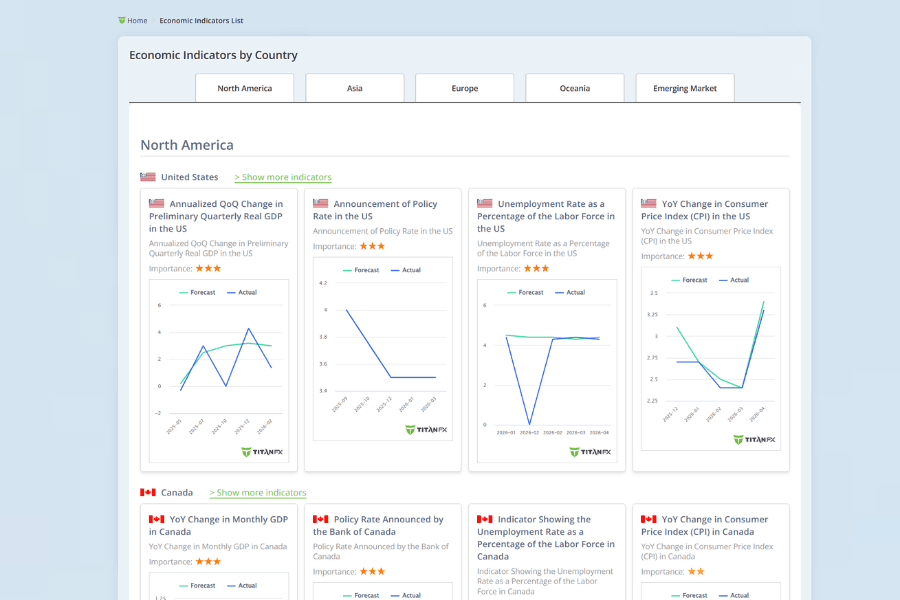
Use the Titan FX economic indicators calendar to follow central-bank meetings, employment reports, inflation prints, and other key releases in one place. It is a practical tool to map risks and opportunities ahead of time—bookmark it as a first step.
Q2. How do central-bank hikes and cuts affect the FX market?
Rate hikes attract capital chasing the rate differential and tend to push the currency higher; cuts work in the opposite direction. In practice, what matters most is the surprise vs consensus: knowing the pre-meeting expectation and watching how the decision deviates from it is the difference between trading the move and being trapped by the volatility spike.
Q3. Which central banks should beginners focus on first?
Start with the Fed (US), ECB (euro area), BOJ (Japan), and PBOC (China). Those four cover the world's biggest reserve currencies (USD, EUR, JPY, CNY). With more experience, layer in the BOE, RBA, and RBNZ to expand your read on cross-yen and cross-euro pairs.
Q4. What are "hawkish" and "dovish," and how do you read statement tone?
"Hawkish" and "dovish" are the standard jargon used to read central-bank stance. Hawkish means tilted toward tighter policy (rate hikes, inflation control); dovish means leaning toward easier policy (cuts, stimulus).
| Stance | Meaning | Typical wording | Market reaction |
|---|---|---|---|
| Hawkish | Tilt toward hikes; inflation focus | "Inflation risks remain elevated", "We stand ready to act" | Currency stronger, bonds lower |
| Dovish | Tilt toward easing; growth focus | "We will remain patient", "More data needed" | Currency weaker, equities supported |
Q5. What does a practical trader workflow around central-bank events look like?
A three-step routine keeps decisions data-driven instead of emotional. Pre-event: confirm meeting dates and market consensus on the economic indicators calendar; map your existing exposure to the likely reaction. Day of: avoid heavy position changes five to ten minutes before release; the first five to fifteen minutes after release tend to feature thin liquidity and outsized spreads. Post-event: read the minutes, summary of opinions, and governor press conference to update expectations for the next meeting.
5. Summary
Central banks set the tempo of global markets. FX, rates, and asset prices all respond directly to policy shifts. For traders, understanding how each major central bank operates and where its stance currently sits adds real value to strategy design and risk management.
Following the news flow and the data continuously sharpens market sense and increases the chance of catching opportunities cleanly.
Titan FX Economic CalendarFurther Reading
- Federal Reserve—mandate, tools, and policy transmission
- BOJ Monetary Policy Meeting—mechanics and schedule
- RBA—operations and policy tools
- RBNZ—operations and policy tools
- Quantitative Easing (QE): liquidity injection and market transmission
Titan FX Research and Review Team — covering forex (FX), commodities (oil, precious metals, agricultural products), stock indices, US equities, and crypto assets, producing educational content for retail and institutional investors.
Primary Sources by Category
- Official data and regulators: Federal Reserve, European Central Bank, Bank of Japan, People's Bank of China, Bank of England, Central Bank of the Republic of China (Taiwan), Hong Kong Monetary Authority, Monetary Authority of Singapore, and Reserve Bank of Australia official sites.
- Market data and liquidity: Bloomberg Markets, Reuters, Bank for International Settlements (BIS) Triennial Central Bank Survey, World Federation of Exchanges (WFE).
- Academic research: Ben S. Bernanke et al., "Monetary Policy in a Low Inflation Era"; Takatoshi Ito, "The Japanese Economy"; Marvin Goodfriend, "How the World Achieved Consensus on Monetary Policy".
- Industry and third-party references: Investopedia (Central Bank), IMF Working Papers, Council on Foreign Relations Central Banking Reports, Titan FX Research economic calendar.