

Dovish
In financial markets, "dovish" appears constantly in central bank policy discussions, news coverage, and investment analysis. It refers to a preference for monetary easing -- prioritizing economic growth and employment even if it means tolerating somewhat higher inflation.
Understanding dovish vs hawkish positions is essential for decoding central bank decisions and grasping the forces behind market movements.
This article covers what "dovish" means in the financial system: definition, origins, policy tools, market impact, and the hawk-dove distribution within major central banks.
What You Will Learn
- The definition of "dovish" and what it means in monetary policy
- How dovish and hawkish stances form a monetary policy spectrum
- The hawk vs dove distribution within the FOMC, ECB, BOE, and BOJ as of August 2025
- How dovish policy affects forex, equities, bonds, and commodities
- Practical techniques for identifying "dovish shifts" and "dovish pivots" in real time
- 1. What Is Dovish? Definition and Meaning in Monetary Policy
- 2. Dovish vs Hawkish: The Monetary Policy Spectrum
- 3. Dovish Impact on Financial Markets
- 4. Central Bank Hawk vs Dove Distribution (as of August 2025)
- 5. Investment Strategy in a Dovish Environment
- 6. How to Identify "Dovish Shifts": Documents, Data, and Signals
- 7. FAQ
- 8. Summary
1. What Is Dovish? Definition and Meaning in Monetary Policy
Definition of Dovish in Finance
In finance and monetary policy, "dovish" (also Dove or Doves) refers to a policy stance that leans toward monetary easing.
This stance prioritizes supporting economic growth and employment. Even if inflation runs somewhat above target, dovish policymakers favor rate cuts, maintaining low interest rates, or expanding the money supply to stimulate the economy.
In contrast to the hawkish approach -- which prioritizes suppressing inflation -- the dovish position places greater emphasis on the vitality of economic activity and financial market stability.
Origin and Symbolism
The term "dovish" originally comes from political discourse, where the dove symbolizes peace and moderation. In financial markets, it has evolved to describe policymakers or viewpoints that are more sensitive to downside economic risks and advocate for policy easing to avoid recession.
The dove as a symbol of peace also implies a preference for "avoiding a hard landing" and "relieving market stress."
Key Dovish Policy Tools
| Policy Tool | Description |
|---|---|
| Rate cuts | Lowering the benchmark interest rate to reduce borrowing costs and stimulate investment and consumption. |
| Quantitative easing (QE) | The central bank purchases government bonds or other assets to inject liquidity directly into the market. |
| Slowing balance-sheet reduction (QT) | Reducing the pace of fund withdrawal to keep market liquidity ample. |
| Dovish forward guidance | Signaling that rates will stay low or that the central bank will remain patient, shaping market expectations. |
2. Dovish vs Hawkish: The Monetary Policy Spectrum
Three Policy Stances
Central bank decision-making generally involves three policy orientations:
- Dovish: Emphasizes employment and economic growth, tolerates higher inflation, and leans toward easing.
- Hawkish: Prioritizes inflation control, even at the cost of some growth, and leans toward tightening.
- Centrist (Owl): Does not lean clearly toward either hawks or doves; adjusts flexibly based on incoming data.
Hawk vs Dove vs Owl: Comparison Table
| Dimension | Dovish | Centrist (Owl) | Hawkish |
|---|---|---|---|
| Policy direction | Rate cuts, QE, slower QT, dovish forward guidance | Data-dependent, flexible | Rate hikes, QT, balance-sheet reduction, hawkish guidance |
| Priority | Sustain economic growth and employment | Balance inflation, employment, and financial stability | Suppress inflation, maintain price stability |
| Tone | Patient, wait-and-see, gradual | Flexible, neutral | Decisive, forceful, direct |
| Typical market impact | Equities and long-duration bonds benefit; currency tends to weaken | Varies with the business cycle | Cash and short-term bonds benefit; growth stocks under pressure; currency tends to strengthen |
Summary
Hawkish and dovish are not fixed labels but stances that shift dynamically with economic data, inflation trends, and labor market conditions.
For investors, understanding this spectrum helps decode changes in central bank tone more quickly and anticipate the implications for equities, forex, and bond markets.
3. Dovish Impact on Financial Markets
What Dovish Means for Markets
In a market context, "dovish" represents a policy orientation that prioritizes growth and employment. The central bank tolerates higher inflation to prevent recession or financial disorder.
A dovish shift signals to participants that funding costs may decline and risk assets may benefit, directly influencing investment strategy and asset allocation.
Dovish Impact Summary Table
| Market | Potential Dovish Impact |
|---|---|
| Forex | The domestic currency weakens as the interest-rate differential narrows; export competitiveness improves, but imported inflation risk rises |
| Equities | Valuation multiples expand; growth stocks and long-duration sectors benefit; financial-sector net interest margins compress |
| Bonds | Long-bond prices rise and yields fall; credit spreads tighten; high-yield and emerging-market debt attract inflows |
| Commodities | A weaker dollar supports gold and crude oil; industrial metals and agricultural demand may recover |
Forex: Domestic Currency Weakens, Exports Benefit
Dovish policy compresses the domestic-foreign interest-rate differential via rate cuts, QE, or forward guidance, reducing the appeal of the home currency.
- Capital flows: Investors move funds to higher-yielding markets, weakening the exchange rate.
- Exports: A weaker currency gives exporters a price advantage and boosts competitiveness.
- Import pressure: Import costs rise, introducing imported-inflation risk.
- Carry trades: Shorting the low-rate currency and going long a high-rate currency accelerates depreciation.
- Example: In 2015, the BOJ's ultra-low rates and QQE weakened the yen significantly, broadly benefiting export-oriented auto and electronics firms.
Equities: Valuation Expansion and Growth-Stock Tailwinds
Falling interest rates lower the discount rate and lift equity valuations across the board.
- Growth stocks: Tech, healthcare innovation, and semiconductors are the most rate-sensitive and see the largest valuation expansion.
- Defensive sectors: Consumer staples and utilities attract allocation as their dividend yields become relatively more attractive.
- Financial-sector pressure: Banks and insurers rely on rate spreads; low rates compress margins and lead to underperformance.
- Investor behavior: Risk appetite rises, driving capital into high-beta and startup-related stocks.
- Example: After the 2020 pandemic, the Fed cut rates to near zero and launched QE. FAANG stocks rebounded powerfully within months, hitting new all-time highs.
Bonds: Long-Duration Tailwinds and Credit-Spread Compression
Dovish policy injects liquidity and boosts bond demand, especially at the long end.
- Long-term government bonds: Falling rates push long-bond prices higher -- the classic dovish beneficiary. Asset managers extend duration.
- Short-term bonds: Limited room for yield declines means smaller gains, though the safe-haven quality persists.
- Credit bonds: Ample liquidity and rising risk appetite compress credit spreads; high-yield and EM debt attract inflows.
- Yield curve: Long-end rates fall, flattening or inverting the curve and reflecting concerns about growth.
- Risk warning: Prolonged easing can lead to excessive yield-chasing. A hawkish pivot may then trigger sharp credit-market corrections.
- Example: Post-2008, the Fed's large-scale QE pushed Treasury prices higher and rapidly improved EM bond issuance conditions.
Commodities: Weaker Dollar Supports Gold and Crude Oil
Dovish policy tends to weaken the US dollar, supporting dollar-denominated commodities.
- Gold: Lower holding costs in a low-rate, weak-dollar environment lift gold demand as an inflation hedge.
- Crude oil and industrial metals: If easing stimulates recovery, energy demand rises, pushing oil and metals (copper, aluminum, steel) higher.
- Agricultural commodities: A weaker dollar boosts non-dollar purchasing power, raising import demand for corn, soybeans, and wheat.
- Investor allocation: In dovish cycles, commodities serve as inflation hedges and diversifiers, attracting notable inflows.
- Example: After the Fed's 2020 QE, the dollar index fell, gold broke $2,000/oz, and crude oil rebounded sharply from lows.
4. Central Bank Hawk vs Dove Distribution (as of August 2025)
The following tables summarize the hawk-dove distribution within major central banks, based on public statements and stances around August 2025. These classifications reflect observations at that time and may shift as economic conditions and policy evolve.
US Federal Reserve (FRB / FOMC)
The FOMC (Federal Open Market Committee) is the body that sets US monetary policy. It consists of:
- 7 FRB Governors
- 5 regional Federal Reserve Bank Presidents (on a voting rotation)
| Stance | Members |
|---|---|
| Hawkish | Michelle Bowman (FRB Governor), Alberto Musalem (St. Louis Fed President), Jeffrey Schmid (Kansas City Fed President) |
| Centrist | Jerome Powell (FRB Chair), Michael Barr (FRB Governor), Christopher Waller (FRB Governor), John Williams (New York Fed President), Susan Collins (Boston Fed President) |
| Dovish | Philip Jefferson (FRB Vice Chair), Lisa Cook (FRB Governor), Adriana Kugler (FRB Governor), Austan Goolsbee (Chicago Fed President) |
European Central Bank (ECB)
ECB policy is determined by the Governing Council, which consists of:
- 6 ECB Executive Board members
- Central bank governors of the 19 euro area member states
| Stance | Members |
|---|---|
| Hawkish | Klaas Knot (Dutch central bank governor), Robert Holzmann (Austrian central bank governor), Peter Kazimir (Slovak central bank governor), Joachim Nagel (Bundesbank president), Isabel Schnabel (ECB Executive Board member) |
| Dovish | Philip Lane (ECB Executive Board member), Piero Cipollone (ECB Executive Board member), Fabio Panetta (Bank of Italy governor) |
Bank of England (BOE)
The BOE's monetary policy is set by the Monetary Policy Committee (MPC), which has 9 members (including the Governor and Deputy Governors) and meets eight times per year.
| Stance | Members |
|---|---|
| Hawkish | Megan Greene (MPC member), Catherine Mann (MPC member) |
| Dovish | Swati Dhingra (MPC member), Dave Ramsden (MPC member) |
Bank of Japan (BOJ)
The BOJ's monetary policy is set by the Policy Board, which consists of:
- 1 Governor
- 2 Deputy Governors
- 6 Board members
| Stance | Members |
|---|---|
| Hawkish | Naoki Tamura (Board member) |
| Leaning hawkish | Hajime Takata (Board member), Junko Koeda (Board member) |
| Centrist | Kazuo Ueda (Governor), Shinichi Uchida (Deputy Governor), Ryozo Himino (Deputy Governor), Junko Nakagawa (Board member) |
| Dovish | Toyoaki Nakamura (Board member), Asahi Noguchi (Board member) |
5. Investment Strategy in a Dovish Environment
Strategy Framework
To translate dovish signals into actionable investment decisions, systematically monitor three categories of information:
- Documents: Policy decision statements, meeting minutes
- Charts and data: Dot plots, projected rate paths
- People: Voting members and senior officials -- track their tone
Asset Allocation Guidelines
| Asset Class | Strategic Focus |
|---|---|
| Forex | Go long risk currencies against currencies of relatively more dovish central banks |
| Equities | Increase growth-oriented exposure |
| Bonds | Extend duration; allocate to investment-grade credit |
| Commodities | Tailwind for raw materials, but confirm demand-side signals |
6. How to Identify "Dovish Shifts": Documents, Data, and Signals
Central banks never announce outright that "we have turned dovish." Investors must read signals across four layers: documents, data, operations, and officials' remarks.
Reading Documents: Wording Is the Most Intuitive Signal
The language used in policy statements and meeting minutes reveals stance changes most clearly.
- Dovish language: Risks tilted to the downside, labor market cooling, progress on inflation returning to target, patience warranted, data-dependent approach.
- Hawkish language (for contrast): Inflation remains entrenched, prolonged tightening is needed, financial conditions are too loose.
- Reading tip: Compare with the previous statement. If the tone has softened or forceful language has been removed, that constitutes a "dovish lean."
Charts and Data: Quantified Policy Expectations
Central bank dot plots and economic projections quantify the policy stance.
- Dovish signals:
- The dot plot shows fewer projected rate hikes (weakened tightening expectations).
- The estimated terminal rate is revised lower.
- Unemployment forecasts are revised higher (increased concern about labor market softening).
- Market reaction: When the dot plot shows fewer hikes than the market has priced in, the dollar typically weakens and long bonds rally.
Operational Changes: Actions Precede Words
Adjustments to the central bank's balance sheet and liquidity management are often the earliest dovish signals.
- Dovish operations: Slowing balance-sheet reduction (QT), expanding reinvestment, postponing or canceling reduction plans.
- Interpretation: If open-market operation data shows an increase in fund supply -- even before statements have changed -- this can be viewed as a harbinger of a dovish policy shift.
Officials' Remarks: Not All Voices Carry Equal Weight
Public comments by central bank officials provide important supplementary signals.
- Dovish phrasing: More patience is needed, we need to see more evidence, financial risks are tilted downward.
- Influence hierarchy: Comments from voting members carry significantly more market impact than those from non-voting participants.
- Key observation: When a previously hawkish official softens their tone, it is typically a major "dovish pivot" signal that markets watch closely.
7. FAQ
Q1: Why does the market sometimes react inconsistently to dovish signals?
Market reactions depend on the "expectations gap." If the market has already fully priced in a dovish stance, additional signals will have limited impact. Conversely, if the market was positioned for hawkishness and a dovish remark appears unexpectedly, asset price swings tend to be much larger.
Q2: How can you distinguish a genuine dovish pivot from a temporary softening of tone?
You need to examine multiple layers: statement wording, dot-plot data, actual operations, and officials' remarks. A single official making dovish comments does not necessarily signal a policy shift. When multiple signals appear simultaneously, the probability of a genuine "dovish pivot" is substantially higher.
Q3: What is the most important dovish-policy impact for bond investors?
Dovish policy typically pushes long-term rates lower and lifts long-bond prices -- a clear positive for holders of long-duration bonds. However, if easing persists too long and bubbles accumulate, the risk of a steep long-bond sell-off when policy eventually turns hawkish also grows.
Q4: What is the relationship between dovish policy and inflation?
A dovish stance implies higher tolerance for inflation, prioritizing growth and employment. If easing goes too far, it can sow the seeds for future inflation, ultimately forcing the central bank to pivot back to a hawkish stance.
Q5: How can investors quickly track dovish signals?
The following sources are effective:
- Meeting minutes and press releases on central bank official websites.
- Dot-plot and economic-projection updates.
- Officials' public speeches and media interviews.
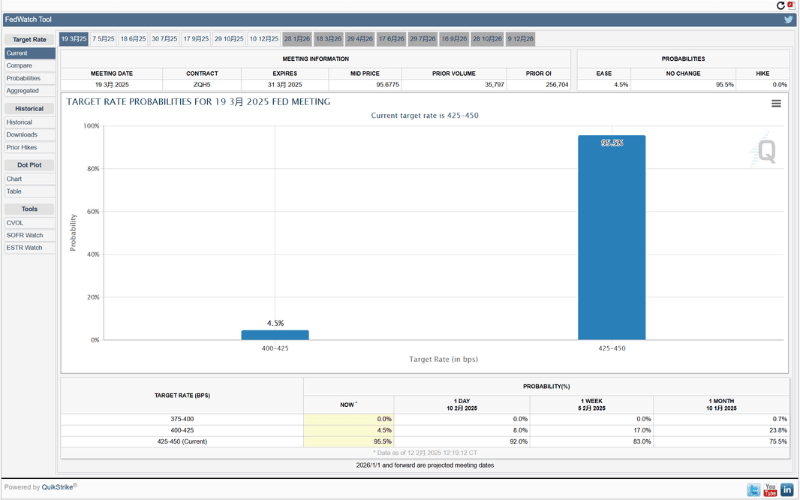
- Rate futures and the CME FedWatch tool, which shows market expectations for rate changes.
Tool: Use the CME FedWatch tool to track the market's probability expectations for Fed rate hikes and cuts in real time.
8. Summary
Dovish is one end of the monetary policy spectrum, and its meaning extends beyond "rate cuts" or "easing." It reflects the value priorities a central bank adopts when facing economic challenges: protecting growth and employment first, while deferring inflation suppression to some degree.
In practice, dovish policy transmits effects through interest rates, liquidity, capital costs, and market expectations, creating chain reactions across forex, equities, bonds, and commodities. It supports markets during crises but can foster asset bubbles and financial imbalances over time.
Understanding what dovish means is therefore a vital lens for observing global financial cycles, cross-market capital flows, and economic resilience. The dynamic balance between doves and hawks shapes the core framework of modern monetary policy.
Further Reading
- What Is FOMC? Understanding the US Monetary Policy Decision Process
- FX Basics
- What Is Hawkish? Central Bank Hawks Explained
The Titan FX financial markets research and analysis team. We produce investor-focused educational content covering a wide range of financial instruments, including foreign exchange (FX), commodities (crude oil, precious metals, agricultural products), stock indices, US equities, and cryptocurrencies.
Primary Sources (by category)
- Central bank official materials: Federal Reserve (FOMC statements, minutes, and dot plot), ECB (monetary policy decisions), BOE (MPC decisions), BOJ (monetary policy meetings)
- Market data and analysis tools: CME Group (FedWatch Tool)
- Educational resources: Titan FX Research (FOMC explainer, gold CFD, crude oil CFD)