

Hawks
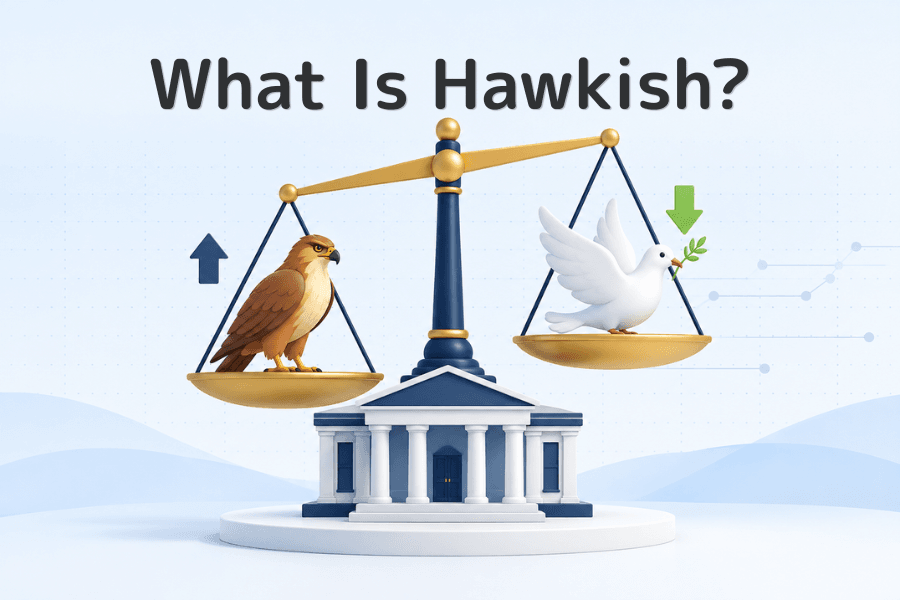
A hawk (adjective: hawkish) is a central bank official or policy stance that gives more weight to inflation risk and leans toward tightening measures such as rate hikes and balance-sheet reduction. The opposite, a dove (dovish), gives more weight to growth and employment risk and leans toward easier policy. Hawkish and dovish describe not only people but also statements, press conferences and whole meetings, as in "the decision was more hawkish than the market expected."
For financial markets, whether rates went up is only the first layer of information. What actually moves currencies, stocks, bonds and gold is usually the gap between what the central bank decided and what the market had priced in beforehand. That is why a rate cut can be read as a "hawkish cut," and a rate hike can turn into a "dovish hike" when it signals that tightening is nearly over.
This article covers the definition and origin of the term, the difference between hawks and doves, how hawkish signals affect the US dollar, stocks, bonds and gold, five things to check when judging how hawkish a meeting was, where the major central banks stood in September 2026 and what their internal votes showed, and three risks to watch before trading a central bank event.
- Hawks give more weight to inflation risk and tend to support higher rates and tighter policy; doves give more weight to growth and jobs and lean toward easing
- Hawkish signals can support the home currency, lift short-term yields and pressure the valuations of stocks and gold, but the actual reaction depends on how much the market had already priced in
- Judging a meeting takes more than the hike-or-cut headline: compare the vote, the wording of the statement, the projections and the press conference with what markets expected going in
- Both "hawkish cuts" and "dovish hikes" happen; what matters is whether the overall policy path is tighter or looser than the market had expected
- Officials' stances shift with inflation, jobs and the economy; the Fed's move from a 9–3 hold in July 2026 to a 12–0 hike in September is an example of internal signals leading the action
- When trading central bank events, look beyond rate differentials to swap points, spreads, liquidity and the fast price moves right after the release
- 1. What Does Hawkish Mean? Central Bank Hawks Explained
- 2. Hawks vs. Doves: Policy Direction and the Stance Spectrum
- 3. How Hawkish Policy Affects the US Dollar, Stocks, Bonds and Gold
- 4. How to Tell Whether a Central Bank Has Turned Hawkish: 5 Things to Check
- 5. Where the Major Central Banks Stand: September 2026 Decisions and Internal Signals
- 6. Analyzing a Hawkish Turn: 3 Risks to Watch Before You Trade
- 7. Hawkish Policy FAQ
- 8. Summary: A Hike or a Cut Alone Does Not Make a Central Bank Hawkish
1. What Does Hawkish Mean? Central Bank Hawks Explained
Hawkish describes the tightening end of the monetary policy spectrum. Officials with this stance believe that high inflation erodes purchasing power and distorts expectations, and that it deserves priority over a short-term slowdown in growth. They therefore tend to act early when inflation risks are tilted to the upside, and they are more willing to accept a cooling economy as the price.
"Hawk" and "dove" started as political terms for the hard-line and the conciliatory camps; the financial press borrowed the pair to describe how central bankers treat inflation. In English the adjectives hawkish and dovish are more common than the nouns, and they describe not only a person but also the overall impression a statement, a press conference or a single decision leaves on the market.
In practice, hawks show three typical traits:
-
A preference for tightening tools: support for rate hikes, balance-sheet reduction and quantitative tightening (QT).
-
Inflation risk weighed more heavily than growth risk: a softening labor market does not easily push them toward easing.
-
A bias toward pre-emptive action: they move when inflation expectations start to rise rather than waiting for the data to fully confirm it.
Example: Two Hawkish Episodes at the Fed
The textbook case is the Federal Reserve's hiking cycle from March 2022 to July 2023. Facing the highest inflation in four decades, the Fed raised rates 11 consecutive times, taking the federal funds rate from 0–0.25% to 5.25–5.50%, including four 0.75-point hikes in 2022 alone.
The more recent case is 2026. After three cuts between September and December 2025, the Fed held rates at its first five meetings of 2026. At the July 29 meeting it kept the range at 3.50–3.75%, but three regional Fed presidents dissented in favor of a quarter-point hike. On September 16 the committee voted 12–0 to raise the range by a quarter point to 3.75–4.00%, the first hike since July 2023.
2. Hawks vs. Doves: Policy Direction and the Stance Spectrum
Doves (dovish) sit at the other end of the spectrum. They see downside risks to employment and growth as more pressing than inflation and support rate cuts, quantitative easing (QE) and low rates, a stance common in recessions and early recoveries. After the pandemic hit in 2020, the Fed cut rates to near zero, and the Fed, the ECB and the BoJ all expanded asset purchases, a collective dovish turn.
The same person's stance changes with conditions. Fed officials were almost uniformly dovish in 2020, turned hawkish as a group in 2022, cut rates repeatedly from September 2024, and hiked again in September 2026. Hawkish and dovish describe an attitude at a point in time; read the latest votes and speeches, and treat old labels as background only.
The Middle of the Spectrum: Neutral, Data-Dependent
Between the hawks and the doves lies a continuum, and most officials, and most central bank statements, sit in the middle: no preset direction, decisions made meeting by meeting on the latest data. The European Central Bank's September 2026 statement, with its "data-dependent and meeting-by-meeting approach" and its refusal to "pre-commit to a particular rate path," is the standard form of this neutral language.
Markets sometimes call this stance an "owl." The term traces back to ECB President Christine Lagarde's first press conference in December 2019, when she said she was neither a dove nor a hawk and hoped to be an owl, associated with wisdom. It is far less common than hawkish and dovish, and in practice "neutral" or "data-dependent" is clearer.
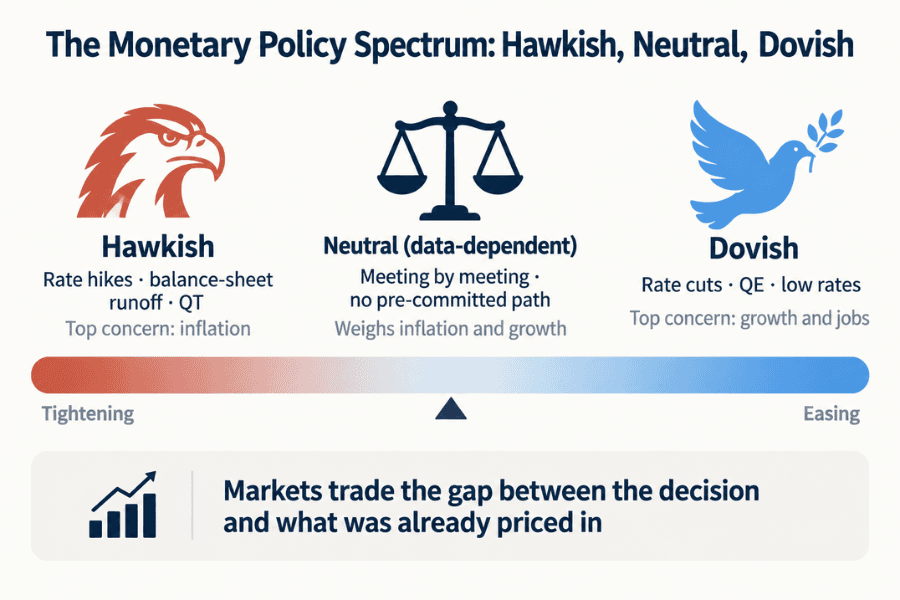
| Item | Hawkish | Neutral (data-dependent) | Dovish |
|---|---|---|---|
| Policy direction | Tightening: hikes, balance-sheet runoff, QT | No preset direction | Easing: cuts, QE, low rates |
| Top concern | Inflation | Both weighed equally | Growth and jobs |
| Typical wording | "Risks to inflation are to the upside," "further tightening is needed" | "Meeting by meeting," "no pre-committed path" | "Downside risks have increased," "policy has room to adjust" |
| How markets read it | Tighter than expected | Depends on data and expectations | Looser than expected |
3. How Hawkish Policy Affects the US Dollar, Stocks, Bonds and Gold
A hawkish signal first changes the market's expectations for future rates, and those expectations then flow through to four asset classes. The channels follow recognizable patterns, but prices reflect part of the expectation before the decision is announced, so what actually moves the market is the gap between the decision and what was priced in. Each asset below is covered in three lines: the typical reaction, the reason, and the exceptions.
The US Dollar and Forex
-
Typical reaction: the currency of the central bank that turns hawkish gets support. When the Fed leans hawkish the US dollar usually strengthens, EUR/USD comes under pressure and USD/JPY rises; when the ECB or the BoJ is the one turning hawkish, the euro or the yen becomes the relatively strong side.
-
Reason: a policy path that is more hawkish than expected widens the expected rate differential against other currencies, and money flows toward the higher-yielding side. Rate differentials are also the basis of the carry trade.
-
Exceptions: if the other currency's central bank is turning hawkish at the same time, or the market has already priced the move, the home currency does not necessarily rise.
Stocks
-
Typical reaction: richly valued growth stocks come under pressure and sectors rotate; volatility is usually highest early in a hiking cycle, while the market is still repricing where rates will peak.
-
Reason: tightening raises corporate borrowing costs and the rate at which future earnings are discounted.
-
Exceptions: which sectors hold up better also depends on earnings, the business cycle and the shape of the yield curve; financials do not automatically benefit from higher rates.
Bonds
-
Typical reaction: short-term government bond yields such as the 2-year rise, and the prices of existing bonds fall.
-
Reason: short-term yields track policy rate expectations directly; for the same change in yield, bonds with longer duration are more price-sensitive.
-
Exceptions: the long end, 10 years and beyond, also reflects growth, inflation expectations and the term premium, so it does not always rise in step. The US Treasury yield is a real-time gauge of how the market is digesting a hawkish signal.
Gold and Commodities
-
Typical reaction: gold comes under pressure, and dollar-priced commodities such as crude oil feel the stronger dollar.
-
Reason: gold pays no interest, so a higher real interest rate raises the opportunity cost of holding it; a stronger dollar makes dollar-priced commodities more expensive for buyers outside the US.
-
Exceptions: safe-haven demand, central bank buying and geopolitical risk can offset that pressure. When the reason for the hike is energy-driven inflation, commodity prices and rates can rise together; the ECB's 2026 statements cite the conflict in the Middle East as a source of inflation pressure.
| Asset | Typical reaction when more hawkish than expected | What else to watch |
|---|---|---|
| US dollar and forex | The hawkish central bank's currency gets support | Rate differentials, positioning shown by the Currency Strength Meter |
| Stocks | Growth-stock valuations under pressure, sector rotation | Growth vs. defensive performance, the yield curve |
| Bonds | Short-term yields up, prices down | 2-year and 10-year yields |
| Gold and commodities | Gold under pressure; dollar-priced commodities follow the dollar | Real rates, the US Dollar Index, safe-haven demand |
4. How to Tell Whether a Central Bank Has Turned Hawkish: 5 Things to Check
Every central bank decision comes with a fixed set of material: the statement, the vote, economic projections at some banks, and a press conference. To judge whether a meeting was more hawkish or more dovish than the last one, work through the following five points in order; the last one is the benchmark for the other four.
1. The Decision: Direction and Size
A hike, a hold or a cut, and whether the move is a quarter point or more. This is the most direct signal, but it is also the part the market prices earliest, so the reaction on the day often hinges on the four points below.
2. The Vote and the Direction of the Dissents
Most central banks publish the vote, and what the dissenters wanted matters more than the count. The Fed held at 9–3 in July 2026 with all three dissents calling for a hike, and two months later the committee hiked; at the Bank of England (BoE), dissents in favor of a hike grew from one in April 2026 to three in July. The direction of the dissents shows whether the committee's internal balance is shifting, though it does not turn into action every time.
3. Changes in the Statement's Wording
Compare the statement with the previous one line by line. Common phrases fall roughly into three groups:
-
Hawkish: "inflation remains too high," "will take the necessary action"
-
Neutral: "monitoring the data," "risks are broadly balanced"
-
Dovish: "downside risks have increased," "policy has room to adjust"
The Fed's September 2026 statement closed with "The Committee will deliver price stability," an unusually direct line for a statement. Additions to or deletions from the forward guidance are also the part markets react to most.
4. Economic Projections and the Dot Plot
The Fed publishes a Summary of Economic Projections (SEP) and a dot plot every quarter. The September 2026 median put the year-end rate at 4.1%, 16 of the 18 participants placed their dots at levels implying at least one more hike, and the 2026 PCE inflation projection was 3.7%. The ECB updates its projections in March, June, September and December, and in September it put 2026 inflation at 3.0%. Upward revisions to the forecasts or a higher rate path are hawkish signals.
5. The Press Conference and What Markets Priced In Beforehand
How the chair or governor answers questions about the next move often moves prices more than the statement does. All of the signals above have to be compared with what the market had priced in before the meeting: CME Group's FedWatch tool converts fed funds futures into the probability of a hike or a cut at each meeting, and the higher the probability going in, the smaller the surprise in the decision itself.
A hike is not necessarily more hawkish than expected, and a cut is not necessarily more dovish. In December 2024 the Fed cut by a quarter point, but the dot plot cut the expected number of 2025 cuts from four to two and the dollar rose on the day: a "hawkish cut." In September 2023 the ECB hiked to 4.00% while signaling that rates had reached a level sufficient to bring inflation down, and the euro fell: a "dovish hike."
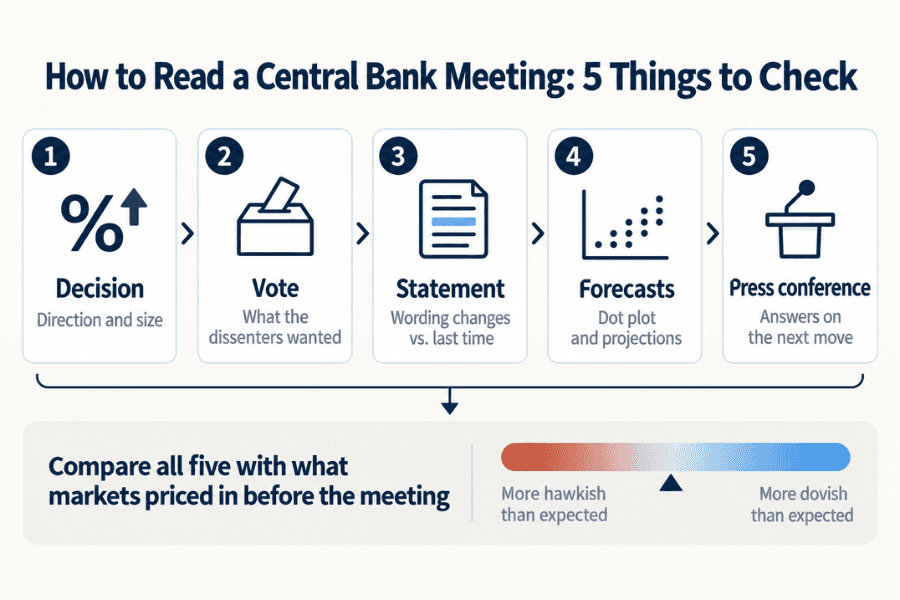
| Actual outcome | Market expectation | Likely reading |
|---|---|---|
| 25 bp hike | 25 bp hike | Broadly as expected; look at the statement and press conference |
| 25 bp hike | Hold | Clear hawkish surprise |
| Hold | Cut | Relatively hawkish |
| 25 bp cut | 50 bp cut | Relatively hawkish |
| 25 bp cut with a hint of a pause | Consecutive cuts | Possibly a "hawkish cut" |
5. Where the Major Central Banks Stand: September 2026 Decisions and Internal Signals
The table below summarizes the latest decisions of six major central banks as of September 18, 2026, followed by the internal signals that can be read from the published 2026 votes at the Fed, the BoE and the BoJ. It is a snapshot: terms and stances change, so check each bank's latest minutes before acting on it. The roles and structures of the six banks are covered in Global Central Banks.
| Central bank | Policy rate | Latest action | Latest vote | Next meeting |
|---|---|---|---|---|
| Federal Reserve (Fed) | 3.75–4.00% | 25 bp hike on September 16, 2026 | 12–0 | October 27–28 |
| European Central Bank (ECB) | Deposit facility rate 2.50% | 25 bp hike on September 10, 2026 (also hiked in June) | Votes not published | October 28–29 |
| Bank of England (BoE) | 3.75% | Hold on September 17, 2026 (also held in July) | 6–3 (three votes for a hike) | November 5 |
| Bank of Japan (BoJ) | 1.25% | Quarter-point hike on September 18, 2026 (also hiked in June) | 7–2 (two votes for a hold) | October 29–30 |
| Reserve Bank of Australia (RBA) | 4.35% | Hike on May 5, 2026 (third of the year); hold on August 11 | Unanimous | September 28–29 |
| Reserve Bank of New Zealand (RBNZ) | 2.75% | 25 bp hike on September 2, 2026 (also hiked in July) | — | October 28 |
The classification of internal signals uses only each member's most recent voting record:
-
Hawkish signal: dissented in favor of a hike
-
Dovish signal: dissented in favor of a cut, or voted against a hike
-
Voted with the majority: everyone else. This does not mean neutral; a hawkish member also votes yes when the committee hikes unanimously
The Federal Reserve (FOMC)
The FOMC has 12 votes: seven governors and five regional Fed presidents. The president of the New York Fed is a permanent voter, and the other four seats rotate among the 11 regional banks; in 2026 the voters are Cleveland, Minneapolis, Dallas and Philadelphia. Kevin Warsh was sworn in as chair on May 22, 2026, and former chair Jerome Powell has stayed on as a governor.
| Recent signal | Members | Basis |
|---|---|---|
| Hawkish | Beth Hammack (Cleveland Fed) Neel Kashkari (Minneapolis Fed) Lorie Logan (Dallas Fed) | Dissented in July 2026 in favor of a 25 bp hike |
| With the majority | Kevin Warsh (Chair) John Williams (New York Fed, FOMC Vice Chair) Philip Jefferson (Vice Chair) Lisa Cook (Governor) Michael Barr (Governor) Anna Paulson (Philadelphia Fed) Jerome Powell (Governor) | Voted with the majority at every 2026 meeting |
| Dovish (2025) | Christopher Waller (Governor) Michelle Bowman (Vice Chair for Supervision) | Dissented in 2025 in favor of an earlier cut; voted for the hike in September 2026 |
The European Central Bank (ECB)
The ECB's Governing Council consists of the six Executive Board members and the governors of the 21 euro area central banks (Bulgaria joined the euro area in 2026); since June 2026 the vice president has been Boris Vujčić, formerly governor of the Croatian National Bank. The ECB does not publish votes or individual stances, so this article does not classify its members. The way to read the Council's internal balance is to follow the speeches of Executive Board members and national governors, and to watch how the president answers the question "have rates reached their peak?" at the post-meeting press conference. Even after the June and September 2026 hikes, the September statement kept its "data-dependent and meeting-by-meeting" language.
The Bank of England (BoE)
The Monetary Policy Committee (MPC) has nine members: the governor, three deputy governors, the chief economist and four external members. It meets eight times a year, and both the vote and individual positions are published. Bank Rate has stayed at 3.75% throughout 2026, and dissents in favor of a hike grew from one in April (Pill) to three in July; on September 17 the same three members again voted for 4.00% in a 6–3 hold.
| Recent signal | Members | Basis |
|---|---|---|
| Hawkish | Megan Greene (external member) Catherine L. Mann (external member) Huw Pill (Chief Economist) | Dissented in July and September 2026 in favor of a hike to 4.00% |
| With the majority | Andrew Bailey (Governor) Sarah Breeden (Deputy Governor) Clare Lombardelli (Deputy Governor) Dave Ramsden (Deputy Governor) | Voted with the majority at every 2026 meeting |
| Dovish (2025) | Swati Dhingra (external member) Alan Taylor (external member) | Dissented several times in 2025 in favor of cuts; voted with the majority in 2026 |
The Bank of Japan (BoJ)
The Bank of Japan's Policy Board has nine members: the governor, two deputy governors and six board members. On June 16, 2026 it raised the policy rate to 1.0% by a 7–1 vote, and on July 31 it held by 8–1, with the lone dissent from Hajime Takata, who proposed a hike to 1.25%. On September 18 it raised the rate to 1.25% by 7–2, with both dissenters preferring to hold.
| Recent signal | Members | Basis |
|---|---|---|
| Hawkish | Hajime Takata (Board member) Naoki Tamura (Board member) | Takata proposed a hike to 1.25% in July; Tamura stated in June that inflation had already reached the target level |
| With the majority | Kazuo Ueda (Governor) Shinichi Uchida (Deputy Governor) Ryozo Himino (Deputy Governor) Junko Koeda (Board member) Kazuyuki Masu (Board member) | Voted with the majority at every 2026 meeting |
| Dovish | Toichiro Asada (Board member) Ayano Sato (Board member) | Asada voted against the June hike, judging that downside risks to output and jobs from the Middle East situation outweighed upside risks to prices; in September both voted against the hike to 1.25%, Asada citing core CPI running below 2% recently and Sato seeing no clear acceleration in activity or prices |
Australia and New Zealand
The Reserve Bank of Australia's Monetary Policy Board raised the cash rate in February, March and May 2026 to 4.35%, held unanimously in June and August, and kept the option of "increasing the cash rate target further if upside risks materialise" in its August statement. The Reserve Bank of New Zealand hiked in July and again in September to 2.75%. Both banks publish decisions in the name of the committee without disclosing individual votes, so this article does not classify their members.
Tracking the Changes with Central Bank Watch
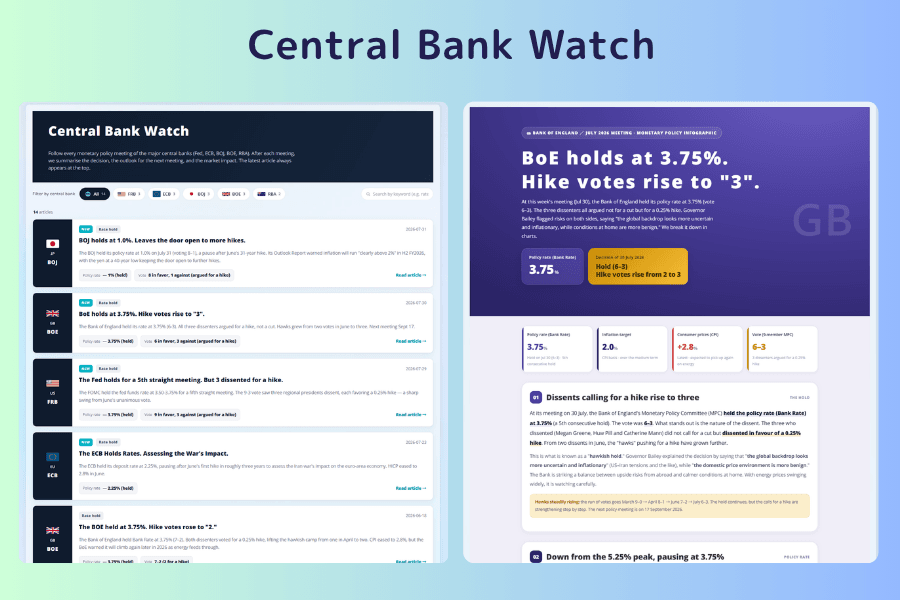
The tables above change with every meeting, and the changes are worth more than any single snapshot: a dissent that flips from dovish to hawkish, a member who voted with the majority starting to use hawkish language, the number of hike votes rising meeting by meeting. All of these show up before the formal action. Titan FX's Central Bank Watch tool tracks them, summarizing the decision, the vote and the outlook for the next meeting for the Fed, the ECB, the BoJ, the BoE and the RBA; the release time of each decision can be confirmed by filtering the Economic Calendar to the central bank category.
6. Analyzing a Hawkish Turn: 3 Risks to Watch Before You Trade
When a central bank turns hawkish, each asset class calls for a different starting point:
-
Forex: the change in policy rate differentials, and whether the market has already repriced
-
Stock indices: growth versus defensive performance and the shape of the yield curve
-
Bonds: short-term yields and changes in the curve
-
Gold and commodities: real rates, the US Dollar Index and safe-haven demand
Each of these should be checked against the five points in Section 4 to confirm whether there is a gap between what the market priced and what was decided.
Three risks are easy to overlook when trading central bank events:
-
The market may have priced it already: markets price the decision beforehand from rate futures and officials' speeches, and a decision that matches expectations can send prices the other way. Comparing how pricing changed before and after the decision matters more than the direction of the decision itself.
-
Rate differentials and swap points are not the same thing: policy rate differentials shape a pair's interest rate environment, but the swap points paid or received on a position held overnight also depend on the instrument, the direction, the broker's financing adjustments and the charging days. Check the sign and the amount on your trading platform for the day, and do not assume that a hike means a long position will earn swap.
-
Liquidity and fills around the release: spreads can widen and prices can gap during the release and the press conference, and stop-loss and limit orders may fill at prices other than expected. Reducing position size for the expected volatility, confirming where the stop sits, and capping risk per trade with a rule such as the 2% rule are the basic ways to handle event risk.
7. Hawkish Policy FAQ
Q1: How do hawks and doves affect stocks and currencies differently?
Hawkish signals raise the cost of money and compress valuations, so stocks usually come under pressure while the home currency is supported by wider expected rate differentials. Dovish signals lower rates and add liquidity, which helps stocks and tends to weaken the currency. The actual reaction depends on the gap between the decision and expectations; a hawkish decision that was fully expected does not necessarily lift the currency.
Q2: What are a "hawkish cut" and a "dovish hike"?
A hawkish cut is when a central bank cuts rates but its statement or projections signal that no further cuts are coming and that it remains wary of inflation, so the market reads the overall signal as tighter; the Fed in December 2024 is an example. A dovish hike is the reverse: a hike accompanied by a hint that tightening is nearly over, as with the ECB in September 2023. Both show that markets trade the overall path, not the single move.
Q3: Does a rate hike always mean the central bank has turned hawkish?
Not necessarily. If the hike is smaller than the market expected, or the bank signals at the same time that the hiking cycle is close to its end, the overall signal can still be read as dovish. Judging hawkish or dovish means comparing the actual decision, the future rate path and pre-meeting expectations, not just whether rates went up or down.
Q4: Do central bank officials change their stance?
Yes. Hawkish and dovish describe an attitude at a point in time, and officials adjust as inflation, the unemployment rate and financial conditions change. Most central bankers turned dovish in 2020 to support the economy and hawkish as a group in 2022; at the Fed, Christopher Waller and Michelle Bowman argued for earlier cuts in 2025 and then voted for the hike in September 2026.
Q5: Where can I check the latest stance of the Fed, the ECB, the BoJ and others?
The primary sources are the decision statements, minutes and speeches on each central bank's website; market pricing can be read from tools such as FedWatch. Titan FX's Central Bank Watch summarizes the decision and the vote at every meeting of the five major central banks, and the Economic Calendar shows the release time of each decision, so the two together cover preparation before the meeting and the check afterward.
8. Summary: A Hike or a Cut Alone Does Not Make a Central Bank Hawkish
Hawkish means monetary policy is leaning tight: more weight on inflation risk and a preference for hikes and balance-sheet reduction; dovish is the reverse. Hawkish signals usually support the home currency, lift short-term yields and weigh on the valuations of stocks and gold through rate expectations, but none of this is a fixed formula, because what markets trade is how hawkish the actual decision was relative to what had been priced in.
To judge whether a meeting was really hawkish, work through the decision's direction and size, the vote and the dissents, the statement's wording, the projections and the dot plot, and the press conference, then set all of them against what the market priced in beforehand. The Fed's path from 9–3 in July 2026 to 12–0 in September shows that internal signals appear before the action. When trading, factor in swap points, spreads and liquidity around the release as well.
Further Reading
- Policy Interest Rate
- Stagflation
- Why Invest in the US Dollar: DXY, Fed Policy and Allocation Strategy
- How to Choose a Currency Pair: Screening with the Currency Strength Meter and Four More Tools
- Risk-on and Risk-off
Titan FX Trading Strategy Lab. We produce investor-education content covering forex, commodities (crude oil, precious metals, agricultural goods), stock indices, US equities, and digital assets.
Primary Sources (by Category)
- Central bank decisions and records: Federal Reserve — FOMC statements (July 29 and September 16, 2026), Summary of Economic Projections (September 2026), FOMC membership, 2026 meeting calendar, press release on the chair's swearing-in (May 22, 2026); European Central Bank — monetary policy decisions and statements (June 11 and September 10, 2026), key interest rates, Executive Board membership, December 2019 press conference; Bank of England — Monetary Policy Summary and minutes (April, July and September 2026), MPC membership; Bank of Japan — statements on monetary policy (June 16, July 31 and September 18, 2026), Policy Board membership and 2026 meeting schedule; Reserve Bank of Australia — monetary policy decision (August 11, 2026), cash rate target history, 2026 meeting dates; Reserve Bank of New Zealand — OCR decisions (July 8 and September 2, 2026)
- Market tools: CME Group — FedWatch Tool
- Research and institutions: Bank for International Settlements (BIS) — research on central bank communication and monetary policy