

Open Market Operations
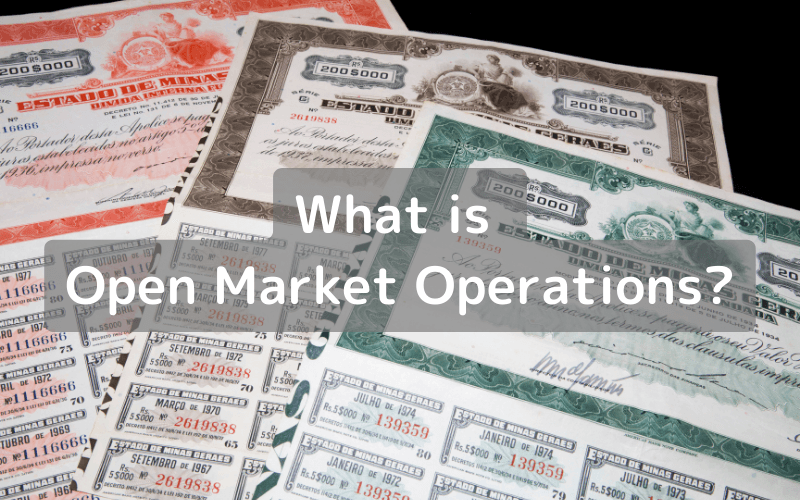
Open Market Operations (OMO) refer to the actions taken by a central bank to buy or sell government bonds or other financial assets in the open market to manage the money supply and interest rates. The main goal is to influence market liquidity and the banking system's reserves, enabling the central bank to achieve its economic objectives.
- What open market operations (OMO) are and their role as a central bank policy tool
- How buying and selling government securities affects money supply and interest rates
- Transmission mechanisms from OMO to forex and bond markets
- How traders can use OMO signals for trading decisions
1. What Are Open Market Operations? Definition and Policy Objectives
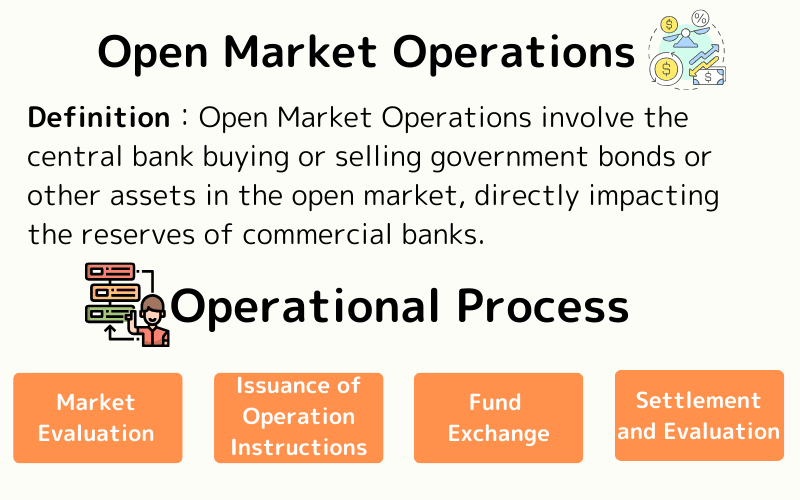
Open Market Operations involve the central bank buying or selling government bonds or other assets in the open market, directly impacting the reserves of commercial banks. This process helps adjust market liquidity, interest rates, and money supply. Central banks often use this tool to influence short-term interest rates, which, in turn, affect the overall economy.
Purpose and Policy Objectives
The primary goals of Open Market Operations are to manage the money supply and interest rates, thereby achieving the following macroeconomic objectives:
Controlling the Money Supply
By buying and selling government bonds or other assets, the central bank can increase or decrease the amount of money circulating in the economy.
Controlling Short-Term Interest Rates
OMO influences the interbank borrowing rates, keeping them within a target range.
Promoting Economic Stability
By adjusting interest rates and money supply, the central bank can meet its inflation targets, encourage economic growth, and stabilize financial markets.
2. Methods and Implementation Process
The Open Market Operations process typically includes the following steps:
1. Market Evaluation
The central bank assesses economic data, market liquidity, and funding needs to determine whether to carry out Open Market Operations.
2. Issuance of Operation Instructions
The central bank issues specific instructions outlining the operation amount, bond types, and other details.
3. Fund Exchange
Through buying and selling government bonds or conducting repo agreements, the central bank implements liquidity adjustments.
4. Settlement and Evaluation
After the operation, the central bank evaluates the market response to determine whether to continue or adjust future operations.
Key Tools and Methods
The central bank uses several tools to implement Open Market Operations, including the following:
Repurchase Agreements (Repos)
Repurchase agreements are used by the central bank to manage liquidity. Banks borrow money from the central bank by pledging government bonds as collateral, returning the principal and interest in a short time.
Reverse Repurchase Agreements (Reverse Repos)
In a reverse repo, the central bank buys government bonds from the market with an agreement to sell them back later. This tool is usually used to reduce money supply and control inflation.
Open Market Purchases or Sales of Government Bonds
The central bank directly buys or sells government bonds in the market, which influences market liquidity and interest rates.
Long-Term Tools
These include Long-Term Repurchase Agreements (LTRO) and Medium-Term Lending Facility (MLF). These tools are used to manage medium- and long-term liquidity, especially in times of liquidity crises.
3. Impact on the Economy and Markets
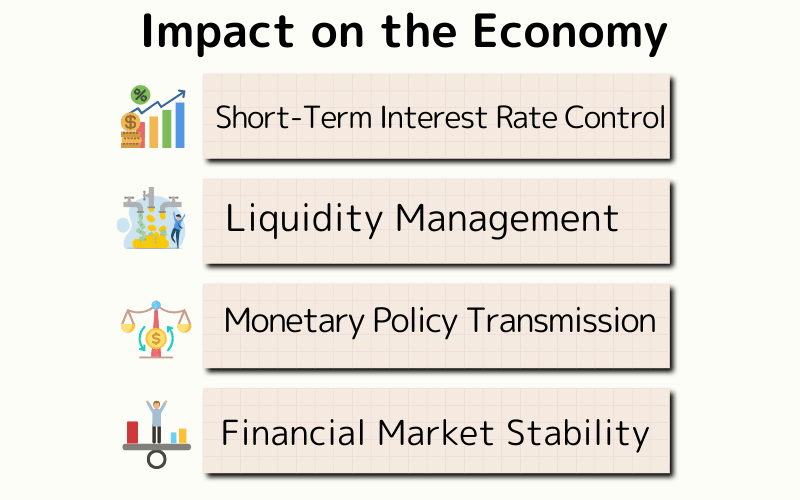
OMO impacts the economy in various ways:
Short-Term Interest Rate Control
By managing interbank borrowing rates, the central bank can control the cost of funds in the market.
Liquidity Management
OMO ensures adequate liquidity in the banking system, preventing liquidity crises.
Monetary Policy Transmission
OMO helps transmit the central bank’s monetary policy goals to the real economy, affecting growth and inflation.
Financial Market Stability
During financial crises or economic downturns, OMO helps stabilize financial markets and ease market panic.
Comparison with Other Monetary Policy Tools
| Monetary Policy Tool | Purpose & Objective | Pros & Cons |
|---|---|---|
| Open Market Operations (OMO) | Buying/selling bonds to manage liquidity and short-term interest rates | Flexible, short-term effective, ideal for rapid adjustments |
| Benchmark Interest Rate Policy | Adjusts interest rates to influence loan costs | Long-term effectiveness, but rate changes can trigger market reactions |
| Quantitative Easing (QE) | Buys long-term assets to lower long-term rates and increase money supply | Effective in low inflation, but may cause asset bubbles |
| Reserve Requirements | Changes bank reserve ratios, affecting lending capacity | Less flexible, used mainly for long-term regulation |
| Foreign Exchange Intervention | Buys/sells foreign currencies to influence exchange rates | Primarily for currency management, with limited domestic impact |
4. Open Market Operations Around the World
Open market operations are practiced by major central banks worldwide, each with distinct approaches:
Federal Reserve (United States): The FOMC directs OMO through the New York Fed, primarily using repo and reverse repo operations to maintain the federal funds rate within its target range.
European Central Bank (ECB): The ECB conducts main refinancing operations (MROs) and longer-term refinancing operations (LTROs) to manage liquidity in the euro area banking system.
Bank of Japan (BOJ): The BOJ has employed aggressive OMO including yield curve control (YCC), purchasing Japanese government bonds to maintain 10-year yields near target levels.
People's Bank of China (PBOC): The PBOC uses a combination of reverse repos, medium-term lending facility (MLF), and standing lending facility (SLF) to manage interbank liquidity.
5. Frequently Asked Questions (FAQ)
Q1: What is the difference between open market operations and quantitative easing?
Traditional OMO targets short-term interest rates by buying/selling short-term government securities. Quantitative easing (QE) involves large-scale purchases of longer-term bonds and sometimes other assets to lower long-term rates when short-term rates are already near zero.
Q2: How quickly do OMO affect forex markets?
OMO signals often impact forex markets within minutes of FOMC announcements. The USD typically strengthens when the Fed signals tightening (selling securities) and weakens during easing (buying securities).
Q3: Can individual traders benefit from OMO announcements?
Yes. Monitoring Fed meeting schedules, FOMC statements, and changes in the federal funds rate target helps traders anticipate USD movements and position accordingly.
Q4: How do open market operations differ from quantitative easing?
Traditional OMO targets short-term interest rates by buying/selling short-term government securities. Quantitative easing (QE) involves large-scale purchases of longer-term bonds to lower long-term rates when short-term rates are already near zero. QE is an unconventional tool used in extreme conditions.
6. Summary
Open market operations are the primary tool central banks use to implement monetary policy. By buying or selling government securities, central banks control the money supply and influence short-term interest rates. For forex and bond traders, understanding OMO signals — particularly from the Federal Reserve's FOMC — is essential for anticipating currency and yield movements.
Related Articles
Titan FX Research. We produce educational content for investors, covering a wide range of financial instruments including forex, commodities (crude oil, precious metals, agricultural products), stock indices, U.S. equities, and digital assets.
Primary Sources (by category)
- Central Bank: Federal Reserve — Open Market Operations
- Academic: IMF — Monetary Policy Instruments
- Market: Bloomberg; Reuters