

FED (Federal Reserve System)
The U.S. central banking system is built around three names that the news routinely mixes up: FED (the Federal Reserve System as a whole), FRB (the Federal Reserve Board of Governors that sets the policy framework), and the FOMC (the committee that actually votes on interest rates and balance-sheet policy).
Getting the difference straight is what lets you read a headline like "FRB raises rates" or "FOMC pivots dovish" without confusion — and translate those signals into FX, bond, and equity decisions.
This article walks through the structure of the FED, the role of the 12 regional Federal Reserve Banks, the mechanics of FOMC voting, and the channels through which Fed policy is transmitted to global markets.
- The "FED" refers to the entire Federal Reserve System, "FRB" is the Federal Reserve Board (its central decision body), and "FOMC" is the committee that actually votes on monetary policy.
- FRB consists of 7 governors; the Chair leads FOMC and is the most market-relevant figure in global finance.
- FOMC has 12 voting members: 7 Board governors plus 5 regional Federal Reserve Bank presidents (NY Fed always voting; other 4 rotate annually).
- FED has a dual mandate: maximum employment and price stability — making CPI/PCE inflation and the NFP labor report core inputs for policy decisions.
- Three policy tools: the federal funds rate, balance-sheet operations (QE/QT), and forward guidance — each transmits to FX, bonds, equities, and commodities through different channels.
- 1. What is the Central Bank of the United States?
- 2. What is the FED (Federal Reserve System)?
- 3. What is the FRB (Federal Reserve Board)?
- 4. What is the Federal Reserve Bank?
- 5. What is the FOMC (Federal Open Market Committee)? Who are its members?
- 6. How is Monetary Policy Determined?
- 7. How Does the FRB Affect Financial Markets?
- 8. Quantitative Easing (QE)
- 9. Frequently Asked Questions about the U.S. Central Bank (FED/FRB)
- 10. Summary: How the U.S. Central Bank (FED/FRB) Operates
1. What is the Central Bank of the United States?
The central bank of the United States refers to the Federal Reserve System (commonly abbreviated as FED or FRS). The Federal Reserve Board (FRB) is the core institution of this system.
In news reports, the FRB is often referred to as the central bank. Therefore, it is essential to interpret this term flexibly.
The FRB is the Board of Governors of the Federal Reserve System — the body that sets the policy framework and supervises the 12 regional Federal Reserve Banks across the United States. The final votes on interest rates and balance-sheet policy (QE/QT) are taken at the FOMC.
Additionally, FRB members and presidents of the regional Federal Reserve Banks hold eight Federal Open Market Committee (FOMC) meetings annually to decide on monetary policy.
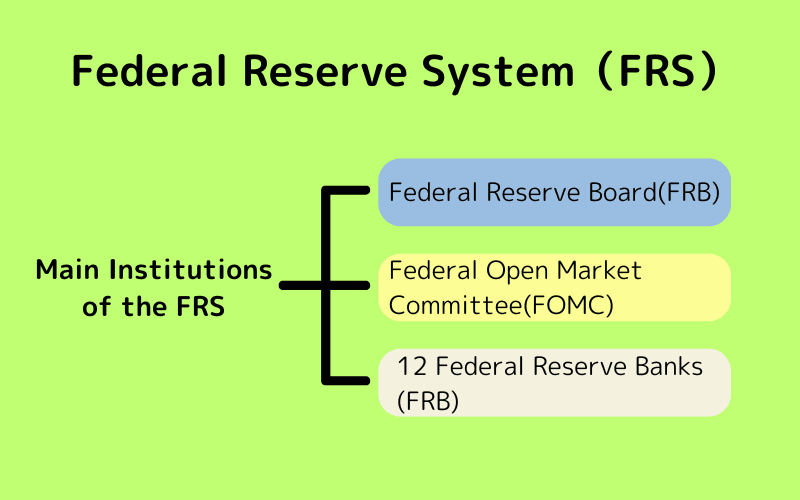
The structure of the U.S. central banking system is illustrated below.
2. What is the FED (Federal Reserve System)?
The FED (Federal Reserve System) is the central banking system of the United States.
It is called a "system" rather than a "bank" because it consists of multiple organizations. This reflects the decentralized philosophy of governance in the United States since its founding, opposing highly centralized institutions.
Within this system, the FRB (Federal Reserve Board) plays a central role in determining basic monetary policies.
The main responsibilities of the FRB include:
Establishing guidelines for open market operations.
Deciding changes to the federal funds rate.
Setting the reserve requirements for depository institutions.
3. What is the FRB (Federal Reserve Board)?
The FRB, short for Federal Reserve Board, is the body that formulates the monetary policy of the United States.
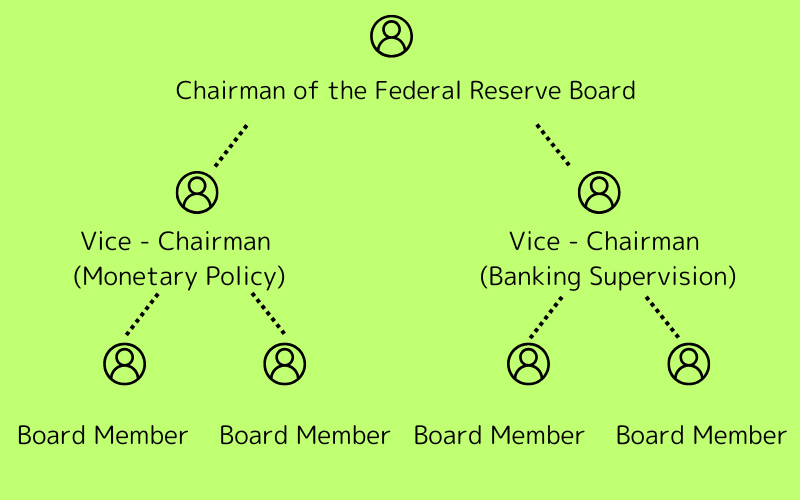
The FRB comprises seven board members, including a Chair and two Vice Chairs (one for monetary policy and one for banking supervision).
Key facts about the FRB:
Board members serve a 14-year term.
The Chair and Vice Chairs serve a 4-year term.
All members are nominated by the President and confirmed by the Senate.
Whenever there are changes in FRB members, especially the Chair, the foreign exchange market often reacts sensitively to news of the new appointments.
4. What is the Federal Reserve Bank?
The term "Federal Reserve Board" (FRB) mentioned earlier is sometimes also used to refer to the Federal Reserve Banks.
Under the supervision of the Federal Reserve Board, there are 12 regional Federal Reserve Banks located across the United States, each functioning as an independent joint-stock company.
The structure of these regional banks reflects the decentralized philosophy of governance in the United States.
Key roles of the regional Federal Reserve Banks:
All commercial banks must deposit statutory reserves with their respective regional Federal Reserve Banks and can borrow from them. Consequently, all commercial banks fall under the supervision of the regional banks.
Adjustments to the federal funds rate require individual applications from regional banks to the FRB.
Presidents of these regional banks participate in FOMC meetings as representatives of their regions.
5. What is the FOMC (Federal Open Market Committee)? Who are its members?
The Federal Open Market Committee (FOMC) is the highest decision-making body of the FED.
It is equivalent to the central banking committees of other countries, as shown in the table below.
| Country/Region | Central Bank Name | Abbreviation |
|---|---|---|
| United States | Federal Reserve Board | FRB |
| Taiwan | Central Bank of the Republic of China | - |
| Hong Kong | Hong Kong Monetary Authority | HKMA |
| Japan | Bank of Japan | BOJ |
| Singapore | Monetary Authority of Singapore | MAS |
The FOMC meets eight times a year in the FRB's meeting room in Washington, D.C., approximately every six weeks. During emergencies, such as the COVID-19 pandemic, meetings may be held virtually.
The FOMC decides the fundamental guidelines for open market operations, which are the primary tools for regulating financial markets.
The FOMC comprises 12 voting members:
1.Seven FRB board members.
2.Five regional Federal Reserve Bank presidents (including the President of the New York Federal Reserve Bank, with the remaining four rotating among the presidents of the other 11 regional banks).
The other seven regional bank presidents attend the meetings as observers without voting rights.
6. How is Monetary Policy Determined?
FOMC meetings are chaired by the FRB Chair, with the President of the New York Federal Reserve Bank serving as the Vice Chair.
Decisions are made by a simple majority vote among the 12 voting members.
The decisions regarding open market operations are then passed as directives to the New York Federal Reserve Bank, the body responsible for implementation.
FOMC Meeting Schedule
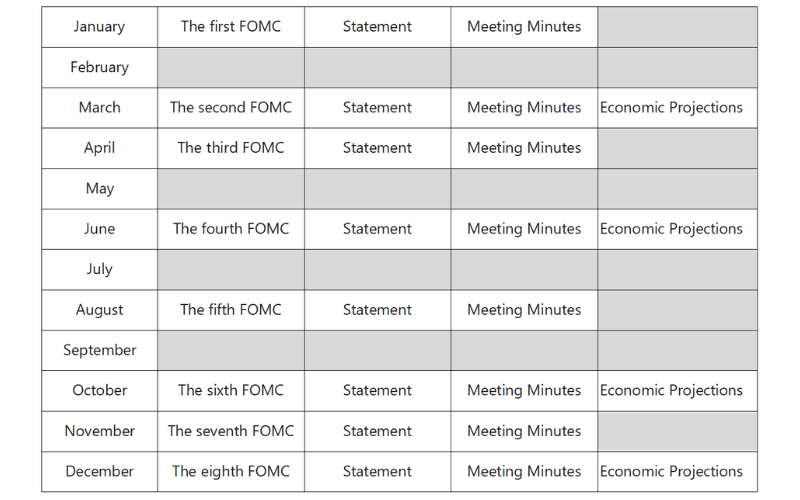
The U.S. monetary policy is determined during the eight annual FOMC meetings. Each meeting lasts two days, and decisions are announced at 2:00 PM (local time) on the second day. A press conference follows 30 minutes later.
Economic forecasts are published alongside the statement, while meeting minutes are released approximately three weeks later.
For an accurate schedule, please refer to the FRB website.
7. How Does the FRB Affect Financial Markets?
The FRB guides the federal funds rate (FFR) through open market operations to achieve its target policy rate. The FFR is the short-term interest rate that U.S. commercial banks charge each other for overnight loans of reserves held at the Federal Reserve.
Since the target policy rate is set by the FOMC, short-term interest rates are essentially determined by the central bank’s monetary policy.
Rate Hikes and Cuts
The FRB adjusts interest rates to regulate the economy, prices, and employment:
Rate hikes: Used to slow down an overheated economy. Higher interest rates curb consumption, increase borrowing costs for businesses, and suppress stock prices. However, they make the U.S. dollar more attractive to buyers.
Rate cuts: Stimulate the economy during slowdowns or recessions. Lower interest rates encourage consumption, reduce borrowing costs for businesses, and boost stock prices. However, they also lead to a weaker U.S. dollar.
8. Quantitative Easing (QE)
Quantitative Easing (QE) is a monetary policy aimed at increasing the monetary base (the supply of money in the market) through large-scale market interventions.
The goal of QE is to lower long-term interest rates, which benefits economic recovery and increases the value of assets like stocks and real estate.
When the FED buys bonds, it lowers long-term interest rates. The increase in market assets relative to the dollar reduces the dollar’s value, making it less attractive to buyers.
9. Frequently Asked Questions about the U.S. Central Bank (FED/FRB)
Q1: How are the FED, FRB, regional Federal Reserve Banks, and FOMC different?
The FED is the entire system, the FRB is the central decision-making board, the regional Federal Reserve Banks are the 12 district branches, and the FOMC is the committee that actually votes on interest rates and asset purchases.
| Term | Other names | Role | Notable detail |
|---|---|---|---|
| FED | Federal Reserve System | The whole system (FRB + 12 district banks + FOMC) | Used in media as shorthand for "the U.S. central bank." |
| FRB | Federal Reserve Board | Sets policy framework, supervises banks | Based in Washington, 7 governors; the Chair (e.g., Powell) is the market focal point. |
| Federal Reserve Bank | District / regional Fed | Regional execution arm — payments, clearing, research | 12 banks total; New York Fed runs open market operations. |
| FOMC | Federal Open Market Committee | Final decision-maker on rates and QE/QT | 12 votes: 7 governors + 5 regional presidents (NY permanent, others rotate). |
Q2: What is the "Dual Mandate" and why does it matter?
The Federal Reserve Act mandates that the FED simultaneously pursue maximum employment and price stability. These two goals are sometimes in tension, which is why the FED constantly balances policy between supporting jobs and containing inflation. Core CPI, Core PCE, and the unemployment rate sit at the center of every policy debate.
Q3: Why do news headlines sometimes treat "FRB" as if it were the U.S. central bank?
Because FRB is the central decision-making body of the FED and the most visible interface — its Chair speaks for the system in testimony and press conferences. Strictly speaking, however, interest-rate decisions and QE/QT scale are voted by the FOMC, not by the FRB alone.
Q4: Are FED policy decisions made by the FRB or the FOMC?
The policy framework and bank supervision belong to the FRB, but the actual votes on rates and asset purchases happen inside the FOMC. When markets read the FED's stance, they watch the FRB Chair, the rest of the Board, and the regional Reserve Bank presidents in combination.
Q5: How do I track FED policy signals in practice?
- Official documents: policy statement, meeting minutes, dot plot / Summary of Economic Projections (SEP).
- Macro data: Core CPI, Core PCE, NFP/unemployment, wages, financial conditions indices.
- Official communications: statements from voting members carry the most weight; a hawkish member turning more dovish is often the earliest signal of a policy pivot.
10. Summary: How the U.S. Central Bank (FED/FRB) Operates
The U.S. central bank, known as the Federal Reserve System (FED), consists of:
The Federal Reserve Board (FRB), the core institution responsible for determining basic monetary policies.
12 regional Federal Reserve Banks, which operate semi-independently under the FRB's supervision.
The Federal Open Market Committee (FOMC), the highest decision-making body.
The FRB comprises seven board members, including the Chair and Vice Chairs. The FOMC consists of 12 voting members: seven FRB board members and five regional Federal Reserve Bank presidents (one permanent member from New York and four rotating members from the other 11 regional banks). Decisions are made by a simple majority vote.
Further Reading
- What is FOMC? Federal Open Market Committee Explained
- Quantitative Easing (QE)
- Policy Interest Rate
- Open Market Operations (OMO)
- U.S. Economic Indicators Calendar
About the Author
This article was prepared by the Titan FX Research editorial team, drawing on official documents from the Federal Reserve Board, FOMC policy statements and meeting minutes, and data releases from the Bureau of Economic Analysis (BEA) and Bureau of Labor Statistics (BLS). Our goal is to give readers a clear framework for interpreting U.S. monetary policy news and translating it into trading decisions.
Primary Sources
- Central bank: Federal Reserve Board, FOMC policy statements
- District banks: New York Fed (open market operations)
- Macro data: BEA (Bureau of Economic Analysis), BLS (Bureau of Labor Statistics)
- Financial conditions: San Francisco Fed Financial Conditions Index