

Policy Interest Rate
A policy interest rate is the benchmark rate a central bank sets to keep prices and the economy stable; by raising or cutting it, the bank steers borrowing costs and moves currencies, bonds, equities, and real estate across financial markets.
The policy interest rate is a cornerstone of central banks’ monetary policy, shaping economic activity, market trends, and investment decisions. This article explores the definition of policy interest rates, their impact on financial markets, current global rates as of May 2026, and answers to common questions, empowering investors to navigate rate changes effectively.
- What a policy interest rate is and how central banks use it to balance inflation, employment, and growth
- The latest levels across the US, Eurozone, Japan, the UK, and other major economies, and how they differ
- How hikes and cuts ripple through currencies (USD/JPY, EUR/USD, etc.), bonds, equities, and real estate
- Reading the next move: the yield curve, fed funds futures, and the Fed dot plot
- Tracking tools: following policy-rate events with the Titan FX economic calendar
1. What Is a Policy Interest Rate?
Definition and Significance
The policy interest rate is a critical tool used by central banks to implement monetary policy, aimed at achieving price stability, fostering economic growth, and other macroeconomic goals. It typically serves as a benchmark short-term interest rate, guiding the cost of funds in financial markets.
While not directly set by central banks, the policy rate is influenced through market operations to align with a target level, making it a key driver of monetary policy. It reflects the cost of short-term borrowing among financial institutions and serves as a reference for broader market rates.
Examples of policy rates vary by country:
- Taiwan: Uses the discount rate as a benchmark for interbank lending rates.
- United States: Employs the federal funds rate, reflecting overnight interbank lending rates.
- Japan: Targets the unsecured overnight call rate.
How Policy Interest Rates Work
Central banks use several tools to manage policy rates, influencing liquidity, borrowing costs, and economic behavior. These mechanisms transmit rate changes to banks, businesses, and consumers, shaping overall economic activity. Common tools include:
Open Market Operations
Central banks buy or sell government bonds to adjust market liquidity:
- Buying bonds: Injects funds, increasing liquidity and lowering rates.
- Selling bonds: Absorbs funds, tightening liquidity and raising rates. This method is highly flexible and widely used for rate management.
Reserve Requirement Adjustments
This sets the proportion of deposits banks must hold in reserve:
- Raising reserve requirements: Reduces lendable funds, tightening liquidity and increasing rates.
- Lowering reserve requirements: Increases available funds, easing liquidity and reducing rates. Adjustments are less frequent, typically used for longer-term strategies.
Direct Lending Rates (e.g., Discount Rate)
This is the rate at which central banks lend to financial institutions, affecting short-term borrowing costs:
- Raising rates: Increases borrowing costs, pushing market rates higher.
- Lowering rates: Reduces costs, encouraging lower market rates.
Interest Rate Corridor
Some central banks, like the European Central Bank, set upper and lower bounds for rates (e.g., deposit and lending rates) to form an “interest rate corridor.” This ensures market rates stay within a target range, enhancing stability.
Through these tools, policy rate changes ripple through bank lending, corporate investment, and consumer spending, influencing economic activity. Balancing transparency and stability is crucial for central banks to maintain market confidence.
2. Global Policy Interest Rates (May 2026)
Overview of Major Economies
The table below summarizes policy interest rates for major economies as of May 2026, based on official central bank announcements:
| Country/Region | Policy Rate Name | Current Rate | Recent Stance |
|---|---|---|---|
| 🇺🇸 United States | Federal Funds Rate | 3.50–3.75% | On hold (3rd straight meeting); rate-cut bets have faded |
| 🇪🇺 Eurozone | Main Refinancing Rate | 2.15% (deposit facility 2.00%) | On hold; the easing cycle has paused |
| 🇬🇧 United Kingdom | Bank Rate | 3.75% | On hold; renewed inflation has revived rate-hike talk |
| 🇯🇵 Japan | Unsecured Overnight Call Rate | 0.75% | Raised to the highest since 1995; further hikes debated |
| 🇦🇺 Australia | Cash Rate | 4.35% | Hiked 0.25% in May 2026 as inflation reaccelerated |
| 🇨🇦 Canada | Overnight Rate | 2.25% | On hold since October 2025 |
| 🇨🇭 Switzerland | SNB Policy Rate | 0.00% | Cut to zero; ready to intervene in FX if needed |
| 🇨🇳 China | 1-Year LPR | 3.00% | Unchanged for 12 straight months |
| 🇸🇬 Singapore | S$NEER (Exchange Rate-Based) | — | Tightened in Apr 2026 (first time in four years) |
Observations and Notes
-
Policy Drivers: Central banks adjust rates based on inflation, economic growth, and currency stability, leading to varying frequencies and magnitudes of changes.
-
Singapore’s Exchange Rate Framework: Unlike most central banks, the Monetary Authority of Singapore (MAS) manages monetary policy through the Singapore Dollar Nominal Effective Exchange Rate (S$NEER). In April 2026, MAS tightened policy for the first time in four years, steepening the S$NEER appreciation slope as Middle East-driven energy prices worsened the inflation outlook.
-
China’s LPR as Reference: The People’s Bank of China uses the 1-Year Loan Prime Rate (LPR) as a key benchmark, guiding market rates through open market operations and reserve requirement adjustments.
2026 Policy Rate Announcement Schedule
Tracking central bank rate announcements is critical for anticipating market movements. The table below outlines 2026 monetary policy meeting dates for major economies, based on official central bank calendars as of May 2026. Some second-half dates (e.g., SNB December, MAS July/October) are not yet finalized and are marked TBA. Dates may shift, so monitor central bank websites for updates.
| Country/Region | Central Bank | Jan | Feb | Mar | Apr | May | Jun | Jul | Aug | Sep | Oct | Nov | Dec |
|---|---|---|---|---|---|---|---|---|---|---|---|---|---|
| 🇺🇸 United States | Federal Reserve (Fed) | 27–28 | – | 17–18 | 28–29 | – | 16–17 | 28–29 | – | 15–16 | 27–28 | – | 8–9 |
| 🇪🇺 Eurozone | European Central Bank (ECB) | – | 5 | 19 | 30 | – | 11 | 23 | – | 10 | 29 | – | 17 |
| 🇬🇧 United Kingdom | Bank of England (BOE) | – | 5 | 19 | 30 | – | 18 | 30 | – | 17 | – | 5 | 17 |
| 🇯🇵 Japan | Bank of Japan (BOJ) | 22–23 | – | 18–19 | 27–28 | – | 15–16 | 30–31 | – | 17–18 | 29–30 | – | 17–18 |
| 🇦🇺 Australia | Reserve Bank of Australia (RBA) | – | 3 | 17 | – | 5 | 16 | – | 11 | 29 | – | 3 | 8 |
| 🇨🇦 Canada | Bank of Canada (BOC) | 28 | – | 18 | 29 | – | 10 | 15 | – | 2 | 28 | – | 9 |
| 🇨🇭 Switzerland | Swiss National Bank (SNB) | – | – | 19 | – | – | 18 | – | – | 25 | – | – | TBA |
| 🇨🇳 China | People's Bank of China (PBOC) | 20 | 20 | 20 | 20 | 20 | 20 | 20 | 20 | 20 | 20 | 20 | 20 |
| 🇸🇬 Singapore | Monetary Authority of Singapore (MAS) | 29 | – | – | 14 | – | – | TBA | – | – | TBA | – | – |
Additional Notes
Announcement Timing:
Most central banks release decisions during local business hours. For example, the Federal Reserve typically issues statements at 2:00 PM ET, the Bank of Canada at 9:45 AM ET, and the ECB holds press conferences at 2:45 PM CET.
China’s Unique Approach:
The People’s Bank of China announces the 1-Year Loan Prime Rate (LPR) monthly on the 20th. Adjustments depend on economic data and policy priorities.
Singapore’s Exchange Rate Policy:
MAS reviews the S$NEER policy band quarterly (January, April, July, and October). In April 2026 it tightened by steepening the band’s slope for the first time in four years.
Investment Tip:
Rate announcements often trigger market volatility. Monitor pre-meeting data (e.g., inflation, employment) and post-meeting statements or press conferences, as these shape market expectations.
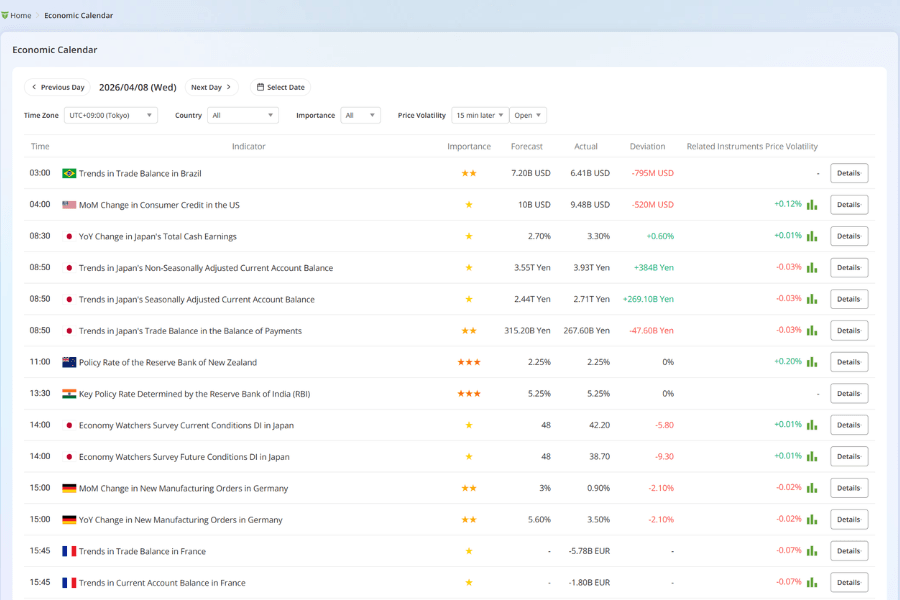
Titan FX offers an economic calendar to help investors stay updated on key economic events.
3. Impact of Policy Interest Rates on Markets
The policy interest rate acts as a lever for central banks to steer economic activity. Each adjustment—whether a rate hike, cut, or hold—ripples through financial markets, influencing capital flows, investor sentiment, and asset prices. Below, we analyze the impact across three scenarios.
3.1 Rate Hikes
Objective: Curb inflation and prevent economic overheatingRate hikes signal a central bank’s intent to tame rising prices or excessive economic expansion. By increasing borrowing costs, hikes discourage lending and spending, effectively slowing the economy.
Market Effects of Rate Hikes:
| Impact Scope | Effects |
|---|---|
| Businesses and Consumers | Higher borrowing costs curb corporate expansion and consumer spending. |
| Currency Markets | Wider interest rate differentials strengthen the currency, attracting foreign capital. For example, U.S. rate hikes often boost the USD/JPY exchange rate. |
| Stock Markets | Growth stocks (e.g., tech) face pressure, while defensive sectors like finance and energy remain resilient. |
| Bond Markets | Bond yields rise, causing older bonds to lose value, impacting fixed-income portfolios. |
| Commodities | A stronger USD depresses prices of dollar-denominated commodities like gold and oil, reducing their appeal. |
3.2 Rate Cuts
Objective: Stimulate growth and boost economic activityWhen economic growth slows or employment weakens, central banks may cut rates to increase liquidity, lower borrowing costs, and encourage investment and consumption.
Market Effects of Rate Cuts:
| Impact Scope | Effects |
|---|---|
| Businesses and Consumers | Cheaper financing fuels corporate expansion and consumer spending. |
| Currency Markets | Narrower rate differentials weaken the currency, supporting exports. |
| Stock Markets | Loose monetary conditions lift growth stocks and riskier assets, boosting market sentiment. |
| Bond Markets | Falling yields increase the value of existing bonds, benefiting bondholders. |
| Commodities | A weaker USD drives up prices of commodities like gold and oil, enhancing their attractiveness. |
3.3 Rate Holds (No Change)
Objective: Monitor economic conditions and maintain stabilityWhen a central bank is uncertain about economic trends, maintaining the current rate is a cautious approach. This avoids over-intervention, allowing markets to adjust naturally.
Market Effects of Rate Holds:
| Effects | |
|---|---|
| Businesses and Consumers | Stable borrowing conditions sustain existing economic activity. |
| Currency Markets | Exchange rates remain steady unless markets expected a change, which may trigger short-term volatility. |
| Stock Markets | Markets tend to consolidate, though unmet expectations for a hike or cut can cause brief fluctuations. |
| Bond Markets | Yields and bond prices see minimal changes, with lower risk appetite. |
| Commodities | Effects are indirect, driven primarily by USD movements and demand factors. |
These three policy rate scenarios reflect central banks’ efforts to balance inflation and growth. For investors, understanding these ripple effects enables more agile asset allocation and navigation of market cycles.
4. Common Questions About Policy Interest Rates
Q1. How Do Policy Rates Affect Foreign Exchange Markets?
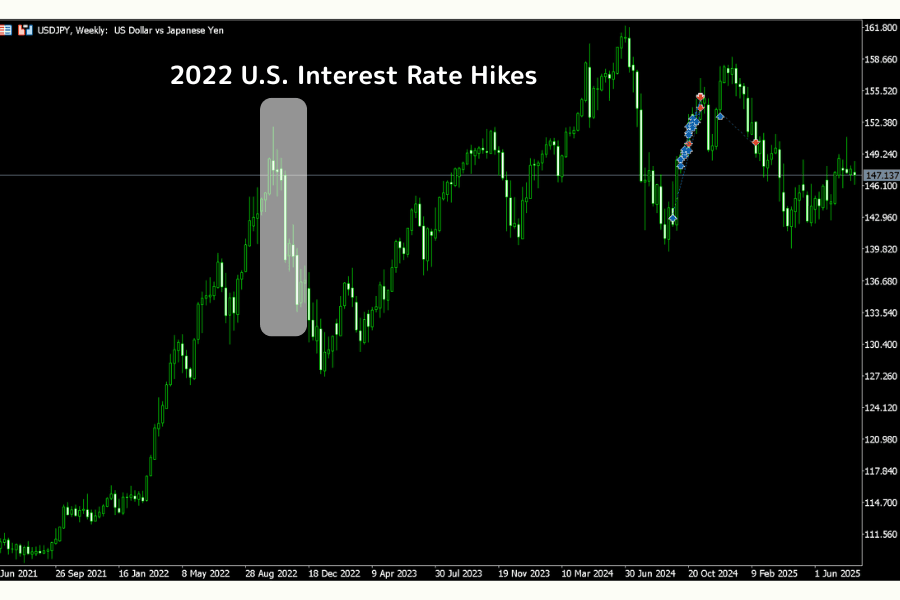
Interest rates strongly influence exchange rates. Higher rates attract foreign capital, strengthening the currency, while lower rates may lead to capital outflows and currency depreciation. For instance, in 2022, the U.S.-Japan interest rate differential drove significant USD/JPY appreciation, creating opportunities for carry trades.
Q2. How Are Policy Rates Linked to Government Bond Yields?
Policy rate changes directly impact short-term bond yields as markets adjust to new funding costs. Long-term bond yields, however, are more influenced by inflation expectations and economic growth forecasts, making their link to policy rates less direct.
Q3. How Do Policy Rates Affect the Housing Market?
Rate hikes increase mortgage rates, dampening homebuying demand and pressuring prices. Conversely, rate cuts lower borrowing costs, stimulating housing activity. In Taiwan, for example, consecutive rate hikes from 2022–2023 raised mortgage costs, leading to a notable decline in housing transactions.
Q4. How Can Investors Track Policy Rate Developments?
Monitor central bank websites and policy statements for updates, and follow key meeting schedules like FOMC or ECB announcements. For in-depth analysis, Titan FX’s 【Market Analysis】 section offers timely economic insights.
Q5. How can policy interest rates be incorporated into FX trading strategies?
Multiple strategies can use policy-rate insights:
- Carry trade: buying high-yielding currencies versus low-yielding ones. Works when target central banks (e.g., NBP, RBA) hold rates above the funding currency
- Central-bank event trading: position around FOMC, ECB, and BOJ decisions for volatility expansion; choose direction based on surprise vs. consensus
- Rate-differential trend following: trade currency pairs where two central banks are clearly diverging (e.g., USD/JPY during 2022 Fed hike cycle)
- Inverted yield curve caution: when a yield curve inverts, scale down risk in anticipation of a recession-driven risk-off environment
5. Conclusion
The policy interest rate is a central bank’s primary tool for shaping economic conditions, influencing borrowing costs, liquidity, and market dynamics across currencies, stocks, bonds, and commodities. In 2025, global central banks are navigating divergent paths: the U.S. and Eurozone lean toward easing, while Japan maintains a cautious stance, reflecting a new era of policy divergence.
For investors, understanding the mechanics and market implications of policy rates is crucial for interpreting macroeconomic trends and optimizing asset allocation. Leverage financial platforms and practice with demo trading accounts to observe real-time market reactions to rate changes, enhancing your ability to adapt to evolving conditions.
Further Reading
- Open Market Operations (OMO) and Central Bank Policy
- CPI (Consumer Price Index) Explained
- NFP (US Non-Farm Payrolls) Overview
- PLN (Polish Złoty) Currency Profile
The financial markets research team at Titan FX. We produce educational content across a broad range of instruments, including forex (FX), commodities (crude oil, precious metals, agricultural products), equity indices, U.S. stocks, and crypto assets.
Primary Sources (by Category)
- Official policy rates: Federal Reserve — FOMC, ECB Key Rates, Bank of Japan
- Market expectations: CME FedWatch Tool, FRED — Federal Funds Rate
- Cross-country comparison: BIS Central Bank Policy Rates, IMF — Global Financial Stability Report