

PLN(Polish Zloty)
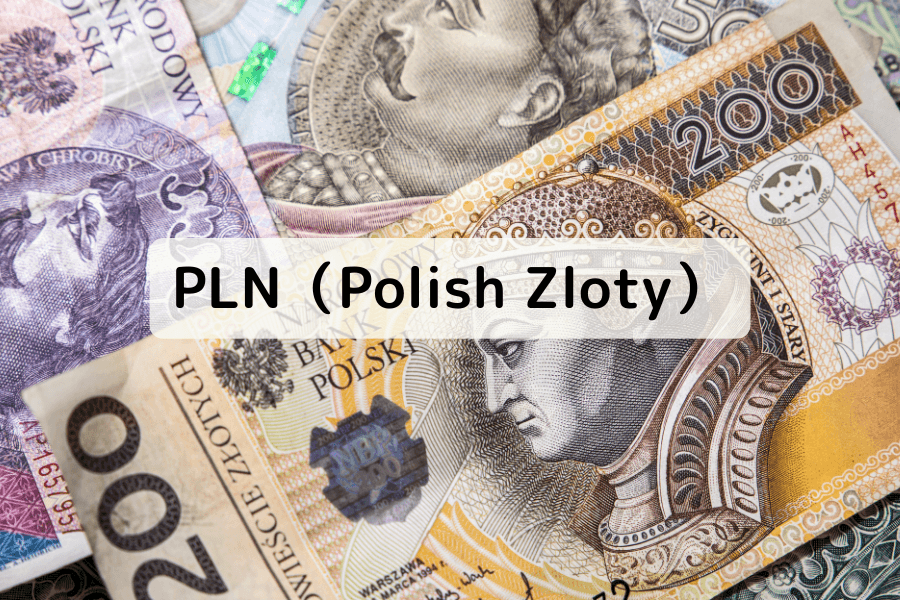
The Polish Złoty (PLN) is Poland's official currency, issued by the National Bank of Poland (NBP) and in use since 1924. It floats freely, with its exchange rate driven mainly by Poland's economic performance, NBP monetary policy, eurozone conditions, and global risk sentiment. As an EU member that has not adopted the euro, PLN keeps policy independence while staying closely tied to the eurozone — making it Central Europe's most representative emerging-market currency, traded mainly via EUR/PLN and USD/PLN.
The Polish Zloty (PLN), commonly referred to as "zloty," is Poland's official currency, which has been in circulation since 1924. As one of Central Europe's key currencies, the Polish Zloty plays a crucial role in regional economic and financial activities.
- History of the Polish Złoty (PLN) and the post-1995 redenomination
- What drives PLN exchange rates: NBP monetary policy, eurozone cycles, geopolitics
- Floating exchange rate regime, EU trade linkages, and emerging-market classification
- Key indicators (CPI, NBP policy rate, GDP, manufacturing PMI) and how they move PLN
- Trading EUR/PLN and USD/PLN: liquidity windows, spread behavior, and event risk
1. History of the Polish Zloty
The history of the Polish Zloty dates back to the Middle Ages when a currency system based on gold and silver began to form.
In 1924, after experiencing hyperinflation, Poland introduced the new Zloty (PLN) to replace the previous currency. Since then, the Zloty has remained Poland's official currency.
Since 1989, Poland has undergone large-scale economic reforms, transitioning from a fixed exchange rate system to a floating exchange rate system. The National Bank of Poland (Narodowy Bank Polski) is responsible for issuing the Zloty and implementing monetary policy, playing a vital role in stabilizing the economy and controlling inflation.
2. Characteristics of the Polish Zloty
As one of Central Europe's important currencies, the Polish Zloty has several distinct characteristics:
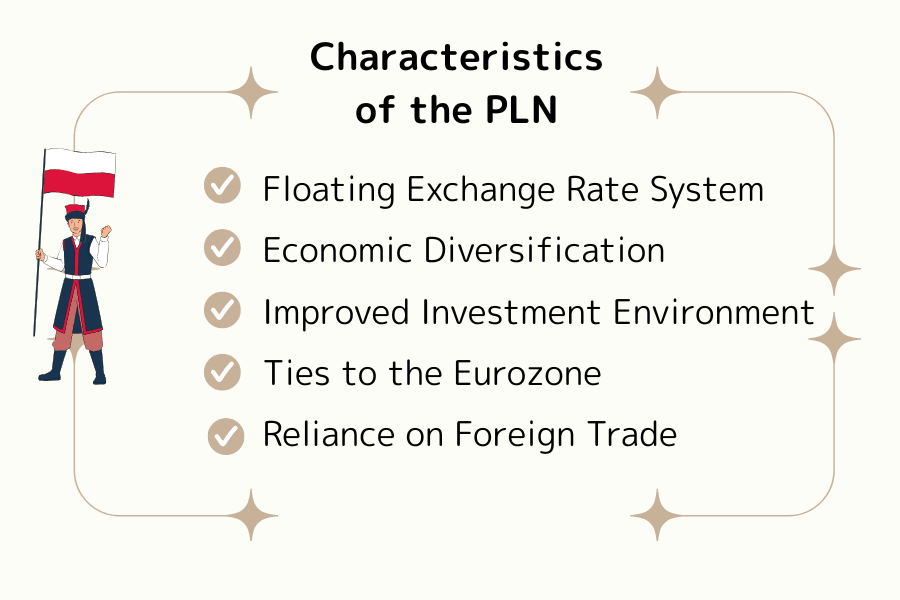
1. Floating Exchange Rate System
Since the 1990s, the Polish Zloty has followed a floating exchange rate system, where the exchange rate is determined by market supply and demand. This allows the Zloty to adjust flexibly to economic and market changes.
2. Economic Diversification
Poland's economy is diversified, encompassing sectors such as industry, services, and agriculture. This diversification helps enhance economic resilience, reducing reliance on any single industry, and consequently bolstering the stability of the Zloty.
3. Improved Investment Environment
With Poland's stable economic growth and improved market conditions, foreign direct investment has been steadily increasing. These inflows of capital support the demand for the Zloty and contribute to its exchange rate stability.
4. Ties to the Eurozone
Poland is an EU member state but has not yet adopted the Euro. Due to Poland's close trade relationship with the Eurozone, the Zloty's exchange rate is often influenced by fluctuations in the Euro.
5. Reliance on Foreign Trade
Poland's economy is highly dependent on exports, particularly in machinery, equipment, and agricultural products. The performance of trade has a significant impact on the demand for the Zloty and its exchange rate.
3. Key Factors Affecting the Exchange Rate of the Polish Zloty
The exchange rate of the Polish Zloty is influenced by multiple factors, including Poland's economic performance, the economic conditions in the Eurozone, the monetary policy of the Polish central bank, and changes in global markets.
1. Poland's Economic Performance
Poland's GDP, inflation rate, and unemployment rate significantly impact the Zloty's exchange rate. When the economy grows strongly, foreign investors increase their demand for Polish assets, boosting the demand for the Zloty and leading to an appreciation in its exchange rate. Conversely, a weak economic performance can lead to a depreciation of the Zloty.
2. Economic Conditions in the Eurozone
Poland has close economic ties with the European Union, particularly with the Eurozone. Therefore, economic changes in the Eurozone directly affect Poland's economy, influencing the exchange rate of the Zloty. For example, an economic slowdown in the Eurozone could reduce demand for Polish exports, which would put downward pressure on the Zloty.
3. The Polish Central Bank's Monetary Policy
The monetary policy of the National Bank of Poland has a direct impact on the Zloty's exchange rate, especially interest rate decisions. When the central bank raises interest rates, it usually attracts foreign capital, increasing demand for the Zloty and leading to an appreciation in its exchange rate. On the other hand, a rate cut may result in capital outflows, putting downward pressure on the Zloty.
4. Global Market Dynamics
The Zloty's exchange rate is also affected by global market dynamics, especially changes in international commodity prices and investor sentiment. In times of global economic uncertainty, the Zloty may experience fluctuations due to risk-averse investor behavior.
4. Economic Basis and International Standing of the Polish Zloty
| Indicator | Description |
|---|---|
| GDP | Measures the total output and growth rate of the Polish economy, with economic growth helping to appreciate the Zloty's exchange rate. |
| Inflation Rate | Affects consumer confidence and purchasing power; high inflation may prompt the central bank to raise interest rates, increasing the Zloty's value. |
| Unemployment Rate | Reflects labor market conditions; low unemployment supports economic stability, helping to maintain the Zloty's exchange rate. |
| Trade Surplus/Deficit | Poland's trade balance directly impacts the demand for the Zloty; a trade surplus typically strengthens the Zloty. |
| Foreign Direct Investment (FDI) | The flow of foreign capital has a positive effect on the demand for the Zloty, supporting its exchange rate. |
Titan FX offers free access to economic indicators
Titan FX provides economic data indicators for major countries such as the US, EU, Japan, and China. You can query data by release time, country, and importance.
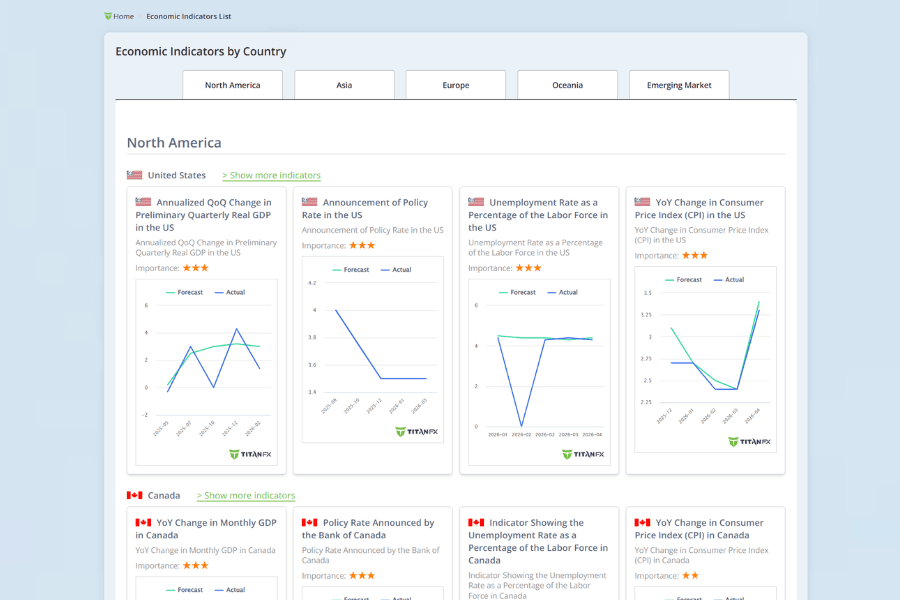
How to Check Economic Indicators Economic Indicator Lookup Page
PLN's Role in the Global Market
Although the Polish Zloty (PLN) does not have the dominant role of currencies like the US Dollar or Euro, it plays an important role in Central Europe and in international trade. Below are the main functions of the Polish Zloty in the global financial system:
1. Activity in the Foreign Exchange Market
The Polish Zloty is one of the more active currencies in the global foreign exchange market, particularly in transactions involving the Euro and the US Dollar. Due to Poland's economic position within the European Union, the Zloty has significant importance in currency trading in the region.
2. Use in International Trade
Poland's main trading partners include Germany, the Czech Republic, and the United Kingdom. The Zloty plays a key role as a settlement currency in regional trade, particularly in trade with the Eurozone and the US Dollar.
3. Connection in the Central European Financial System
As an important currency in Central Europe, the Polish Zloty is frequently traded with neighboring countries, enhancing its position and influence in the regional financial system.
5. How to Trade PLN (Polish Zloty)
Trading the Polish Zloty (PLN) can be done in various ways, with the most common being forex margin trading. This method offers the advantage of leverage, allowing investors to control larger positions with smaller amounts of capital.
Additionally, forex margin trading allows for bidirectional trading, enabling investors to trade both long and short positions based on market fluctuations.
The forex market operates 24 hours a day, making it one of the largest markets in the world, offering high flexibility and liquidity. This makes it suitable for various trading strategies and risk tolerance levels.
Further Reading: Introduction to Forex Margin Trading
Trading Forex with Titan FX
1. Open a Trading Account:
Titan FX offers a fast and simple account opening process with no requirement for ID or address verification.
Titan FX provides Standard and Blade account types. Traders can choose their preferred type during registration.
Titan FX Account Opening Guide2. Deposit Funds:
After registration, deposit funds into your account. Titan FX supports multiple deposit methods, with credit card deposits being the fastest and most convenient, usually processed instantly.
Titan FX Credit Card Deposit Guide3. Download and Install Trading Platforms (MT4/MT5):
Titan FX offers MT4 and MT5 platforms for Windows, Mac, iOS (iPhone/iPad), and Android.
Titan FX MT5 Installation and Login Titan FX MT4 Installation and Login4. Choose Currency Pair
Titan FX offers around 60 currency pairs, with the most common being the Euro (EUR) paired with the Polish Zloty (PLN), such as the Euro/Polish Zloty (EUR/PLN).
Query for all currency pairs5. Place Trades:
Log into the MT4 or MT5 platform, select your trading instrument, and start buying or selling.
MT5 Interface and Order Methods
MT4 Interface and Order Methods
Titan FX Provides Free Trading Tools (Custom Indicators and EAs)
Titan FX is dedicated to providing traders with advanced trading support, including free trading tools such as custom indicators and EAs (Expert Advisors). These tools are designed to enhance traders' efficiency and strategy precision.
Custom indicators help traders analyze market trends more accurately and identify potential trading opportunities.
Meanwhile, EAs can automatically execute pre-set trading strategies, avoiding emotional interference and ensuring that each trade is executed accurately.
With these free tools, Titan FX helps you gain an edge in the competitive financial market and improve your trading performance.
All Custom Indicators EA Trading Program Rankings6. Frequently Asked Questions (FAQ)
Q1: Is PLN suitable for short-term or long-term trading?
PLN works for both styles depending on your approach. Short-term traders can exploit the volatility around NBP policy decisions, Polish CPI releases, and eurozone macro events. Long-term traders typically focus on the medium-term yield differential between NBP and major central banks, plus structural factors such as EU integration and Polish GDP growth.
Q2: What are the most common currency pairs involving PLN?
The most liquid pairs are EUR/PLN (most tradable, narrowest spreads during European hours), USD/PLN (reflects US macro and global risk sentiment), and GBP/PLN / CHF/PLN as secondary crosses. EUR/PLN is the natural starting point for traders new to PLN because of its depth and information efficiency.
Q3: Is PLN affected by seasonal factors?
Yes, particularly around the EU budget cycle, agricultural export seasonality, and tourism flows. Year-end tax adjustments and dividend repatriation by foreign-owned enterprises can also cause short-term flows. These seasonal patterns are typically secondary to macro factors but become more visible during quieter macro periods.
Q4: How do you assess PLN market risk?
Combine three layers: (1) policy risk — NBP rate decisions, EU constitutional disputes, fiscal policy; (2) geopolitical risk — Russia/Ukraine spillover, EU eastern border tensions; (3) global risk sentiment — emerging-market fund flows, US FOMC, and changes in carry-trade appetite. ATR and implied volatility on EUR/PLN are useful quantitative gauges.
Q5: What specific time windows are best for trading PLN?
The European session (08:00-17:00 CET / 16:00-01:00 JST) offers the best PLN liquidity and tightest spreads. NBP policy decision day (typically early month) and Polish CPI release day are the highest-volatility windows. Avoid the Asia session for active PLN trading unless you are positioning around overnight gaps from European-session news.
7. Summary
The Polish Złoty (PLN) is the central European region's most actively traded emerging-market currency, with a unique position as an EU member currency that has not adopted the Euro. Its exchange rate reflects three intertwined forces: Poland's domestic macro performance (GDP growth, NBP monetary policy, inflation), eurozone trade and policy spillovers (Germany manufacturing, ECB rate path), and global emerging-market sentiment (US FOMC, geopolitical risk premia).
For forex traders, the practical playbook is:
- Use EUR/PLN as the primary instrument for European-session strategies; USD/PLN when global risk sentiment is the dominant theme
- Track NBP policy meetings, Polish CPI, and German manufacturing PMI as the highest-impact event calendar
- Apply conservative position sizing — PLN can experience sharp gap moves around EU policy disputes or Russia/Ukraine geopolitical shifts
- Combine technical confluence (key support/resistance, ATR-based stops) with macro overlays for a complete risk framework
Understanding PLN as both a regional barometer and an emerging-market carry candidate allows traders to capture opportunities that pure G10 currency strategies cannot offer.
Further Reading
- What Is the Euro (EUR)?
- What Is the US Dollar (USD)?
- What Is the Czech Koruna (CZK)?
- What Are Exchange Rates?
Titan FX's financial-market research team. We cover a broad set of instruments — foreign exchange, commodities (crude oil, precious metals, agricultural products), equity indices, US equities, and digital assets — producing educational content for investors.
Primary Sources (by Category)
- Central bank & monetary policy: Narodowy Bank Polski (NBP), ECB Monetary Policy
- Economic statistics: Statistics Poland (GUS), Eurostat — Poland
- FX market data: BIS Triennial Central Bank Survey, IMF — Poland