

RBA (Reserve Bank of Australia)

The Reserve Bank of Australia (RBA) is Australia's central bank and the single most important driver of the Australian dollar (AUD). As an open commodity-exporting economy with deep trade exposure to China, Australia's policy choices often mirror shifts in global growth and resource demand — which is why FX traders pay close attention to every RBA decision, statement, and speech.
This article walks through the RBA's role, policy mechanism, key publications, and how they move AUD, and then offers a practical guide to trading AUD on Titan FX. Whether you are new to FX or already running active strategies, the framework below should help you build a more disciplined view of the RBA.
- RBA (Reserve Bank of Australia): Australia's central bank, established under the Reserve Bank Act 1959 and operational from 1960. Responsible for monetary policy under an inflation-targeting framework, financial-system supervision, AUD issuance, and the payment-settlement system.
- Core policy tools: Cash Rate Target (the official overnight rate target, set by the Monetary Policy Board at roughly eight meetings per year) plus the Statement on Monetary Policy (SMP, the quarterly detailed report) and Minutes.
- Impact on AUD: Australia is a small open economy with high commodity-export exposure, so small shifts in RBA tone translate quickly into AUD moves. AUDUSD moves of 30–100 pips on Cash Rate decision day are typical, with surprises producing 150+ pip moves.
- Notable features: A 2–3% inflation-target band established in 1996; a governance reform effective from 1 March 2025 that established the Monetary Policy Board (responsible for monetary policy and financial stability) alongside a separate Governance Board (responsible for corporate governance); high sensitivity to Chinese demand and commodity prices.
- Trading priorities: Reduce leverage and confirm stops around Cash Rate decisions, SMP releases, Minutes, and Governor speeches; volatility peaks tend to cluster in the 5–30 minutes after publication.
- 1. RBA Overview: Role, Targets, and Institutional Design
- 2. Core RBA Functions: Monetary Policy and Financial Stability
- 3. How the RBA Sets Policy: The Mechanism Behind AUD Moves
- 4. Key RBA Publications Every Trader Should Read
- 5. Trading AUD on Titan FX: Markets and Strategy
- 6. Frequently Asked Questions
- 7. Summary: Why the RBA Matters to Traders
1. RBA Overview: Role, Targets, and Institutional Design
Background: How the RBA Came to Be
The Reserve Bank of Australia (RBA) was established under the Reserve Bank Act 1959 and began operations in 1960 as Australia's central bank. Its mandate covers price stability, financial-system soundness, AUD issuance, and the operation of the country's payment-clearing infrastructure. With commodity exports forming a large share of Australia's economy, international prices of iron ore, coal, and liquefied natural gas feed directly into domestic conditions — and into AUD's exchange rate.
In 1996, the RBA and the Australian Government signed the first Statement on the Conduct of Monetary Policy, establishing an inflation-targeting band of 2–3% on average over the cycle. The framework was reaffirmed in 2010 and 2016. The band is the single most important reference point for traders thinking about the medium-term policy direction, alongside data on wages, employment, housing, and Chinese growth.
Institutional Design: The 2024 Governance Reform
Following the independent RBA Review published in 2023 and the resulting Reserve Bank Reform Act 2023, the central bank's decision-making structure was substantially reorganised. From 1 March 2025, monetary policy decisions and financial-stability policy are made by a newly established Monetary Policy Board, while corporate governance falls to a separate Governance Board. The Monetary Policy Board now meets eight times a year by default to review the Cash Rate Target.
For new traders, key advantages of the framework include:
- ▸ Clear policy framework: The inflation target is quantified, making rate decisions easier to interpret.
- ▸ Transparent decision body: The 2025 split between policy and corporate governance has clarified who is accountable for what.
Because of this clarity, AUD is one of the more central-bank-sensitive major currencies — shifts in tone or projections feed into FX pricing quickly.
2. Core RBA Functions: Monetary Policy and Financial Stability
The RBA's work centres on interest-rate management, financial-system soundness, and market-infrastructure stability — the three pillars that determine how Australia's economy operates and how AUD trades.
Function 1: Setting the Cash Rate Target
The Cash Rate Target (the Official Cash Rate Target) is the benchmark for every interest rate in Australia — mortgages, corporate funding, and a wide range of borrowing costs all key off it. By moving the target, the RBA paces the overall economy: tightening when inflation runs above the band, easing when demand and employment weaken.
AUD is sensitive to rate changes, so adjustments to the Cash Rate Target — and the language surrounding them — feed into FX pricing rapidly. It is the single most important RBA observable for FX traders.
Function 2: Maintaining Financial Stability
Banking supervision in Australia is shared between the RBA, APRA (Australian Prudential Regulation Authority), and ASIC (Australian Securities and Investments Commission). The RBA's role focuses on inter-bank liquidity, system-wide risk monitoring, and regular publications on financial stability. When pressures emerge in housing, credit, or market sentiment, the RBA can lean on policy tone and, when needed, provide liquidity to keep the system functioning.
When financial stability is challenged, confidence in AUD is affected as well, which is why this function matters for traders as much as for households and firms.
Function 3: Payment System and Currency Operations
The RBA operates the Reserve Bank Information and Transfer System (RITS) for inter-bank settlement and oversees the issuance and circulation of physical AUD. These functions do not move FX directly but are the infrastructure that lets financial transactions, commerce, and everyday payments run safely.
The three functions reinforce each other — interest-rate adjustment, bank supervision, and payment infrastructure together form the backbone of Australia's financial environment.
3. How the RBA Sets Policy: The Mechanism Behind AUD Moves
RBA policymaking is transparent and heavily data-driven. Markets reprice AUD quickly in response to rate direction, economic projections, and tone.
Process: How the Monetary Policy Board Reaches Decisions
The Monetary Policy Board now meets eight times per year by default to review inflation, growth, employment, and external risks — and to decide whether to adjust the Cash Rate Target. The process can be summarised in three stages:
- ▸ ① Policy assessment: Members debate the appropriate rate path based on the latest price, employment, and growth data — hike, cut, or hold.
- ▸ ② Financial-condition response: Once the decision is published, market rates, bond yields, and bank funding costs adjust immediately, reshaping the financial environment.
- ▸ ③ Real-economy effect: Households and firms adjust spending, investment, and borrowing in line with the new cost of credit, feeding into the next round of demand and inflation dynamics.
Because AUD is highly sensitive to policy expectations, markets often start to price decisions well ahead of the meeting itself.
Key Inputs: Data the RBA Watches
RBA decisions hinge on broad economic conditions. The data points below carry particular weight and tend to drive AUD moves:
- ▸ Inflation (CPI): Whether headline and trimmed-mean inflation are within the 2–3% target band; the monthly CPI Indicator and quarterly CPI both matter.
- ▸ Wages and employment: The Wage Price Index (WPI) and the unemployment rate — wage growth supports inflation, while rising unemployment flags softer demand.
- ▸ Domestic demand and GDP: Whether the economy is expanding or slowing.
- ▸ Housing and credit: Australia's household debt-to-GDP ratio is among the highest globally, so housing dynamics matter for both consumption and financial stability.
- ▸ Chinese demand and commodity prices: China is Australia's largest trading partner; iron-ore, coal, and LNG export revenue feeds back into policy direction.
Tone Signals: How Statements Move AUD
The tone of an RBA statement often moves markets faster than the rate decision itself. Hints that "further tightening may be needed" raise hike expectations; emphasis on "softening demand" reads as dovish. Because the RBA communicates more directly than several peer central banks, even small shifts in language can produce meaningful AUD moves.
Policy direction, economic data, and tone signals together form the framework markets use to interpret the RBA — essential context for analysing AUD volatility.
4. Key RBA Publications Every Trader Should Read
The RBA uses several publications to communicate its assessment and direction. Understanding the role of each makes event-driven trading more precise.
Type 1: Monetary Policy Decision
Publishes the latest Cash Rate Target and a concise rationale. The single most market-moving RBA release in the short term — when the result diverges from market expectations, AUD typically moves immediately. The decision is released shortly after each Monetary Policy Board meeting.
On the Titan FX economic indicators page, traders can see the latest consensus, actual values, and market-reaction data on the RBA Cash Rate Target — a more complete view of how AUD trades around each decision.
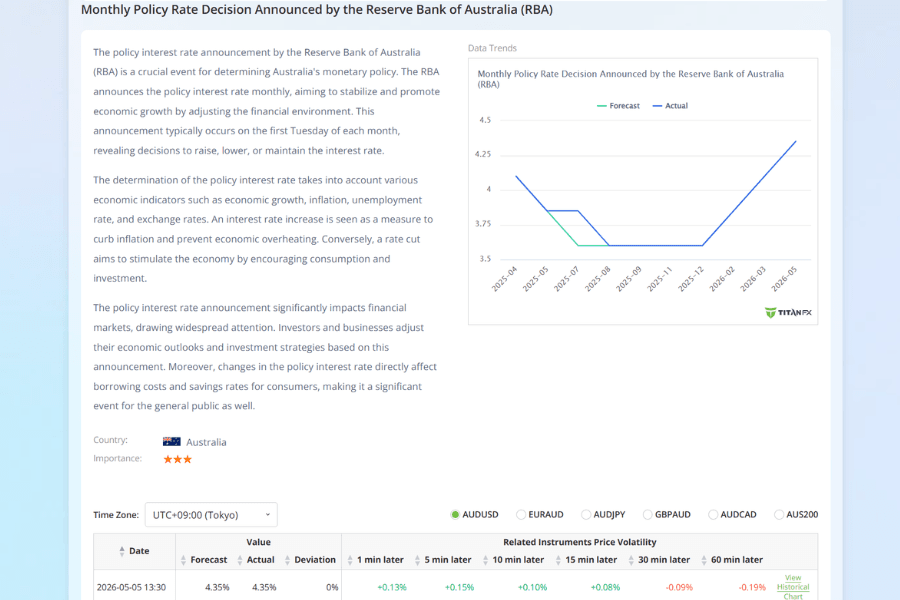
See the latest RBA Cash Rate Target
Type 2: Statement on Monetary Policy (SMP)
Released quarterly, the SMP is the RBA's most comprehensive document. It covers medium-term inflation and growth forecasts, policy risk analysis, model projections, and the implied rate path. It often resets market expectations on AUD direction, especially when forecasts are revised.
On the Titan FX economic indicators page, traders can review the structure of the quarterly SMP and the market reactions on release — useful for tracking shifts in policy stance.
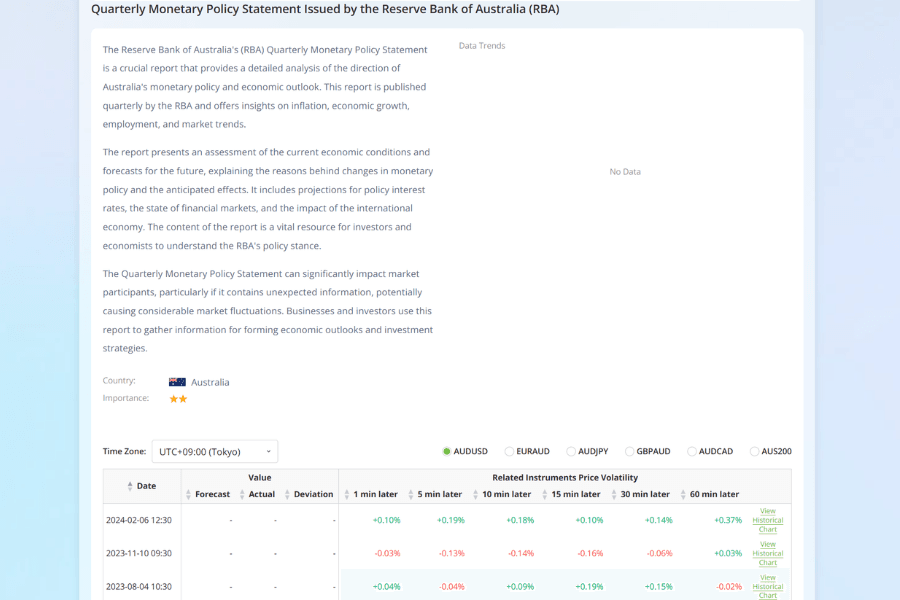
See the latest RBA Statement on Monetary Policy
Type 3: Minutes of the Monetary Policy Meeting
Published about two weeks after each meeting, the Minutes contain the rationale for the decision, the range of views among board members, and subtle shifts in policy bias. They are an important resource for refining expectations heading into the next meeting.
On the Titan FX economic indicators page, traders can review the information categories captured in the Monetary Policy Board Minutes and the market reactions on release — a faster way to get the most out of each Minutes set.
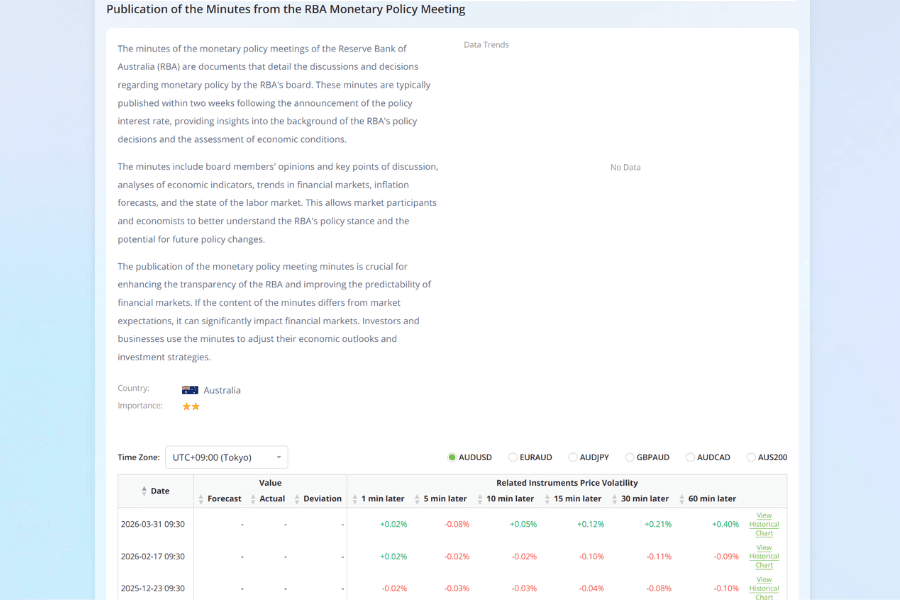
See the latest RBA Monetary Policy Meeting Minutes
Type 4: Financial Stability Review
A semi-annual publication focused on system soundness, with particular attention to housing prices, credit growth, and bank capital. Given Australia's housing-heavy household balance sheet, a Review flagging rising housing risk can shift expectations on whether the RBA leans more toward tightening or easing — indirectly moving AUD.
Type 5: Speeches and the RBA Bulletin
RBA Governor and Deputy Governor speeches, plus the quarterly RBA Bulletin, are not on a fixed calendar but often signal policy bias on inflation, external demand, or financial conditions. Even small changes in phrasing can move AUD over short windows.
Reading Guide
- ▸ Check whether the result aligns with market expectations — bigger surprises produce bigger moves
- ▸ Watch whether tone leans hawkish or dovish — tone often signals direction earlier than the rate itself
- ▸ Look for revisions to inflation, growth, or financial-risk wording — these drive repricing
- ▸ Track references to Chinese demand and commodity prices, given Australia's trade exposure
- ▸ Watch the first market reaction after release — a clean break or reversal usually means market interpretation is consistent
5. Trading AUD on Titan FX: Markets and Strategy
AUD is one of the most liquid major currencies and is well-suited to event trading, trend strategies, and short-term setups. Titan FX offers multiple AUD products so traders can pick the market that fits their strategy.
Tradable Products
| Category | Symbols |
|---|---|
| Major pairs | AUDUSD / AUDJPY |
| Cross pairs | EURAUD / GBPAUD / AUDCAD / AUDCHF / AUDNZD |
Trading Workflow
| Step | Action |
|---|---|
| Step 1: Open an account | Sign up on the Titan FX site with email and password; complete verification to activate the account |
| Step 2: Fund the account | Log in to the client portal and choose a deposit method (credit card, e-wallet, bank transfer) |
| Step 3: Download the platform | Titan FX offers MT4 and MT5 across Windows, Mac, iOS, and Android |
| Step 4: Place trades | Trade AUD-related products such as AUDUSD with long or short orders |
Strategy: Risk Management Around Events
AUD volatility tends to expand around policy events, key data releases, and central-bank speeches. Practical principles for stable execution:
- ▸ Reduce leverage ahead of events to avoid runaway exposure
- ▸ Wait for confirmation after a release before entering, rather than chasing the headline tick
- ▸ Use technical analysis to anchor entries and place a stop-loss
- ▸ Stay alert to false breakouts, gaps, and slippage in high-volatility windows
6. Frequently Asked Questions
Q1: How does the RBA differ from the Fed, ECB, and BOJ?
The RBA oversees a commodity-exporting open economy and is highly sensitive to Chinese demand, iron-ore and coal prices, and global risk appetite. The Fed runs a dual mandate (price stability plus maximum employment); the ECB and BOJ focus primarily on price stability. The RBA blends a 2–3% inflation target with explicit attention to employment, giving it a framework that is close to the Fed but with stronger small-open-economy features. AUD reacts to RBA tone more directly than larger-economy currencies do to their own central banks.
Q2: How does the Cash Rate Target differ from other countries' policy rates?
The Cash Rate Target is the inter-bank overnight rate target set directly by the RBA, similar in role to the Fed Funds Rate target ceiling or BOJ short-term policy rate. Standard adjustments are typically 25 bp, though the RBA used 50 bp moves during the rapid 2022–2023 tightening cycle. Since the governance reform effective from 1 March 2025, decisions are taken by the newly established Monetary Policy Board, which meets eight times per year by default.
Q3: How much does AUD typically move on an RBA decision day?
AUDUSD moves of 30–100 pips around a Cash Rate decision are standard, with surprise outcomes or sharp tone shifts producing 150+ pip moves. The subsequent Statement on Monetary Policy (SMP) — the quarterly detailed report — can produce comparable secondary moves. Volatility typically peaks in the first 5–30 minutes after release, then settles as the market digests the analysis and the Minutes.
Q4: Why does the RBA emphasise both inflation and employment?
In 1996 the RBA and the Australian Government signed the first Statement on the Conduct of Monetary Policy, establishing a 2–3% inflation target on average over the cycle. The framework was reaffirmed in 2010 and 2016, and the reform effective from 1 March 2025 made explicit the trio of "price stability, full employment, and the economic prosperity of the people of Australia". As a result, markets watch quarterly inflation and unemployment closely as central signals for the policy path.
Q5: When is the best time to trade AUD on Titan FX?
The best windows for AUD liquidity and volatility are around RBA announcements (Cash Rate decisions and SMP releases), Australian CPI and unemployment releases, and key Chinese data. The Asian morning session (Australian time 09:00–12:00) is when AUD liquidity tends to be deepest. European and US sessions also matter, but liquidity and spreads can widen modestly. Reducing leverage and confirming stops before events is basic discipline.
7. Summary: Why the RBA Matters to Traders
The RBA is the single most important driver of AUD: its rate decisions, policy tone, and economic projections set the underlying direction. Markets usually price expectations of the rate path in advance, so traders benefit more from watching for shifts in policy direction than from second-guessing the outcome.
Understanding the RBA's policy logic helps traders read AUD moves more accurately and keep a clearer sense of direction even when volatility expands. Combine that view with Titan FX's market quotes, economic calendar, and technical analysis tools to translate RBA signals into disciplined, repeatable trading decisions.
Further Reading
- What Is the Australian Dollar (AUD)?
- What Is Monetary Policy?
- What Is CPI?
- What Is Quantitative Easing (QE)?
- Forex Trading Basics
- What Is Leverage?
Titan FX Research. Investor-education content covering forex (FX), commodities (oil, precious metals, agricultural products), stock indices, US equities, and crypto assets across global markets.
Primary Sources by Category
- RBA official materials: Reserve Bank of Australia official site (rba.gov.au); Statement on Monetary Policy (each issue); Monetary Policy Decision releases; Minutes
- Policy history and framework: Reserve Bank Act 1959; the 1996, 2010, and 2016 Statement on the Conduct of Monetary Policy; the 2023 RBA Review and the governance reform effective from 1 March 2025
- Market analysis: BIS Triennial Survey (AUD turnover data); CME, Bloomberg, and Reuters RBA commentary
- Academic background: Bernanke, B. & Mishkin, F. (1997) "Inflation Targeting"; Stevens, G. R. (collected speeches of past RBA Governors); Lowe, P. (RBA Governor 2016–2023 policy retrospective)