

Forward Guidance

In financial markets, prices are driven not only by events that have already happened but also by investors' expectations about the future. In recent years, central banks have placed increasing emphasis on communicating with markets, and "forward guidance" has become a key force shaping asset prices.
Whether it's the pace of rate hikes, inflation pressure, or an assessment of the growth outlook, signals about these are typically released early through a central bank's language. For investors, understanding forward guidance helps frame possible policy paths before they are fully reflected in market prices.
- Why central banks use forward guidance as a policy communication tool
- The difference between calendar-based, state-contingent, Delphic, and Odyssean guidance
- How guidance can affect rates, bonds, currencies, and equities
- What language and economic data to watch when reading central-bank signals
- Why forward guidance is conditional and should not be treated as a guarantee
1. What Is Forward Guidance?
Forward guidance is the way central banks communicate their view on future monetary policy — through public speeches, meeting minutes, or official statements. It covers whether rates will stay on hold, when hikes might happen, or the conditions required for a policy change.
These signals are typically not legally binding, yet their impact on markets often takes effect before the actual decision. Investors adjust their expectations based on the information, and asset prices start moving accordingly.
A simple comparison is a weather forecast: advance notice gives people time to prepare. In finance, central banks use communication so markets can adjust expectations before a policy change, reducing the chance of a sudden shock.
2. Main Types of Forward Guidance
Central banks choose different formats based on the economic environment. Forward guidance generally falls into two categories.
Type 1: Calendar-based
Calendar-based guidance specifies a clear time horizon — for example, "low rates maintained for the next year" or "no hikes in the near term." It is simple, easy for markets to understand, and quickly forms a consistent expectation.
But when the economy changes fast, a fixed-time commitment can face pressure to be adjusted, which can hurt policy credibility.
Type 2: State-contingent
State-contingent guidance ties to specific economic indicators such as inflation or unemployment. The central bank commits to not changing direction until certain conditions are met.
It is more flexible — policy speed can adjust along with data — and it gives investors concrete indicators to watch (for example, whether inflation hits a target or jobs markets improve).
A Note on Academic Classification
In academic research, forward guidance is sometimes split into "Delphic" and "Odyssean" forms.
Delphic guidance mainly conveys the central bank's forecasts for the economy and policy; it is closer to information sharing without strong commitment.
Odyssean guidance carries a clearer policy commitment — for example, refusing to move rates until certain conditions are met. Its impact on market expectations is typically more direct.
Overall these labels are more theoretical. In practice, most investors find "calendar-based vs state-contingent" more intuitive.
3. Why Do Central Banks Use Forward Guidance?
Historically, central-bank decisions were often treated as surprises, which could increase market volatility. Forward guidance helps policymakers communicate intentions gradually and guide expectations before decisions are made.
Benefit 1: Managing Market Expectations
By releasing signals in advance, a central bank lets markets absorb possible policy changes gradually. This can reduce the risk of abrupt reactions in equities, FX, and bond markets on the day of a rate decision.
Benefit 2: Strengthening the Impact of Policy
Even without moving rates, a clear stance delivered through guidance can influence long-term rates such as mortgage rates or corporate funding costs. This allows policy expectations to affect financial conditions before the next formal decision.
Benefit 3: Enhancing Central-Bank Credibility and Transparency
Regular communication helps markets and firms understand the logic behind decisions. When the central bank's reaction function is clearer, uncertainty can decline and planning becomes easier.
4. Practical Impact for Investors
Forward guidance shapes market rate expectations — and rates are a key foundation of asset pricing — so the impact spreads across markets.
Equity Market Moves
When markets expect rates to stay low, financing costs fall, valuations tend to rise, and equities get upward momentum. If guidance hints at future hikes, markets may correct in advance.
Bond and Rate Markets
Bond prices move inversely to rates. A hawkish signal lifts yields and depresses bond prices; a dovish signal does the opposite.
Exchange-Rate Volatility
Rate expectations influence capital flows and shift relative currency strength. Hawkish guidance from a central bank usually supports its currency.
Case Study: The Fed's Taper Preview
In 2021–2022, markets watched closely for when the U.S. would end quantitative easing. The Fed did not rely only on a surprise announcement. It used statements, minutes, and speeches to prepare markets for a possible tapering of asset purchases.
That communication allowed markets to reprice the expected path of monetary policy before the formal decision. The point is not that guidance removed volatility entirely, but that it reduced the chance of a completely unexpected policy shift.
5. How to Read Forward Guidance
The key to understanding forward guidance is careful reading of the language combined with data — not just the surface.
Technique 1: Watch the Tone
Central banks choose words very precisely. "May," "will," "continues to monitor" — each implies a different intensity of policy lean. The clearer the tone, the more consistent the market interpretation.
Technique 2: Hawkish or Dovish?
Hawkish tone leans toward tightening (rate hikes, inflation control). Dovish tone leans toward accommodation (low rates, stimulus). The language of forward guidance helps identify whether policymakers are leaning toward tighter or easier policy.
Technique 3: Combine with Economic Data
Forward guidance is closely tied to data on inflation, employment, and growth. Watching these indicators helps gauge whether the central bank might shift its stance.
Technique 4: Use a Trading Platform to React in Real Time
After understanding the logic of guidance, traders need to know which policy events and data releases to track. Titan FX tools can help traders track policy events and the data that shape expectations.
Economic Calendar
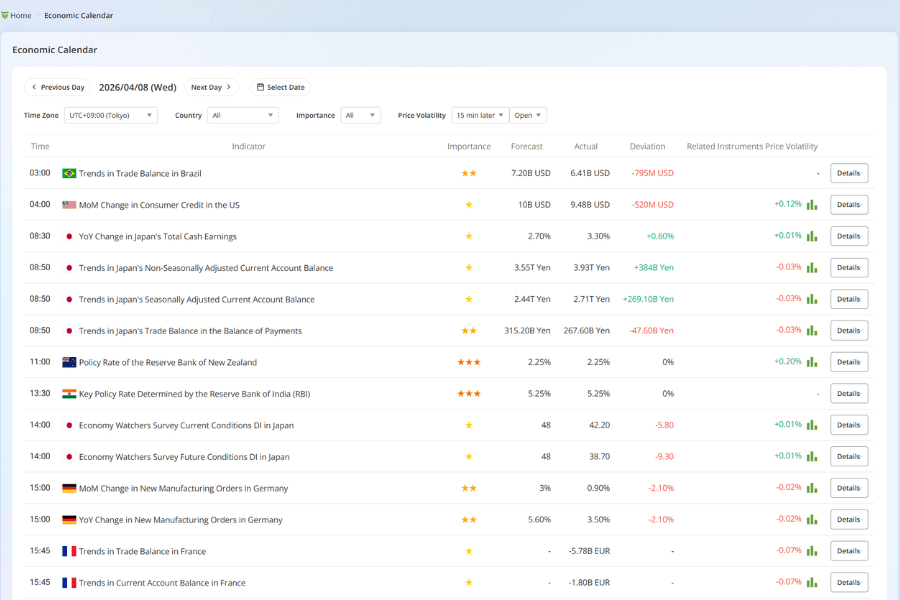
Titan FX's Economic Calendar is more than a schedule — it's an important tool for watching forward guidance. Through central-bank meetings and major data releases, investors can spot policy direction and market expectations in advance.
Combining expected vs actual values with real-time market reaction helps tell hawkish from dovish, turning guidance into an actionable trading basis.
Economic Indicators List
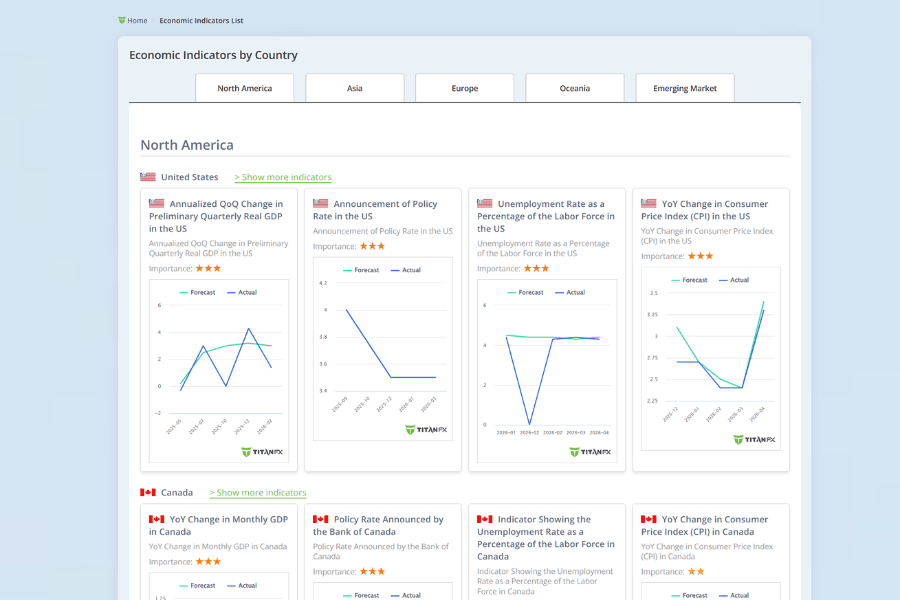
The indicators list consolidates key data across countries, making it easy to follow variables that matter most — GDP, inflation, unemployment — all of which help decode forward guidance.
By watching historical data and trend shifts, investors can better understand the logic behind central bank policy and anticipate future direction. Forward guidance is not a standalone trading signal; it is a reference point for organizing policy scenarios.
6. Summary
Forward guidance lets central banks shape markets not only through the policy itself but through expectation management — reshaping capital flows and asset prices. For investors, what matters most is not the moment of policy announcement, but how to understand the market's direction as signals are gradually released.
By watching central-bank tone, combining it with economic data and market reaction, you gradually build your sense of the policy cycle. Forward guidance is conditional, so it should not be treated as a guarantee. Used with data and market reaction, it becomes one input for reading the policy cycle.
7. FAQ
Is forward guidance a promise about future interest rates?
Usually no. It is a conditional signal based on the central bank's current economic outlook. New inflation, labor-market, or growth data can change the guidance.
What is the difference between calendar-based and state-contingent guidance?
Calendar-based guidance gives a time frame, such as keeping rates low for a period. State-contingent guidance ties policy to economic conditions such as inflation, employment, or growth.
Why can markets move before an actual policy decision?
Markets price expected future rates and liquidity in advance. If central-bank language changes the expected policy path, bond yields, currencies, and equity valuations can adjust before the formal decision.
Which data should investors watch with forward guidance?
Read policy statements and minutes alongside inflation, unemployment, GDP, wages, and central-bank meeting calendars. This helps judge whether the tone is becoming more hawkish or more dovish.
Further Reading
Titan FX Trading Strategy Research Institute
Titan FX's financial market research team produces educational content for investors across forex (FX), commodities, stock indices, U.S. equities, and crypto assets.
Primary Sources by Category
- Central-bank explainers: Federal Reserve - What is forward guidance?, ECB - What is forward guidance?
- Policy examples and timelines: Federal Reserve - Timeline: Forward Guidance about the Federal Funds Rate, Bank of England - MPC minutes, August 2013
- Research context: BIS Working Papers No 1024 - Forward guidance and expectation formation