

Greater Fool Theory
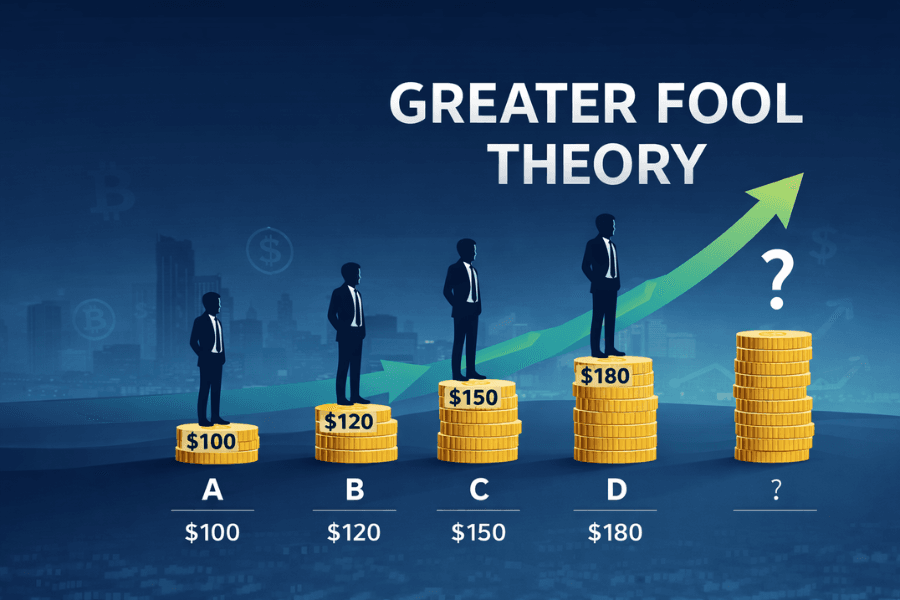
The Greater Fool Theory explains speculative buying based on the belief that someone else will pay an even higher price later, rather than on the asset's intrinsic value. Prices can keep rising while sentiment is strong, but when new buyers disappear, the last buyer often carries the greatest risk.
This article explains how the theory works, what signs appear in speculative markets, and what risk-management points traders should check when sentiment becomes extreme.
- What market psychology the Greater Fool Theory explains
- Why price expectations can dominate intrinsic value
- How bubbles form and why last-buyer risk matters
- What risk controls traders should use in speculative markets
1. What Is the Greater Fool Theory
The Greater Fool Theory is a concept that explains speculative behavior in markets. It suggests that an investor purchases an asset not because of its intrinsic value, but because they believe someone else will be willing to buy it at a higher price in the future.
In other words, the reason a trader buys an asset is not that it "is worth that price," but that they believe a "greater fool" willing to pay even more still exists in the market. As long as that expectation persists, asset prices can continue to be pushed higher.
This phenomenon is not uncommon in financial markets. When sentiment runs hot and capital floods in, rising prices tend to attract more speculators, and the market's focus gradually shifts from asset value to price itself.
A Simple Greater Fool Theory Example
The table below is a simplified scenario illustrating how the theory can emerge in trading.
| Sequence | Buyer | Purchase Price | Rationale |
|---|---|---|---|
| Trade 1 | Investor A | 100 | Believes the price is fair |
| Trade 2 | Investor B | 120 | Believes the price will keep rising |
| Trade 3 | Investor C | 150 | Believes someone else will buy at higher price |
| Trade 4 | Investor D | 180 | Jumps in following market heat |
In this process, every buyer believes someone else will be willing to pay more later. But the moment new buyers stop appearing, prices can fall back sharply, and the last entrant typically bears the heaviest risk.
2. The Core Logic of the Greater Fool Theory
The heart of the Greater Fool Theory lies in market participants' expectations and psychology. When investors believe there is still upside in asset prices, they may continue buying even at stretched valuations, because they expect to sell higher later.
In this setting, rising prices form a self-reinforcing loop. Higher prices attract more capital, new buyers push prices further, and the market still appears to be in an "uptrend."
However, this cycle depends on a steady stream of new buyers. Once confidence wavers or inflows slow, the price structure built on expectations can unravel quickly.
3. The Greater Fool Theory in Financial Markets
In markets, the Greater Fool Theory typically surfaces during periods of heightened speculation, when prices are rising rapidly, a topic dominates market discussion, and investors broadly expect further gains. In such an environment, participants often buy in not because of intrinsic value, but because they trust prices will be pushed higher.
As sentiment keeps heating up, rising prices draw in more capital, and new buyers lift prices further. Over time, the market's focus may shift from corporate fundamentals and economic data to the price itself, for example, "how much further will it go" or "is the next leg coming?" In these conditions, the gap between price and underlying value tends to widen.
Throughout history, many bubbles have been tied to similar speculative psychology. The 17th-century Tulip Mania, the dot-com bubble around 2000, and the rapid price surges in parts of the crypto market in recent years all featured episodes where investors bought heavily on the expectation that prices would keep rising.
In such environments, asset prices can climb quickly over a short period, but when sentiment turns or inflows weaken, prices can fall just as rapidly.
4. How to Tell if the Market Has Entered a "Greater Fool" Phase
Greater Fool markets are rarely recognized early. In many cases, observers only realize the signs of intense speculation in retrospect, after large price swings. That said, there are common features worth watching while markets are running.
One relatively clear signal is that price increases far outpace changes in fundamentals. When the center of market conversation drifts from earnings or economic data toward "how much higher it can go," it is often a sign that speculative sentiment is rising.
Another clue is the shifting composition of market participants, for example, large inflows of short-term money, unusually uniform bullish views on social media or investing communities, or extreme expectations that "prices will only go up." These dynamics suggest the market is increasingly driven by sentiment and expectations rather than underlying value.
5. How Traders Can Navigate a Greater Fool Market
Greater Fool conditions do not necessarily require traders to stay out entirely. In some market phases, prices can indeed rise continuously on capital flow and sentiment. The key is for traders to clearly recognize that they are operating in a high-risk environment.
In that context, risk management matters more than any long-term valuation call. Examples include setting clear stop losses, controlling position size, and avoiding blindly chasing highs when sentiment is most extreme.
Staying sensitive to shifts in market sentiment is equally important. When inflows fade or price action shows a clear trend change, the market structure can evolve quickly. For traders, the ability to adjust strategy in time often matters more than predicting the market's next move.
6. Conclusion
The Greater Fool Theory reminds investors that prices are not always determined by asset value alone, they can also be shaped by market sentiment and expectations. During highly speculative phases, prices can be pushed higher again and again, but such markets carry significant risk.
For traders, understanding market psychology and maintaining disciplined judgment is more valuable than simply chasing price moves. When the market shows clear signs of speculation, robust risk management is what allows a steadier response in an uncertain environment.
Further Reading
- What Is the Depression Effect?
- What Is the Gini Coefficient?
- What Is Engel's Coefficient?
- What Is the Effective Exchange Rate?
Titan FX's financial market research and analysis team produces investor education content across a wide range of financial instruments, including foreign exchange (FX), commodities (crude oil, precious metals, and agricultural products), stock indices, U.S. equities, and crypto assets.
Primary Sources by Category
- Investor education and market-risk materials: SEC Investor.gov, FINRA, CFTC.
- Behavioral-finance and speculative-behavior references: CFA Institute and public educational materials from universities and research institutions.
- Supporting materials on price formation: Investor-risk materials published by exchanges and regulators.