

Effective Exchange Rate

The effective exchange rate (EER) measures whether a currency is strengthening or weakening overall against the currencies of its main trading partners. It helps investors look beyond a single pair such as USD/JPY or EUR/USD and judge broader currency strength and price competitiveness.
This article explains the difference between the nominal effective exchange rate (NEER) and real effective exchange rate (REER), why CPI and trade weights matter, and how EER can be used as a macro filter in FX analysis.
It also helps when comparing major currencies such as EUR, GBP and CHF.
- What the effective exchange rate measures beyond a single currency pair
- How NEER, REER, CPI adjustment and trade weights differ
- How to read export competitiveness and over- or undervaluation risk
- How to use EER as a macro filter in FX analysis
1. Why EER Is More Important Than a Single Rate
The rates investors most often encounter are single bilateral pairs like USD/JPY or EUR/USD. They reflect the relative price between two currencies and are useful for observing short-term moves and making trading decisions, but they have a clear limit: they cannot describe how strong or weak a currency is across the overall international trade environment.
The Effective Exchange Rate (EER) is a weighted gauge of a currency's overall strength against the currencies of its main trading partners. Using trading-partner weights, covering both direct bilateral trade and third-market competition, it aggregates multiple bilateral changes via geometric weighted averaging to show how the currency is moving in international trade overall.
Simply put:
- ▸ Single rate: "Which of these two currencies is stronger?", good for short-term trading.
- ▸ EER: "Is this currency strengthening or weakening across the global trade system?", good for judging macro trends.
Why Traders Need EER
Because EER builds in trading weights, it more realistically reflects a country's external price competitiveness. For example, if the yen falls against USD but rises against RMB and EUR, its EER may be relatively stable, indicating that Japan's overall price competitiveness hasn't risen as much as USD/JPY alone might suggest.
Watching EER lets investors step out of the noise of a single pair and precisely assess whether a currency is genuinely in a strong or weak cycle.
2. Nominal vs Real EER (NEER / REER)
Based on whether relative-price factors are considered, EER splits into NEER (Nominal Effective Exchange Rate) and REER (Real Effective Exchange Rate), which play different roles in judging sentiment and competitiveness.
NEER Reflects Headline Price Movement
NEER is calculated purely from bilateral market rates using geometric trade weighting, without incorporating inflation or price differentials across countries.
It intuitively captures relative appreciation/depreciation at the rate level and is the most direct reference for observing short-term rate trends and sentiment.
REER Reveals Real Price Competitiveness
REER adjusts NEER for relative price levels (typically using CPI differentials), measuring a currency's real price competitiveness after inflation differences are taken into account. By correcting for the bias from asynchronous price moves across countries, it better reflects whether a currency sits in a relatively over- or undervalued risk zone, making it a key reference for medium- to long-term trends.
Key: The Gap Between Headline Price and Real Value
For beginners, the simplest distinction is: NEER focuses on the "headline price" of the rate, while REER evaluates the "underlying price competitiveness" behind it.
When the two diverge significantly, it often hints at latent value correction pressure on the currency, highly valuable when building long-term trading strategies.
3. What Can You Analyze with EER?
EER isn't just an academic reference, it carries real value in practical analysis and investment decisions, helping build a more complete macro map.
Use 1: Judging Overall Trend Strength
When an EER index keeps rising, the currency is usually strengthening overall against its main trading partners, not just against a single counterpart.
This helps fill the blind spot of observing a single pair and confirms whether the current strength is a broadly based trend or short-term volatility in one pair.
Use 2: Detecting Over- or Undervaluation Risk
By analyzing how far REER deviates from its long-run average, investors can assess whether a currency's real price competitiveness has drifted out of a reasonable range.
If REER sits materially above its historical mean, the currency may be relatively overvalued at the real-rate level, with potential correction risk (e.g., depreciation pressure). The opposite suggests a relatively undervalued zone with potential for appreciation.
Use 3: Linking Export Competitiveness with Macro Performance
REER movements directly affect external-trade advantages.
Rising REER typically undermines export price competitiveness (real appreciation makes exports more expensive), which is a negative signal for export-oriented economies. Falling REER supports exports and stimulates growth.
This is exactly why central banks closely watch EER when setting monetary policy or engaging in FX intervention.
4. FAQ
Q1: Is EER the same concept as the U.S. Dollar Index (DXY)?
Similar, but with key differences. The DXY uses fixed weighting against six currencies such as EUR, JPY, GBP (EUR alone is about 57.6%), and mainly reflects the dollar's strength versus developed economies.
In contrast, EER adjusts dynamically based on actual trade weights (BIS and similar bodies update periodically), covers a broader range including EM currencies (e.g., RMB), and therefore more accurately represents a currency's overall competitiveness in the real trade environment.
Q2: Which is better for trading decisions, NEER or REER?
It depends on horizon and purpose. Short-term traders should lean on NEER, since it directly reflects rate-level moves and sentiment.
Investors doing medium- to long-term trend analysis or judging whether a currency is relatively over- or undervalued in price competitiveness should use REER, which factors in inflation differentials and purchasing-power changes and helps avoid pricing traps caused by asynchronous inflation. BIS and similar agencies also use REER for long-term competitiveness and deviation analysis.
Q3: Does rising EER always mean the economy is improving?
Not necessarily. Rising EER may reflect strong inflows, rate advantages, or improving confidence, but it can also weigh on the economy. For export-heavy economies, excessive real appreciation erodes price competitiveness for exports, narrowing trade surpluses, pressuring corporate earnings, and even affecting jobs and growth.
So EER needs to be read alongside industry structure, export dependence, and broader macro fundamentals.
Q4: If REER is high, will it always fall back?
Not always. REER does have a long-run mean-reverting tendency (large deviations create correction pressure), but central banks can keep REER elevated via monetary policy, FX intervention, capital controls, or reserve operations, especially in countries with large reserves or capital controls.
While persistent deviation accumulates correction risk, investors shouldn't bet on an immediate reversal purely because REER is elevated. Combine it with other fundamental and technical signals.
Q5: In FX trading, how do you combine EER with pairs?
In practice, treat EER as a macro filter. Start by observing the EER trend of the target currency (e.g., USD).
If USD's REER keeps rising, the dollar is real-strong broadly, and long-USD trades like USD/JPY or USD/CHF tend to have a higher win rate.
If USD EER is weakening, long-USD trades warrant caution. Combining EER with technicals (support/resistance, trendlines) can materially improve the accuracy of decisions and risk control.
5. Titan FX Tool: EER Analysis
To help investors intuitively understand EER changes, Titan FX provides an EER Analysis Tool that offers a quick read on the relative strength of major global currencies.
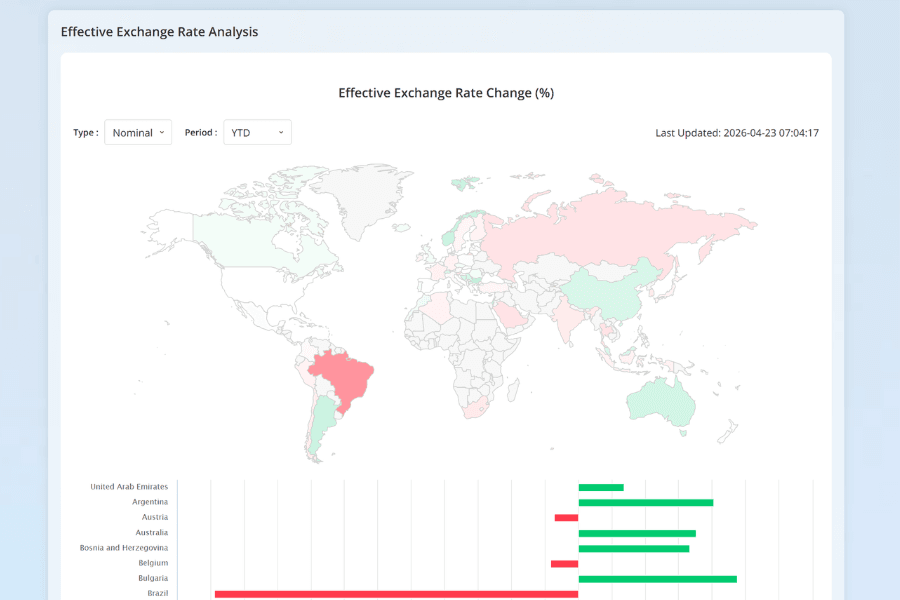
Highlights include a globally visualized map using color to show the direction and magnitude of EER changes across countries at a glance. You can switch between NEER and REER and choose time horizons (YTD, 1Y, 3Y, 5Y, 10Y) for short- or long-term comparison.
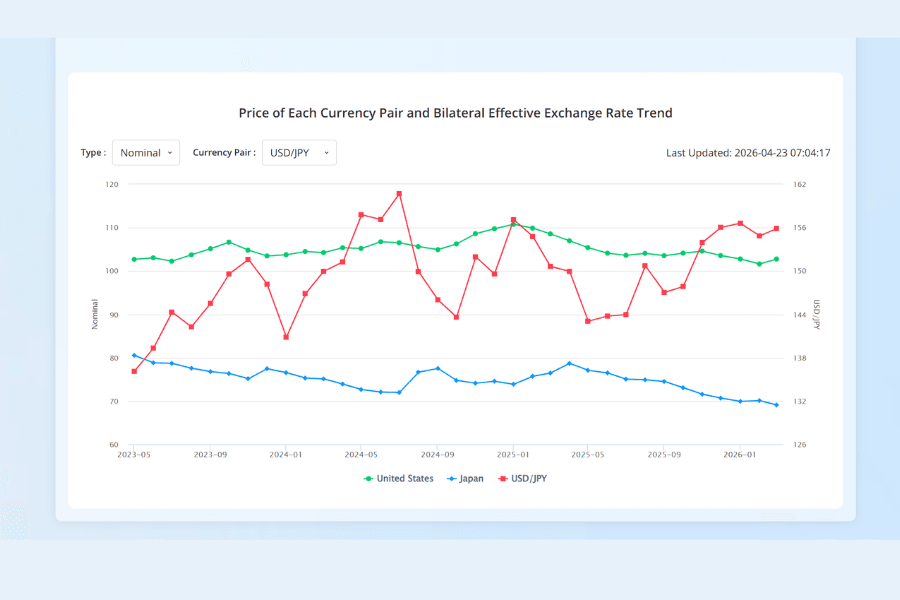
The tool also integrates pair charts, selecting USD/JPY lets you directly compare with USD's EER trend, helping you see whether a single pair is consistent with the overall landscape. A bar-chart ranking feature quickly shows which currencies are relatively strong or weak by EER change magnitude, providing macro reference for trading decisions.
6. Conclusion
The Effective Exchange Rate is a key tool for escaping the "can't see the forest for the trees" trap. It compresses complex international trade weights into an intuitive data signal, so that when you observe currency moves, you're no longer limited to the up/down of one counterpart but can identify the real trend ignition points and latent risks at the level of overall price competitiveness.
Once you grasp NEER's short-term sentiment and REER's long-term competitiveness judgment, you can deal with market swings more calmly. Whether avoiding real-overvalued currencies (to stay out of chase-the-high risk) or positioning for relatively undervalued value-reversion opportunities, EER provides solid macro data support.
In day-to-day analysis, combine Titan FX's EER analysis tool with technical indicators such as trendlines, support and resistance, and candlestick patterns. This helps connect the macro backdrop with concrete trade planning and reduces the risk of judging a currency from a single pair in isolation.
Further Reading
- What Is Engel's Coefficient?
- What Is the Gini Coefficient?
- What Is the Depression Effect?
- What Is the Greater Fool Theory?
Titan FX's financial market research and analysis team produces investor education content across a wide range of financial instruments, including foreign exchange (FX), commodities (crude oil, precious metals, and agricultural products), stock indices, U.S. equities, and crypto assets.
Primary Sources by Category