

Engel's Coefficient
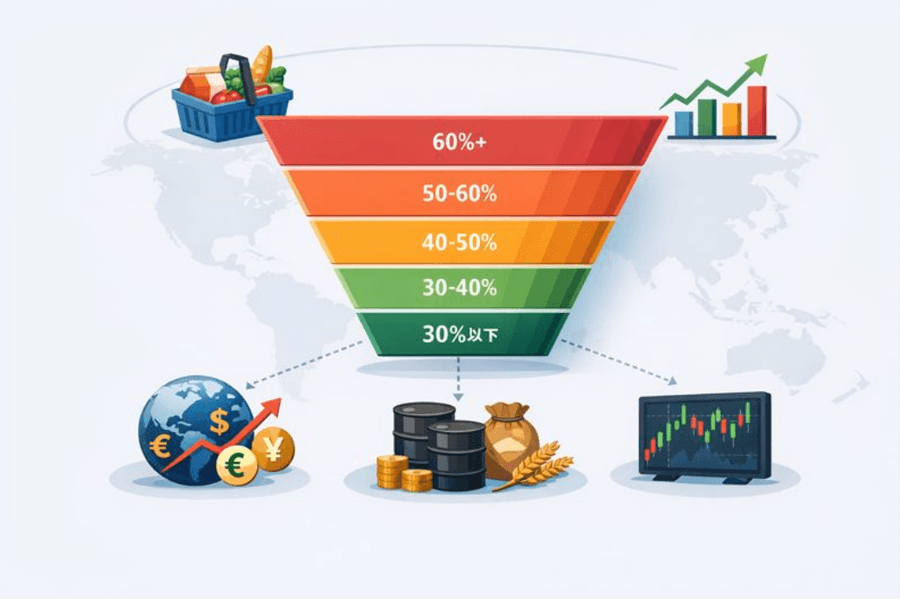
Engel's coefficient measures the share of household consumption spent on food. As income rises, the food-spending share usually falls, and consumption expands into education, healthcare, services, leisure and investment.
This article explains how Engel's coefficient is calculated, how it relates to development and inflation, and how traders can use it alongside GDP, monetary policy and FX or CFD analysis.
- What Engel's coefficient measures and how it is calculated
- How food-spending share reflects living standards and consumption structure
- How inflation, GDP and monetary policy affect the signal
- How traders can use it as a supporting macro indicator
1. What Is Engel's Coefficient?
1-1. Origins
Engel's Coefficient comes from the work of 19th-century German statistician Ernst Engel. Analyzing spending data across households of different incomes, he found that as income rose, the absolute amount spent on food went up, but the share of food in total household spending fell.
That observation came to be known as "Engel's Law," and the share of food spending as "Engel's Coefficient."
1-2. How to Calculate
The formula is straightforward.
Engel's Coefficient = Food Spending ÷ Total Household Spending × 100%
If a household spends $5,000 a month and $2,000 on food, the coefficient is 40%.
The level signals different living standards and stages of development.
- Higher: a larger share of income goes to basic survival needs; living pressure is heavier
- Lower: more disposable income; spending structure is more diversified
1-3. Reading Economic Development
Generally, Engel's Coefficient is higher in developing economies than in developed ones. As industries upgrade and incomes rise, households redirect more of their budgets toward education, healthcare, insurance, travel, and investing, and food's share falls naturally.
So the coefficient is often used as a reference for living standards and economic maturity.
Common ranges can serve as a structural guide.
| Engel's Coefficient | Economic State | Spending Profile |
|---|---|---|
| Above 60% | Low-income stage | Mostly basic survival spending |
| 50%–60% | "Getting by" stage | Food still central to spending |
| 40%–50% | Moderately prosperous | Spending begins to diversify |
| 30%–40% | Well-off | Services and leisure spending rise |
| Below 30% | Highly developed | Investment and quality spending dominate |
Statistical definitions and living costs vary by country, so these ranges are structural references rather than absolutes.
Over the long run, a sustained decline in the coefficient often signals ongoing domestic-demand upgrade and industrial transformation.
2. The Coefficient and Macroeconomics
The coefficient matters not just because it reflects living standards, but because it reveals the direction of structural change in an economy. For market participants, these shifts often carry more signal than short-term data swings.
2-1. A Snapshot of the Development Stage
Early in industrialization, incomes are limited and food takes a large share of the household budget. As manufacturing upgrades, services expand, and wages rise, spending tilts toward non-essentials.
This transition typically coincides with:
- A larger share for services
- Faster urbanization
- A growing middle class
- Higher contribution of domestic demand to GDP
So a long-term decline in Engel's Coefficient usually signals an economy in structural upgrade rather than just short-term growth.
2-2. Interaction with Inflation
Food prices carry significant weight in the consumer price index (CPI). When food prices rise sharply, lower-income households feel it most, and the overall coefficient can tick up temporarily.
That tends to trigger a chain of effects.
- Rising living costs
- Pressured consumption capacity
- Increased inflation pressure on the central bank
- A pivot toward tighter monetary policy
For traders, when rising food prices push up inflation expectations, markets may start pricing in higher rate-hike probabilities, feeding through into FX and bond yields.
2-3. Consumption Upgrade and Industry Transformation
A continued decline in the coefficient means households have more disposable income flowing into other areas, such as:
- Education and skills
- Healthcare and insurance
- Travel and leisure
- Financial investing and asset allocation
This signals improvements in quality of life and a shift in economic engine from "basic need" to "quality need."
At market level, this transition often brings:
- Higher valuations for consumption-related stocks
- Growth in domestic-demand-led companies
- Rising long-term demand for the domestic currency
For traders watching emerging markets, observing changes in the coefficient helps judge whether a country is in a consumption-upgrade cycle.
3. Implications for Financial Markets
Engel's Coefficient isn't a high-frequency data point released in real time, but the shifts it reflects in consumption structure show up in medium- to long-term market trends. For traders, it functions more like a "backdrop variable" that tells you what stage the economy is at.
3-1. Meaning for Currency Markets
When the coefficient falls over time, it typically suggests:
- Rising household income
- A growing middle class
- Domestic demand becoming the main economic engine
That structural improvement tends to boost confidence in steady growth. Paired with sound fiscal and monetary policy, the currency can be supported over the medium to long term.
Conversely, if a food-price spike or recession pushes the coefficient back up, it can indicate weakening real purchasing power. When markets grow worried about consumption, capital flows turn defensive and the currency faces greater risk.
3-2. How to View Commodity Markets
Because food is such an important part of household budgets, agricultural-price moves are especially sensitive to the economy.
When global food prices rise:
- Food-exporting countries may benefit
- Countries with high food-import reliance face more inflation pressure
This structural divergence often shows up in the volatility of commodity currencies and EM currencies.
For traders focusing on energy and agricultural CFDs, changes in Engel's Coefficient help judge a country's resilience to food-price shocks and inform assessment of currency risk.
3-3. Impact on Stock Indices and Sector Rotation
A falling coefficient means consumption is shifting from "essential spending" to "quality and experience." This change typically supports:
- Consumption-upgrade names
- The services and travel industries
- Rising demand for finance and insurance
If an economy moves from manufacturing-led to domestic-demand-driven, the structure of its equity market usually also shows sector rotation. For index traders, this means the sector weightings under the index may be shifting.
4. How Traders Can Use Engel's Coefficient
Engel's Coefficient is not suitable as a short-term entry/exit signal, but it can be part of a fundamental analysis framework.
4-1. As a Medium- to Long-Term Positioning Tool
When evaluating a currency, traders typically look at:
- Growth rates
- Inflation levels
- Rate policy
Adding the trend of Engel's Coefficient helps identify whether the economy is in:
- Early-growth phase
- Structural transition
- Mature/stable phase
This matters especially for medium- and long-term position allocation.
4-2. Cross-Check with Inflation Data
When food prices push CPI higher, if the coefficient is also high, it suggests people are more sensitive to price moves and the central bank faces greater pressure.
That can help:
- Assess rate-hike expectations
- Infer the rate path
- Judge risks of a policy pivot
In FX, changes in policy expectations often show up in prices before the actual decisions.
4-3. Assessing Emerging-Market Risk
In emerging markets, the coefficient is typically higher than in developed economies. When global food or energy prices swing sharply, these countries are more exposed.
For traders, that means:
- Higher risk of FX volatility
- Greater risk of policy intervention
- Capital flows more vulnerable to sentiment
Understanding this structural difference helps adjust positions ahead of rising market risk.
5. Conclusion: Seeing Trend Direction From Spending Structure
Prices in financial markets move every day, but what truly sets the long-term trajectory is often structural economic change.
Engel's Coefficient captures a snapshot of a country's income distribution, purchasing power, and industrial upgrade, not short-term data noise. A gradually falling food-spending share tells you society is moving from basic survival needs toward quality and efficiency; a coefficient pushed up by inflation or economic stress suggests purchasing power is under strain and policy risk is rising.
For traders, understanding this kind of structural change is more meaningful than just scoring any single data point as good or bad.
In FX, it helps judge the long-term fundamental support behind a currency; in commodities, it helps assess how food and energy price shocks affect different economies; in index trading, it helps make sense of the logic behind sector rotation and domestic-demand transitions.
Opportunities often come from differences, in development stages, consumption structures, and policy space across countries. Engel's Coefficient is exactly the kind of tool that lets you see these differences.
Short-term moves matter, but building an understanding of the macro backdrop is what gives your decisions a framework and a direction. When you can read the trajectory of an economy from the ratio of food on the table, you'll also be able to read the logic behind the flow of capital.
Further Reading
- What Is the Gini Coefficient?
- What Is the Effective Exchange Rate?
- What Is the Depression Effect?
- What Is the Greater Fool Theory?
Titan FX's financial market research and analysis team produces investor education content across a wide range of financial instruments, including foreign exchange (FX), commodities (crude oil, precious metals, and agricultural products), stock indices, U.S. equities, and crypto assets.
Primary Sources by Category
- Household-consumption and cost-of-living statistics: National statistical agencies, OECD, World Bank.
- Prices and income-related data: FRED, IMF.
- Supporting materials: Public CPI, household survey, and income-statistics data.