

SEC
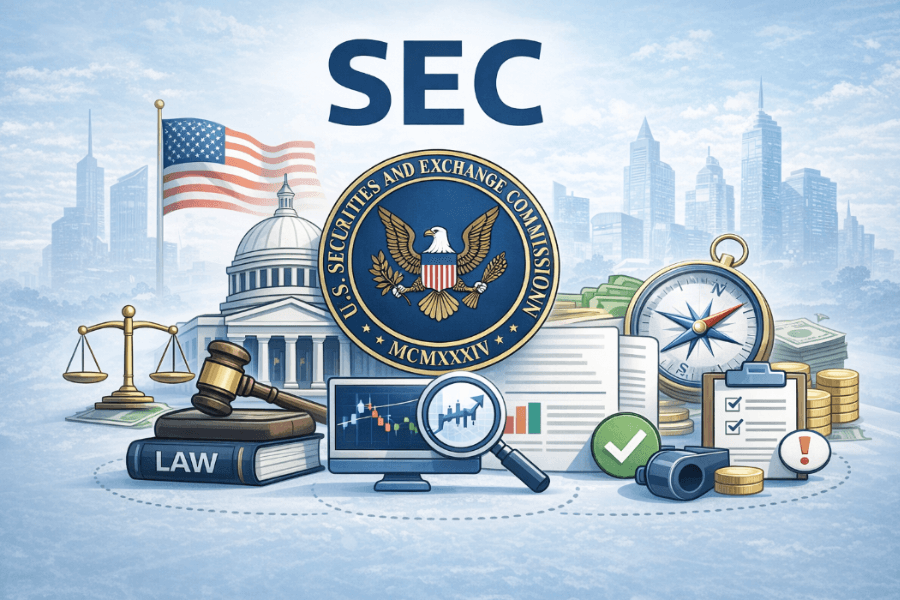
In global securities markets, government regulators play a key role in maintaining market order and protecting investors.
For investors, understanding the role and position of the SEC (U.S. Securities and Exchange Commission) helps build a basic grasp of how the U.S. securities market is regulated.
This article covers the SEC's founding background, core functions, and its role in the U.S. securities market.
- Position: the SEC is the core federal regulator of U.S. securities markets, founded in 1934
- Core functions: rule-making and enforcement, mandatory disclosure, investigation
- Split with FINRA: the SEC sets rules and final oversight; FINRA handles front-line self-regulation
- Divisions: Corporation Finance, Enforcement, Investment Management, Economic and Risk Analysis, Trading and Markets
- For investors: not advice or loss compensation, but a transparent, fair market framework
1. What Is the SEC?
The SEC (Securities and Exchange Commission) is the securities-market regulator established by the U.S. federal government. It oversees the operation of U.S. securities markets and, by setting and enforcing rules, protects market order and investors' rights.
As a government regulator, the SEC's core mission is to ensure transparent disclosure in securities markets, prevent manipulation and misconduct, and promote a fair and efficient market environment. Its oversight spans securities issuance, the operation of trading markets, and the conduct of related market participants.
Within the U.S. financial regulatory system, the SEC handles policy-making and final oversight, working alongside self-regulatory organisations to keep securities markets running stably. With government oversight and market mechanisms complementing each other, the U.S. securities market balances legal constraints against market development.
2. Founding Background and Development
The SEC was established in 1934, and its origins are closely tied to the early development of U.S. securities markets. In the early 20th century, U.S. securities markets grew rapidly, but regulation was still incomplete; opaque market information and speculative behaviour were widespread, raising overall market risk.
After the 1929 stock market crash, market confidence was severely damaged, and the government began building a more complete securities regulatory system to address investor protection and market order. In this context, the U.S. Congress passed securities legislation and created the SEC as the federal agency dedicated to overseeing securities markets.
Since its founding, the SEC has continually adjusted its regulatory focus and institutional design as market size and financial products evolved. By strengthening disclosure, disciplining market conduct, and enforcing regulatory policy, the SEC has played an important role in stabilising the framework and maintaining trust over the long-term development of U.S. securities markets.
3. Role and Oversight Scope
Within the U.S. securities regulatory structure, the SEC is the core government regulator. It mainly sets securities-market rules and provides final oversight of market operations. Its role centres on institution-level design and enforcement, ensuring market participants follow established laws and norms.
The SEC's oversight covers the issuance and trading of securities, the operation of market institutions, and the disclosure obligations of listed companies and related participants. Through rule-making and supervision, the SEC works to improve market transparency and reduce the impact of misconduct on investors and market confidence.
In practice, the SEC also divides work with self-regulatory organisations: SROs handle front-line day-to-day supervision, while the SEC handles policy-making and oversight direction, forming a multi-layered system.
The difference between the SEC and FINRA
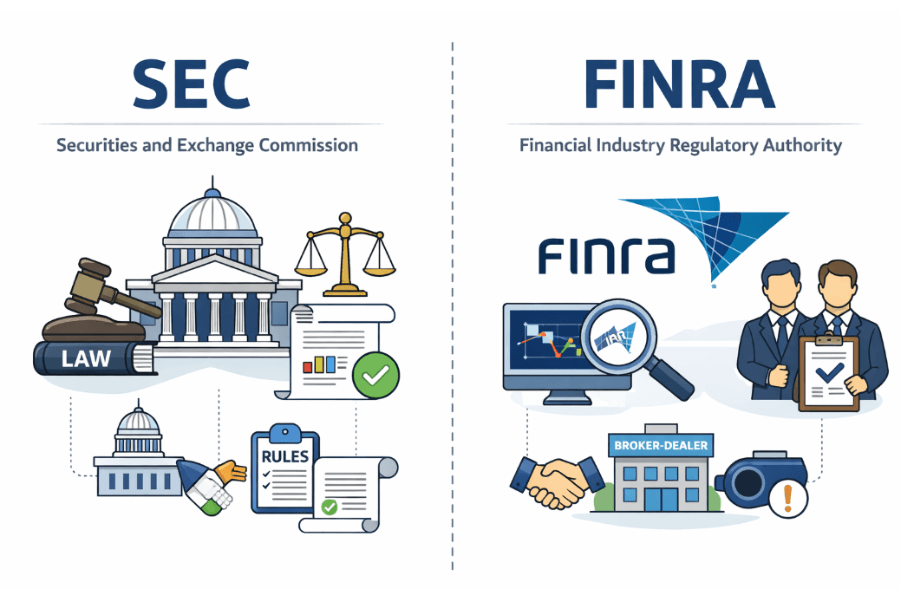
In U.S. securities markets, the SEC and FINRA play different roles — government oversight versus market self-regulation. As a federal agency, the SEC sets securities rules and provides final oversight; FINRA, as a self-regulatory organisation, focuses on practical supervision of broker-dealers and their staff.
By dividing work and coordinating, the two help maintain market order and operational stability, letting the U.S. securities market balance regulation against flexibility. It is also worth knowing the differences among the three major U.S. exchanges (NYSE, NASDAQ, AMEX).
4. Key Duties and Investor Protection
As the core government regulator of U.S. securities markets, the SEC's main duty is to build and maintain the legal foundation of the market, ensuring participants follow basic principles such as disclosure, fair trading, and compliance. Through institutional design and supervisory enforcement, the SEC provides a stable, consistent regulatory framework.
In practice, the SEC emphasises transparency, requiring listed companies and market institutions to disclose material financial and operational information by law. This reduces information-asymmetry risk and helps investors make more rational judgements. The SEC also has investigative and enforcement powers, addressing securities-law violations to prevent manipulation, insider trading, and other misconduct from harming market order.
On investor protection, the SEC's role is not to provide investment advice but, through rules and disclosure mechanisms, to create an environment where investors can understand market risk. This institution-centred form of protection helps maintain market trust and supports the long-term, stable development of securities markets.
The SEC's main divisions and duties
To carry out these supervisory and protective functions, the SEC operates through several divisions; each, according to its specialty, handles policy-making, disclosure review, market supervision, and enforcement, together supporting the U.S. securities regulatory system.
| Division | English name | Main duties |
|---|---|---|
| Corporation Finance | Division of Corporation Finance | Reviews disclosure documents filed by listed companies and issuers so investors get sufficient, transparent material information. |
| Enforcement | Division of Enforcement | Investigates securities-law violations and pursues civil or administrative enforcement to uphold market order and the authority of the rules. |
| Investment Management | Division of Investment Management | Regulates investment companies, funds, and advisers, ensuring operations meet rules and disclosure requirements. |
| Economic and Risk Analysis | Division of Economic and Risk Analysis | Provides economic analysis and risk assessment to support policy-making and supervisory judgement. |
| Trading and Markets | Division of Trading and Markets | Supervises securities trading markets and related institutions, helping keep markets fair, orderly, and stable. |
Through this structure, the SEC balances rule-making, supervisory enforcement, and investor protection, ensuring securities markets operate effectively under regulation while retaining necessary flexibility.
5. Frequently Asked Questions (FAQ)
Q1. What is the difference between the SEC and FINRA?
The SEC is the U.S. federal securities regulator, responsible for rule-making and final oversight. FINRA is a self-regulatory organisation handling front-line, day-to-day supervision of broker-dealers and their staff. The two divide work and coordinate to maintain market order.
Q2. Does the SEC compensate investors for investment losses?
No. The SEC's role is to build a framework of disclosure and fair trading and to enforce against misconduct, but it does not provide investment advice or compensate individual investors for market losses.
Q3. Are non-U.S. investors affected by SEC regulation?
Yes. As long as you deal in securities issued or traded in the U.S., the related disclosure and market rules apply equally, so the SEC's framework also affects the quality of information and market transparency available to global investors.
Q4. How do the SEC's disclosure requirements help investors?
The SEC requires listed companies to disclose financial and material information regularly, reducing information asymmetry so investors can judge based on more transparent, comparable data rather than market rumour.
Q5. What is the relationship between the SEC and exchanges (NYSE, NASDAQ)?
Exchanges handle market operation and front-line trading supervision, while the SEC provides institution-level final oversight of exchanges and market institutions, forming a multi-layered system.
6. Conclusion: Why Understanding the SEC Matters
As the core government regulator of U.S. securities markets, the SEC provides a stable, consistent institutional foundation through rule-making and supervisory enforcement. Its role reflects how the U.S. securities market relies on rules and institutions to maintain market order.
For investors, understanding the SEC's position and oversight scope helps build an overall picture of the U.S. securities regulatory structure and a clearer sense of where risk and responsibility lie under different market systems.
Overall, knowing the SEC is less about trading technique and more about understanding market rules and regulatory logic. In a market environment that increasingly values transparency and investor protection, a basic grasp of regulation supports a steadier, longer-term investment mindset.
Further Reading
- What Is FINRA?
- The Three Major U.S. Exchanges: NYSE, NASDAQ, AMEX
- What Is an IPO?
- What Is a CFD?
- What Is Stock Par Value?
Titan FX Research Hub — investor education across foreign exchange, commodities (oil, precious metals, agriculture), stock indices, U.S. equities, and crypto assets.
Primary Sources (by category)
- Regulator and framework: U.S. Securities and Exchange Commission (SEC) public materials; public information on U.S. federal securities legislation (Securities Act of 1933 / Securities Exchange Act of 1934)
- Self-regulation and exchanges: FINRA public materials; public institutional information from major securities exchanges
- Concept explanation: general public knowledge on securities regulation and investor protection; Titan FX platform public information