

ADP
At the start of each month, traders' eyes turn to two jobs reports—and the first to arrive is often the ADP Employment Report, nicknamed the "mini NFP." Just how well does it preview the official data, and how should you read it?
This article covers what the ADP report contains and where its data comes from, its release timing, how it differs from Nonfarm Payrolls (NFP), how to read it, and its impact on the forex, stock, and bond markets.
- What the ADP Employment Report measures and why it matters
- Release schedule with time zone conversions
- Key differences between ADP and Nonfarm Payrolls (NFP)
- How to navigate the five sections of the official ADP report
- Market impact patterns across bonds, equities, USD, gold, and crypto
1. What Is the ADP Employment Report?
The ADP National Employment Report, often called the "mini NFP," is a monthly employment report published by ADP (Automatic Data Processing), the largest payroll services provider in the United States. It is compiled from actual payroll records covering more than 500,000 companies and roughly 25 million workers.
The report breaks down new job creation across industries and establishment sizes nationwide, providing a real-time snapshot of U.S. private-sector labor market conditions. Because it is released ahead of the government's official Nonfarm Payrolls report (NFP), the ADP report is widely used as a leading indicator for forecasting NFP results.
Unlike government surveys that rely on questionnaire-based sampling, ADP uses actual payroll processing data, which gives it strong immediacy and practical relevance for financial markets and economic analysis.
2. Release Schedule and Source
The ADP Employment Report is typically published two business days before the monthly Nonfarm Payrolls (NFP) release, making it a key reference for gauging U.S. employment ahead of the official numbers.
Note: While the ADP report usually falls on a Wednesday, the actual date is determined by counting two business days back from the current month's NFP schedule. U.S. public holidays may shift the date earlier or later.
Release Time by Region
| Region | Standard Time | Daylight Saving Time |
|---|---|---|
| United States (ET) | 8:15 AM | 8:15 AM |
| Japan | 10:15 PM | 9:15 PM |
| China / Hong Kong / Taiwan | 9:15 PM | 8:15 PM |
| Singapore | 9:15 PM | 8:15 PM |
| Australia (Sydney) | 11:15 PM | 10:15 PM |
Data Source
The report is produced by ADP (Automatic Data Processing). Since August 2022, ADP has partnered with the Stanford Digital Economy Lab to co-design and refine the statistical model, enhancing the data's scientific rigor and policy relevance.
You can check the next ADP release date on the U.S. Economic Indicators Calendar.
3. ADP vs Nonfarm Payrolls (NFP): Key Differences
Both the ADP Employment Report and the U.S. Bureau of Labor Statistics' Nonfarm Payrolls (NFP) are essential gauges of the U.S. labor market, but they differ significantly in data sources, methodology, issuing authority, and intended use.
Why Do the Two Reports Diverge?
ADP, as a private payroll services giant, bases its data on actual payroll records it processes, reflecting employment changes at companies that actually paid wages. This approach provides high immediacy and a firm-level perspective.
NFP, on the other hand, is compiled by the Bureau of Labor Statistics (BLS) through periodic sample surveys of households and businesses. It carries official status and nationwide representativeness, giving it broader influence on policy decisions.
Comparison Table
| Item | ADP Employment Report | Nonfarm Payrolls (NFP) |
|---|---|---|
| Issuing body | Private firm (ADP) | U.S. Bureau of Labor Statistics (BLS) |
| Data source | Payroll records from ~500K firms, 25M+ workers | Household and establishment survey samples |
| Methodology | Internal payroll system data | Questionnaire surveys (Establishment + Household) |
| Official status | No | Yes |
| Release timing | Two business days before NFP | First Friday of each month (8:30 AM ET) |
| Revision cycle | Ad hoc | Defined revision cycle (typically revised the following month) |
| Market role | Pre-NFP expectations gauge; short-term trading reference | Policy benchmark; influences Fed rate decisions and macro forecasts |
Additional Notes
- Divergence is normal: Different sample sources and methods mean ADP and NFP frequently produce different numbers, especially during periods of rapid economic change.
- Market reaction: Although ADP lacks official standing, its earlier release often drives trader expectations for NFP, amplifying short-term volatility.
- Academic credibility boost: Since 2022, the Stanford Digital Economy Lab partnership has strengthened ADP's methodology, improving its value as a trend predictor for NFP.
In short, ADP is best suited for gauging market sentiment in advance, while NFP serves as the official benchmark for labor market policy. They are complementary, not competing, indicators.
4. How to Read the ADP Report
The ADP Employment Report goes beyond a single national headline number. It offers detailed breakdowns by industry, establishment size, and region, enabling multi-angle analysis of U.S. labor market trends.
You can browse or download each month's report and data for free at the official website: adpemploymentreport.com.
Report Categories
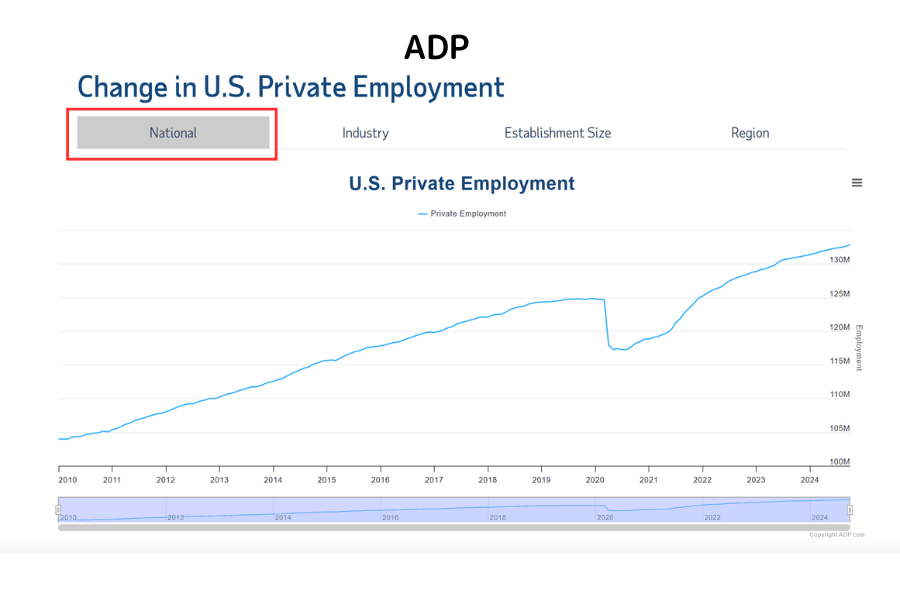
Shows the month-over-month change in total U.S. private nonfarm employment, the most direct measure of overall labor market strength.
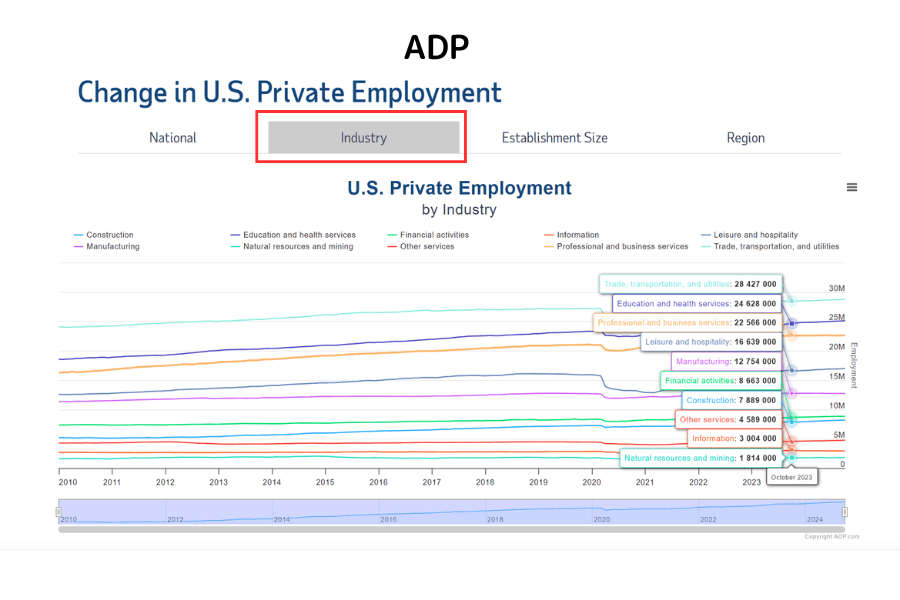
Breaks down job gains and losses by sector (e.g., manufacturing, construction, education and health services, leisure and hospitality), revealing which parts of the economy are driving hiring.
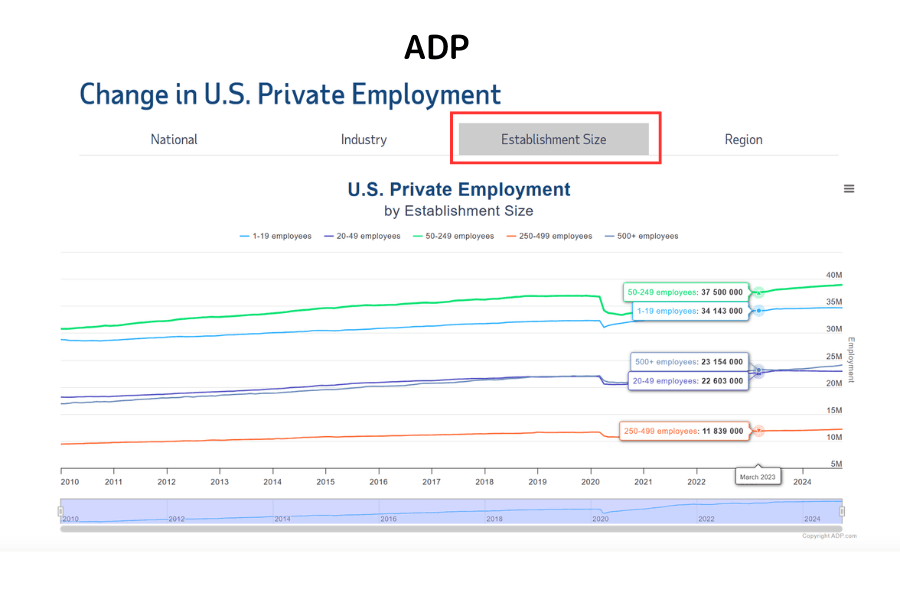
Segments results by employer size (small, medium, and large businesses), useful for assessing how different parts of the economy contribute to or strain overall employment.
Tracks employment changes across U.S. regions (Northeast, South, Midwest, West), supporting analysis of regional economic trends and geographic disparities.
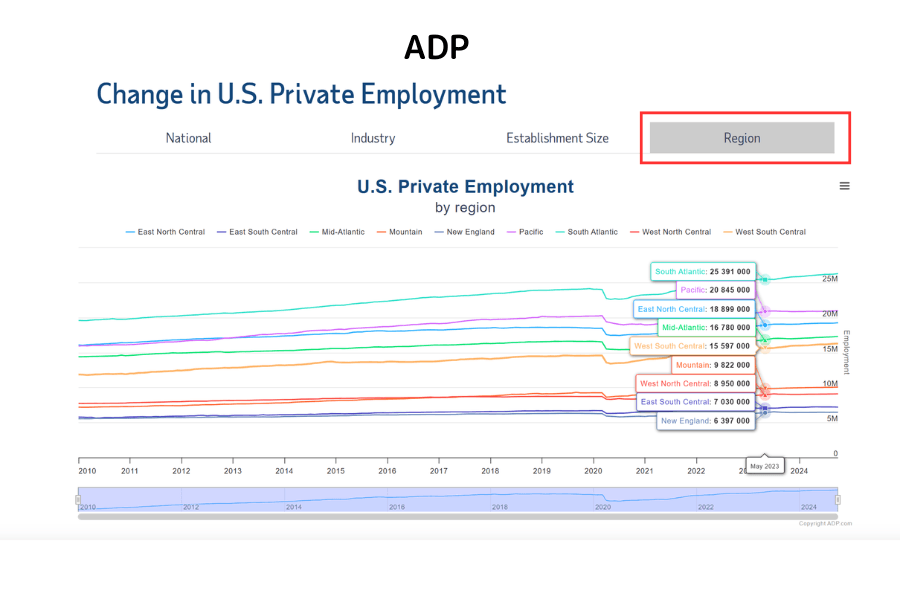
Full data files are available for download, suitable for research analysis or quantitative modeling.
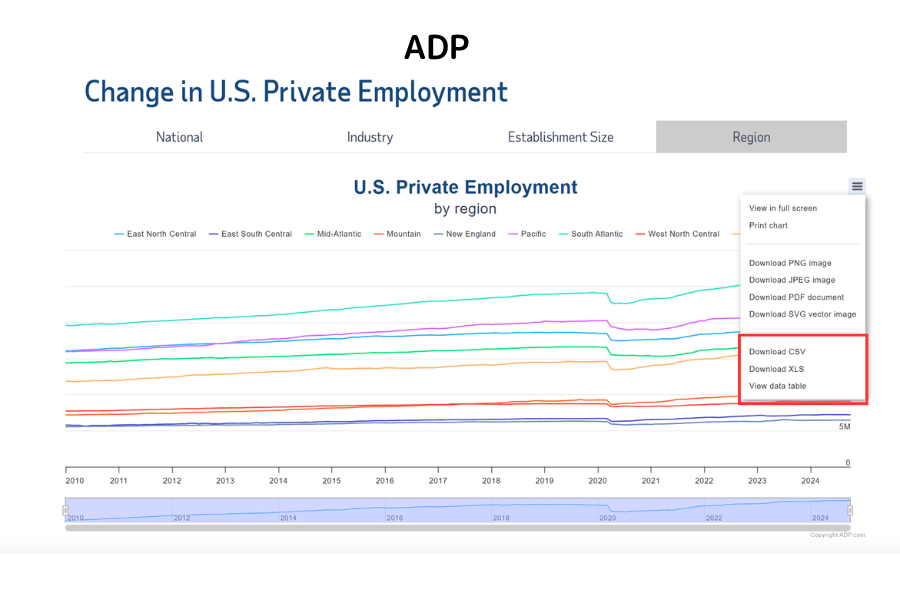
Key Observation Points
- Industry comparison: Is the services sector or goods-producing sector recovering faster?
- Establishment size analysis: Are small businesses resuming hiring?
- Regional comparison: Which regions show signs of a strengthening labor market?
- Month-over-month trends: Is there a deceleration or reversal underway?
Traders and researchers can cross-reference the ADP report with NFP data and the ISM Manufacturing Index for more robust analysis of U.S. economic conditions and potential Fed policy shifts.
5. Trading Applications and Market Impact
Because it is released before NFP, the ADP Employment Report is treated as an advance indicator of U.S. labor market conditions. While it holds no official status, it exerts real influence in financial markets, particularly on short-term volatility and sentiment.
Why Traders Watch the ADP Report
The Federal Reserve pursues a dual mandate of price stability and maximum employment when setting interest rate policy. ADP data reflects private-sector hiring trends, making it a valuable input for anticipating the Fed's next move.
Ahead of major economic releases, the ADP report helps the market form baseline expectations about the jobs picture, which in turn moves bond, equity, currency, and commodity prices.
Market Impact by Asset Class
| Asset class | ADP beats expectations | ADP misses expectations |
|---|---|---|
| U.S. Treasuries | Rate-hike expectations rise; bond prices fall, yields rise | Rate-hike pressure eases; bond prices rise, yields fall |
| Equities | Economic confidence improves; growth stocks benefit | Slowdown fears rise; defensive assets favored |
| U.S. Dollar | Strong jobs support rate-hike bets; USD strengthens | Recession concerns weigh; USD weakens |
| Gold and Silver | Rate-hike risk rises; non-yielding assets under pressure | Easing expectations emerge; safe-haven assets recover |
| Crypto | Liquidity-tightening concerns; volatility expands | Liquidity-improvement hopes; risk appetite rebounds |
Practical Application Tips
The ADP report is most useful for:
- A quick early-month read on the labor market before NFP
- Building a composite employment view alongside other indicators (ISM, Initial Jobless Claims, JOLTS)
- Timing short-term trades, especially at the start of data-release cycles or around policy inflection points
For longer-term investors, ADP data can be volatile month to month, but it still helps identify where the economy sits in the business cycle and informs asset allocation decisions, particularly around employment turning points.
Titan FX's Economic Indicators page provides real-time updates on ADP, JOLTS, unemployment rate, and other key U.S. data to help you stay on top of market developments.
6. FAQ
Q1: ADP and NFP often show different numbers. Is ADP still worth watching?
Yes. The two reports use different samples and statistical models, so discrepancies are expected. However, ADP draws on actual payroll data and provides early clues before the official NFP release. As a complementary observation tool for the labor market, it offers forward-looking and practical reference value.
Q2: How accurate is the ADP report at predicting NFP?
ADP is not designed to "predict" NFP. It reflects actual private-sector employment conditions for the period in question. In most months, its trend direction aligns with the official data, though significant deviations can occur during extreme events such as a pandemic.
Q3: Does the Federal Reserve use ADP data for policy decisions?
The Fed primarily relies on official BLS reports for its rate-setting framework. However, when ADP data aligns with other leading indicators (Initial Jobless Claims, JOLTS Job Openings), it draws attention from policymakers and the broader market.
Q4: What is the single most important data point in the ADP report?
Market focus centers on whether the headline "change in private employment" significantly beats or misses consensus forecasts. A large surprise can trigger immediate reactions in the dollar, bonds, and equities. Beyond the headline, industry and establishment-size breakdowns offer clues about structural shifts in the labor market.
7. Summary
The ADP Employment Report is an unofficial but highly influential indicator, valued by investors, analysts, and traders for three key reasons:
- Early release timing — published two business days before NFP
- Large-scale real data — based on actual payroll records from 500,000+ companies
- Granular breakdowns — by industry, region, and establishment size
During FOMC decision weeks or on the eve of NFP releases, the ADP report frequently acts as a catalyst for market volatility.
Combining ADP with NFP, Initial Jobless Claims, and ISM data gives you a more comprehensive foundation for market analysis. For the basics of currency trading around major data releases, see the FX Trading Basics guide.
For the full official report, visit: https://adpemploymentreport.com/.
Further Reading
- What Is FOMC? Meeting Schedule and Policy Framework
- U.S. Economic Indicators Calendar
- FX Trading Basics — Getting Started
Titan FX Trading Strategy Lab. We produce educational content for investors covering FX, commodities (crude oil, precious metals, agricultural products), stock indices, U.S. equities, and cryptocurrencies.
Titan FX Trading Strategy Research. We produce educational content for investors covering forex, commodities (crude oil, precious metals, agricultural products), stock indices, U.S. stocks, and digital assets.
Primary Sources (by Category)
- Official statistics: U.S. Bureau of Labor Statistics (BLS) — Employment Situation Summary; ADP Research Institute — ADP National Employment Report
- Academic and research: Stanford Digital Economy Lab — ADP methodology and data documentation
- Economic data: Federal Reserve Economic Data (FRED) — Nonfarm Payroll Employment