

Commodity Trading Advisor
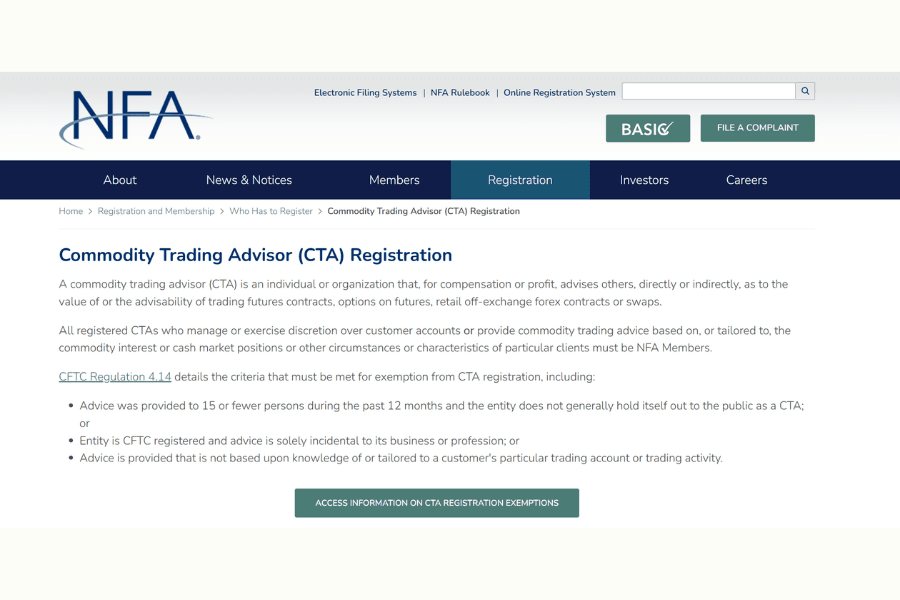
A Commodity Trading Advisor (CTA) is a professional or firm that manages clients' trading in futures and derivatives markets using systematic, rules-based strategies, and is regulated in the U.S. by the CFTC and NFA.
CTAs are often classified as a subset of the hedge fund industry, distinguished by their focus on exchange-traded futures and their use of quantitative, rules-based trading systems. Because CTA strategies tend to have low correlation with traditional equity and bond markets, they can serve as a diversification tool within a broader investment portfolio.
- What a CTA is and how it differs from traditional investment funds
- How CTA operations work, from data analysis to trade execution
- The U.S. regulatory framework governing CTAs (CFTC and NFA)
- The core CTA strategies: trend-following, arbitrage, and volatility
- Answers to common questions about CTA investing
1. What Is a CTA (Commodity Trading Advisor)?
A Commodity Trading Advisor (CTA) is an individual or organization registered to provide trading advice or manage client assets in futures and options markets. Despite the name, CTAs are not limited to physical commodities. Their investment universe includes financial futures such as currencies, stock indices, interest rates, energy, metals, agricultural products, and increasingly, cryptocurrency derivatives.
Most CTAs employ systematic, quantitative approaches to trading. They use statistical models and algorithms to analyze market data, generate trade signals, and execute positions with minimal human discretion. This systematic framework allows CTAs to maintain consistent decision-making across diverse market conditions.
CTA vs. Traditional Fund Comparison
| Feature | CTA | Traditional Investment Fund |
|---|---|---|
| Primary instruments | Futures and derivatives | Stocks and bonds |
| Trading approach | Systematic / quantitative | Fundamental analysis |
| Profit opportunities | Both rising and falling markets | Primarily rising markets |
| Correlation with equities | Low (diversification benefit) | High |
| Leverage | Futures margin system | Generally limited |
| Regulator | CFTC / NFA | SEC / local financial authority |
This low correlation with traditional asset classes is one of the main reasons institutional investors allocate to CTA strategies. During periods of market stress, when equities and bonds may decline simultaneously, CTAs can potentially profit from short positions, earning them the label "crisis alpha" among portfolio managers.
2. How CTAs Work
A CTA's operation follows a structured workflow that combines data science, signal generation, execution, and risk control. Understanding this process clarifies what differentiates CTA management from conventional asset management.
Data Collection and Analysis
CTAs collect and process large volumes of market data, including historical prices, trading volumes, volatility measures, open interest, and macroeconomic indicators. Most systematic CTAs automate this process with real-time data pipelines that continuously feed their analytical models.
Signal Generation and Trade Execution
Based on model output, the system generates buy or sell signals across multiple markets simultaneously. Systematic CTAs execute these signals automatically through algorithmic trading platforms, ensuring speed and consistency. Discretionary CTAs, though less common, rely on the manager's judgment to interpret model output and decide on execution.
Risk Management
Risk management is the operational backbone of CTA strategies. Key risk controls include:
- Position sizing: Adjusting exposure based on market volatility and portfolio risk budget
- Stop-loss rules: Predefined exit points to limit drawdowns on individual positions
- Diversification: Spreading positions across uncorrelated markets and asset classes
- Correlation monitoring: Tracking inter-market relationships to avoid concentration risk
The Role of Technology
The CTA industry has evolved significantly with advances in computing power and data availability. Modern CTAs increasingly incorporate artificial intelligence and machine learning into their models, enabling pattern recognition that goes beyond traditional statistical methods. Big data analytics, including analysis of news feeds, satellite imagery, and social media sentiment, allows CTAs to capture market signals that were previously invisible.
These technological advances have improved both prediction accuracy and execution speed, making CTA strategies more adaptive to changing market regimes.
3. CTA Regulation in the United States (CFTC / NFA)
In the United States, CTAs operate under a well-defined regulatory framework designed to protect investors and ensure market integrity. The two primary regulatory bodies are the CFTC (Commodity Futures Trading Commission) and the NFA (National Futures Association).
The CFTC
The CFTC is the independent federal agency responsible for overseeing U.S. futures and derivatives markets. It establishes the registration requirements for CTAs, sets rules governing trading practices, and enforces compliance to maintain fair and transparent markets. For a detailed overview of the CFTC's structure and mission, see our dedicated CFTC article.
The NFA
The NFA is a self-regulatory organization (SRO) operating under CFTC oversight. All CTAs must register with the NFA before conducting business. The NFA's responsibilities include:
- Reviewing CTA registration applications and verifying qualifications
- Setting and enforcing disclosure standards for performance reporting
- Establishing rules for client fund management and segregation
- Providing dispute resolution and complaint handling mechanisms
CTA Registration Process
To operate as a CTA in the United States, the following steps are required:
| Step | Description |
|---|---|
| 1. File with the NFA | Submit an application through the NFA's Online Registration System (ORS) |
| 2. Pass the qualifying exam | Successfully complete the Series 3 (National Commodity Futures Examination) |
| 3. Submit a Disclosure Document | File a document detailing the CTA's trading strategy, risks, and fee structure with the NFA |
| 4. Maintain ongoing compliance | Provide periodic performance reports, maintain client disclosures, and cooperate with NFA audits |
This regulatory structure ensures that investors can review a CTA's track record, fee arrangements, and risk disclosures before committing capital, providing a transparent environment for managed futures investment.
Exemptions
Not all advisors are required to register. The CFTC provides certain exemptions, such as for advisors who manage assets for a limited number of clients (generally 15 or fewer within the past 12 months) and do not hold themselves out publicly as CTAs. Additionally, advisors registered with the SEC as investment advisers may qualify for an exemption if their CTA activities are incidental to their primary business.
4. Core CTA Investment Strategies
CTAs employ a range of strategies, but three approaches dominate the industry. Each has distinct return drivers, risk profiles, and market conditions where it performs best.
Trend-Following
Trend-following is the most widely used CTA strategy and forms the core of the managed futures industry. The premise is straightforward: identify the direction of a market's price movement and take a position in that direction. CTAs use technical indicators such as moving averages, channel breakouts, and momentum oscillators to detect trend initiation and exhaustion.
Trend-following performs well in markets that exhibit sustained directional moves, whether upward or downward. However, it tends to underperform during choppy, range-bound periods when false signals generate repeated small losses.
Arbitrage
Arbitrage strategies seek to profit from pricing inefficiencies between related markets or instruments. Examples include calendar spreads (price differences between futures contract months for the same commodity), inter-market spreads (such as the crack spread between crude oil and refined products), and cross-exchange arbitrage.
Because arbitrage does not depend on market direction, it can deliver relatively stable returns. However, the opportunities are typically small in magnitude and require precise analysis and rapid execution. Arbitrage strategies also carry liquidity risk and model risk if assumed pricing relationships break down.
Volatility
Volatility strategies treat price fluctuation itself as the tradable asset. CTAs in this category may trade options, variance swaps, or volatility indices such as the VIX to capitalize on changes in market uncertainty.
Events such as FOMC policy announcements, geopolitical developments, or unexpected economic data releases can trigger sharp volatility shifts, creating profit opportunities for CTAs positioned for such moves.
Strategy Comparison
| Strategy | Return Driver | Best Market Environment | Key Risks |
|---|---|---|---|
| Trend-following | Sustained price trends | Strong directional markets | Consecutive losses in range-bound conditions |
| Arbitrage | Price convergence | Market-neutral (any environment) | Liquidity risk, model breakdown |
| Volatility | Changes in implied/realized vol | High-uncertainty regimes | Sudden volatility regime shifts |
In practice, many modern CTAs operate as multi-strategy funds, blending elements of all three approaches. The integration of machine learning models has enabled more adaptive strategy selection, where the system adjusts its weighting across strategies based on current market regime characteristics.
5. Frequently Asked Questions (FAQ)
Q1. How can an individual invest in CTA strategies?
Individual investors typically access CTA strategies through managed futures funds or fund-of-funds vehicles. Some CTAs accept direct investment from qualified investors who meet minimum capital requirements. Before investing, it is essential to review the CTA's NFA-filed Disclosure Document, which details the trading approach, fee structure, historical performance, and risk factors.
Q2. What is the typical fee structure for a CTA?
CTAs generally charge two layers of fees: a management fee (typically 1-2% of assets under management annually) and an incentive fee (typically 15-25% of profits). Most incentive fee arrangements include a high-water mark provision, meaning the CTA only earns performance fees on gains that exceed the previous peak portfolio value, protecting investors from paying fees during recovery periods.
Q3. In what market conditions do CTAs tend to perform best?
CTAs, particularly those using trend-following strategies, tend to perform strongly during periods of sustained market moves, whether up or down. They have historically generated positive returns during equity market crises, including the 2008 financial crisis, because their ability to hold short positions allows them to profit from extended declines. This characteristic has led to the "crisis alpha" label in portfolio management literature.
Q4. What is the difference between a CTA and a hedge fund?
While CTAs are sometimes categorized as a type of hedge fund, the key distinctions are the investment universe and the regulatory framework. CTAs focus primarily on exchange-traded futures and derivatives and are regulated by the CFTC and NFA. Hedge funds typically invest across a broader range of assets, including equities, bonds, and private markets, and are primarily regulated by the SEC. The two structures can overlap when a hedge fund also trades futures, in which case dual registration may be required.
Q5. Can retail traders apply CTA techniques to their own trading?
Yes, the core principles behind CTA strategies, especially trend-following, are accessible to retail traders. Using technical analysis tools such as moving averages and breakout systems, combined with disciplined risk management, individual traders can adopt a similar framework. However, replicating the full diversification, execution speed, and scale of institutional CTAs is not feasible for most retail accounts.
6. Summary
Commodity Trading Advisors represent a specialized segment of the investment management industry, focused on systematic trading across futures and derivatives markets. Their core strengths lie in quantitative analysis, disciplined risk management, and the ability to profit in both rising and falling markets.
The U.S. regulatory framework, governed by the CFTC and NFA, provides a transparent and structured environment for CTA operations, giving investors access to verified performance records and standardized disclosure.
As artificial intelligence, machine learning, and big data analytics continue to advance, CTA strategies are becoming more sophisticated and adaptive. For institutional and individual investors alike, understanding how CTAs operate offers valuable perspective on trend analysis, risk management, and portfolio diversification.
For foundational context on currency and derivatives markets, see our FX basics guide and CFTC overview.
Further Reading
- What Is the CFTC? -- The role and structure of the U.S. Commodity Futures Trading Commission
- What Is the FOMC? -- Understanding the Federal Reserve's policy-setting body and its market impact
- FX Trading Basics -- Foundation concepts for foreign exchange trading
Titan FX's financial market research and analysis team produces investor education content across a wide range of financial instruments, including foreign exchange (FX), commodities (crude oil, precious metals, and agricultural products), stock indices, U.S. equities, and crypto assets.
Primary Sources by Category
- Regulatory and official data: CFTC Official Website, NFA (National Futures Association), Commodity Exchange Act
- Industry data and research: BarclayHedge CTA Index, CME Group
- Educational resources: Investopedia: Commodity Trading Advisor